
Question 323 marksMedium
On a still night a layer of warmer air lies over cold air at . Treat the boundary between them as sharp and flat. Sound obeys the same law of refraction as light, , where and are the speeds of sound in the first and the second medium. A sound wave travelling through the cold air meets the boundary at to the normal, as shown.
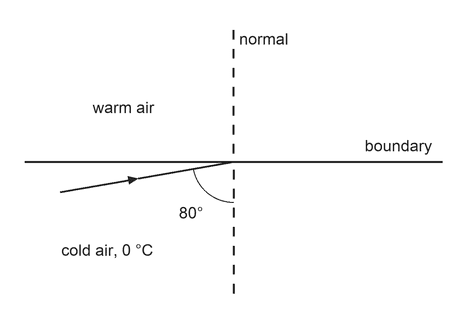
(a) Using , show that the sound is totally reflected back into the cold air if , where and are the absolute temperatures of the warm and the cold air and is the angle of incidence.
(b) Find the lowest temperature of the warm layer, in degrees Celsius, for which this sound is totally reflected.
(c) Explain why the sound most easily turned back down by such a layer is sound travelling nearly parallel to the ground.