
Opening your dashboard
Class 11 Physics Chapter 24 Sound Waves: Competency-Based Questions (CBQ)
40 questions on Chapter 24, each worked through on its own page with the AI tutor. Class 11 Physics, ICSE 2026-27.
40 questions
1–5 marks · Mixed difficulty
- 13 marks
Question 1
Competency: Application
A long railway platform has two loudspeakers, A and B, apart. Both are fed by the same announcement system, so each word leaves A and B at the same instant. A passenger P stands on the line joining them, from A, as shown. Take the speed of sound in air as . (Hypothetical data.)
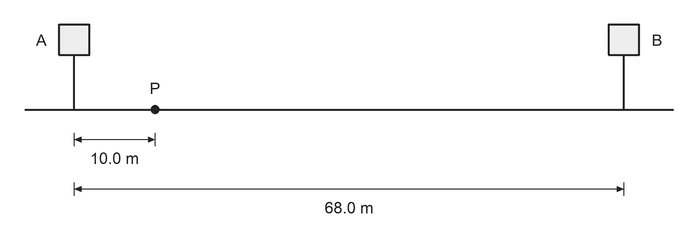
The ear hears two copies of the same sound as one sound if they arrive less than about apart; if the gap is longer, the listener hears the word twice, like an echo.
(a) Find how long after hearing a word from A the passenger hears the same word from B.
(b) Does the passenger hear each word once or twice? Give a reason.
(c) Find the part of the line between A and B where a passenger hears each word only once.
- 21 mark
Question 2
Competency: Analysis & Evaluation
Two children make a toy telephone from two paper cups joined by a long string. When the string is pulled tight, words spoken into one cup are heard clearly at the other.
Assertion (A): If someone pinches the tight string firmly between two fingers, the listener can no longer hear the speaker.
Reason (R): Sound needs a material medium to travel; it cannot travel through a vacuum.
- 31 mark
Question 3
Competency: Application
A candle flame is placed a few centimetres in front of a loudspeaker that plays a steady, low note of at a moderate loudness. The flame is in line with the centre of the speaker cone. What does the flame do?
- 43 marks
Question 4
Competency: Application
A boat moves at a steady straight towards a tall cliff, as shown. The captain sounds the horn once and hears its echo from the cliff later. Take the speed of sound in air as and ignore any wind. (Hypothetical data.)
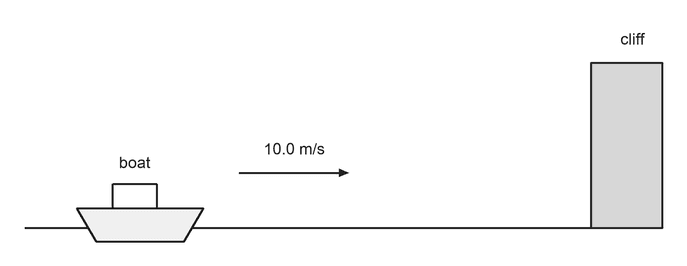
(a) How far from the cliff was the boat when the horn was sounded?
(b) How far from the cliff is the boat when the echo is heard?
(c) Suppose instead that the horn had been sounded at the same place while the boat was moving straight away from the cliff at . After what time would the echo have been heard?
- 51 mark
Question 5
Competency: Analysis & Evaluation
Noise-cancelling headphones have a small microphone that picks up the noise outside and a tiny speaker that adds an “anti-noise” wave. The anti-noise is meant to reach the ear exactly half a cycle out of step with the noise, so that the two interfere destructively. In one pair of headphones the anti-noise always arrives about later than it should, whatever the frequency. (Hypothetical data.)
Assertion (A): These headphones cancel a steady engine hum much better than a steady whistle.
Reason (R): A delay of is a tiny fraction of the period of the hum, but it is half the period of the whistle, so for the whistle the anti-noise arrives in step with the noise instead of out of step.
- 61 mark
Question 6
Competency: Application
An acoustic engineer wants to fix a small hard reflecting panel on the flat side wall of a lecture hall, so that sound from the lecturer's position S is reflected to a seat L at the back. The figure is a plan view. S is from the wall and L is from the wall; the perpendiculars from S and L meet the wall at N and M, which are apart. (Hypothetical data.)
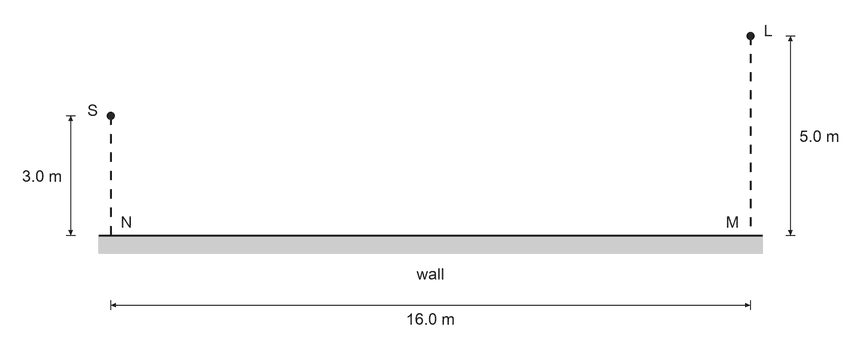
Sound obeys the laws of reflection. How far from N must the centre of the panel be?
- 71 mark
Question 7
Competency: Analysis & Evaluation
A student stands in front of a large flat cliff and claps once. Take the speed of sound in air as , and take as the shortest gap at which the ear hears two sounds separately.
Assertion (A): The student does not hear the echo of the clap as a separate sound.
Reason (R): Sound is not reflected by a surface that is closer than about to the source.
- 83 marks
Question 8
Competency: Application
A steel guy wire long helps to hold up a mobile-phone tower. Its mass per unit length is . To check the tension, a technician strikes the wire sharply near its lower end. A transverse pulse runs up the wire, is reflected at the top, and arrives back at the bottom after the strike. Treat the tension as the same all along the wire. (Hypothetical data.)
(a) Find the speed of the pulse.
(b) Find the tension in the wire.
(c) The design asks for a tension of . What return time should the technician measure when the wire is correctly tightened?
- 91 mark
Question 9
Competency: Analysis & Evaluation
Two steel strings on a guitar have the same length and are tuned to the same tension, but one string is thicker than the other.
Assertion (A): Transverse waves travel more slowly along the thicker string.
Reason (R): At a given tension, the speed of a transverse wave on a string depends only on the density of the material the string is made of.
- 103 marks
Question 10
Competency: Application
In a classroom demonstration, a light rope (rope 1), long, is tied at J to a heavier rope (rope 2), long, whose far end is fixed to a wall, as shown. Rope 1 has a mass per unit length of and rope 2 of . A student holds the free end and keeps both ropes horizontal and taut with a tension of ; the sag is negligible. The student then flicks the free end to send a transverse pulse towards the wall. (Hypothetical data.)
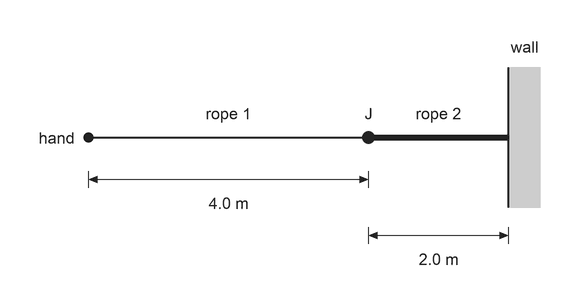
(a) Find the speed of the pulse in each rope.
(b) Find the time the pulse takes to travel from the hand to the wall.
(c) To what value must the tension be raised so that this time becomes ?
- 111 mark
Question 11
Competency: Analysis & Evaluation
For any substance, the elasticity for quick (adiabatic) compressions is times the elasticity for slow (isothermal) ones, where is the ratio of the principal specific heats. For air , and for water at room temperature .
Assertion (A): Laplace's correction changes the calculated speed of sound in air a great deal, but it would change the calculated speed of sound in water by less than one per cent.
Reason (R): For water the ratio is very close to 1, so its adiabatic and isothermal elasticities are almost equal.
- 121 mark
Question 12
Competency: Analysis & Evaluation
Water is about 830 times as dense as air, yet sound travels about 4.3 times as fast in water. Take for water a bulk modulus of and a density of ; for air take , a pressure of and a density of . Which statement correctly explains why sound is faster in water?
- 133 marks
Question 13
Competency: Application
Deep-sea divers often breathe “heliox”, a mixture of helium and oxygen, instead of air. When they speak, their voices sound squeaky, like a cartoon duck. Take for heliox and an average molar mass of ; for air take and a molar mass of . Both gases are at , and . (Hypothetical data.)
(a) Using , find the speed of sound in heliox and in air at .
(b) Suppose the same heliox is compressed to a pressure of about 10 atmospheres, still at . Does this high pressure change your answers to (a)? Explain.
(c) The mouth and throat strengthen certain frequencies of the voice (resonances). The wavelength of each resonance is fixed by the size and shape of these air spaces, not by the gas in them. A resonance that is at when the diver breathes air moves to what frequency in heliox?
- 141 mark
Question 14
Competency: Analysis & Evaluation
A student seals some room air in a syringe and pushes the plunger in very slowly, so that the air stays at room temperature, . The volume falls from to while the pressure rises from to . The density of the room air is , and . (Hypothetical data.) What do these readings tell the student about the speed of sound in the room?
- 151 mark
Question 15
Competency: Application
A music teacher strikes a tuning fork in a classroom early on a winter morning, when the air is at , and again in the afternoon, when a heater has warmed the air to . The speed of sound in air at is . (Hypothetical data.) How does the wavelength of the note in the air change between the morning and the afternoon?
- 161 mark
Question 16
Competency: Analysis & Evaluation
A steady breeze of about blows across flat, open country in which a factory siren sounds. Take the speed of sound in still air as about .
Assertion (A): The siren can usually be heard much farther away downwind of the factory than upwind of it.
Reason (R): The speed of sound over the ground is increased by the wind on the downwind side and decreased by it on the upwind side.
- 171 mark
Question 17
Competency: Analysis & Evaluation
A common rule for thunderstorms says: “Count the seconds between the lightning flash and the thunder, and divide by 3 to get the distance in kilometres.” The speed of sound in air at is , and the light of the flash takes a negligible time to arrive. At about what air temperature does this rule give exactly the right distance?
- 183 marks
Question 18
Competency: Analysis & Evaluation
A school science club measures the speed of sound twice on the same day by timing the echo from a large wall away, using a microphone and a data logger. In the morning the echo returns after ; in the afternoon, after . A barometer reads in the morning and in the afternoon, and the afternoon is also more humid. The speed of sound in dry air at is . (Hypothetical data.)
(a) Find the speed of sound in the morning and in the afternoon.
(b) Assuming that the change in speed is due only to temperature, estimate the air temperature at each time.
(c) A club member says, “Part of the change is due to the fall in pressure, and part to the extra humidity.” Comment on each of these two claims, and say whether the extra humidity makes the afternoon estimate in (b) too high or too low.
- 193 marks
Question 19
Competency: Application
A boat moving through deep water makes waves, and the waves that keep pace with it are those whose speed equals the boat's speed. For gravity waves on deep water, , where is the wavelength. A displacement boat (one that pushes through the water rather than skimming over it) finds it very hard to go faster than its “hull speed”, the speed at which the wave it makes is as long as the boat's waterline. Take . (Hypothetical data.)
(a) A boat moves at . Find the wavelength of the waves that keep pace with it.
(b) Find the hull speed of a boat whose waterline is long.
(c) A second boat of the same type has a waterline four times as long. How many times as large is its hull speed?
- 201 mark
Question 20
Competency: Analysis & Evaluation
A diver rests on the sandy bottom of a calm bay a few metres deep while ordinary waves pass overhead.
Assertion (A): The passing waves rock the diver mainly up and down.
Reason (R): Near the bottom, the up-and-down part of the water's motion dies away, and the water there moves mainly to and fro along the direction in which the waves travel.
- 211 mark
Question 21
Competency: Analysis & Evaluation
An undersea earthquake starts a tsunami with a wavelength of about in an ocean deep. Water waves travel at only when the water is much deeper than the wavelength; when the water is much shallower than the wavelength, they travel at , where is the depth. Take . (Hypothetical data.) About how long does the tsunami take to reach a coast away across this ocean?
- 221 mark
Question 22
Competency: Analysis & Evaluation
A shop fits a device that gives out a steady tone of frequency to keep groups of young people from loitering outside. Most teenagers find the tone irritating, but most adults over about 30 cannot hear it, because the ability to hear high frequencies falls with age. Take the speed of sound in air as . (Hypothetical data.) Which statement about the tone is correct?
- 233 marks
Question 23
Competency: Application
An inspector checks the steel plates of a ship's hull with an ultrasonic thickness gauge. The probe, pressed against the outer face of a plate, sends short pulses of ultrasound straight into the plate and times the echo from its inner face. In the plate these waves travel at . (Hypothetical data.)
(a) When the hull was new, the plate was thick. What echo time did the gauge show then?
(b) Today the gauge shows . Find the present thickness of the plate and the percentage of its original thickness lost to corrosion.
(c) Each pulse lasts , and the gauge can time an echo only if the echo starts to return after the whole pulse has been sent. Find the smallest plate thickness this gauge can measure.
- 241 mark
Question 24
Competency: Analysis & Evaluation
A military jet climbs, then flies level and faster than sound for several minutes over open country before slowing down again.
Assertion (A): People on the ground hear the jet's sonic boom only at the moment when the jet first goes faster than sound.
Reason (R): While an aircraft flies faster than sound, it carries a cone-shaped shock wave along with it the whole time.
- 253 marks
Question 25
Competency: Application
A light aircraft has a two-bladed propeller across, which turns at revolutions per minute. Take the air to be at everywhere; the speed of sound in air at is . The chapter calls a Mach number below subsonic and from to transonic. (Hypothetical data.)
(a) The aircraft stands still on the ground with the engine running. Find the speed of a blade tip and its Mach number, and name the range it falls in.
(b) In flight the aircraft moves forward at . Each blade tip then moves forward at while it goes round, and these two velocities are at right angles. Find the speed of a tip through the air and its Mach number.
(c) Propeller tips become very noisy and waste power as their speed approaches the speed of sound, so the designer keeps the Mach number of the tips in flight at or below . Find the highest rotation rate allowed at , in revolutions per minute.
- 264 marks
Question 26
(Hypothetical data.) A sonic anemometer on a weather mast has two ultrasonic transducers, P and Q, facing each other apart along the direction of the wind, which blows from P towards Q, as shown.

A pulse sent from P to Q takes , and a pulse sent from Q to P takes . Treat the wind as blowing steadily along PQ.
(a) Let be the distance PQ, the time from P to Q and the time from Q to P. Show that the speed of sound in still air, , and the wind speed, , are given by and .
(b) Find and .
(c) The speed of sound in dry air at is . Estimate the temperature of the air.
- 274 marks
Question 27
The speed of a wave on the surface of deep water is given by , where is the wavelength, the surface tension and the density of the water.
(a) Show that is least when , and that this least speed is .
(b) Find this wavelength and the least speed for water, with , and .
(c) Which term of the formula decides the speed of waves much shorter than this, and which decides the speed of waves much longer than this?
- 284 marks
Question 28
(Hypothetical data.) A jet flies level at Mach 1.5 at a height of and passes directly over an observer, as shown.
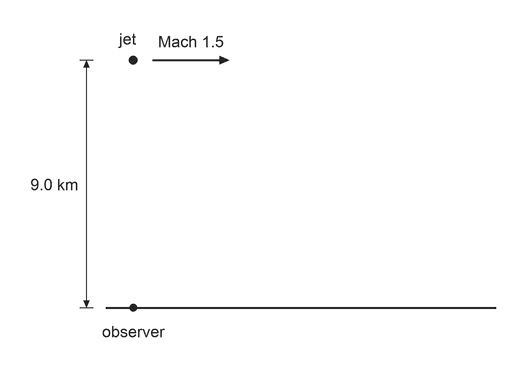
Take the speed of sound as at all heights. The edge of the jet's Mach cone makes an angle with its flight path, where and is the Mach number.
(a) Find .
(b) How far beyond the point directly above the observer is the jet when the observer hears the sonic boom?
(c) How long after the jet passes overhead is the boom heard? Why does the observer hear nothing from the jet before this?
- 291 mark
Question 29
Competency: Analysis
A spectator in the upper stand of a cricket stadium sits from the batter. A fan at home watches the same ball live on television, sitting from the TV set. A stump microphone right beside the batter picks up the crack of bat on ball, and the broadcast carries it as a radio signal over a total path of through a satellite, at . The broadcasting equipment adds a further processing delay of . The air in the stadium and in the fan's room is at , and the speed of sound in air at is . (Hypothetical data.) Who hears the crack first, and by about how much?
- 301 mark
Question 30
Competency: Analysis
Out at sea, a train of waves travels towards a long, straight, gently sloping beach, with its crests at an angle to the shoreline. Near the beach the water is so shallow that its depth is much less than the wavelength, and there the waves travel at , where is the acceleration due to gravity.
Assertion (A): As the waves move into shallower water, their crests turn so that they become more nearly parallel to the shoreline.
Reason (R): Along each crest, the part that is still in deeper water moves faster than the part that has already reached shallower water, so the crest swings round towards the line of the shore.
- 311 mark
Question 31
Competency: Evaluation
Before an ultrasound scan of a patient's abdomen, a technician spreads a layer of gel on the skin and then presses the probe on it. The probe sends ultrasound of a few megahertz into the body and picks up the echoes from the organs inside.
Assertion (A): If the probe were pressed on dry skin without the gel, much less ultrasound would enter the body.
Reason (R): Ultrasound cannot travel through air at all, because a gas cannot carry vibrations of frequency above .
- 321 mark
Question 32
Competency: Understanding
A concrete wall high is built along a busy highway to shield a housing colony from traffic noise. Residents behind the wall find that the high-pitched hiss of the tyres, mostly near , is cut down a lot, but the low rumble of lorry engines, mostly near , is cut down much less. Take the speed of sound in air as . (Hypothetical data.) Which statement best explains this?
- 331 mark
Question 33
Competency: Application
A bat hunting a moth sends out short ultrasonic calls and listens for their echoes. To avoid mixing up echoes, it sends each new call only after the echo of the previous call has come back, and as it closes in on the moth it calls faster and faster. Take the speed of sound in air as , ignore the length of each call, and treat the bat and the moth as almost at rest while a call and its echo travel. (Hypothetical data.) When the moth is away, what is the highest call rate the bat can use?
- 342 marks
Question 34
Competency: Analysis
A physics teacher knots a hard-drawn copper wire of diameter to an aluminium wire and stretches the joined wire between two clamps, so that the whole length is under a tension of . When a wave reaches a boundary between two media in which its speed is different, part of it is reflected. The teacher wants a transverse pulse to cross the knot with no reflection, so the pulse must have the same speed on both wires. The densities of copper and aluminium are and . Ignore the mass of the knot and any sag. (Hypothetical data.)
(a) Explain why the two wires must have the same mass per unit length.
(b) Find the diameter the aluminium wire must have, and the speed of the pulse.
- 352 marks
Question 35
Competency: Analysis
A rover on Mars fires a short laser pulse at a rock away. The tiny spark on the rock makes a sharp crack, which the rover's microphone, mounted beside the laser, records after the pulse is fired; the light takes a negligible time. The Martian air is almost pure carbon dioxide: take , molar mass and . (Hypothetical data.)
(a) Find the speed of sound near the rock and, using , the temperature of the air there.
(b) A classmate says, “Sound is slow on Mars because the Martian air is so thin.” Use the formula in (a) to judge this claim.
- 362 marks
Question 36
Competency: Analysis
A student stands on level ground some distance in front of a long, steep flight of stone steps in an old stadium and claps once. The vertical face (riser) of each step reflects a little of the sound back, so the student hears a quick train of echoes, one from each step. The tread (horizontal depth) of every step is . Assume that the echo from each riser travels farther, out and back, than the echo from the riser just below it, and take the speed of sound in air as . (Hypothetical data.)
(a) Find the time between two successive echoes.
(b) The echo is heard as a short musical note (a “chirp”) instead of a clap. Explain why, and find the frequency of the note.
- 373 marks
Question 37
Competency: Creativity
A school eco-club wants to estimate the depth of a shallow, flat-bottomed ornamental pond about long, without wading into it. For water waves whose wavelength is much greater than the depth , the speed is ; this formula does not hold for short ripples. Take .
(a) Plan a method that uses only a long flat board, a measuring tape and a stopwatch. Say what you would do and measure, how you would get the depth from your readings, and how you would make sure the formula applies.
(b) In a trial, the club marks two posts on the bank apart along the length of the pond. The top of a long, low hump of water made with the board takes to pass from one post to the other. (Hypothetical data.) Find the depth of the pond.
- 383 marks
Question 38
Competency: Evaluation
A technician checks a straight air-filled pipe long for blockages by sending a short sound pulse through the air inside it. The first of the pipe passes through a cold store, where the air in the pipe is at ; the other passes through a warm hall, where it is at . The air in the pipe is still. The speed of sound in air at is . (Hypothetical data.)
(a) Find the time the pulse takes to travel the whole .
(b) A trainee finds the time instead from the speed of sound at the average temperature, . Find the trainee's answer.
(c) The trainee says, “Using the average temperature always gives the right travel time.” Judge this claim using your results, and explain why the true time is longer or shorter than the trainee's.
- 395 marks
Question 39
Competency: Analysis
A hydrogen fuelling station uses an acoustic leak sensor. A small fan draws a sample of the surrounding air into a chamber, where the sensor times a sound pulse across a gap of , and a thermometer records the sample temperature. Hydrogen in air can catch fire from about by volume, so the alarm is set to sound at . Treat air, hydrogen and their mixtures as ideal diatomic gases with ; a mixture's molar mass is the average of its parts' molar masses, weighted by their fractions by volume. Take the molar mass of air as , that of hydrogen as , and . The table gives three readings. (Hypothetical data.)
Reading Sample temperature Pulse time P Q R (a) Using , find the speed of sound in clean air at and the pulse time the sensor should show for clean air at that temperature.
(b) Reading Q has a shorter pulse time than reading P. Show that the higher temperature alone explains this, and explain why the sensor must also measure the temperature.
(c) Find the pulse time the sensor would show at for a sample containing hydrogen by volume, and decide which reading, if any, should set off the alarm.
- 404 marks
Question 40
Competency: Evaluation
In a sprint, the starter stands beside the track near lane 1 and fires a starting pistol. Results are timed to , and the starting blocks record each runner's reaction time, measured from the moment the pistol fires. A reaction time below counts as a false start, because no one can truly react to a sound that fast. On race day the air is at , and the speed of sound in air at is . The table gives the distance from the pistol to the ears of the runners in three lanes. (Hypothetical data.)
Lane Distance from the pistol 1 4 8 (a) Find the speed of sound, and how long after the pistol fires its sound reaches the runners in lanes 1, 4 and 8. Is the difference between lanes 1 and 8 important in a race timed to ?
(b) The runner in lane 1 pushes off after the sound reaches the runner's ears. Find the reaction time the blocks record and say whether a false start is called. What does this show about the rule when the start is given by the sound from one pistol?
(c) At modern races the start signal is sent electrically to a small loudspeaker behind every runner's block, from the runner's ears. Find the delay now, and explain whether the start is now fair to all lanes and whether a change in air temperature matters.