
Question 475 marksMedium
(a) Describe an experiment to show that sound waves can be (i) reflected and (ii) refracted.
(b) Write down the expression for the speed of sound in (i) a solid and (ii) a liquid.
Confirming your payment
Sign up now and get 250 free tokens.
Sound Waves · Question 47 of 48
(a) Describe an experiment to show that sound waves can be (i) reflected and (ii) refracted.
(b) Write down the expression for the speed of sound in (i) a solid and (ii) a liquid.
Solution:
Concept: Sound waves are reflected at a hard surface, obeying the laws of reflection (angle of incidence = angle of reflection, and the incident wave, the normal and the reflected wave lie in one plane). They are refracted when they pass into a medium in which their speed is different. Their speed in a medium is .
Step 1 — (a)(i) Set up the reflection experiment. Two long tubes and are placed horizontally, pointing at the same point O of a polished wooden board AB that acts as a vertical reflecting surface. A ticking watch W is placed at the far end of , and a screen S is placed along the normal at O, between the tubes, to stop the direct sound.
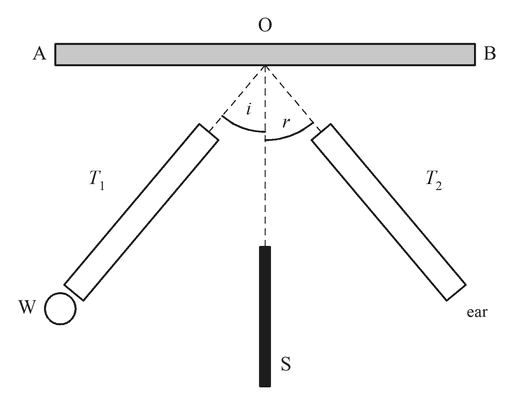
Step 2 — (a)(i) Look for the loudest reflected sound. With the ear at the end of , the tube is turned until the ticking is heard most loudly. In that position the angles that the axes of the two tubes make with the normal at O are found to be equal: the angle of incidence equals the angle of reflection . The tubes, the normal and the board are also in one plane. So sound is reflected, and it obeys the laws of reflection.
Step 3 — (a)(ii) Set up the refraction experiment. A thin rubber balloon is filled with carbon dioxide, in which sound travels more slowly than in air. A ticking watch W is placed on one side of the balloon, and a stethoscope (or the ear) is moved along the line through the watch and the balloon on the other side.
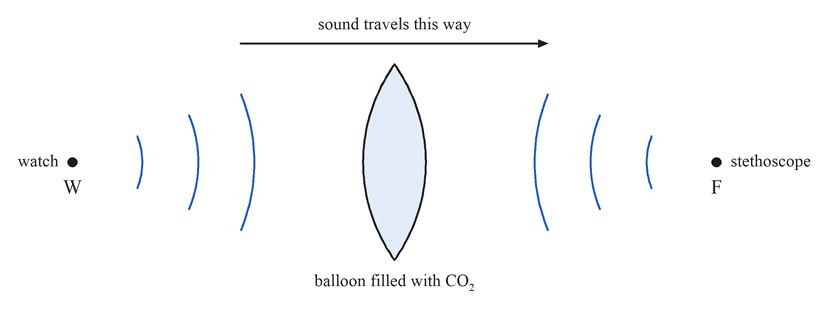
Step 4 — (a)(ii) Explain the result. At one point F the ticking is heard much more loudly than anywhere else. The middle of each spherical wavefront from W passes through the thickest part of the balloon and is slowed down more than its edges, so the wavefronts leaving the balloon are curved inwards and converge at F. The balloon acts like a convex lens for sound, which shows that sound is refracted.
Step 5 — (b)(i) Speed in a solid. For a solid in the form of a thin rod, the elasticity is Young's modulus :
For an extended solid, , where is the bulk modulus and the modulus of rigidity.
Step 6 — (b)(ii) Speed in a liquid. A liquid resists only a change of volume, so its elasticity is its bulk modulus :
In each formula is the density of the medium.
Therefore, (a) the two-tube experiment with shows that sound is reflected, and the CO₂ balloon that brings sound to a focus shows that it is refracted; (b) the speed of sound is in a solid rod and in a liquid.