
Question 465 marksMedium
(a) Explain the production of sound waves.
(b) Show that mechanical waves require a medium for propagation.
(c) Explain Newton's formula for speed of sound in air.
Confirming your payment
Sign up now and get 250 free tokens.
Sound Waves · Question 46 of 48
(a) Explain the production of sound waves.
(b) Show that mechanical waves require a medium for propagation.
(c) Explain Newton's formula for speed of sound in air.
Solution:
Concept: Sound is a mechanical, longitudinal wave produced by vibrating bodies. It travels through a medium as alternate condensations and rarefactions, with speed , where is the elasticity and the density of the medium.
Step 1 — (a) Explain the production of sound. Sound is produced whenever a body vibrates: a struck bell, a plucked string, the vocal cords or a loudspeaker cone. Consider a pipe of air with a piston at one end.

When the piston moves forward, it crowds the air in front of it into a condensation C (higher density and pressure). When it moves back, the air spreads out into a rarefaction R (lower density and pressure). Moving the piston to and fro sends alternate condensations and rarefactions along the pipe. The air particles only vibrate about their mean positions along the direction of travel, so the sound wave is longitudinal.
Step 2 — (b) Show that a medium is needed. An electric bell is set ringing inside a bell jar connected to a vacuum pump.
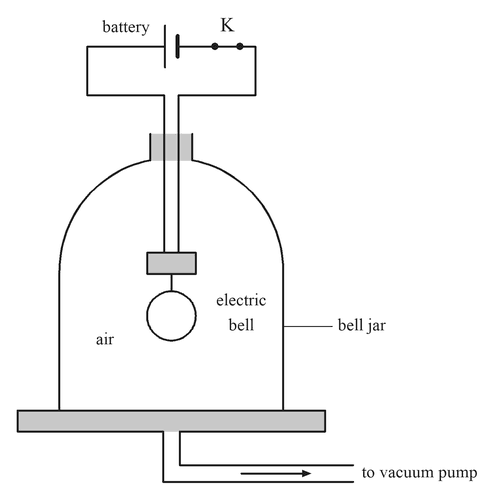
At first the bell is heard clearly. As the air is pumped out, the sound grows fainter and fainter, although the hammer is still seen striking the gong; when nearly all the air is gone, the sound is hardly heard. When air is let back in, the sound returns. Mechanical waves travel by making the particles of a medium vibrate, so without a medium they cannot travel. (Electromagnetic waves, such as light, need no medium: the bell can still be seen.)
Step 3 — (c) State Newton's assumption. Newton assumed that when sound passes through a gas, its temperature stays constant, so the compressions and rarefactions are isothermal and obey Boyle's law.
Step 4 — (c) Find the elasticity of the gas. Let a volume of gas at pressure be squeezed in a condensation to volume at pressure . Boyle's law gives:
The product of two small changes is negligible, so:
The right-hand side is the bulk modulus (change in pressure divided by volume strain), so for an isothermal change .
Step 5 — (c) Write Newton's formula and test it. We replace by in the general formula ; this gives Newton's formula:
For air at N.T.P., and :
The measured speed at is about . Newton's value is too low because the changes are really adiabatic, not isothermal; Laplace's correction, , removes the difference.
Therefore, (a) sound is produced by a vibrating body that sends alternate condensations and rarefactions through the medium, (b) the bell-jar experiment shows that sound cannot travel without a medium, and (c) Newton's formula is , which gives about 280 m/s for air because it wrongly assumes isothermal changes.