
Question 282 marksMedium
How will you prove that sound waves are longitudinal waves?
Confirming your payment
Sign up now and get 250 free tokens.
Sound Waves · Question 28 of 48
How will you prove that sound waves are longitudinal waves?
Solution:
Concept: In a longitudinal wave the particles of the medium vibrate along the direction in which the wave travels, producing alternate compressions (condensations) and rarefactions. In a transverse wave they vibrate at right angles to it.
Step 1 — Set up a vibrating tuning fork. Strike a tuning fork and hold it so that its prong A faces along a line in the air, as in the figure.
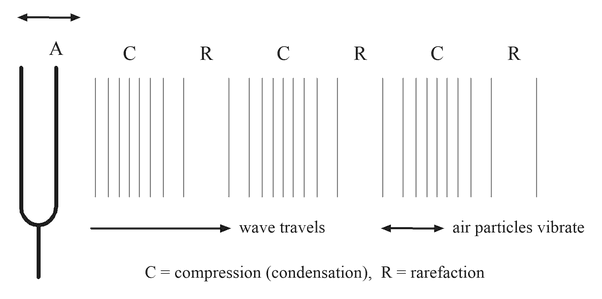
Step 2 — Follow the motion of the air. When prong A moves outwards, it pushes the layer of air next to it and crowds the air into a compression C. When it moves back, it leaves a region of lower density and pressure, a rarefaction R. As the prong keeps vibrating, alternate compressions and rarefactions are produced and travel outward through the air.
Step 3 — Compare the two directions. The prong, and with it each layer of air, moves to and fro along the same line along which the compressions and rarefactions travel. The particles vibrate along the direction of propagation, which is exactly what a longitudinal wave is. A transverse wave would make crests and troughs, not compressions and rarefactions.
Step 4 — Add a second check. Sound waves cannot be polarised, unlike transverse waves such as light, which also shows that sound in air is longitudinal.
Therefore, sound waves are longitudinal because the vibrating prong produces alternate compressions and rarefactions, and the air particles vibrate along the same direction as the wave travels.