
Opening your dashboard
Class 11 Physics Chapter 22: Free, Forced and Damped Oscillations Solutions
27 textbook questions with step-by-step answers, free to read, for ISC 2026-27.
Get talked through Ch 22, not just shown the answer
Reading a finished solution is not the same as being able to do it. The AI tutor takes one question at a time and works it with you, in your own words, until you can.
- Ask it out loud, in your own words
- It gives you the next step, not the answer
- Stuck on part (ii)? Start there
27 questions with solutions
1–5 marks · Mixed difficulty
The first 26 solutions are on this page. This chapter is a long one, so the rest open on their own page to keep this one quick to load.
- 11 mark
Question 1
A particle oscillating under a force is a ( and are constants)
(A) Simple harmonic oscillator
(B) Non-linear oscillator
(C) Damped oscillator
(D) Forced oscillator
(E) Linear oscillator
Solve with AIWritten solution
Solution:
Concept: A restoring force , proportional to the displacement and directed towards the mean position, gives oscillations on its own. A force , proportional to the velocity and opposite to it, is a damping (resistive) force: it takes energy away, so the amplitude dies down.
Step 1 — Identify the two parts of the force. The term always points back towards the mean position, so it is the restoring force. The term always opposes the motion, so it is a damping force.
Step 2 — Name the oscillator. A damping force acts and no external periodic force is applied, so the amplitude keeps decreasing with time. The particle is therefore a damped oscillator, option (C), which is the expected answer.
Step 3 — Check whether the motion is linear. Newton's second law gives the equation of motion:
Every term contains or one of its derivatives only to the first power, so this is a linear equation. In that sense the particle is also a linear oscillator, option (E).
Step 4 — Rule out the other options. The remaining options each need something that is missing here:
- (A) Simple harmonic motion needs the restoring force alone; the damping term makes the amplitude fall, so the motion is not simple harmonic.
- (B) A non-linear oscillator would have terms such as or in its force; here the force depends only on the first powers of and .
- (D) A forced oscillator needs an external periodic force such as ; no such force acts.
Note: The book's answer key gives only “damped oscillator”, the feature that the term adds. Because the equation of motion is also linear, “linear oscillator” describes the particle correctly as well, so both are named.
Therefore, the particle is a damped oscillator, option (C); since its equation of motion is linear, option (E), linear oscillator, is also correct.
- 21 mark
Question 2
The motion of a particle varies with time according to the relation , then
Solve with AIAnswer
(A) The motion is oscillatory but not S.H.M.
(B) The motion is S.H.M. with amplitude
- Correct
(C) The motion is S.H.M. with amplitude
(D) The motion is S.H.M. with amplitude
Answer: (C) The motion is S.H.M. with amplitude
Concept: Two simple harmonic motions of the same angular frequency along the same line add up to a single simple harmonic motion of that frequency. A sum can be written as one sine, , and its amplitude is .
Step 1 — Take out a common factor. We multiply and divide the bracket by , so that the coefficients become :
Step 2 — Use the angle-sum formula. Since and both equal , the bracket is :
Step 3 — Confirm that the motion is S.H.M. Differentiating twice with respect to time gives the acceleration:
The acceleration is proportional to the displacement and directed opposite to it, which is the condition for S.H.M. The largest value of is , so that is the amplitude.
Step 4 — Check the other options. Each of the other options misreads the sum:
- (A) The acceleration is at every instant, which is exactly the defining condition of S.H.M., so the motion is not merely oscillatory.
- (B) This takes the common coefficient as the amplitude, but at each term is and reaches , more than .
- (D) This adds the two largest values, ; the two terms never peak together (one is when the other is zero), so never reaches .
Therefore, the motion is S.H.M. with amplitude .
- 31 mark
Question 3
A simple pendulum is set into vibrations. The bob of the pendulum comes to rest after some time due to
Solve with AIAnswer
- Correct
(A) Air friction
(B) Moment of inertia
(C) Weight of the bob
(D) Combination of all the above
Answer: (A) Air friction
Concept: A free oscillation keeps the same amplitude only if no mechanical energy is lost. Resistive forces such as air resistance (and a little friction at the point of support) remove energy from the swinging bob, so the oscillations are damped and finally stop.
Step 1 — Find what removes the energy. As the bob moves, it pushes the air aside. The air resistance (air friction) acts opposite to the velocity, does negative work on the bob and turns its mechanical energy into heat.
Step 2 — Follow the effect on the motion. With less energy in every swing, the amplitude becomes smaller and smaller, and the bob finally comes to rest at the mean position.
Step 3 — Check the other options. None of the other quantities takes energy away:
- (B) Moment of inertia only describes how hard a body is to turn; it removes no energy, so it cannot stop the motion.
- (C) The weight of the bob supplies the restoring force that keeps the pendulum swinging; gravity is a conservative force and takes no energy away over a complete swing.
- (D) Moment of inertia and weight do not remove energy, so a combination of all three is not the cause; only the resistive force is.
Therefore, the bob comes to rest because of air friction (air resistance).
- 41 mark
Question 4
A particle of mass is attached to a spring (of spring constant ) and has a natural angular frequency . An external force proportional to is applied to the oscillator. The time displacement of the oscillator will be proportional to
Solve with AIAnswer
(A)
- Correct
(B)
(C)
(D)
Answer: (B)
Concept: A periodic force drives the particle at the frequency of the force. For an undamped oscillator the forced displacement is , and its amplitude is found by putting this into Newton's second law. The natural angular frequency is , so .
Step 1 — Write the equation of motion. Let the applied force be . With the spring force , Newton's second law gives:
Step 2 — Try a displacement at the driving frequency. We take , so the acceleration is:
Putting both into the equation of motion gives:
Step 3 — Solve for the amplitude. Cancelling and collecting the terms in gives:
Above this value of is negative: the displacement is then opposite in phase to the force, and the size of the amplitude is .
Step 4 — Read off the proportionality. The displacement is , so for a given force it is proportional to .
Watch out: Without damping, any free oscillation at that starts when the force is switched on never dies away. The question is about the forced part of the motion, which follows the driving force.
Step 5 — Check the other options. Each of the other options has a definite slip:
- (A) This puts in the numerator; by Newton's second law the same force moves a heavier particle less, so the mass belongs in the denominator.
- (C) This has a plus sign; the spring term and the inertia term work against each other, so the frequencies are subtracted, and that is why the amplitude grows without limit as approaches .
- (D) This makes both slips at once: the mass in the numerator and a plus sign between the frequencies.
Therefore, the displacement is proportional to .
- 51 mark
Question 5
The amplitude of a damped oscillator becomes half in one minute. The amplitude after 3 minutes will be times the original, where is
Solve with AIAnswer
(A)
- Correct
(B)
(C)
(D)
Answer: (B)
Concept: In damped oscillations the amplitude decreases exponentially with time. If is the starting amplitude, the damping constant and the mass, the amplitude at time is:
Over equal intervals of time the amplitude is multiplied by the same factor; it does not fall by the same amount.
Step 1 — Use the decay in one minute. Write and measure in minutes. After one minute the amplitude is half:
Step 2 — Find the amplitude after 3 minutes. Three minutes means the factor acts three times over:
Step 3 — Compare with . The amplitude after 3 minutes is . Comparing this with shows that .
Step 4 — Check the other options. Each of the other values comes from a different (wrong) rule:
- (A) This multiplies the factor 2 by the number of minutes, giving 6, as if the factors of 2 for the three minutes were added; in fact each minute halves the amplitude again, so the three factors multiply and give .
- (C) This swaps the number and the power, giving 9; a factor of 2 in each of 3 minutes gives .
- (D) This gives 12, which no constant-factor decay of 2 per minute produces in 3 minutes.
Therefore, : after 3 minutes the amplitude is of the original.
- 61 mark
Question 6
A damped harmonic oscillator has a frequency of 5 oscillation per second. The amplitude drops to half its value for every 10 oscillations. The time it will take to drop to of the original amplitude is close to
Solve with AIAnswer
(A) 100 s
- Correct
(B) 20 s
(C) 10 s
(D) 50 s
Answer: (B) 20 s
Concept: In damped oscillations the amplitude decreases exponentially with time. If is the starting amplitude, the damping constant and the mass, the amplitude at time is:
Over equal intervals of time the amplitude is multiplied by the same factor; it does not fall by the same amount.
Step 1 — Find the time in which the amplitude halves. At 5 oscillations per second one oscillation takes s, so 10 oscillations take:
Step 2 — Count the halvings needed. After halvings the amplitude is of the original, and we need this to be :
Taking logarithms to base 10 of both sides gives:
(A quick check: , which is close to 1000.)
Step 3 — Convert the halvings into time. Each halving takes 2 s:
Step 4 — Check the other options. Each of the other times gives a very different fall in amplitude:
- (A) In 100 s the amplitude would halve 50 times, a factor of about , far below .
- (C) In 10 s it halves only 5 times, a factor of , so the amplitude would still be of the original.
- (D) In 50 s it halves 25 times, a factor of about , again far beyond 1000.
Therefore, the amplitude drops to of its value in about 20 s.
- 71 mark
Question 7
The amplitude of a damped oscillator decreases to 0.9 times its original magnitude in 5 s. In another 10 s it will decrease to times its original magnitude where equals
Solve with AIAnswer
(A) 0.6
(B) 0.7
(C) 0.81
- Correct
(D) 0.729
Answer: (D) 0.729
Concept: In damped oscillations the amplitude decreases exponentially with time. If is the starting amplitude, the damping constant and the mass, the amplitude at time is:
Over equal intervals of time the amplitude is multiplied by the same factor; it does not fall by the same amount.
Step 1 — Use the decay in the first 5 s. Write . After 5 s the amplitude is 0.9 of the original:
Step 2 — Find the total time. “Another 10 s” comes after the first 5 s, so the amplitude is wanted at s, which is three intervals of 5 s.
Step 3 — Apply the factor three times. In each 5 s the amplitude is multiplied by 0.9:
Step 4 — Check the other options. Each of the other values follows a wrong rule:
- (A) 0.6 would need the amplitude to fall from 0.9 to 0.6, a factor of about 0.667, in the next 10 s, that is about 0.816 per 5 s, not the steady 0.9.
- (B) This takes the loss as a fixed amount, 0.1 of the original every 5 s (); damping removes a fixed fraction of the present amplitude, not a fixed amount.
- (C) This is , the factor for 10 s from the start; the total time here is 15 s.
Therefore, .
- 81 mark
Question 8
In forced oscillation of a particle the amplitude is maximum for a frequency of the force, while the energy is maximum for a frequency of the force, then
Solve with AIAnswer
- Correct
(A)
(B)
(C) when damping is small and when damping is large
(D)
Answer: (A)
Concept: In this chapter, resonance happens when the frequency of the driving force equals the natural frequency of the oscillator. At resonance the amplitude of the forced oscillations is maximum, and the driving force transfers energy to the oscillator most effectively, so the energy of the oscillations is also maximum.
Step 1 — Find the frequency of maximum amplitude. The amplitude of forced oscillations is greatest at resonance, when the driving frequency equals the natural frequency:
Step 2 — Find the frequency of maximum energy. At resonance the oscillator takes in the most energy from the driving force, so its energy is also largest there:
Step 3 — Compare the two. Both maxima occur at the natural frequency, so .
Step 4 — Check the other options. The other options compare the two frequencies differently:
- (B) This is ruled out in every treatment: the amplitude peak never lies above the energy peak.
- (C) This is also ruled out: for every amount of damping the amplitude peak lies at or below the energy peak, never above it when the damping is large.
- (D) This is what the exact theory of a damped oscillator gives (see the note), but the difference is very small for light damping, and in the resonance model used in this chapter both maxima occur at the natural frequency.
Note: With damping, the displacement amplitude is largest at , slightly below , while the kinetic energy is largest exactly at . Strictly, therefore, , as in option (D). For light damping the two frequencies are practically equal, which is the reading behind the expected answer, .
Therefore, in the resonance model of this chapter (strictly, with damping, is less than , and only slightly less when the damping is light).
- 91 mark
Question 9
A simple pendulum has a time period . The point of suspension is now moved upward according to the relation where is the vertical displacement. The time period now becomes . The ratio of is
Solve with AIAnswer
(A)
- Correct
(B)
(C) 1
(D)
Answer: (B)
Concept: A simple pendulum of length has time period . If its point of suspension accelerates upwards with acceleration , then in the frame of the support the bob feels an extra downward pseudo-force in addition to its weight , so the pendulum behaves as if gravity were .
Step 1 — Find the acceleration of the support. Differentiating twice with respect to time gives the acceleration:
With , this gives . It is constant and directed upwards, the direction in which increases.
Step 2 — Find the effective value of . The figure shows the two downward forces on the bob, as seen from the moving support:
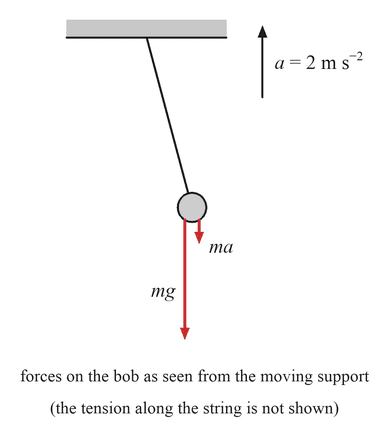
Adding the pseudo-force to the weight gives the effective acceleration due to gravity:
Step 3 — Form the ratio of the squared periods. Since , the square of the period is inversely proportional to :
Step 4 — Check the other options. Each of the other values comes from a definite slip:
- (A) This is the ratio turned upside down; is the value of .
- (C) This would be right only if the support moved at a constant velocity; gives a steady acceleration of .
- (D) This takes the acceleration of the support as downward, so that the effective becomes and the ratio .
Therefore, .
- 101 mark
Question 10
What is an ideal oscillator?
Solve with AIWritten solution
Solution:
Concept: In every real oscillator some energy is lost to friction and air resistance, so the amplitude slowly decreases. An ideal oscillator is the limiting case with no such loss.
Step 1 — State the definition. An ideal oscillator is one whose free oscillations keep a constant amplitude for ever, because no energy is lost by damping.
Step 2 — Give an example. A mass on a spring with no friction and no air resistance would be an ideal oscillator; its displacement–time graph is a sine curve whose crests all have the same height.
Therefore, an ideal oscillator is one whose free oscillations keep a constant amplitude, because it loses no energy to damping.
- 111 mark
Question 11
What is damping force?
Solve with AIWritten solution
Solution:
Concept: Forces such as air resistance, friction and viscous drag oppose the motion of an oscillating body and take mechanical energy away from it.
Step 1 — State the definition. The damping force is the frictional (resistive) force acting on an oscillating body in the direction opposite to its direction of motion.
Step 2 — State its effect. It converts mechanical energy into heat, so the amplitude of the oscillations decreases with time.
Therefore, the damping force is the resistive force on an oscillating body that acts opposite to its velocity and makes the amplitude decrease.
- 121 mark
Question 12
What is the relation connecting damping force and velocity of the particle?
Solve with AIWritten solution
Solution:
Concept: For a body moving slowly through air or a liquid, the resistive force grows in step with the speed.
Step 1 — Write the relation. When the velocities are not large, the damping force is directly proportional to the velocity of the particle at that instant and opposite to it:
Step 2 — Explain the symbols. Here is the damping constant, and the minus sign shows that the force opposes the motion. Since , its SI unit is , which is the same as .
Therefore, : the damping force is proportional to the velocity and opposite to it.
- 131 mark
Question 13
What are forced oscillations?
Solve with AIWritten solution
Solution:
Concept: A body left to itself oscillates at its own natural frequency. A periodic force applied from outside can make it oscillate at a different frequency.
Step 1 — State the definition. Forced (driven) oscillations are the oscillations of a body under the action of an external periodic force, at the frequency of that force rather than at the body's own natural frequency.
Step 2 — Give an example. A swing pushed again and again at regular intervals, or the sounding board of a musical instrument made to vibrate by its strings, performs forced oscillations.
Therefore, forced oscillations are the oscillations a body makes under an external periodic force, at the frequency of that force.
- 141 mark
Question 14
Give an example for resonance from electronics.
Solve with AIWritten solution
Solution:
Concept: Resonance occurs when a system is driven at its own natural frequency; its response is then largest.
Step 1 — Name the example. A radio receiver is tuned to a station by resonance.
Step 2 — Explain it. The aerial picks up signals of many frequencies. Turning the tuning knob changes the natural frequency of the receiver's inductor–capacitor circuit; when it equals the frequency of the wanted station, the current for that station becomes largest and the station is heard.
Therefore, tuning a radio receiver to a selected station is an example of resonance in electronics.
- 152 marks
Question 15
Write down the expression for natural frequency of an oscillator. Explain the symbols used.
Solve with AIWritten solution
Solution:
Concept: A body of mass held by a spring of force constant feels a restoring force when displaced by . Its acceleration is therefore
This is simple harmonic motion with angular frequency
Step 1 — Write the expression. The natural frequency is divided by :
Step 2 — Explain the symbols. Here is the natural frequency (in hertz), is the force constant of the oscillator, which is the restoring force per unit displacement (in ), and is the mass of the oscillating body (in kg).
Therefore, , where is the force constant and is the mass of the oscillator.
- 162 marks
Question 16
Draw graphs to show the variation of displacement with time (i) for a free oscillator and (ii) a damped oscillator.
Solve with AIWritten solution
Solution:
Concept: A free (undamped) oscillator loses no energy, so its displacement varies as with a constant amplitude . In a damped oscillator energy is lost, and the displacement is , whose amplitude falls exponentially.
Step 1 — Describe the graph of the free oscillator. The graph is a cosine (or sine) curve. Every crest reaches and every trough reaches , so the amplitude stays the same for all time.
Step 2 — Describe the graph of the damped oscillator. The curve still crosses the time axis at regular intervals, but each crest is lower than the one before it. The crests and troughs lie (very nearly) on the dashed envelope curves , which fall exponentially towards zero.
Step 3 — Draw the two graphs. The figure shows both graphs with the same time axis.
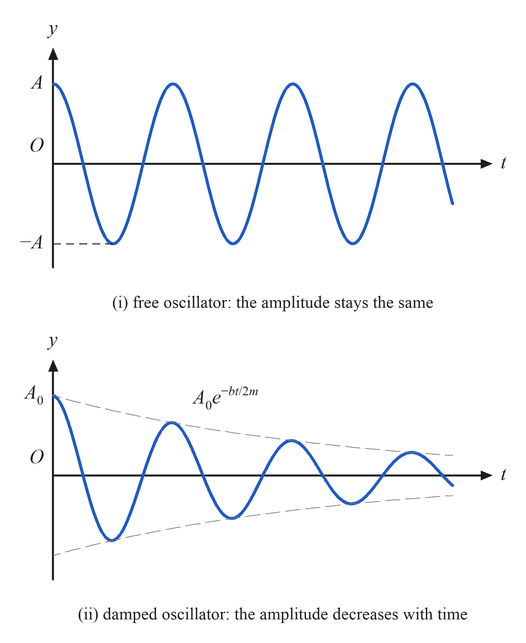
Therefore, the displacement–time graph of a free oscillator is a sine curve of constant amplitude, while that of a damped oscillator is a sine-like curve whose amplitude decreases exponentially with time.
- 172 marks
Question 17
What is amplitude of a damped oscillator? What is its angular frequency?
Solve with AIWritten solution
Solution:
Concept: A body of mass on a spring of force constant , with a damping force , obeys . For small damping its displacement is
Step 1 — Write the amplitude. The factor multiplying the cosine is the amplitude of the damped oscillator:
Here is the amplitude at (the amplitude it would keep without damping), is the damping constant and is the mass. The amplitude decreases exponentially with time.
Step 2 — Write the angular frequency. The angular frequency of the damped oscillations is:
It is a little less than the natural angular frequency , so damping makes the period slightly longer.
Therefore, the amplitude of a damped oscillator is , and its angular frequency is .
- 182 marks
Question 18
Distant explosion can break glass windows. How?
Solve with AIWritten solution
Solution:
Concept: A periodic push on a body makes it perform forced vibrations; when the frequency of the push matches the body's natural frequency, resonance makes the amplitude very large.
Step 1 — Follow the energy from the explosion. An explosion sends out pressure (sound) waves of very large amplitude in all directions. These waves carry mechanical energy over long distances.
Step 2 — See what the waves do to a window. When the waves reach a window, the changing air pressure pushes the large, thin glass pane back and forth, so the glass is made to perform forced vibrations. If the frequency of the waves matches a natural frequency of the pane, resonance makes these vibrations especially large.
Step 3 — Explain the breaking. Glass is brittle: it cannot bend much without cracking. The large vibrations strain it beyond its limit, and the window breaks.
Therefore, the large-amplitude pressure waves from the explosion force the window glass to vibrate strongly (most strongly when their frequency matches the natural frequency of the pane), and the brittle glass breaks.
- 192 marks
Question 19
What is resonance? What is resonant frequency?
Solve with AIWritten solution
Solution:
Concept: When a periodic force drives an oscillator, the amplitude of the forced oscillations depends on how close the driving frequency is to the oscillator's natural frequency.
Step 1 — Define resonance. As the frequency of the driving force comes close to the natural frequency of the oscillating body, its amplitude increases, and it becomes largest when the two frequencies are equal or very nearly so. This phenomenon is called resonance. At resonance the driving force transfers energy to the body most effectively.
Step 2 — Define resonant frequency. The frequency of the driving force at which the amplitude of the driven oscillator becomes maximum is called the resonant frequency. For light damping it is very nearly equal to the natural frequency of the oscillator, ; damping moves the peak slightly below , by an amount too small to notice when the damping is light.
Step 3 — Give an example. A child on a swing goes highest when the pushes are given at the natural frequency of the swing.
Therefore, resonance is the build-up of a large amplitude when the driving frequency equals the natural frequency, and the resonant frequency is the driving frequency at which the amplitude is maximum.
- 202 marks
Question 20
Draw graphs to show the variation of amplitude with driving frequency of a forced harmonic oscillator under (i) zero damping, (ii) low damping and (iii) high damping.
Solve with AIWritten solution
Solution:
Concept: For a driving force the amplitude of the forced oscillations is
Here is the natural angular frequency, is the mass and is the damping constant. The amplitude is largest when is close to , and the damping term decides how tall that peak can be.
Step 1 — Note what the three curves share. For a very slow force () every curve starts at , the steady stretch of the spring. For a very fast force every curve falls towards zero.
Step 2 — Describe the curve for zero damping. With the amplitude is , which grows without limit as approaches ; the curve goes up on both sides of . In practice the amplitude is limited by friction, or the system breaks.
Step 3 — Describe the curve for low damping. The curve has a tall, narrow peak at (very nearly) : the resonance is sharp.
Step 4 — Describe the curve for high damping. The peak is low and broad, so the resonance is flat, and it lies a little below .
Step 5 — Draw the graphs. The figure shows the three curves on the same axes.

Therefore, the amplitude–frequency graph has a peak at or very near the natural frequency: infinitely high for zero damping, tall and sharp for low damping, and low and flat for high damping.
- 212 marks
Question 21
“Marching soldiers are asked to break their steps while crossing a bridge.” Why?
Solve with AIWritten solution
Solution:
Concept: If a periodic force acts on a structure at its natural frequency, resonance builds up a very large amplitude of vibration.
Step 1 — See what the marching does. Soldiers marching in step strike the bridge together at regular intervals. This is a periodic force on the bridge, with the frequency of their steps.
Step 2 — Explain the danger. If the frequency of the steps happens to equal the natural frequency of the bridge, the bridge is in resonance with the footsteps. Its amplitude of vibration becomes very large, and the bridge may be damaged or even collapse.
Step 3 — Explain the remedy. When the soldiers break step, their footfalls no longer come at regular intervals, so there is no periodic force at one frequency and resonance cannot build up.
Therefore, soldiers break step so that their regular footfalls cannot set the bridge into resonance, which could make it vibrate violently and break.
- 222 marks
Question 22
When the stem of a vibrating tuning fork is gently pressed on the surface of a table louder sound is heard. Why?
Solve with AIWritten solution
Solution:
Concept: How loud a sound is depends on how much air is set vibrating. A periodic force makes a body perform forced vibrations at the frequency of the force, even when this is not the body's natural frequency.
Step 1 — Look at the fork alone. The prongs of a tuning fork are thin and have a small area, so they set only a little air vibrating, and the sound is faint.
Step 2 — See what the table does. When the stem is pressed on the table, the vibrating stem pushes the table top up and down at the frequency of the fork. The table top is made to perform forced vibrations.
Step 3 — Explain the louder sound. The table top has a much larger area than the prongs, so it sets a much larger mass of air vibrating, and the sound is louder. Because energy now leaves the fork faster, the sound also dies away sooner.
Note: The book's hint calls this resonance. Resonance would need the natural frequency of the table top to equal the fork's frequency; the louder sound is heard with forks of any frequency, so it is due to the forced vibration of the large table surface.
Therefore, the table top is forced to vibrate at the fork's frequency, and its large area sets much more air vibrating, so a louder sound is heard.
- 233 marks
Question 23
What are (i) free oscillations, (ii) damped oscillations and (iii) forced oscillations?
Solve with AIWritten solution
Solution:
Concept: Oscillations are classed by the forces acting on the body: a restoring force alone, a restoring force with a resistive force, or these together with an external periodic force. Below, is the displacement, the force constant, the damping constant and the mass.
Step 1 — Define free oscillations. When a body is displaced from its mean position and released, it oscillates under its own restoring force alone. These are free oscillations; their frequency is the natural frequency , and with no energy loss their amplitude stays constant. The equation of motion is:
Examples are a tuning fork struck once, or an ideal pendulum swinging with no air resistance.
Step 2 — Define damped oscillations. In practice a resistive force, such as air resistance or friction, opposes the motion and turns mechanical energy into heat. The amplitude then decreases gradually with time, ; these are damped oscillations. With the damping force the equation of motion is:
Examples are a pendulum swinging in air, which slowly comes to rest, and a block on a spring immersed in a liquid.
Step 3 — Define forced oscillations. When an external periodic force acts on the body, its natural oscillations soon die out and it oscillates with the frequency of the applied force, not its natural frequency, with a constant amplitude. These are forced (driven) oscillations. The equation of motion is:
Examples are a swing pushed at regular intervals and the sounding board of a musical instrument.
Therefore, free oscillations take place at the natural frequency with constant amplitude, damped oscillations lose amplitude with time because of resistive forces, and forced oscillations take place at the frequency of an applied periodic force.
- 243 marks
Question 24
Using displacement–time graph, explain the effect of damping on the oscillations of a mass attached to a spring, (i) for small damping and (ii) large damping.
Solve with AIWritten solution
Solution:
Concept: For a mass on a spring of force constant with a damping force , the displacement for small damping is:
Its angular frequency is:
The damping constant decides both how fast the amplitude falls and how much the period changes.
Step 1 — Recall the case with no damping. With the mass oscillates for ever with constant amplitude, and its displacement–time graph is a sine curve with crests of equal height.
Step 2 — Draw the graphs with damping. The figure shows the mass released from rest at displacement for different amounts of damping.

Step 3 — Explain the graph for small damping. When is small, the factor falls slowly, so the amplitude decreases gradually and the mass makes many oscillations before stopping, as in graph (i). Because is tiny compared with , the period stays almost equal to the natural period.
Step 4 — Explain the graph for large damping. When is large, the amplitude falls rapidly and the mass comes to rest after only one or two oscillations, as in graph (ii). The term now makes noticeably smaller, so the period becomes longer.
Step 5 — Note the limit of very large damping. The expression for stops being real when the damping term is at least as large as :
This is the same as . The damping is then so large that there is no oscillation at all: the mass simply creeps back to the mean position, as in the last graph.
Therefore, with small damping the amplitude decreases slowly and the mass oscillates many times, while with large damping the amplitude dies out after one or two oscillations (and with very large damping the mass returns to rest without oscillating).
- 253 marks
Question 25
What are forced oscillations? Explain the action of external periodic force and the restoring force on an oscillator.
Solve with AIWritten solution
Solution:
Concept: A forced (driven) oscillator is acted on by three forces: the restoring force , the damping force and the external periodic force . Its motion obeys Newton's second law with all three.
Step 1 — Define forced oscillations. The oscillations made by a body under the action of an external periodic force, with the frequency of that force rather than its own natural frequency, are called forced (driven) oscillations.
Step 2 — Show the forces. The figure shows a block of mass on a spring of force constant , displaced by from the mean position O and moving with velocity .
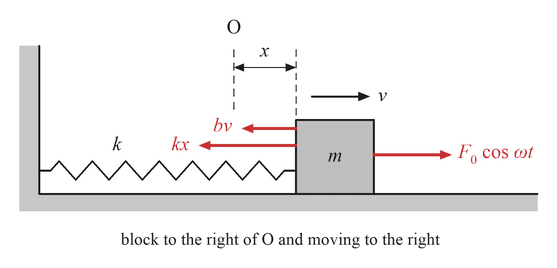
The restoring force points back towards O, the damping force opposes the velocity, and the external force changes its size and direction periodically. Newton's second law gives:
Step 3 — Explain the action of the restoring force. The restoring force always pulls the body back towards its mean position. On its own it would make the body oscillate at its natural frequency ; it is what makes the system an oscillator at all.
Step 4 — Explain the action of the external force. At first the body tries to vibrate at its natural frequency while the applied force tries to drive it at its own frequency. Damping soon makes the free (natural) vibrations die out, and the body then vibrates steadily with the frequency of the applied force and a constant amplitude. The energy lost to damping in each cycle is made up by the work done by the external force.
Step 5 — Show how the two forces together fix the amplitude. For small damping, and a driving frequency not too close to the natural frequency, the amplitude of the forced oscillations is:
With and , this is the same as . The modulus keeps the amplitude positive: above the natural frequency the displacement is simply opposite in phase to the force. When the driving frequency is far from the natural frequency, the factor is large and the amplitude is small. As the two frequencies come closer this factor shrinks, so the amplitude grows; it is largest at resonance, where only the damping keeps it finite.
Therefore, forced oscillations are the oscillations made under an external periodic force, at its frequency; the restoring force tries to keep the body oscillating at its natural frequency, while the external force drives it at its own frequency and supplies the energy lost to damping, giving a constant amplitude that is largest when the two frequencies are equal or very nearly so.
- 265 marks
Question 26
What is resonance? Using a graph, explain the variation of amplitude of a driven oscillator with the frequency of the applied force and show that the amplitude is maximum at resonant frequency.
Solve with AIWritten solution
Solution:
Concept: A driven oscillator obeys Newton's second law with three forces: the restoring force , the damping force and the driving force . Once the free oscillations have died out, it oscillates at the driving frequency , and the size of that oscillation depends on how close is to the natural angular frequency .
Step 1 — Define resonance. Resonance is the phenomenon in which a body is made to vibrate by an external periodic force whose frequency equals its natural frequency; the amplitude of vibration then becomes maximum, and the energy supplied by the driving force is just enough to overcome the damping. The driving frequency at which the amplitude is maximum is the resonant frequency.
Step 2 — Write the equation of motion. For a body of mass , Newton's second law gives:
Dividing by and writing and gives:
Step 3 — Write the steady motion. After the free oscillations die out, the body oscillates at the driving frequency, lagging behind the force by some phase :
Differentiating once and then again gives the velocity and the acceleration:
Step 4 — Rewrite the driving force in the same terms. Writing and using the angle-sum formula gives:
Step 5 — Compare the two sides. We substitute everything into the equation of Step 2. The equation must hold at every instant, so the coefficients of on the two sides are equal, and so are the coefficients of :
Step 6 — Find the amplitude. Squaring both equations and adding them removes , because :
Step 7 — Find where the amplitude is largest. The numerator is fixed, so is largest when the quantity under the root, , is smallest. We differentiate with respect to :
Setting this equal to zero gives the frequency of maximum amplitude:
For small damping is tiny compared with , so : the amplitude is maximum when the driving frequency equals the natural frequency. This is resonance. Putting into the formula of Step 6 gives the maximum amplitude:
Step 8 — Explain the graph. The figure shows the amplitude against the driving frequency for different amounts of damping.
For a very slow force () the amplitude is , the steady stretch of the spring. As increases, the amplitude rises, reaches its peak at (very nearly) and then falls towards zero for a very fast force. With zero damping the peak would be infinitely high; in practice friction limits it, or the system breaks. The smaller the damping, the taller and sharper the peak (); with high damping the peak is low and flat and lies a little below .
Therefore, the amplitude of a driven oscillator is maximum when the driving frequency equals its natural frequency (exactly at , which is practically for small damping); this is resonance, and the smaller the damping, the taller and sharper the peak.
- 275 marks
Question 27
What is damping constant? Write down the expression for the amplitude of a damped harmonic oscillator and show that the amplitude decreases exponentially with time.
What Class 11 Physics Ch 22 covers
The sections of the chapter, in the order the book takes them. Every question above comes from one of these.
- 01Free Oscillations
- 02Damped Oscillations
- 03Forced Oscillations
- 04Resonance
More ways to study this chapter
The same chapter asked three other ways. Practise it, revise it, and see what the board has set on Ch 22 before.
Class 11 Physics Ch 22 questions students ask
How many questions are there in Class 11 Physics Ch 22?
27 questions. Every one is solved step by step on this page.
Are these Class 11 Physics solutions free?
Yes. Every question and its full working is free to read, with no account needed.
Can I download the Class 11 Physics Ch 22 solutions as a PDF?
There is no PDF to download. Every solution is on this page instead, which means it is searchable, always the current syllabus, and readable on a phone. Use your browser's print option if you want it on paper.