
Question 91 markMCQMedium
A simple pendulum has a time period . The point of suspension is now moved upward according to the relation where is the vertical displacement. The time period now becomes . The ratio of is
Confirming your payment
Sign up now and get 250 free tokens.
Free, Forced and Damped Oscillations · Question 9 of 27
A simple pendulum has a time period . The point of suspension is now moved upward according to the relation where is the vertical displacement. The time period now becomes . The ratio of is
(A)
(B)
(C) 1
(D)
Answer: (B)
Concept: A simple pendulum of length has time period . If its point of suspension accelerates upwards with acceleration , then in the frame of the support the bob feels an extra downward pseudo-force in addition to its weight , so the pendulum behaves as if gravity were .
Step 1 — Find the acceleration of the support. Differentiating twice with respect to time gives the acceleration:
With , this gives . It is constant and directed upwards, the direction in which increases.
Step 2 — Find the effective value of . The figure shows the two downward forces on the bob, as seen from the moving support:
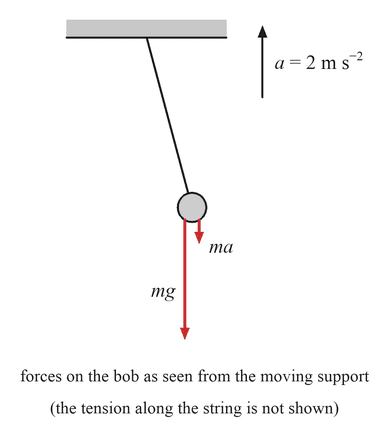
Adding the pseudo-force to the weight gives the effective acceleration due to gravity:
Step 3 — Form the ratio of the squared periods. Since , the square of the period is inversely proportional to :
Step 4 — Check the other options. Each of the other values comes from a definite slip:
Therefore, .