
Opening your dashboard
Class 11 Physics Chapter 22 Free, Forced and Damped Oscillations: Competency-Based Questions (CBQ)
40 questions on Chapter 22, each worked through on its own page with the AI tutor. Class 11 Physics, ICSE 2026-27.
40 questions
1–5 marks · Mixed difficulty
- 14 marks
Question 1
Competency: Application
A dairy cooperative checks milk samples with a vibrating-tube density meter. A thin glass U-tube is held only at its open ends, as shown in the figure, and is filled with the sample. Its closed bend is then set into free oscillations, and the meter measures the period .
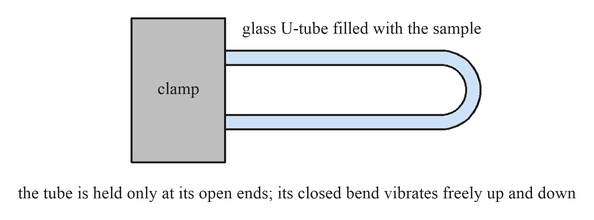
The tube behaves like a mass on a spring. Its stiffness does not change, and the vibrating mass is the mass of the tube plus the mass of the liquid inside it, where is the density of the liquid and the inside volume of the tube. So
The meter is calibrated with air in the tube (take the mass of the air as negligible) and with pure water (). Pure milk from this dairy has a density of . (Hypothetical data.)
Tube filled with Air Pure water Sample P Sample Q Period (ms) 2.500 3.000 3.0137 3.0110 (a) Show that the density of a sample is given by , where and are the periods with air and with water.
(b) Find the density of sample P.
(c) Find the density of sample Q. If Q is pure milk to which water has been added, find what percentage of its volume is added water. Assume that the volumes of milk and water simply add.
- 21 mark
Question 2
Competency: Application
At a fruit stall, a crate of mangoes is hung from the hook of a spring balance, and the spring stretches by more than when the hook is empty. When the crate is bumped, it bobs up and down freely. (Hypothetical data.) Taking and the natural frequency of a mass on a spring of spring constant as , the crate bobs with a frequency of about
- 31 mark
Question 3
Competency: Analysis & Evaluation
A metal ball hanging from a light spring is pulled down a little and released. It then oscillates freely up and down; air resistance is negligible.
Assertion (A): The ball has its greatest acceleration when it is at the highest and lowest points of its motion.
Reason (R): At the highest and lowest points of its motion the ball is momentarily at rest.
- 44 marks
Question 4
Competency: Analysis & Evaluation
A liquid stands in a U-tube of uniform cross-sectional area , as shown in the figure. The total length of the liquid column, measured along the tube, is . When the liquid surface in one arm is pushed down by a small distance and released, the whole column oscillates freely. Viscosity and surface tension may be neglected, and the natural frequency of a mass held by a restoring force is .

(a) Show that the restoring force on the column is , where is the density of the liquid, and hence that .
(b) In a laboratory U-tube the mercury column is long. Find the natural frequency and the period of its free oscillations. Take . (Hypothetical data.)
(c) Find the length of a water column that would oscillate with a period of . Would a mercury column of the same length have a different period? Explain.
- 51 mark
Question 5
Competency: Analysis & Evaluation
In a laboratory, the same block and the same light spring are used in two ways. First the block rests on a smooth horizontal table and is attached to the spring; then the block hangs vertically from the spring. Each time it is displaced slightly and released.
Assertion (A): The natural frequency of the block is the same in the two arrangements.
Reason (R): When the block hangs, gravity only shifts its equilibrium position lower; for a further displacement from this new position, the restoring force is still .
- 61 mark
Question 6
Competency: Analysis & Evaluation
A glider on a level air track is held between two stretched springs. It is pulled to one side and released, and it then oscillates freely; friction and air resistance are negligible.
Assertion (A): The kinetic energy of the glider is the same at every point of its motion.
Reason (R): The total mechanical energy of the glider and springs stays the same during the free oscillations.
- 74 marks
Question 7
Competency: Application
The pendulum of a grandfather clock has a bob of mass and a period of ; treat it as a simple pendulum whose bob swings with an amplitude of . Air resistance and friction at the pivot damp it, but once in each swing a small push from the clock's escapement makes up the energy lost, so the amplitude stays constant. The energy comes from a weight that falls in days. (Hypothetical data.) Assume that all the energy given up by the falling weight goes to the pendulum, and take .
For a lightly damped oscillator of mass , acted on by a damping force , the energy of oscillation is , the energy is lost at the rate , and without any pushes the amplitude would fall as .
(a) Find the energy of oscillation of the pendulum.
(b) Find the average power supplied by the falling weight, and hence the damping constant .
(c) One day the clock is not wound and the weight reaches the bottom, so the pushes stop. How long does the amplitude take to fall from to ?
- 81 mark
Question 8
Competency: Analysis & Evaluation
Three designs P, Q and R of an analogue voltmeter use the same needle and the same control spring but different amounts of damping. The same steady voltage is applied to each. Design P's needle swings past the final reading and oscillates several times before settling; design Q's needle moves to the final reading without overshooting and settles there soonest; design R's needle creeps slowly towards the final reading and takes much longer to settle. Which statement is correct?
- 91 mark
Question 9
Competency: Analysis & Evaluation
A block on a spring oscillates in light oil, which exerts a damping force on it, where is the velocity of the block.
Assertion (A): The block loses mechanical energy fastest when it is close to its mean position.
Reason (R): The damping force on the block is greatest when it is at its extreme positions.
- 101 mark
Question 10
Competency: Analysis & Evaluation
A double-acting swing door of a hospital ward (one that can swing both ways) is fitted with a closer: a spring pulls the door back to the closed position, and an oil damper slows it. With the damper set light, a pushed door swings past the closed position and flaps back and forth a few times before stopping. A technician increases the damping with an adjusting screw.
Assertion (A): The more the damping is increased, the sooner the door comes to rest in the closed position.
Reason (R): The damper turns some of the mechanical energy of the moving door into heat in the oil.
- 113 marks
Question 11
Competency: Analysis & Evaluation
A mechanical kitchen scale has a platform of mass on a spring of spring constant . A small oil damper gives a damping force with . When a load is put on, the platform and load (total mass ) move down to a new rest position. (Hypothetical data.)
The platform settles without overshooting if . If , it oscillates about the new rest position with angular frequency while the oscillations die away.
(a) Show that the empty platform, when pressed down and released, returns without overshooting.
(b) A load is placed on the platform. Show that the platform now oscillates, and find the period of these damped oscillations.
(c) Find the largest load for which the platform still settles without overshooting.
- 121 mark
Question 12
Competency: Application
A science museum wants a pendulum display that keeps swinging for as long as possible after each push. Four designs, all with the same thread length, are tested; their bobs differ in size and material, so air gives each a different damping force . The energy of each pendulum falls as , where is the mass of the bob. (Hypothetical data.) Which design takes the longest for its energy to fall to half?
- 131 mark
Question 13
Competency: Analysis & Evaluation
A mass on a spring has a natural frequency of , and its damping is small. A vibration generator applies to it an upward periodic force with , and after a while the mass oscillates steadily. (Hypothetical data.) For an undamped forced oscillator, the displacement is , with upward taken as positive. At an instant when the upward force on the mass is greatest, the mass is
- 144 marks
Question 14
Competency: Application
A diesel generator in a housing society runs at revolutions per minute. A slight imbalance in its rotating parts gives a vertical periodic force at the frequency of rotation. To stop the floor from shaking, the generator is mounted on four identical rubber pads, so that the generator on its pads is a forced oscillator with small damping. (Hypothetical data.)
For such a mounting, the amplitude of the force passed on to the floor is , where is the amplitude of the force produced by the generator, is the running frequency, and is the natural frequency of the generator (mass ) on its pads (total spring constant ).
(a) Find the frequency of the periodic force in hertz.
(b) The pads must pass on no more than one-tenth of to the floor. Find the highest natural frequency allowed, and the largest spring constant that each pad may have.
(c) A worker suggests using much stiffer pads, which give , "to hold the generator more firmly". Find for these pads and explain the result.
- 151 mark
Question 15
Competency: Analysis & Evaluation
Two identical mass–spring systems X and Y, with the same small damping, are driven by identical vibration generators at the same frequency. System X starts from rest when its generator is switched on; system Y is given a large push at the moment its generator is switched on.
Assertion (A): After a long time, X and Y oscillate with the same amplitude.
Reason (R): The free oscillations set up at the start die away because of damping, and the steady amplitude depends only on the driving force, the driving frequency and the mass, stiffness and damping of the system.
- 161 mark
Question 16
Competency: Analysis & Evaluation
In a laboratory test, a mass on a spring of spring constant has a natural frequency , and its damping is negligible. A periodic force of amplitude and frequency acts on it. For a very slowly varying force, the amplitude is just the stretch . In general the amplitude of the forced oscillations is , where a negative value means that the displacement is opposite to the force. Apart from very low frequencies, at which driving frequency is the size of the amplitude again equal to ?
- 174 marks
Question 17
Competency: Analysis & Evaluation
In a woofer loudspeaker, the moving part (cone and coil) has a mass of and is held by a springy suspension of spring constant . The current in the coil applies a periodic force of amplitude to the cone. (Hypothetical data.) Treat the cone as an undamped forced oscillator, whose amplitude is (a negative value means only that the displacement is opposite to the force).
(a) Find the natural frequency of the cone on its suspension.
(b) Find the size of the amplitude of the cone when the force has a frequency of , and when it has a frequency of .
(c) The acceleration amplitude of the cone is . Find it at both frequencies and compare it with . For a cone that is small compared with the wavelength of the sound, the loudness of the sound depends on the acceleration amplitude of the cone. What does your result tell you about the loudness at the two frequencies?
- 184 marks
Question 18
Competency: Application
Students in a school music club make a "bottle organ". Blowing gently across the mouth of a bottle makes the air inside it sound a note. The air in the neck behaves like a mass, and the air in the body of the bottle like a spring, with natural frequency , where is the speed of sound, the cross-sectional area of the neck, its effective length and the volume of air in the body. One bottle has , and a body of volume ; ignore the volume of the neck. (Hypothetical data.)
(a) The jet of air blown across the mouth disturbs the air in the neck irregularly, giving it pushes over a wide range of frequencies. Explain why the bottle nevertheless sounds one clear note.
(b) Find the frequency of the note when the bottle is empty.
(c) How much water must be poured into the bottle to raise its note by one octave (to twice the frequency)?
- 194 marks
Question 19
Competency: Analysis & Evaluation
A reed frequency meter checks the output of a diesel generator. It has a row of thin steel reeds, each fixed at one end to a common bar, with natural frequencies from to in steps of ; the reeds are lightly damped. A small electromagnet worked by the generator's output shakes the bar at the frequency of that output. The figure shows how far the free end of each reed swings at one moment. (Hypothetical data.)
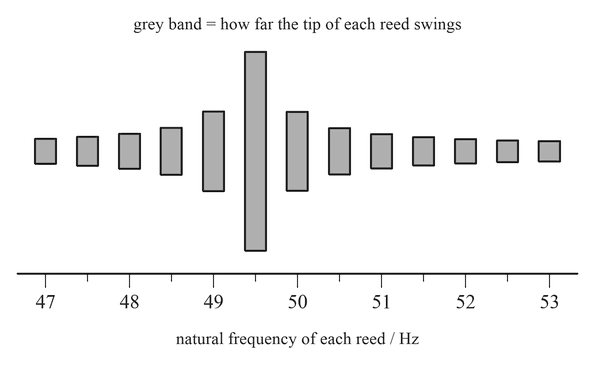
(a) Read the output frequency from the figure, and explain the reading using resonance.
(b) The output frequency of this generator, in hertz, is twice its rotation rate in revolutions per second. Find the engine speed in revolutions per minute. The generator is meant to give ; is it running fast or slow?
(c) For reeds made from the same steel strip, the natural frequency is inversely proportional to the square of the free length of the reed. A technician wants to retune a reed from to . By what percentage must its free length be shortened?
- 203 marks
Question 20
Competency: Application
When wind blows past a tall circular chimney, swirls of air (vortices) break away alternately from its two sides. Each swirl gives the chimney a small sideways push, so the wind applies a periodic sideways force of frequency , where is the wind speed and the diameter of the chimney. A steel chimney of diameter has a natural frequency of sideways sway of and very little damping. (Hypothetical data.)
(a) At what wind speed is the sway caused by the swirls likely to be the largest? Give your answer in and in .
(b) During a storm the wind speed is . Find the frequency of the sideways force and explain why the swirls do not build up a large sway.
(c) Engineers often wrap a spiral strip, called a strake, round the top part of such a chimney. It makes the swirls break away irregularly instead of alternately. Explain how this protects the chimney.
- 214 marks
Question 21
Competency: Analysis & Evaluation
In a simple model, a hydrogen chloride (HCl) molecule vibrates like a mass on a spring: the chemical bond acts as a spring of force constant , and the vibrating mass is the "effective mass" , where and are the masses of the two atoms. HCl gas absorbs infrared radiation strongly in a narrow band of frequencies around . Take the masses of H, D (deuterium, heavy hydrogen) and Cl atoms as , and , with and .
(a) Find the wavelength of the absorbed radiation. The H and Cl atoms carry small opposite charges, and the oscillating electric field of the radiation pushes them to and fro. Explain why the absorption is strong only near one frequency.
(b) Find the effective mass of HCl and the force constant of its bond.
(c) In DCl the hydrogen atom is replaced by a deuterium atom, while the bond, and so , stays the same. Find the frequency at which DCl absorbs strongly.
- 221 mark
Question 22
Competency: Application
The tiny tuning-fork-shaped quartz crystal in a wristwatch is kept vibrating at its natural frequency, , by an electronic circuit. Its damping is very small, and it is described by its quality factor . (Hypothetical data.) For a lightly damped oscillator the energy falls as when nothing drives it, where . If the circuit stopped, the energy of the crystal's vibration would fall to of its value in about
- 231 mark
Question 23
Competency: Analysis & Evaluation
Besides its main playing strings, a sitar has about eleven to thirteen thin "sympathetic" strings (taraf) that run under the frets and are never plucked. Before playing, the musician tunes them to the notes of the raga to be played.
Assertion (A): When the musician plays a note to which one of the sympathetic strings is tuned, that string starts vibrating strongly by itself.
Reason (R): A periodic force whose frequency equals the natural frequency of a body makes it vibrate with a large amplitude.
- 241 mark
Question 24
Competency: Analysis & Evaluation
In the inner ear, the basilar membrane runs along the coiled cochlea. Near its base (the end next to the middle ear) it is narrow and stiff; towards its far end (the apex) it becomes wider and more flexible. Sound sets the fluid in the cochlea vibrating, which in turn makes the membrane vibrate.
Assertion (A): A pure tone of one frequency makes one region of the basilar membrane vibrate much more strongly than the rest.
Reason (R): The narrow, stiff base of the membrane has the lowest natural frequency, so it responds most strongly to low-pitched sounds.
- 251 mark
Question 25
Competency: Analysis & Evaluation
In one design of electric toothbrush, the brush head sits on a springy metal bar, and together they have a natural frequency of . A small electromagnet, worked by the battery, pushes the head with a periodic force of frequency exactly . (Hypothetical data.) Why do the designers make the driving frequency equal to the natural frequency?
- 263 marks
Question 26
A simple pendulum has a bob of mass and would swing with a period of without damping. Air resistance exerts a damping force on the bob, with . (Hypothetical data.)
(i) Find the undamped angular frequency and the damping term .
(ii) Using , find by how much the damping lengthens the period, and comment on your answer.
- 273 marks
Question 27
A block hangs from a spring of force constant , and it can be made to oscillate in liquids that damp it by different amounts. (Hypothetical data.)
(i) Find the damping constant that makes the period exactly 1% longer than the undamped period.
(ii) With this damping, by what factor does the amplitude decrease in each oscillation? Comment on how strongly the damping affects the period and the amplitude.
- 284 marks
Question 28
A body of mass on a spring of spring constant is acted on by a damping force with and by a driving force with . (Hypothetical data.) With damping, the amplitude of the forced oscillations is
Here is the natural angular frequency.
(a) Find the amplitude when . What would the undamped formula give there?
(b) Find the amplitude when , and compare it with the value given by the undamped formula.
(c) If were halved, by what factor would each of these two amplitudes change? What do your results show about where damping matters?
- 291 mark
Question 29
Competency: Application
In a school laboratory, a trolley rests on a smooth level track. It is joined to a fixed support by a light horizontal spring of spring constant , and the spring is unstretched. A student gives the trolley a sharp tap, so that it leaves its rest position with a speed of . It then oscillates freely. (Hypothetical data.) In free oscillations the total energy stays constant. The amplitude of the oscillations is about
- 301 mark
Question 30
Competency: Analysis
A physiotherapist checks the knee joints of two people, X and Y. Each sits on a high table and the lower leg is raised and then let go, so that it swings freely from the knee with no muscular effort. Treat each swinging lower leg as a lightly damped oscillator whose angular amplitude falls as , where is the damping constant of the knee and the effective mass of the leg, taken to be the same for both. Without damping, each leg would swing with a period of about ; with damping the angular frequency is . Both legs start from an amplitude of . X's amplitude falls to in , and Y's falls to in . (Hypothetical data.) Which conclusion is correct?
- 311 mark
Question 31
Competency: Analysis
Two identical tuning forks A and B, each mounted on its own sounding box, stand close together on a bench with the open ends of the boxes facing each other. When fork A is struck, fork B is also heard to vibrate. A small lump of wax is then stuck to one prong of fork B, and fork A is struck again in the same way.
Assertion (A): Fork B now vibrates much less strongly than before when fork A is struck.
Reason (R): The wax makes the prong of fork B stiffer, so it raises the natural frequency of fork B above that of fork A.
- 321 mark
Question 32
Competency: Evaluation
In a science show, a singer sings a very loud, steady note at a thin wine glass placed in front of her mouth. When the note has the natural frequency of the glass, the rim of the glass is seen to vibrate more and more until the glass cracks. When she sings an equally loud note about higher in frequency, the glass does not crack.
Assertion (A): The glass cracks with the note at its natural frequency, but not with the equally loud higher note.
Reason (R): When the frequency of the sound equals the natural frequency of the glass, the glass gains energy from the sound in every cycle, so the amplitude of its vibration builds up to a large value.
- 331 mark
Question 33
Competency: Analysis
A half-metre scale hangs horizontally from a rigid support by two strings. Four pendulums hang from the scale. Pendulum 1 has a heavy bob; pendulums 2, 3 and 4 have light bobs. Pendulum 1 is set swinging at right angles to the scale, and after a few minutes all the pendulums swing steadily. Take . (Hypothetical data.)
Pendulum 1 2 3 4 Length (m) 0.50 0.30 0.50 0.80 Which statement about the steady swinging is correct?
- 342 marks
Question 34
Competency: Analysis & Evaluation
A car is stuck in mud. When it is pushed from behind and let go, it rocks back and forth on its tyres and springs with a natural period of . Three friends try to rock it out, each pushing on their own with the same force each time. (Hypothetical data.)
- Raju pushes once every , each time just as the car starts moving away from him.
- Meena pushes once every , each time just as the car starts moving away from her.
- Tanvi pushes once every , whatever the car is doing at that moment.
(a) Rank the three ways of pushing from the one that builds up the rocking fastest to the one that builds it up least, giving a reason for each.
(b) Tanvi pushes most often of the three. Explain why her pushing still fails to build up a large rocking motion.
- 353 marks
Question 35
Competency: Evaluation
In a laboratory, a mass hangs from a spring of spring constant . A vibration generator applies a periodic force of amplitude and frequency to it, and the damping is negligible. (Hypothetical data.) The amplitude of the forced oscillations is , where is the natural frequency; a negative value means only that the displacement is opposite to the force. A student claims: "If the mass is doubled to and nothing else is changed, the size of the amplitude is halved."
(a) Show that the size of the amplitude can be written as .
(b) Test the claim when the driving frequency is .
(c) Test the claim when the driving frequency is , and state when the claim is a good rule.
- 362 marks
Question 36
Competency: Creativity
In a laboratory, a mass hangs from a spring clamped to a stand. The stand is on a bench on which a small motor turns an unbalanced wheel, so the bench shakes slightly once in every turn of the wheel. The mass is seen to bob gently up and down. Ria thinks that the shaking bench is forcing the mass to bob. Arjun thinks that someone knocked the stand, and the mass is only bobbing freely at its own natural frequency. The motor has a speed control that can be set anywhere from to turns per second, and the students have a stopwatch.
(a) Design a simple test, using only the speed control and the stopwatch, that would show which of them is right. Say what you would measure.
(b) State what result would support Ria and what result would support Arjun, and give the physics behind each.
- 373 marks
Question 37
Competency: Creativity & Application
A company designs a baby bouncer: a seat hung from a door frame by a strong spring, in which a baby can bounce up and down. For comfort, the seat with the baby should bounce at a natural frequency between and for every baby it is meant for. The combined mass of the seat and the baby ranges from to . Treat the seat and baby as a mass on a light spring, with natural frequency , and take . (Hypothetical data.)
(a) Find the range of spring constants that meets the frequency requirement for every mass in the range.
(b) The designer chooses . Find the natural frequency for the lightest and the heaviest load, and check that both are within the range.
(c) Find how far this spring stretches when the heaviest load hangs on it at rest, and say why the designer must know this.
- 383 marks
Question 38
Competency: Analysis & Evaluation
In a laboratory, a tuning fork is struck and held in the air. Its amplitude falls to one-tenth of its starting value in . The same fork is then struck equally hard and its stem is fixed into a wooden sounding box. Now it sounds much louder, but its amplitude falls to one-tenth in only . (Hypothetical data.) In each case take the amplitude to fall as , so that the energy falls as .
(a) Find the value of for the fork in the air and for the fork on the box.
(b) Find the fraction of the starting energy of vibration that is left after in each case.
(c) A student says: "The box must be adding energy to the fork, because the sound is louder." Evaluate this claim, and explain why the fork on the box stops sounding sooner.
- 394 marks
Question 39
Competency: Analysis
Case study: Engineers want the natural frequency of a scale model of a building without driving it at resonance, which could damage it. A small vibration generator clamped to the roof applies a periodic sideways force of the same amplitude at every frequency used. The model behaves like a mass on a spring, with negligible damping. At both test frequencies the roof was seen to move in step with the force. Its forced amplitude is , where is the natural frequency and the driving frequency. (Hypothetical data.)
Driving frequency (Hz) 2.0 4.0 3.0 Amplitude of the roof (mm) 3.0 6.0 3.8 (a) Explain why the roof moving in step with the force at both frequencies shows that both test frequencies are below the natural frequency.
(b) Using the readings at and only, find the natural frequency of the model and the amplitude of the force.
(c) Use your results to predict the amplitude at , and compare it with the reading in the table. What does the comparison tell the engineers?
- 405 marks
Question 40
Competency: Analysis & Evaluation
Case study: A new steel footbridge sways sideways when crowds cross it. People walk at about to steps per second. Because the body shifts slightly towards the foot that is on the ground, each person also pushes the deck sideways, first one way and then the other, once for every two steps. For sideways sway the deck behaves like a mass on a spring, with natural frequency and damping constant . A crowd walking in step gives a sideways force of amplitude . With damping, the amplitude is , where . (Hypothetical data.)
Proposed fix What changes P: fit dampers rises to ; natural frequency stays Q: stiffen the deck natural frequency rises to ; stays (a) Find the range of frequencies of the sideways force from walkers, and explain why this bridge sways strongly.
(b) Find the amplitude of the sway when the crowd's sideways force is at .
(c) The sway must stay below for every walking pace. For each fix, find the largest amplitude over the range in part (a), and decide which fix the engineers should choose.