
Competency: Application
A dairy cooperative checks milk samples with a vibrating-tube density meter. A thin glass U-tube is held only at its open ends, as shown in the figure, and is filled with the sample. Its closed bend is then set into free oscillations, and the meter measures the period .
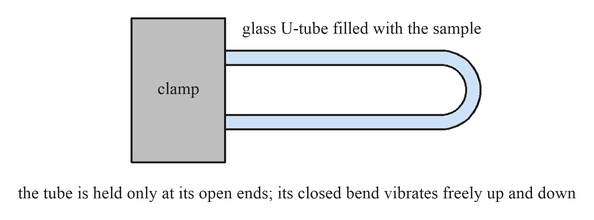
The tube behaves like a mass on a spring. Its stiffness does not change, and the vibrating mass is the mass of the tube plus the mass of the liquid inside it, where is the density of the liquid and the inside volume of the tube. So
The meter is calibrated with air in the tube (take the mass of the air as negligible) and with pure water (). Pure milk from this dairy has a density of . (Hypothetical data.)
| Tube filled with | Air | Pure water | Sample P | Sample Q |
|---|---|---|---|---|
| Period (ms) | 2.500 | 3.000 | 3.0137 | 3.0110 |
(a) Show that the density of a sample is given by , where and are the periods with air and with water.
(b) Find the density of sample P.
(c) Find the density of sample Q. If Q is pure milk to which water has been added, find what percentage of its volume is added water. Assume that the volumes of milk and water simply add.