
Question 253 marksMedium
What are forced oscillations? Explain the action of external periodic force and the restoring force on an oscillator.
Confirming your payment
Sign up now and get 250 free tokens.
Free, Forced and Damped Oscillations · Question 25 of 27
What are forced oscillations? Explain the action of external periodic force and the restoring force on an oscillator.
Solution:
Concept: A forced (driven) oscillator is acted on by three forces: the restoring force , the damping force and the external periodic force . Its motion obeys Newton's second law with all three.
Step 1 — Define forced oscillations. The oscillations made by a body under the action of an external periodic force, with the frequency of that force rather than its own natural frequency, are called forced (driven) oscillations.
Step 2 — Show the forces. The figure shows a block of mass on a spring of force constant , displaced by from the mean position O and moving with velocity .
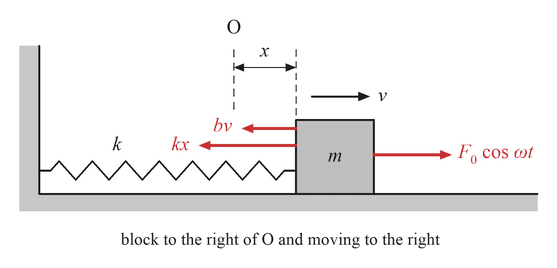
The restoring force points back towards O, the damping force opposes the velocity, and the external force changes its size and direction periodically. Newton's second law gives:
Step 3 — Explain the action of the restoring force. The restoring force always pulls the body back towards its mean position. On its own it would make the body oscillate at its natural frequency ; it is what makes the system an oscillator at all.
Step 4 — Explain the action of the external force. At first the body tries to vibrate at its natural frequency while the applied force tries to drive it at its own frequency. Damping soon makes the free (natural) vibrations die out, and the body then vibrates steadily with the frequency of the applied force and a constant amplitude. The energy lost to damping in each cycle is made up by the work done by the external force.
Step 5 — Show how the two forces together fix the amplitude. For small damping, and a driving frequency not too close to the natural frequency, the amplitude of the forced oscillations is:
With and , this is the same as . The modulus keeps the amplitude positive: above the natural frequency the displacement is simply opposite in phase to the force. When the driving frequency is far from the natural frequency, the factor is large and the amplitude is small. As the two frequencies come closer this factor shrinks, so the amplitude grows; it is largest at resonance, where only the damping keeps it finite.
Therefore, forced oscillations are the oscillations made under an external periodic force, at its frequency; the restoring force tries to keep the body oscillating at its natural frequency, while the external force drives it at its own frequency and supplies the energy lost to damping, giving a constant amplitude that is largest when the two frequencies are equal or very nearly so.