
Question 275 marksMedium
What is damping constant? Write down the expression for the amplitude of a damped harmonic oscillator and show that the amplitude decreases exponentially with time.
Confirming your payment
Sign up now and get 250 free tokens.
Free, Forced and Damped Oscillations · Question 27 of 27
What is damping constant? Write down the expression for the amplitude of a damped harmonic oscillator and show that the amplitude decreases exponentially with time.
Solution:
Concept: For speeds that are not large, the damping force on an oscillating body is proportional to its velocity and opposite to it, . Adding this force to the restoring force in Newton's second law gives the equation of a damped harmonic oscillator.
Step 1 — Define the damping constant. The damping constant is the damping force per unit velocity of the oscillating body:
Its SI unit is , which is the same as . The larger is, the stronger the damping.
Step 2 — Write the equation of motion. For a mass on a spring of force constant , with displacement , Newton's second law gives:
Dividing by puts it in the standard form:
Step 3 — Write its solution. For small damping the solution of this equation is:
Here is the initial phase, and the angular frequency is:
Substituting back into the equation shows that it is satisfied at every instant exactly when has this value.
Step 4 — Write the expression for the amplitude. The factor in front of the cosine is the amplitude of the damped oscillations:
Here is the amplitude at .
Step 5 — Show that the amplitude falls exponentially. We compare the amplitude at any time with the amplitude one period later:
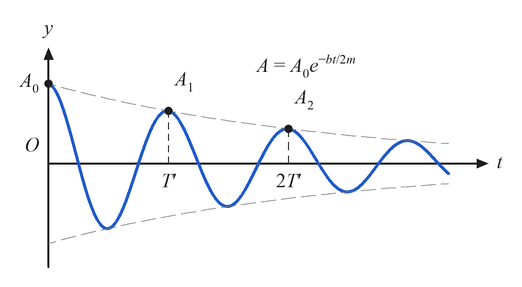
This ratio does not depend on . So in every period the amplitude is multiplied by the same factor , which is less than 1. For the crests , , one period apart:
Falling by the same fraction in equal times is exactly what an exponential decrease means. Taking natural logarithms of shows the same thing:
So a graph of against is a straight line with negative slope. The figure shows the crests , , lying (very nearly) on the curve .
Step 6 — Note the energy. For light damping the energy of the oscillator is very nearly , so it is proportional to the square of the amplitude. It therefore also falls exponentially, twice as fast as the amplitude:
Therefore, the damping constant is the damping force per unit velocity; the amplitude of a damped harmonic oscillator is , and because it is multiplied by the same factor in every period, it decreases exponentially with time.