
Opening your dashboard
Class 11 Physics Chapter 22 Free, Forced and Damped Oscillations: Practice Questions
59 questions on Chapter 22, each worked through on its own page with the AI tutor. Class 11 Physics, ICSE 2026-27.
59 questions
1–3 marks · Mixed difficulty
- 11 mark
Question 1
Which of the following is an example of a free oscillation?
- 23 marks
Question 2
A block of mass hangs from a light spring. When it is pulled down a little and released, it makes free oscillations with a natural frequency of . (Hypothetical data.)
(i) Find the force constant of the spring.
(ii) An extra mass is now fixed to the block, and the natural frequency falls to . Find the extra mass.
- 31 mark
Question 3
A block on a spring makes free oscillations with natural frequency . Which single change doubles its natural frequency?
- 42 marks
Question 4
A simple pendulum in a laboratory is pulled aside, released and then left alone. Asha says that it performs free oscillations. Ravi says that it performs damped oscillations. Explain why both of them are right, and state what happens to the amplitude and to the frequency of the pendulum as time passes.
- 53 marks
Question 5
For a simple pendulum of length with a bob of mass , the restoring force for a small sideways displacement of the bob is . So the pendulum behaves like a block on a spring of force constant .
(i) Use to show that the natural frequency of the pendulum does not depend on the mass of the bob.
(ii) A designer wants a pendulum whose natural frequency is . (Hypothetical data.) Find the length it needs. Take .
- 61 mark
Question 6
The figure shows how the displacement of an ideal oscillator changes with time during its free oscillations. (Hypothetical data.)

What is the natural frequency of the oscillator?
- 71 mark
Question 7
A tuning fork marked is struck gently with a rubber pad, and later it is struck much harder. Compared with the first sound, the second sound is
- 83 marks
Question 8
On board an orbiting space station, a weighing scale cannot be used to find an astronaut's mass, so a chair mounted on springs is used instead. The empty chair, of mass , oscillates freely with a period of . With an astronaut strapped into it, the period becomes . (Hypothetical data.)
(i) Explain why a weighing scale does not work in orbit, while the oscillation method does.
(ii) Find the astronaut's mass.
- 93 marks
Question 9
A test tube loaded with lead shot floats upright in a tall jar of water, as shown. The tube and the shot together have a mass , and the tube has an external cross-sectional area . The tube is pushed down a little and released, and it then bobs up and down freely. (Hypothetical data.)
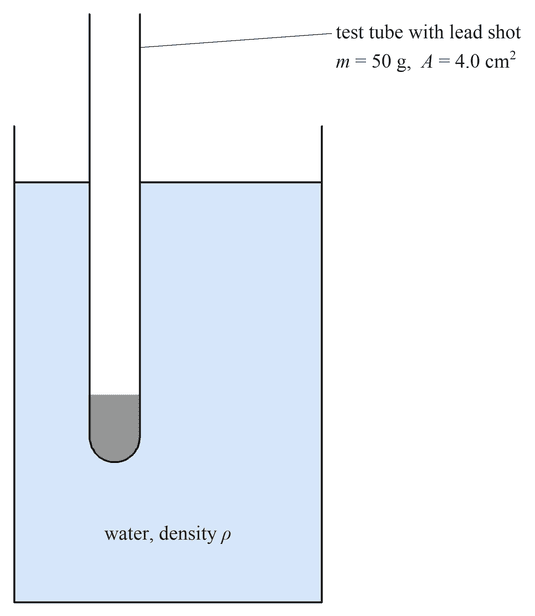
(i) Show that when the tube is pushed down by a further distance from its floating position, the net restoring force on it is , where is the density of water. Hence state its force constant .
(ii) Find the natural frequency of the bobbing. Take and , and neglect damping and the water that moves along with the tube.
- 101 mark
Question 10
A block fixed to a spring of force constant slides on a smooth horizontal surface. (Hypothetical data.) Its natural frequency of free oscillation is about
- 113 marks
Question 11
On the Earth (), a block hanging from a spring has a natural frequency of , and a simple pendulum has a natural frequency of . Both are taken to the Moon, where . (Hypothetical data.)
(i) Find the natural frequency of each on the Moon.
(ii) Explain why one frequency changes and the other does not.
- 121 mark
Question 12
In a damped oscillator the damping force is written as , where is the velocity of the oscillator. The SI unit of the damping constant is
- 131 mark
Question 13
A block on a spring oscillates inside a liquid, which exerts a damping force on it. Which statement about this damped oscillator is NOT correct?
- 141 mark
Question 14
The damping constant of a block–spring oscillator is increased step by step, while its mass and force constant stay the same and the damping never becomes large enough to stop it oscillating. As increases, the period of oscillation
- 153 marks
Question 15
A block oscillates on a spring in air, and its amplitude is recorded every . (Hypothetical data.)
Time (s) 0 10 20 30 Amplitude (cm) 8.0 5.9 4.4 3.3 (i) Show from the readings that the amplitude decreases exponentially and not by equal amounts.
(ii) Using the first and last readings and , find the damping constant .
(iii) What fraction of the initial energy of oscillation is left at ?
- 161 mark
Question 16
A lightly damped oscillator loses 36% of its mechanical energy in each complete oscillation. By what percentage does its amplitude decrease in each oscillation?
- 173 marks
Question 17
A block on a spring of force constant moves in a thick liquid that gives a damping constant . (Hypothetical data.)
(i) Find the period of oscillation without damping and with this damping.
(ii) Using the formula for the angular frequency of a damped oscillator, find the value of at which the block would no longer oscillate.
- 181 mark
Question 18
The motion of a damped oscillator is described by , with all quantities in SI units. (Hypothetical data.) Its energy of oscillation falls to of its initial value in a time of
- 193 marks
Question 19
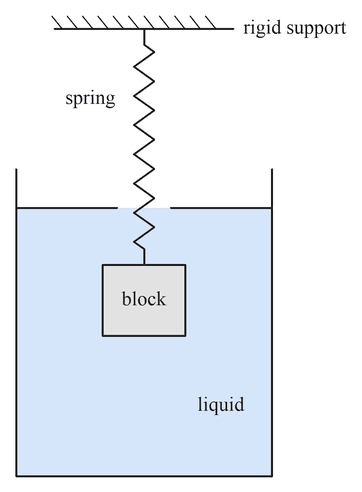
A block of mass hangs from a spring of force constant and is immersed in a liquid, as shown. It is pulled down by from its rest position and released. The liquid gives a damping constant . (Hypothetical data.)
(i) Find the initial energy of oscillation.
(ii) Find the amplitude after .
(iii) How much heat has been given to the liquid and the block in these ?
- 201 mark
Question 20
The figure shows the displacement–time graph of a block of mass oscillating on a spring in air. The two marked peaks are successive maxima on the same side, one period () apart, with displacements of and . (Hypothetical data.)

Taking the amplitude to decrease as , the damping constant is about
- 212 marks
Question 21
Two simple pendulums have threads of the same length and bobs of the same diameter, one made of steel and the other of expanded polystyrene, a very light foam. Both are pulled aside by the same small angle and released together. Assume that the air exerts a damping force with the same value of on both bobs, since they are the same size, and neglect the upthrust of the air.
(i) Do the two pendulums swing with the same period? Give a reason.
(ii) Which pendulum comes to rest sooner? Explain using .
- 222 marks
Question 22
A car rests on springs, one at each wheel. After the car goes over a bump, its body would oscillate up and down on these springs. Beside each spring there is a shock absorber, a piston that forces oil through small holes as the body moves.
(i) What is the job of the shock absorbers, in terms of damping and energy?
(ii) Describe how the car body would move after a bump if the damping were much too small.
- 233 marks
Question 23
The displacement of a damped oscillator of mass is , with in metres and in seconds. (Hypothetical data.) Compare it with , where .
(i) State the initial amplitude and the angular frequency of the damped oscillation.
(ii) Find the damping constant .
(iii) Find the force constant of the spring, and the natural angular frequency that the oscillator would have without damping.
- 241 mark
Question 24
A toy bird of mass hangs from a spring of spring constant . A small motor pushes it up and down with a periodic force of frequency , and the damping is small. (Hypothetical data.) After the start-up motion has died away, the bird oscillates
- 253 marks
Question 25
A body of mass is attached to a spring of spring constant . A periodic force with acts on it, and the damping is negligible. (Hypothetical data.) Take the amplitude of the forced oscillations as
Here is the natural frequency and the frequency of the force.
(a) Find the natural frequency of the body.
(b) Find the amplitude of the forced oscillations when .
(c) Find the amplitude when , and explain what the minus sign that the formula now gives tells you.
- 261 mark
Question 26
A lightly damped oscillator has a natural frequency of . It is driven by a periodic force of fixed amplitude at , and then the driving frequency is raised to . (Hypothetical data.) The amplitude of the steady oscillations becomes
- 271 mark
Question 27
A body of mass on a spring is driven by a force newton ( in seconds). After the start-up motion has died away, its displacement is metre, in step with the force. The damping is negligible. (Hypothetical data.) Using , the natural frequency of the body is
- 283 marks
Question 28
A driven oscillator is acted on by a damping force with . In the steady state it oscillates with angular frequency and a constant amplitude . (Hypothetical data.) The damping force takes energy from the oscillator at an average rate of .
(a) Find the maximum speed of the oscillator and the largest value of the damping force.
(b) Find the average power that the driving force supplies, and explain why it must equal the rate at which damping removes energy.
(c) Find the energy that the driving force supplies in one oscillation.
- 291 mark
Question 29
Which one of the following statements is true of steady forced oscillations but NOT of free oscillations?
- 303 marks
Question 30
A mass on a spring has a natural frequency of and light damping. It is at rest when a vibrator that applies a periodic force of frequency is switched on. The graph shows the displacement of the mass against time . (Hypothetical data.)
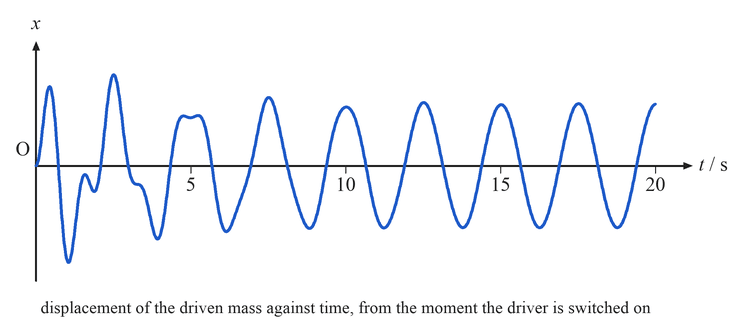
(a) Why is the motion irregular during the first few seconds?
(b) What is the period of the oscillations after about ? Check your answer from the graph.
(c) Why does the irregular part disappear? What would happen to it if there were no damping at all?
- 313 marks
Question 31
A sieve used to grade grain rests on springs. The sieve and its load have a mass of , and the springs together have a spring constant of . A motor applies a vertical periodic force of amplitude , and the damping is negligible. (Hypothetical data.) The sieve works best when its amplitude is . Take the amplitude of the forced oscillations as .
(a) Find the natural frequency of the sieve.
(b) Find the two driving frequencies at which the amplitude is .
(c) At which of these two frequencies does the sieve move opposite to the force?
- 321 mark
Question 32
An oscillator has a natural frequency of and negligible damping. It is driven in turn by two periodic forces of the same amplitude, one of frequency and the other of frequency . (Hypothetical data.) The ratio of the amplitude at to the amplitude at is
- 332 marks
Question 33
The amplitude of the forced oscillations of an undamped oscillator is , where is the amplitude of the driving force, the mass, the natural frequency and the driving frequency.
(a) Show that the right-hand side has the dimensions of length.
(b) Show that for a very slowly varying force () the amplitude becomes , where is the spring constant, and explain this result physically.
- 341 mark
Question 34
A small electromagnet drives a mass on a spring. The mass has a natural frequency of , and the damping is negligible. (Hypothetical data.) The mass is to oscillate with an amplitude of at a driving frequency of . Using , the amplitude of the driving force must be about
- 353 marks
Question 35
In a simple seismometer, a heavy mass hangs from a soft spring inside a frame that stands on the ground, as shown in the figure. The mass on its spring has a natural frequency of . During an earthquake the ground, and with it the frame, shakes up and down at with an amplitude . The damping is negligible. (Hypothetical data.) The shaking frame acts on the mass, through the spring, like a periodic force of amplitude , where is the spring constant.
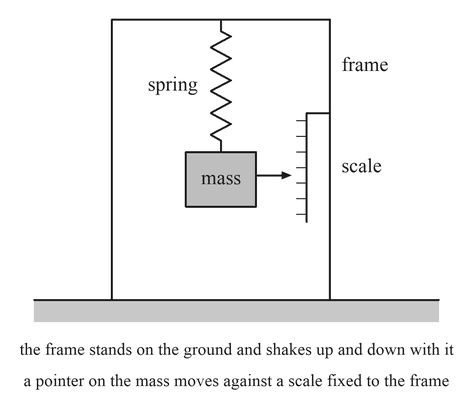
(a) Using , show that the mass oscillates with amplitude , and find .
(b) Find the amplitude of the motion of the mass relative to the frame, which the pointer shows on the scale.
(c) Explain why a seismometer uses a heavy mass on a soft spring.
- 361 mark
Question 36
A lamp hangs from a ceiling on a light chain and behaves as a simple pendulum of length . A machine on the floor above makes the ceiling vibrate gently from side to side. Take . (Hypothetical data.) The lamp will swing the most when the frequency of the vibration is about
- 373 marks
Question 37
Engineers often estimate the natural period of sway of a building as about seconds, where is the number of storeys. In a city built on soft soil, the shaking of the ground during earthquakes is strongest at a period of about . The city has buildings of 4, 12 and 30 storeys. (Hypothetical data.)
(a) Find the natural frequency of sway of each building and the frequency of the strongest shaking.
(b) Which building is in the most danger? Explain using resonance.
(c) Suggest two ways in which engineers can make that building safer.
- 381 mark
Question 38
A part of a machine shakes violently whenever the motor runs at one particular speed, because the motor then drives the part at its natural frequency. Which one of the following changes would NOT reduce the shaking of the part?
- 393 marks
Question 39
The tuning circuit of a radio has a coil of inductance and a variable capacitor. The natural frequency of the circuit is , where is the capacitance. (Hypothetical data.)
(a) To what capacitance must the capacitor be set to receive a station broadcasting at ?
(b) What capacitance is needed for a station at ?
(c) Many stations send their signals to the aerial at the same time. Explain how the circuit picks out only one of them.
- 403 marks
Question 40
The tub of a washing machine hangs on springs. With a load of wet clothes, it has a natural frequency of for side-to-side shaking. During the spin cycle the drum speeds up from rest to revolutions per minute, and an uneven lump of clothes gives the tub a sideways push once in every revolution. (Hypothetical data.)
(a) At what drum speed, in revolutions per minute, is the shaking likely to be worst? Explain.
(b) Why is the machine designed to speed up quickly through this speed?
(c) At revolutions per minute the machine runs much more smoothly. Explain why.
- 411 mark
Question 41
A lightly damped oscillator is driven exactly at its natural frequency, and its steady amplitude is large. Which statement about the driving force is correct?
- 423 marks
Question 42
A mass of hangs from a spring and is driven by a vibration generator whose frequency can be varied. The amplitude is largest when the generator runs at . The damping is small, so take this as the natural frequency. (Hypothetical data.)
(a) Find the spring constant.
(b) A further is added to the hanging mass. At what generator frequency will the amplitude now be largest?
(c) What total hanging mass would make the amplitude largest at ?
- 431 mark
Question 43
Two oscillators P and Q have the same spring constant and are driven by periodic forces of the same amplitude. The figure shows how the amplitude of each depends on the driving frequency. (Hypothetical data.)
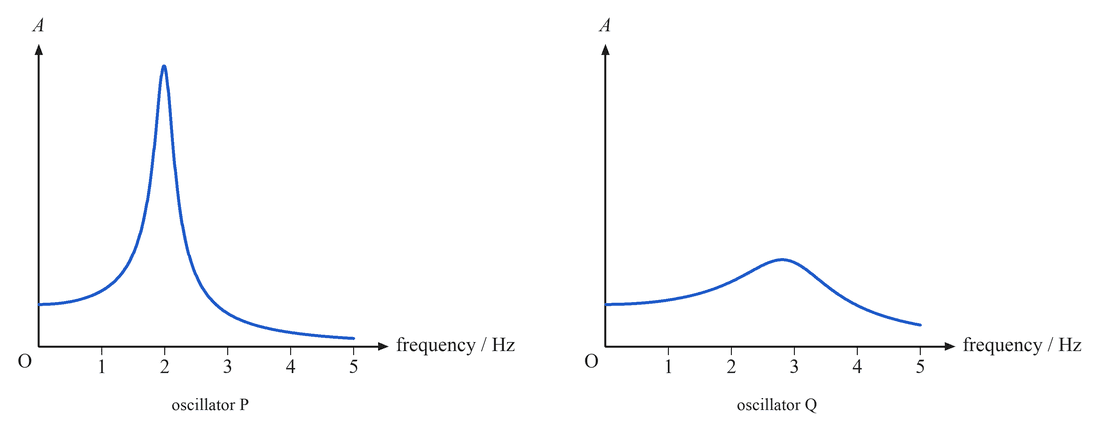
Which statement is correct?
- 443 marks
Question 44
A tall tower sways from side to side in strong winds with a natural period of . To reduce the sway, engineers hang a heavy mass as a simple pendulum of length from a floor near the top, as shown in the figure, and choose so that the pendulum has the same natural period as the tower. Take . (Hypothetical data.)
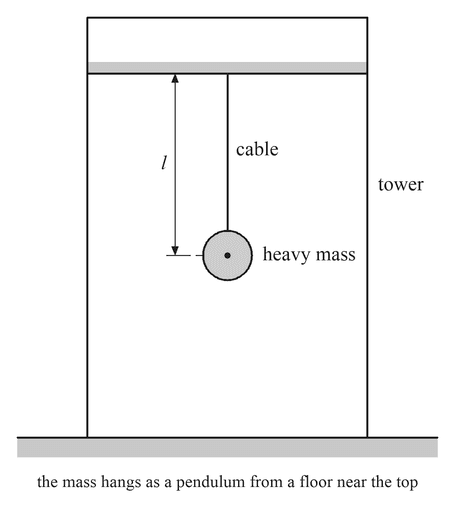
(a) Find .
(b) Why must the natural period of the pendulum be the same as that of the tower?
(c) Would a pendulum of length work as well? Give a reason with a calculation.
- 453 marks
Question 45
In a laboratory, a mass hangs from a spring of spring constant and is driven by a vibration generator. The amplitude of the forced oscillations is measured at several driving frequencies. (Hypothetical data.)
Driving frequency (Hz) Amplitude (mm) 1.5 3.2 2.0 5.5 2.3 11.9 2.5 25.5 2.7 10.8 3.0 4.5 3.5 2.1 (a) At about what frequency does resonance occur?
(b) Taking the damping as small, find the mass.
(c) A light card is now fixed to the mass, so that air resistance gives much more damping. How will the readings at and at change? Explain.
- 461 mark
Question 46
A mass hung from a uniform spring resonates when it is driven at ; the damping is small. (Hypothetical data.) The spring is cut into two equal halves, and the same mass is hung from one half. Each half has twice the spring constant of the whole spring. The mass will now resonate at about
- 473 marks
Question 47
A concrete road is made of slabs long, and a delivery van gets a small jolt each time its wheels cross a joint between slabs. Treat the body of the van as one mass bouncing on its springs, with a natural frequency of . (Hypothetical data.)
(a) At what speed of the van, in , is the bouncing worst?
(b) Explain why the bouncing is much less at .
(c) The van is now fully loaded, with the same springs. Will the speed at which the bouncing is worst be higher or lower than before? Explain.
- 481 mark
Question 48
In damped oscillations, the amplitude of oscillations is reduced to one-third of its initial value at the end of 100 oscillations. When the oscillator completes 200 oscillations, its amplitude must be
- 491 mark
Question 49
In case of forced vibration, the resonance wave becomes very sharp when the
- 501 mark
Question 50
Two simple harmonic motions are represented by and . The resultant amplitude is
- 511 mark
Question 51
Resonance is an example of
- 521 mark
Question 52
The equation of a damped simple harmonic motion is . Then the angular frequency of oscillation is
- 531 mark
Question 53
If a simple pendulum has significant amplitude (up to a factor of of original) only in the period between s to s, then may be called the average life of the pendulum. When the spherical bob of the pendulum suffers a retardation (due to viscous drag) proportional to its velocity, with ‘’ as the constant of proportionality, the average life time of the pendulum is (assuming damping is small) in seconds
- 541 mark
Question 54
A particle of mass 200 g is making SHM under the influence of a spring of force constant and a damping constant . Calculate the time elapsed for the amplitude to drop to half its initial value (Given )
- 551 mark
Question 55
The displacement of a damped harmonic oscillator is given by . Here is in seconds. The time taken for its amplitude of vibration to drop to half of its initial value is close to
- 561 mark
Question 56
A block of mass 1 kg attached to a spring is made to oscillate with an initial amplitude of 12 cm. After 2 minutes the amplitude decreases to 6 cm. Determine the value of the damping constant for this motion (take )
- 571 mark
Question 57
Amplitude of a mass–spring system, which is executing simple harmonic motion decreases with time. If mass = 500 g, decay constant = 20 g/s, then how much time is required for the amplitude of the system to drop to half of its initial value ()?
- 581 mark
Question 58
Read the assertion and reason carefully to mark the correct option out of the options given below:
Assertion: Soldiers are asked to break steps while crossing the bridge.
Reason: The frequency of marching may be equal to the natural frequency of bridge and may lead to resonance which can break the bridge.
- 591 mark
Question 59
Read the assertion and reason carefully to mark the correct option out of the options given below:
Assertion: The amplitude of an oscillating pendulum decreases gradually with time.
Reason: The frequency of the pendulum decreases with time.