
Question 353 marksMedium
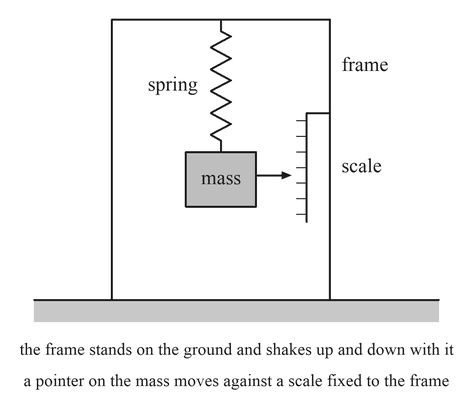
In a simple seismometer, a heavy mass hangs from a soft spring inside a frame that stands on the ground, as shown in the figure. The mass on its spring has a natural frequency of . During an earthquake the ground, and with it the frame, shakes up and down at with an amplitude . The damping is negligible. (Hypothetical data.) The shaking frame acts on the mass, through the spring, like a periodic force of amplitude , where is the spring constant.
(a) Using , show that the mass oscillates with amplitude , and find .
(b) Find the amplitude of the motion of the mass relative to the frame, which the pointer shows on the scale.
(c) Explain why a seismometer uses a heavy mass on a soft spring.