
Opening your dashboard
Class 11 Physics Chapter 2: Units and Measurements - Accuracy and Errors Solutions
63 textbook questions with step-by-step answers, free to read, for ISC 2026-27.
Get talked through Ch 2, not just shown the answer
Reading a finished solution is not the same as being able to do it. The AI tutor takes one question at a time and works it with you, in your own words, until you can.
- Ask it out loud, in your own words
- It gives you the next step, not the answer
- Stuck on part (ii)? Start there
63 questions with solutions
1–5 marks · Mixed difficulty
The first 44 solutions are on this page. This chapter is a long one, so the rest open on their own page to keep this one quick to load.
- 11 mark
Question 1
S.I. unit of universal gas constant is
Solve with AIAnswer
(A)
- Correct
(B)
(C)
(D)
Answer: (B)
Concept: The ideal gas equation is , where is the number of moles, so the gas constant is .
Step 1 — Find the unit of . Pressure is in and volume in , so their product has the unit:
A newton metre is the joule (J).
Step 2 — Divide by moles and temperature. Dividing by (in mol) and (in K) gives the unit of :
Its value is about .
Step 3 — Check the other options. Each of the other units is wrong for a definite reason:
- (A) This has no ; it is the unit of energy per mole, such as the product , not of itself.
- (C) This puts the mole in the numerator, but is divided by the number of moles.
- (D) This uses the newton instead of the joule, so it lacks the metre that comes from .
Therefore, the S.I. unit of the universal gas constant is , option (B).
- 21 mark
Question 2
One Planck length is equal to
Solve with AIAnswer
(A)
(B)
- Correct
(C)
(D)
Answer: (C)
Concept: The Planck length is a length built from the fundamental constants , and ; it is about , far smaller than a nucleus.
Step 1 — Recall its size. The Planck length is about , so its order is .
Step 2 — Match with the options. Only option (C) has this power of ten.
Step 3 — Check the other options. Each of the other values is far from the Planck length:
- (A) is one picometre, a hundredth of an angstrom (about a hundredth of the size of an atom); it is roughly times the Planck length.
- (B) is roughly times the Planck length.
- (D) is roughly times smaller than the Planck length.
Therefore, one Planck length is of the order of , option (C).
- 31 mark
Question 3
One parsec is equal to
Solve with AIAnswer
(A)
(B)
- Correct
(C)
(D)
Answer: (C)
Concept: A parsec (parallactic second) is a unit of length: it is the distance at which one astronomical unit () subtends an angle of one second of arc.
Step 1 — Change one second of arc into radian. One second is of a degree, and is rad:
Step 2 — Divide the arc by the angle. For a small angle, distance equals arc divided by angle:
This matches option (C), .
Step 3 — Check the other options. Each of the other options fails for a definite reason:
- (A) This is a time, but the parsec is a unit of length, not of time.
- (B) is one micron, a tiny length used for small objects.
- (D) This has the wrong sign in the power of ten; a parsec is an enormous astronomical distance.
Therefore, one parsec is about , option (C).
- 41 mark
Question 4
1 Å is equal to
Solve with AIAnswer
(A)
- Correct
(B)
(C)
(D)
Answer: (B)
Concept: The angstrom (Å) is a small unit of length used for atomic sizes and for wavelengths of light.
Step 1 — Recall the definition. One angstrom is defined as . This is the same length as .
Step 2 — Match with the options. This is option (B).
Step 3 — Check the other options. Each of the other values names a different length:
- (A) is , a hundred times one angstrom.
- (C) is one micron (micrometre).
- (D) is one picometre, a hundredth of an angstrom.
Therefore, is , option (B).
- 51 mark
Question 5
1 AU is equal to
Solve with AIAnswer
(A)
- Correct
(B)
(C)
(D)
Answer: (B)
Concept: The astronomical unit (AU) is the mean distance between the Earth and the Sun, used for distances within the solar system.
Step 1 — Recall its value. The mean Earth–Sun distance is about (about 150 million kilometres).
Step 2 — Match with the options. This is option (B).
Step 3 — Check the other options. Each of the other values is a different quantity:
- (A) is one light year, about 63,000 AU.
- (C) is only about one-fifth of the Earth–Sun distance; the number is the speed of light in , not a length.
- (D) is close to one parsec, about AU.
Therefore, is , option (B).
- 61 mark
Question 6
Which of the following is not a unit of length?
Solve with AIAnswer
(A) fermi
(B) parsec
(C) light year
- Correct
(D) poise
Answer: (D) poise
Concept: Units are grouped by the quantity they measure; a unit of length must measure a distance.
Step 1 — Identify the poise. The poise is the C.G.S. unit of coefficient of viscosity (), so it is not a unit of length.
Step 2 — Check the remaining options. Each of the other three is a unit of length:
- (A) The fermi is , used for the sizes of nuclei.
- (B) The parsec is about , used for distances to stars.
- (C) The light year is the distance light travels in one year, about .
Therefore, the poise is not a unit of length, option (D).
- 71 mark
Question 7
Which of the following is a unit of energy?
Solve with AIAnswer
(A) J/s
- Correct
(B) watt-day
(C)
(D) kilowatt
Answer: (B) watt-day
Concept: Power is energy per unit time, so energy is power multiplied by time.
Step 1 — Look at the watt-day. A watt is a unit of power and a day is a unit of time, so a watt-day is power × time, which is energy.
Step 2 — Find its size in joules. One day is , so:
Step 3 — Check the other options. Each of the other units measures a different quantity:
- (A) J/s is the watt, a unit of power.
- (C) is the dyne, a unit of force.
- (D) The kilowatt is a unit of power.
Therefore, the watt-day is a unit of energy, option (B).
- 81 mark
Question 8
If , where is in metre and in hours (h), then the unit of is
Solve with AIAnswer
(A) m
(B) m/h
- Correct
(C)
(D)
Answer: (C)
Concept: Quantities can be added only if they have the same unit, so every term on the right must have the unit of , the metre.
Step 1 — Write the condition for the term . The term must be in metres:
Step 2 — Solve for the unit of . Dividing both sides by gives:
Step 3 — Check the other options. Each of the other units fails the same test:
- (A) With in m, the term would be in , not in m.
- (B) m/h is the unit of (so that is in m); with it, would be in m h.
- (D) With in , the term would be in , which is not a length.
Therefore, the unit of is , option (C).
- 91 mark
Question 9
1 micron (m) is
Solve with AIAnswer
(A)
(B)
- Correct
(C)
(D)
Answer: (C)
Concept: The prefix micro () means ; the micron is the old name of the micrometre.
Step 1 — Apply the prefix. One micron is one micrometre. The prefix micro gives its size in metres as .
Step 2 — Match with the options. This is option (C).
Step 3 — Check the other options. Each of the other values belongs to a different prefix:
- (A) is one nanometre.
- (B) is one picometre.
- (D) is one fermi (femtometre).
Therefore, is , option (C).
- 101 mark
Question 10
If the unit of length is metre, then an area of will become
Solve with AIAnswer
(A)
(B)
(C)
- Correct
(D)
Answer: (D)
Concept: When the unit becomes larger, the numerical value becomes smaller in the same ratio: numerical value × size of unit stays the same.
Step 1 — Find the new unit of area. If the unit of length is , the unit of area is a square of side :
Step 2 — Express in the new unit. We divide by the size of the new unit:
Step 3 — Check the other options. Each of the other options contains a slip:
- (A) The numerical value must go down as the unit grows, so it cannot be (for ).
- (B) converts a length of 1 m; an area needs the square of the factor.
- (C) multiplies by the size of the new unit instead of dividing by it.
Therefore, an area of becomes in the new unit, option (D).
- 111 mark
Question 11
The damping force on an oscillating particle is observed to be proportional to velocity. The constant of proportionality can be measured in
Solve with AIAnswer
- Correct
(A)
(B) kg s
(C)
(D)
Answer: (A)
Concept: If , then the constant is , and its unit is the unit of force divided by the unit of velocity.
Step 1 — Write the units of force and velocity. Force is measured in newton, and one newton is (mass × acceleration). Velocity is measured in .
Step 2 — Divide them. The unit of is:
Step 3 — Check the other options. Each of the other units fails:
- (B) With in kg s, the product would be in kg m, which is not a force.
- (C) and (D) is the unit of momentum; with it, would be in , which is energy, not force.
Note: Options (C) and (D) are printed exactly alike; both are wrong.
Therefore, the constant of proportionality is measured in , option (A).
- 121 mark
Question 12
The error in the measurement of the radius of a sphere is 1%. The error in the measurement of volume is
Solve with AIAnswer
(A) 1%
- Correct
(B) 3%
(C) 5%
(D) 8%
Answer: (B) 3%
Concept: If , the relative (percentage) error in is times the relative (percentage) error in .
Step 1 — Write the volume formula. The volume of a sphere is ; the constant has no error, and appears to the power 3.
Step 2 — Multiply the error by the power. The percentage error in is:
Step 3 — Check the other options. Each of the other values uses a wrong power of :
- (A) 1% ignores the power 3 of in the volume.
- (C) 5% would need .
- (D) 8% would need .
Therefore, the error in the volume is 3%, option (B).
- 131 mark
Question 13
While measuring the acceleration due to gravity by a simple pendulum, a student makes a positive error of 1% in the length of the pendulum and a negative error of 3% in the value of time period. His percentage error in the measurement of by the relation will be
Solve with AIAnswer
(A) 2%
(B) 4%
- Correct
(C) 7%
(D) 10%
Answer: (C) 7%
Concept: For , the fractional change in is ; a quantity in the denominator enters with a minus sign, and its power multiplies its error.
Step 1 — Write the signed errors. The length is too large by 1%, so . The period is too small by 3%, so .
Step 2 — Combine them. We put these values into the expression for the error in :
Both errors push upwards, so they add.
Step 3 — Check the other options. Each of the other values comes from a slip:
- (A) 2% comes from simply adding and , ignoring both the power 2 and the minus sign of .
- (B) 4% comes from adding 1% and 3% without the factor 2 for .
- (D) 10% would need to appear to the power 3 ().
Therefore, the percentage error in is 7%, option (C).
- 141 mark
Question 14
The percentage errors in the measurement of mass and speed are 2% and 3% respectively. How much will be the maximum error in the estimate of the kinetic energy obtained by measuring mass and speed?
Solve with AIAnswer
(A) 11%
- Correct
(B) 8%
(C) 5%
(D) 1%
Answer: (B) 8%
Concept: For a product of powers, the maximum percentage error is the sum of each quantity's percentage error multiplied by its power.
Step 1 — Write the formula. Kinetic energy is ; the factor has no error, has power 1 and has power 2.
Step 2 — Add the errors with their powers. The maximum percentage error in is:
Step 3 — Check the other options. Each of the other values comes from a slip:
- (A) 11% uses the power 3 for ().
- (C) 5% leaves out the power 2 of ().
- (D) 1% subtracts the errors; maximum errors always add.
Therefore, the maximum error in the kinetic energy is 8%, option (B).
- 151 mark
Question 15
The density of a cube is measured by measuring its mass and the length of its sides. If the maximum errors in the measurement of mass and length are 3% and 2% respectively, then the maximum error in the measurement of the density is
Solve with AIAnswer
- Correct
(A) 9%
(B) 7%
(C) 5%
(D) 1%
Answer: (A) 9%
Concept: The density of a cube of side is ; in a quotient the maximum relative errors add, and the power 3 multiplies the error in .
Step 1 — Write the error expression. The maximum percentage error in density is:
Step 2 — Substitute the given errors. We put in 3% for mass and 2% for length:
Step 3 — Check the other options. Each of the other values comes from a slip:
- (B) 7% uses the power 2 for length, as if the volume were ().
- (C) 5% leaves out the power 3 ().
- (D) 1% subtracts the errors because is in the denominator; maximum errors always add.
Therefore, the maximum error in the density is 9%, option (A).
- 161 mark
Question 16
A physical quantity is represented by . If percentage error in the measurement of , and are , and respectively, then total percentage error is
Solve with AIAnswer
(A)
- Correct
(B)
(C)
(D) None of the above
Answer: (B)
Concept: If , the maximum relative error is ; every term is added, whether the power is positive or negative.
Step 1 — Multiply each error by its power. The three contributions are , and .
Step 2 — Add them. Errors in the worst case all act in the same direction, so the total is:
Step 3 — Check the other options. Each of the other options fails:
- (A) This subtracts the contribution of ; maximum errors never cancel.
- (C) This subtracts the contributions of and . The power of is positive, so there is no reason at all to subtract its term; and for the negative power only reverses the direction in which an error in changes , not the size of the possible error. In the worst case all three errors push the same way, so every term is added.
- (D) This is wrong, because option (B) gives the total percentage error.
Therefore, the total percentage error is , option (B).
- 171 mark
Question 17
The least count of a stopwatch is 1/5 second. The time of 20 oscillations of a pendulum is measured to be 25 seconds. The minimum percentage error in the measurement of time will be
Solve with AIAnswer
(A) 0.1%
- Correct
(B) 0.8%
(C) 1.8%
(D) 8%
Answer: (B) 0.8%
Concept: A reading cannot be more certain than the least count of the instrument, so the least count is the smallest possible error in a reading; percentage error is .
Step 1 — Write the error and the measured time. The least count is one-fifth of a second, so the error in the reading is ; we call it . The measured time is .
Step 2 — Find the percentage error. We divide and multiply by 100:
Step 3 — Check the other options. Each of the other values implies a different uncertainty in the 25 s reading:
- (A) 0.1% of 25 s is , eight times smaller than the least count.
- (C) 1.8% of 25 s is , more than twice the least count.
- (D) 8% of 25 s is , ten times the least count.
Therefore, the minimum percentage error in the measurement of time is 0.8%, option (B).
- 181 mark
Question 18
An experiment measured quantity , , and then is calculated from . If the percentage error in , , are 1%, 3% and 2% respectively, the percentage error in can be
Solve with AIAnswer
- Correct
(A) 13%
(B) 7%
(C) 4%
(D) 1%
Answer: (A) 13%
Concept: For , the maximum percentage error is (error in ) (error in ) (error in ).
Step 1 — Write the error expression. Each error is multiplied by its power, and all the terms are added:
Step 2 — Substitute the given errors. We put in 1%, 3% and 2%:
Step 3 — Check the other options. Each of the other values comes from a slip:
- (B) 7% leaves out the error in altogether ().
- (C) 4% adds only the errors in and , without the power 2 ().
- (D) 1% subtracts the error of the denominator (); maximum errors always add.
Therefore, the percentage error in can be , option (A).
- 191 mark
Question 19
The length and breadth of a metal sheet are 3.124 m and 3.002 m respectively. The area of this sheet upto four correct significant figures is
Solve with AIAnswer
(A)
- Correct
(B)
(C)
(D)
Answer: (B)
Concept: In multiplication, the result keeps as many significant figures as the factor with the fewest significant figures.
Step 1 — Multiply the two lengths. Area is length times breadth:
Step 2 — Round to four significant figures. Both factors have four significant figures, so the area keeps four. The first digit dropped is 2, so the fourth digit 8 stays:
Step 3 — Check the other options. Each of the other values has the wrong number of figures:
- (A) has only three significant figures, and even to three figures the value rounds to , not .
- (C) has five significant figures, more than the data justify.
- (D) is the unrounded calculator value with seven significant figures.
Therefore, the area to four significant figures is , option (B).
- 201 mark
Question 20
What is light years?
Solve with AIWritten solution
Solution:
Concept: Distances to stars are so large that astronomers measure them by how far light travels in a given time.
Step 1 — Give the definition. One light year is the distance travelled by light in vacuum in one year. It is a unit of length, not of time.
Step 2 — Give its value. Light travels at about , so in one year it covers about .
Therefore, a light year is the distance travelled by light in vacuum in one year, about .
- 211 mark
Question 21
What is parsec?
Solve with AIWritten solution
Solution:
Concept: The parsec (parallactic second) is a unit of length defined through the parallax angle: it is the distance at which a base line of one astronomical unit subtends one second of arc.
Step 1 — Give the definition. One parsec is the distance at which one astronomical unit (the mean Earth–Sun distance) subtends an angle of one second of arc. The figure shows this: the Earth E and the Sun S are 1 AU apart, and seen from the point P the line SE subtends .
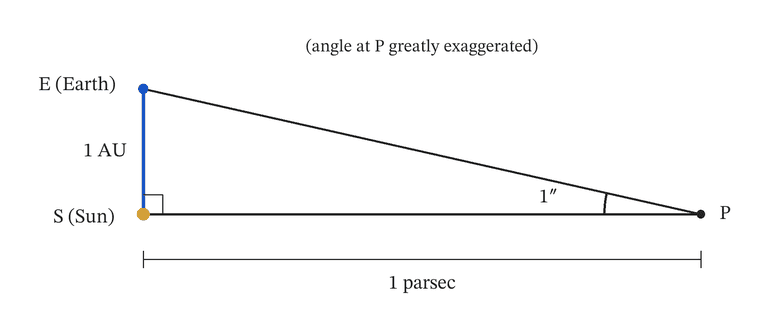
Step 2 — Find its value. For a small angle, distance equals arc divided by angle in radian. One second of arc is about , so:
Therefore, one parsec is the distance at which one astronomical unit subtends an angle of one second of arc, about .
- 221 mark
Question 22
What is shake?
Solve with AIWritten solution
Solution:
Concept: Very short time intervals, such as those in nuclear processes, are measured in small special units.
Step 1 — Say what kind of unit it is. The shake is a unit of time used for very short intervals.
Step 2 — Give its value. One shake is (10 nanoseconds).
Therefore, the shake is a unit of time, and .
- 231 mark
Question 23
What is lunar month?
Solve with AIWritten solution
Solution:
Concept: A month based on the Moon is the time the Moon takes to go once round the Earth.
Step 1 — Give the definition. The time taken by the Moon to complete one revolution around the Earth is called the lunar month.
Step 2 — Give its length. Measured against the distant stars, one revolution takes about 27.3 days.
Note: The month of the Moon's phases, from one new moon to the next, is longer, about 29.5 days, because the Earth moves along its orbit during the month and the Moon must go a little further to line up with the Sun again.
Therefore, a lunar month is the time taken by the Moon to complete one revolution around the Earth, about 27.3 days.
- 241 mark
Question 24
What is one micron?
Solve with AIWritten solution
Solution:
Concept: The micron is the old name of the micrometre; the prefix micro means .
Step 1 — Say what it measures. The micron is a unit of length used for small objects such as cells and fine fibres.
Step 2 — Give its value. One micron is , written .
Therefore, .
- 251 mark
Question 25
What is a solar year?
Solve with AIWritten solution
Solution:
Concept: A year based on the Sun is the time the Earth takes to go once round the Sun.
Step 1 — Give the definition. The time taken by the Earth to complete one revolution around the Sun is called one solar year.
Step 2 — Give its length. It is about 365.25 days.
Therefore, a solar year is the time taken by the Earth to complete one revolution around the Sun, about 365.25 days.
- 261 mark
Question 26
Obtain the S.I. unit of energy in terms of fundamental unit.
Solve with AIWritten solution
Solution:
Concept: Energy is measured as work, and work is force × displacement; the joule must therefore be built from kg, m and s.
Step 1 — Write the joule as N m. One joule is the work done by a force of one newton through one metre:
Step 2 — Replace the newton. The newton is (mass × acceleration), so:
Therefore, the S.I. unit of energy is (the joule).
- 271 mark
Question 27
Name of unit used for measuring small area of cross-section like nuclear cross-section.
Solve with AIWritten solution
Solution:
Concept: Nuclear cross-sections are tiny areas, so a special small unit of area is used for them.
Step 1 — Name the unit. The unit is the barn.
Step 2 — Give its value. One barn is .
Therefore, the barn is used, and .
- 281 mark
Question 28
What is the difference between Å and A.U.?
Solve with AIWritten solution
Solution:
Concept: Both are units of length, but they are used at opposite ends of the scale of sizes.
Step 1 — Describe the angstrom. The angstrom (Å) is a very small unit, used for atomic sizes and wavelengths:
Step 2 — Describe the astronomical unit. The astronomical unit (AU) is the mean Earth–Sun distance, used for distances in the solar system:
Therefore, the angstrom () is a tiny unit for atomic distances, while the astronomical unit () is a huge unit for distances in the solar system.
- 291 mark
Question 29
What is 'u'?
Solve with AIWritten solution
Solution:
Concept: The masses of atoms and nuclei are given in a small unit of mass based on the carbon-12 atom.
Step 1 — Say what it is. The symbol u stands for the unified atomic mass unit, a unit of mass. It is one-twelfth of the mass of a carbon-12 atom.
Step 2 — Give its value. One atomic mass unit is about .
Therefore, u is the atomic mass unit, a unit of mass equal to about .
- 301 mark
Question 30
Which is greater, a pound or a kilogram?
Solve with AIWritten solution
Solution:
Concept: The pound is the unit of mass of the F.P.S. system and the kilogram that of S.I.; to compare them we express one in terms of the other.
Step 1 — Convert the pound. One pound is (more exactly ).
Step 2 — Compare. Since is less than , a kilogram is greater, about 2.2 pounds.
Therefore, a kilogram is greater than a pound ().
- 311 mark
Question 31
What are (i) yocto and (ii) yotta?
Solve with AIWritten solution
Solution:
Concept: S.I. prefixes stand for powers of ten and are written before a unit.
Step 1 — Give yocto. The prefix yocto (symbol y) stands for .
Step 2 — Give yotta. The prefix yotta (symbol Y) stands for .
Note: Since 2022 the prefixes ronna (), quetta (), ronto () and quecto () have also been in use.
Therefore, (i) and (ii) .
- 321 mark
Question 32
What is an error?
Solve with AIWritten solution
Solution:
Concept: No measurement is perfect; every measured value differs a little from the true value.
Step 1 — Give the definition. Error is the difference between the measured value of a quantity and its true value.
Step 2 — Say why it arises. It can come from the instrument, from the person measuring, from the surroundings or from causes we cannot control.
Therefore, error is the difference between the carefully measured value and the true value of a quantity.
- 331 mark
Question 33
To which group of errors do zero error and back lash error belong?
Solve with AIWritten solution
Solution:
Concept: Systematic errors have known causes; one group of them comes from defects in the instrument itself.
Step 1 — Look at the causes. A zero error (as in a screw gauge or vernier callipers) and a back lash error (play in a nut and screw) both come from a built-in defect of the instrument.
Step 2 — Name the group. Errors due to defects of the instrument are called instrumental errors; they are a type of systematic error and can be corrected (zero correction, turning the screw in one direction only).
Therefore, zero error and back lash error belong to instrumental errors, which are systematic errors.
- 341 mark
Question 34
To avoid random errors, what should we do?
Solve with AIWritten solution
Solution:
Concept: Random errors are equally likely to make a reading too large or too small, so they tend to cancel when many readings are averaged.
Step 1 — Say what to do. We should take the same measurement a large number of times and find the arithmetic mean of the readings.
Step 2 — Say why it works. The positive and negative random errors largely cancel in the mean, so the mean is closer to the true value than a single reading.
Watch out: Random errors can be made small in this way, but never removed completely.
Therefore, to reduce random errors we take the measurement a number of times and find the arithmetic mean of the readings.
- 351 mark
Question 35
What is the use of calculating percentage error?
Solve with AIWritten solution
Solution:
Concept: Percentage error is the error expressed as a percentage of the value measured, .
Step 1 — Say what it shows. Because it compares the error with the size of the quantity, it shows how good a measurement is, whatever the size of the quantity or its unit.
Step 2 — Give the use. It lets us compare measurements made by different observers or with different instruments, and see which is more accurate.
Therefore, calculating the percentage error lets us compare the errors made by different observers (or instruments) and judge which measurement is better.
- 361 mark
Question 36
Does the number of significant figures used depend on the system of unit used?
Solve with AIWritten solution
Solution:
Concept: The number of significant figures depends on the precision of the measurement, that is, on the least count of the instrument, not on the unit in which the result is written.
Step 1 — Change the unit of an example. A length of can be written as or .
Step 2 — Count the figures. Each form has three significant figures; the zeros added in front only fix the decimal point.
Therefore, no: the number of significant figures does not depend on the system of units used.
- 371 mark
Question 37
Mention the advantages of writing the final experimental results in significant figure.
Solve with AIWritten solution
Solution:
Concept: Significant figures are the reliable digits of a measurement plus the first doubtful digit.
Step 1 — First advantage. They show how many digits of the result are meaningful, so no false precision is claimed.
Step 2 — Second advantage. They tell the reader the extent of uncertainty in the measurement, that is, its precision.
Therefore, writing results in significant figures gives the number of meaningful digits and shows the extent of uncertainty in the measurement.
- 381 mark
Question 38
Round off the following to three significant figures. (i) 25.76 kg (ii) 0.02234
Solve with AIWritten solution
Solution:
Concept: When rounding, if the first digit dropped is more than 5 the last kept digit increases by one; if it is less than 5 the last kept digit is unchanged. Zeros before the first non-zero digit are not significant.
Step 1 — Round 25.76 kg. We keep 2, 5 and 7; the digit dropped is 6, which is more than 5, so 7 becomes 8.
(i) becomes .
Step 2 — Round 0.02234. The leading zeros are not significant, so the three significant figures are 2, 2 and 3; the digit dropped is 4, which is less than 5, so 3 stays.
(ii) becomes .
Therefore, (i) rounds to and (ii) rounds to .
- 391 mark
Question 39
Is there any specific reason for using caesium-133 atom for defining one second?
Solve with AIWritten solution
Solution:
Concept: A good time standard must repeat at a rate that never changes and is the same everywhere.
Step 1 — Describe the caesium radiation. A caesium-133 atom, in a transition between two hyperfine levels of its ground state, emits electromagnetic radiation of a precise and unvarying frequency, .
Step 2 — Explain why that suits a standard. All caesium-133 atoms are identical, so this frequency is the same in every laboratory and does not change with time. One second is the time of exactly periods of this radiation.
Therefore, yes: caesium-133 emits radiation of a precise and unvarying frequency that can be reproduced anywhere, so it gives a highly accurate time standard.
- 401 mark
Question 40
Why do we go for an atomic standard for defining 'metre' and 'second'?
Solve with AIWritten solution
Solution:
Concept: A standard made of a material object (a metal bar, the Earth's rotation) can change or be damaged, while atomic properties are the same everywhere and for all time.
Step 1 — Problems with older standards. A metre bar can expand, wear or be lost, and the Earth's rotation slowly varies, so standards based on them are not perfectly constant.
Step 2 — Advantages of atomic standards. Atomic frequencies (and the speed of light) do not change, can be reproduced in any laboratory and can be measured very precisely.
Therefore, atomic standards are used because they do not change with time or place and are easily reproduced, so length and time can be measured with higher precision and accuracy.
- 411 mark
Question 41
“The definition of metre based on velocity of light is considered to be absolutely constant.” Why?
Solve with AIWritten solution
Solution:
Concept: Since 1983 the metre has been defined as the length of the path travelled by light in vacuum in of a second.
Step 1 — Use the property of light. The speed of light in vacuum is a universal constant: it does not change with place or time and is the same for every observer, whatever their frame of reference.
Step 2 — Link it to the metre. The speed of light is now fixed exactly at , so the metre is tied to this constant and to the very stable atomic second.
Therefore, the metre defined through the speed of light is absolutely constant because the speed of light in vacuum does not change with space or time and is independent of the frame of reference or observer.
- 422 marks
Question 42
What is one micron?
Solve with AIWritten solution
Solution:
Concept: The micron is the old name of the micrometre; the prefix micro means one millionth.
Step 1 — Say what it measures. The micron is a unit of length used for very small objects such as cells and fine fibres.
Step 2 — Give its value. One micron is one micrometre:
Therefore, one micron is one micrometre, .
- 432 marks
Question 43
Give the advantages of selecting wavelength of light as a standard of length.
Solve with AIWritten solution
Solution:
Concept: From 1960 to 1983 the metre was defined as wavelengths of a particular orange-red light emitted by krypton-86 atoms, in place of a metal bar.
Step 1 — It does not change with conditions. The wavelength of a chosen atomic line is not affected by temperature, pressure and similar conditions, unlike a metal bar, which expands and contracts.
Step 2 — It does not depend on other quantities. It is fixed by the atom itself, not by any other physical quantity.
Step 3 — It can be reproduced easily. Any laboratory with the same atoms can produce the same wavelength, so there is no need to compare with one stored object.
Step 4 — It does not change with time. A wavelength does not wear, corrode or age.
Note: Since 1983 the metre has been defined through the speed of light, the length travelled by light in vacuum in of a second, which is even more precise.
Therefore, a wavelength of light makes a good standard because it is unaffected by temperature and pressure, does not depend on other quantities, is easily reproduced and does not change with time.
- 442 marks
Question 44
Name the unit in which size of a nucleus is measured.
Solve with AIWritten solution
Solution:
Concept: A nucleus is about a hundred thousand times smaller than an atom, so its size needs a very small unit.
Step 1 — Name the unit. The size of a nucleus is measured in fermi (the femtometre, fm).
Step 2 — Give its value. One fermi is:
Nuclei have radii of a few fermi.
Therefore, the size of a nucleus is measured in fermi, where .
- 452 marks
Question 45
What is the new name of litre?
- 462 marks
Question 46
What is a light year? How is it related to metre?
- 472 marks
Question 47
Is there any difference between Å and A.U.?
- 482 marks
Question 48
The mean diameter of a thin brass rod is to be measured by a vernier callipers. Why is a set of 100 measurements of the diameter expected to yield a more reliable estimate than a set of 5 measurements only?
- 492 marks
Question 49
If you look out of the window of a fast-moving train, the nearby trees, houses etc. seem to move rapidly in a direction opposite to the train's motion, but the distant objects seem to be stationary. Why?
- 502 marks
Question 50
If , then what is the relative error in ?
- 512 marks
Question 51
Which of the following length measurements is/are the most accurate and why?
(a) 5.0 cm
(b) 0.006 cm
(c) 0.0005 cm
(d) 5.000 cm
- 522 marks
Question 52
What is the difference between accuracy and precision?
- 532 marks
Question 53
Is there any difference between an 'error' and a 'mistake'? Explain.
- 542 marks
Question 54
While finding the value of acceleration due to gravity using a simple pendulum, which quantity should be measured most accurately and why?
- 552 marks
Question 55
In the equation , what is the unit of if is the speed, is the displacement and is the time?
- 562 marks
Question 56
The mass and volume of a body are found to be kg and respectively. Calculate the minimum possible percentage error in its density.
- 573 marks
Question 57
(a) What are the fundamental and supplementary quantities in S.I. and their units?
(b) What are the advantages of S.I. units?
- 583 marks
Question 58
(a) Define one metre. How will you measure length using the method of parallax?
(b) Define one kilogram and atomic mass unit. How will you measure mass of a body?
- 593 marks
Question 59
(a) Distinguish between precision and accuracy.
(b) Explain (i) systematic errors and (ii) random errors.
- 603 marks
Question 60
What are significant figures? Explain the rules for various arithmetic operations with significant figures.
- 615 marks
Question 61
(a) What are the fundamental quantities and supplementary quantities in S.I.? Give their units.
(b) Define metre, kilogram and second in S.I.
(c) What are the advantages of S.I.?
- 625 marks
Question 62
(a) What is an error?
(b) Explain absolute error, mean absolute error and percentage error.
(c) Discuss the combination of errors in various cases.
- 635 marks
Question 63
(a) Explain parallax.
(b) How is the method of parallax used to find the distance of a planet?
(c) How is the distance from the Moon to the Earth determined?
What Class 11 Physics Ch 2 covers
The sections of the chapter, in the order the book takes them. Every question above comes from one of these.
- 01Measurement and Units
- 02Fundamental and Derived Quantities
- 03Systems of Units and SI
- 04Measurement of Length, Mass and Time
- 05Measurement of Large Distances - Parallax Method
- 06Accuracy, Precision and Significant Figures
More ways to study this chapter
The same chapter asked three other ways. Practise it, revise it, and see what the board has set on Ch 2 before.
Class 11 Physics Ch 2 questions students ask
How many questions are there in Class 11 Physics Ch 2?
63 questions. Every one is solved step by step on this page.
Are these Class 11 Physics solutions free?
Yes. Every question and its full working is free to read, with no account needed.
Can I download the Class 11 Physics Ch 2 solutions as a PDF?
There is no PDF to download. Every solution is on this page instead, which means it is searchable, always the current syllabus, and readable on a phone. Use your browser's print option if you want it on paper.