
Question 635 marksMedium
(a) Explain parallax.
(b) How is the method of parallax used to find the distance of a planet?
(c) How is the distance from the Moon to the Earth determined?
Confirming your payment
Sign up now and get 250 free tokens.
Units and Measurements - Accuracy and Errors · Question 63 of 63
(a) Explain parallax.
(b) How is the method of parallax used to find the distance of a planet?
(c) How is the distance from the Moon to the Earth determined?
Solution:
Concept: When the point of observation changes, a nearby object appears to shift against a distant background. For a small parallax angle (in radian), the basis and the distance are related by , so .
Step 1 — Explain parallax. For part (a), hold a pencil in front of your face and look at it first with the left eye L closed, then with the right eye R closed: the pencil seems to jump against the background. This apparent shift in the position of an object, caused by a change in the point of observation, is called parallax. The distance between the two points of observation is the basis , and the angle LOR between the two lines of sight is the parallax angle .

Step 2 — Relate the angle to the distance. When the object is far away compared with the basis, LR is very nearly an arc of a circle of radius centred at O, so:
A nearer object gives a larger parallax angle.
Step 3 — Choose a long basis for a planet. For part (b), a planet is so far away that the distance between the eyes gives an angle far too small to measure. So two observatories A and B on the Earth, a known distance apart, are used as the two points of observation.

Step 4 — Measure the parallax angle of the planet. The planet O is observed at the same time from A and from B. At each place, the angle between the direction of O and the direction of a very distant star is measured; the star's direction is the same from A and B, so these angles, and , add to give the parallax angle .
Step 5 — Calculate the distance of the planet. With in radian, the distance is:
Step 6 — Use the Earth's diameter for the Moon. For part (c), the Moon is observed at the same time from two places A and B on the Earth that are (very nearly) at the two ends of a diameter, so the basis is the Earth's diameter. The figure is not to scale: with the Moon about 60 Earth radii away, each of the two places where the Moon is on the horizon lies within about of an end of the diameter at right angles to the Earth–Moon line, so the basis is very nearly the full diameter.
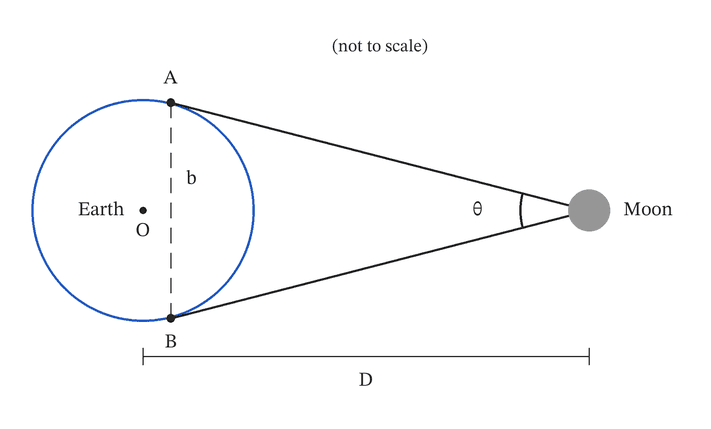
Step 7 — Find the distance of the Moon. Measuring the angle that the Earth's diameter subtends at the Moon gives:
For example, suppose the measured angle is and . First we change the angle into radian:
Then the distance is:
This agrees with the mean Earth–Moon distance of about .
Note: Today the Moon's distance is measured even more precisely by timing a laser pulse reflected from mirrors left on the Moon: a round trip of about gives .
Therefore, (a) parallax is the apparent shift of an object when the point of observation changes; (b) a planet's distance is found by observing it from two places a known distance b apart and measuring the parallax angle θ, so that D = b/θ; (c) the Moon's distance is found in the same way using the Earth's diameter as the basis, giving about .