
Opening your dashboard
Class 11 Physics Chapter 2 Units and Measurements - Accuracy and Errors: Competency-Based Questions (CBQ)
40 questions on Chapter 2, each worked through on its own page with the AI tutor. Class 11 Physics, ICSE 2026-27.
40 questions
1–5 marks · Mixed difficulty
- 13 marks
Question 1
Competency: Analysis & Evaluation
In September 1999 the spacecraft Mars Climate Orbiter was lost as it arrived at Mars. The investigation found that one computer program gave the impulse of small thruster firings in pound-force seconds (lbf s), while the navigation software that used these numbers took them to be in newton seconds (N s). As a result, the spacecraft passed much closer to Mars than planned.
Suppose one thruster firing had a true impulse of , and the navigation software read the number as . Take . (Hypothetical data.)
(a) Find the true impulse of this firing in newton seconds.
(b) What fraction of the true impulse did the navigation software use? By what percentage did it underestimate the impulse?
(c) Using the relation between a physical quantity, its numerical value and its unit, explain why the number 20.0 on its own did not describe the impulse, and state one working habit that prevents such errors.
- 21 mark
Question 2
Competency: Analysis & Evaluation
Riya notices that her father's car has a speedometer, which shows the car's speed directly, and an odometer, which shows the total distance travelled.
Assertion (A): Speed is a derived quantity, even though the speedometer shows it directly.
Reason (R): Any quantity that an instrument can show directly must be a base quantity.
- 33 marks
Question 3
Competency: Application
The fuel efficiency of a small car is per litre of petrol, written . In many countries, fuel use is given instead as the number of litres needed for . Take . (Hypothetical data.)
(a) Fuel efficiency is a derived quantity. Write the unit in terms of SI base units, and express in these units.
(b) Find the car's fuel use in litres per , and express it in SI base units.
(c) The quantity in (b) has the same unit as an area. Imagine that the petrol used were laid along the road as one thin thread of circular cross-section, as long as the distance travelled. Find the diameter of this thread.
- 41 mark
Question 4
Competency: Application
In November 2022 the General Conference on Weights and Measures added four new SI prefixes: ronna (symbol R, ), quetta (Q, ), ronto (r, ) and quecto (q, ). By the SI rules, prefixes for mass are attached to the gram, not to the kilogram. The mass of the Earth is about . Written with a single SI prefix on the gram, this mass is about
- 53 marks
Question 5
Competency: Analysis & Evaluation
Aarav buys an external hard disk labelled "1 TB". When he connects it, his computer reports its size as "931 GB". The disk maker uses SI prefixes, in which every prefix is an exact power of ten (kilo = , giga = , tera = ). His computer's software, however, divides the number of bytes by and calls the result "GB".
(a) How many bytes does the disk hold, according to the SI meaning of "1 TB"?
(b) Show that the computer's figure of 931 comes from the same number of bytes, so that no storage is missing.
(c) The International Electrotechnical Commission calls bytes a gibibyte (GiB) and bytes a tebibyte (TiB). By what percentage is 1 TiB larger than 1 TB? Explain why an SI prefix must never be used for a power of two.
- 61 mark
Question 6
Competency: Analysis & Evaluation
In a quiz on the International System of Units, two statements are read out about the mole, the unit of amount of substance.
Assertion (A): Since the 2019 redefinition of the SI, the mole is no longer one of the SI base units.
Reason (R): Since 2019, the mole has been defined by fixing the numerical value of the Avogadro constant at exactly .
- 74 marks
Question 7
Competency: Application
A planetary rover finds the distances of rocks with two cameras and , mounted apart on a bar. Both cameras look at the same rock , which lies straight ahead of the mid-point of the bar. The directions of from the two cameras differ by an angle ; this is the angle that the bar subtends at the rock, as shown in the figure. The angle can be measured to within , and the length of the bar is known so well that its error can be neglected. (Hypothetical data.)

(a) Find the distance of the rock from the bar.
(b) Find the uncertainty in this distance, and write the result in the form .
(c) For another rock three times as far away, find the angle and the percentage uncertainty in its distance. What does this show about measuring distances with two cameras on a short bar?
- 81 mark
Question 8
Competency: Analysis & Evaluation
A shopkeeper's beam balance, with arms of equal length, is just balanced when a bag of rice is in one pan and standard masses of total mass are in the other. (Hypothetical data.) Suppose the same balance, bag and standard masses were taken to the Moon. Ignore the upthrust of the air.
Assertion (A): On the Moon, the bag of rice would still just balance the same of standard masses.
Reason (R): The acceleration due to gravity on the Moon is only about one-sixth of its value on the Earth.
- 94 marks
Question 9
Competency: Application
On an equinox day, the Sun is overhead at the equator at noon. Students in Bengaluru (B) and in Delhi (D) each set up a vertical stick on level ground. At local noon, the Sun's rays make an angle of with the vertical stick in Bengaluru and with the vertical stick in Delhi. The two cities lie almost on the same north–south line, and the distance between them along this line is . The Sun is so far away that its rays reaching the two cities are parallel. The arrangement is shown in the figure, where E is the point on the equator where the Sun is overhead. (Hypothetical data.)
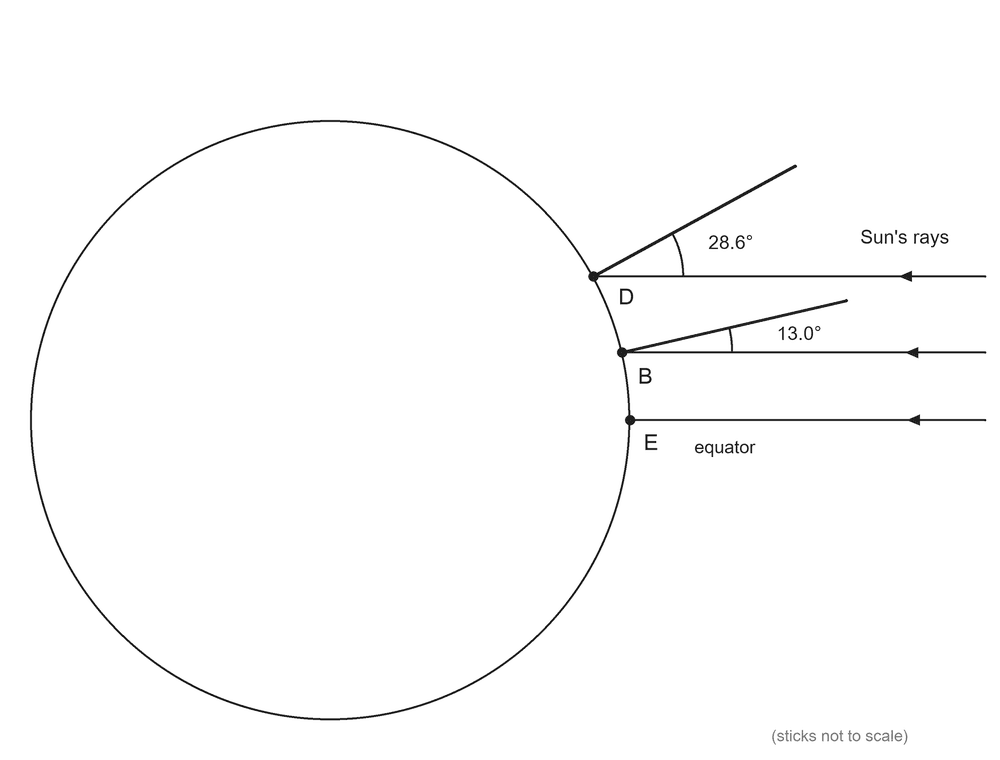
(a) The vertical lines at the two cities, produced downwards, meet at the centre of the Earth. Explain why the angle between them is .
(b) Find the circumference and the radius of the Earth from these measurements.
(c) Each shadow angle is measured to within , and the distance can be taken as exact. Find the maximum percentage error in the circumference, and the corresponding absolute error.
- 101 mark
Question 10
Competency: Analysis & Evaluation
To measure the distance of a nearby star by the parallax method, astronomers need two points of observation separated by a known baseline.
Assertion (A): To find the distance of a nearby star by parallax, astronomers compare its directions observed from the Earth six months apart, instead of observing it at the same time from two places on the Earth.
Reason (R): For a star at a given distance, the parallax angle is larger when the baseline between the two points of observation is longer.
- 113 marks
Question 11
Competency: Analysis & Evaluation
The Laws of Cricket give the length of the pitch as 22 yards, and the yard is now defined as exactly . Before a match, a groundsman measures the pitch with a steel tape marked in centimetres and records the length as . (Hypothetical data.)
(a) Express 22 yards in metres. How many significant figures does this value have? Explain.
(b) How many significant figures does the groundsman's reading have? Which digit is doubtful, and between what limits does the true length lie?
(c) In a report, one person copies the reading as and another as . Which of these is a correct way of writing the measurement? Explain.
- 121 mark
Question 12
Competency: Analysis & Evaluation
A map app on Neha's phone shows her position as latitude N, a number with six decimal places of a degree. (Hypothetical data.)
Assertion (A): Because the latitude is shown to six decimal places, the phone must be giving Neha's position correct to about .
Reason (R): On the Earth's surface, a change of one-millionth of a degree in latitude corresponds to a distance of about .
- 134 marks
Question 13
Competency: Analysis & Evaluation
On a highway, two cameras apart record the time at which each car passes them; the distance between them was surveyed accurately. The cameras record times to the nearest second. A car passes the first camera at 10:14:05 and the second at 10:15:32. The speed limit on this stretch is . (Hypothetical data.)
(a) Find the time the car took between the cameras. How many significant figures does it have?
(b) Find the car's average speed in and in , written with the correct number of significant figures.
(c) The driver argues: "My speed is only to two significant figures, so you cannot say I was above the limit." Each recorded time may be off by up to . Find the lowest average speed the car could have had, and decide whether the driver's argument is right.
- 141 mark
Question 14
Competency: Analysis & Evaluation
Kabir measures a rectangular flower bed as by . His calculator shows the product of these lengths as 9.022. (Hypothetical data.)
Assertion (A): Written with the correct number of significant figures, the area of the flower bed is , not .
Reason (R): In multiplication, the result is rounded to the same number of decimal places as the factor with the fewest decimal places.
- 154 marks
Question 15
Competency: Analysis & Evaluation
At a school sports meet, a race is started with a starting pistol. An electronic timer, started by the pistol itself, records the winner's time as and the runner-up's as ; it reads to . A teacher standing at the finish line also times the winner with a stopwatch. The teacher starts it on hearing the pistol and stops it as the winner crosses the line. Take the speed of sound in air as , and assume that the teacher's reaction delay is the same when starting and when stopping the watch. (Hypothetical data.)
(a) What time will the teacher's stopwatch show for the winner?
(b) Is the error in the teacher's time systematic or random? Explain, and suggest how the teacher should start the watch.
(c) Find the winner's average speed. Taking the runner-up's speed near the finish to be about the same, estimate how far behind the winner the runner-up was when the winner crossed the line.
- 161 mark
Question 16
Competency: Analysis & Evaluation
The scale of a laboratory ammeter has a narrow strip of mirror just behind the pointer, running along the scale. The instruction card says: "Read the meter with one eye placed so that the pointer hides its own image in the mirror."
Assertion (A): The mirror strip helps to reduce the parallax error in reading the meter.
Reason (R): When the pointer hides its own image in the mirror, the line of sight from the eye through the pointer is perpendicular to the scale.
- 174 marks
Question 17
Competency: Analysis & Evaluation
A student of mass walks in shoes with stiletto heels. At one moment in each step the student's whole weight rests on one heel, whose tip is a circle of diameter . The pressure on the floor is then ; take as exact. (Hypothetical data.)
(a) Find the pressure under the heel.
(b) Find the maximum percentage error and the absolute error in , and write in the form .
(c) Which measurement limits the accuracy of most, and why? If the diameter were measured with vernier callipers to within , what would the percentage error in become?
- 181 mark
Question 18
Competency: Application
The resistance of an electric room heater is measured as , and the mains voltage across it as . (Hypothetical data.) Its power is found from . The maximum percentage error in is about
- 193 marks
Question 19
Competency: Application
A school in a dry region plans to collect rainwater from its flat roof, which is long and wide. The average rainfall there is a year. The school has 500 students, and each needs about of drinking water on each of the 200 school days in a year. Take . (Hypothetical data.) Use the rule that a quantity written as , with , has order of magnitude if and if .
(a) Find the volume of rain, in litres, that falls on the roof in a year, and its order of magnitude.
(b) Find the yearly need for drinking water, in litres, and its order of magnitude.
(c) Only about 60% of the rain falling on the roof can actually be collected and stored. Can the orders of magnitude alone tell whether the stored water will meet the need? Find out whether it will.
- 201 mark
Question 20
Competency: Analysis & Evaluation
Use the rule that a quantity written as , with , has order of magnitude if and if . Two hill roads are and long. (Hypothetical data.)
Assertion (A): The lengths of the two roads have different orders of magnitude.
Reason (R): Two quantities that have different orders of magnitude always differ by a factor of at least 10.
- 211 mark
Question 21
Competency: Application
On an orbiting space station everything is in free fall and appears weightless, so neither a beam balance nor a spring balance can find an astronaut's mass. Instead, the astronaut sits on a chair fixed to springs and is set oscillating; the time period is , where is the oscillating mass and is the spring constant. For astronaut X, of mass , the period is ; for astronaut Y on the same chair it is . Ignore the mass of the chair. (Hypothetical data.) The mass of astronaut Y is about
- 221 mark
Question 22
Competency: Application
Tanvi wants the kinetic energy of a ball of mass moving at . She puts and into and writes the answer as 4500 J. (Hypothetical data.) The kinetic energy of the ball, in joules, is
- 231 mark
Question 23
Competency: Analysis & Evaluation
A cyclist's bike computer counts the turns of the front wheel and multiplies the count by the wheel's circumference, which the cyclist has entered as . The true circumference of the wheel is . After a ride the computer shows . (Hypothetical data.) The true distance ridden is
- 241 mark
Question 24
Competency: Application
To find the spring constant of a spring, a student hangs a load of mass from it and measures the extension as . The student uses , with taken as exact. (Hypothetical data.) The result, with its maximum error, should be written as
- 251 mark
Question 25
Competency: Application
A health club poster asks how many times a person's heart beats in a lifetime. Take an average heart rate of 72 beats per minute, a lifetime of 75 years and 365 days in a year. (Hypothetical data.) Use the rule that a quantity written as , with , has order of magnitude if and if . The order of magnitude of the number of heartbeats in a lifetime is
- 264 marks
Question 26
In an experiment, the value of refractive index of glass was found to be 1.54, 1.53, 1.44, 1.54, 1.56 and 1.45 in successive measurement. Calculate (i) the mean value of refractive index, (ii) absolute error of each measurement, (iii) mean absolute error, (iv) relative error and (v) percentage error.
- 273 marks
Question 27
The centripetal force acting on a body of mass 4 kg moving in a circle of radius 0.3 m with a uniform speed 5 m/s is calculated using the equation . If , and are measured to accuracies of 0.04 kg, 0.01 m/s and 0.009 m, respectively, find the percentage error in the force.
- 283 marks
Question 28
Calculate the percentage error in the volume of a cylinder of diameter 2.4 cm and height 10.5 cm, both measured using a metre scale of least count 0.1 cm. What will be the percentage error if dimensions are measured using a vernier calliper of least count 0.01 cm?
- 293 marks
Question 29
In an experiment to determine the coefficient of viscosity of a liquid using the formula , the radius of the capillary tube was measured to be 0.41 mm using an instrument of least count 0.001 cm, length was measured using a metre scale as 15 cm. The percentage error in the pressure difference is 0.4% and the percentage error in the volume of the liquid flowing out per second is 0.3% what is the maximum percentage error in the coefficient of viscosity?
- 303 marks
Question 30
The percentage error in the evaluation of the area of one surface of a rectangular sheet is 2.2%. The length and breadth are measured using a metre scale. If the breadth is 7.9 cm, calculate the length of the sheet.
- 313 marks
Question 31
The resistance of a metallic conductor is equal to the ratio of potential difference across the resistor to the current through the conductor. Calculate , given that volt and A.
- 323 marks
Question 32
A physical quantity is related to three observable , and as . The errors of measurements in , and are 4%, 3% and 2%, respectively. What is the percentage error in the quantity ?
- 331 mark
Question 33
Competency: Analysis
(Hypothetical data.) Four groups of students find the resistivity of the same alloy wire material. Each group cuts its own piece of wire and uses the relation below, where is the diameter of the wire, its resistance and its length.
Every group measures with a screw gauge (uncertainty ), with a metre scale (uncertainty ) and with a meter that reads to (uncertainty ). Their readings are given in the table.
Group (mm) (cm) () Group 1 0.50 100.0 2.50 Group 2 0.80 50.0 0.49 Group 3 1.20 100.0 0.44 Group 4 0.80 200.0 1.95 Which group's value of has the smallest maximum percentage error?
- 341 mark
Question 34
Competency: Analysis & Evaluation
(Hypothetical data.) A laboratory thermometer has a constant error: at every point of its scale it reads higher than the true temperature. In a calorimeter experiment, a student uses it to read the temperature of some water before and after heating it. The readings are and .
Assertion (A): The rise in the temperature of the water found from these two readings, , is not affected by the thermometer's constant error.
Reason (R): A constant error changes its sign from one reading to the next, so it cancels when one reading is subtracted from the other.
- 351 mark
Question 35
Competency: Understanding
Meera is measuring the diameter of a wire with a screw gauge. She turns the thimble too far, so the jaws press the wire tightly. She then turns the thimble back a little until the jaws only just touch the wire, and takes her reading. Her teacher asks her to open the jaws and bring them onto the wire again, turning the thimble only in the forward direction.
Assertion (A): The teacher's advice helps Meera avoid backlash error in her reading.
Reason (R): Because of the small play between the screw and its nut, when the direction of rotation is reversed the thimble can turn through a small angle before the spindle starts to move.
- 362 marks
Question 36
Competency: Application & Evaluation
(Hypothetical data.) An electricity bill charges for energy in “units”, where one unit is one kilowatt hour (). On a summer evening, a family's smart meter shows that their air conditioner used units in hour minutes. Rohan writes in his notebook: “The power of our air conditioner is .”
(a) Express in joules, and show that the kilowatt hour is a unit of energy, not of power.
(b) Find the average power of the air conditioner in kilowatts, and explain what is wrong with Rohan's statement.
- 372 marks
Question 37
Competency: Application
(Hypothetical data.) A map of a district is drawn to a scale of , and this scale is exact: on the map stands for exactly on the ground. Using tracing graph paper, Kavya finds that a lake covers an area of on the map.
(a) Find the area of the lake on the ground in square metres, written with the correct number of significant figures.
(b) Her friend says that the answer can have only two significant figures, “because has only two significant figures”. Is the friend right? Explain.
- 383 marks
Question 38
Competency: Analysis & Creativity
(Hypothetical data.) Arjun has to find the diameter of a thin copper wire, but the only instrument he has is a metre scale of least count . He winds the wire closely round a pencil, with the turns touching side by side, and counts turns. The turns cover a length of along the pencil. Take the uncertainty in the scale reading as one least count; the number of turns is an exact count.
(a) Find the diameter of the wire, its absolute error and its percentage error.
(b) What is the least number of touching turns he should wind so that the percentage error in the diameter, due to the least count of the scale, is not more than ?
(c) Suppose the turns are wound loosely, with small gaps between some of them. Is the error this causes random or systematic? Will his value of the diameter come out too large or too small? Suggest one way to reduce this error.
- 393 marks
Question 39
Competency: Analysis & Evaluation
(Hypothetical data.) A shopkeeper's beam balance hangs level when both pans are empty, but its two arms are not exactly equal in length. To find the true mass of a packet of almonds, an inspector first places the packet in the left pan and finds that it is balanced by standard masses of in the right pan. She then places the packet in the right pan and finds that it is balanced by in the left pan. Use the principle of moments: when the beam is level, the load in the left pan multiplied by the length of the left arm equals the load in the right pan multiplied by the length of the right arm.
(a) Show that , and find .
(b) Find the ratio of the length of the right arm to the length of the left arm.
(c) The shopkeeper always puts the goods in the left pan and the standard masses in the right pan. When a customer buys of almonds, what mass does the customer actually receive? Is the error random or systematic?
- 405 marks
Question 40
Competency: Analysis & Evaluation
(Hypothetical data.) A survey boat measures the depth of the sea with an echo sounder. The sounder sends a short pulse of sound straight down and records the time taken for the echo from the sea bed to return. It then works out the depth as , using a speed of sound that has been set in the instrument as . Over one spot, five pings gave the echo times in the table.
Ping 1 2 3 4 5 Echo time (s) 0.262 0.266 0.264 0.263 0.265 Later the crew measures the temperature and the saltiness of the water and finds that the speed of sound in it is really . Take the sound to travel straight down and back at one steady speed.
(a) Find the mean echo time, the mean absolute error and the percentage error in the echo time.
(b) Find the depth given by the echo sounder, with its absolute error due to the scatter of the echo times, in the form .
(c) Find the true depth. Compare the error caused by the wrong speed setting with the error found in (b). Which type of error is each, and can taking more pings reduce the error caused by the wrong speed setting?