
Competency: Application
On an equinox day, the Sun is overhead at the equator at noon. Students in Bengaluru (B) and in Delhi (D) each set up a vertical stick on level ground. At local noon, the Sun's rays make an angle of with the vertical stick in Bengaluru and with the vertical stick in Delhi. The two cities lie almost on the same north–south line, and the distance between them along this line is . The Sun is so far away that its rays reaching the two cities are parallel. The arrangement is shown in the figure, where E is the point on the equator where the Sun is overhead. (Hypothetical data.)
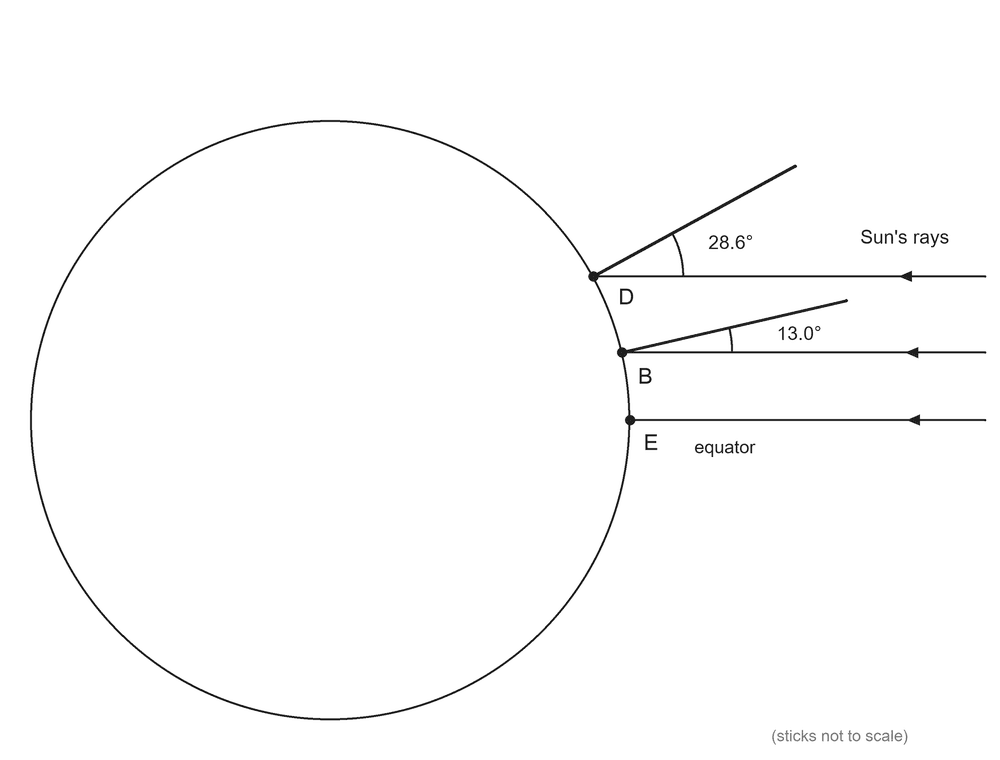
(a) The vertical lines at the two cities, produced downwards, meet at the centre of the Earth. Explain why the angle between them is .
(b) Find the circumference and the radius of the Earth from these measurements.
(c) Each shadow angle is measured to within , and the distance can be taken as exact. Find the maximum percentage error in the circumference, and the corresponding absolute error.