
Question 583 marksMedium
(a) Define one metre. How will you measure length using the method of parallax?
(b) Define one kilogram and atomic mass unit. How will you measure mass of a body?
Confirming your payment
Sign up now and get 250 free tokens.
Units and Measurements - Accuracy and Errors · Question 58 of 63
(a) Define one metre. How will you measure length using the method of parallax?
(b) Define one kilogram and atomic mass unit. How will you measure mass of a body?
Solution:
Concept: Long distances that cannot be reached are found from the parallax angle, for a small angle, where is the basis (the distance between the two points of observation) and is the distance of the object. Masses are measured by comparing them with standard masses on a balance.
Step 1 — Define one metre. One metre is the length of the path travelled by light in vacuum during a time interval of of a second.
Step 2 — Describe the parallax set-up. To find the distance of a far object O, such as a planet, we observe it from two points A and B on the Earth a known distance apart, as in the figure.

Step 3 — Measure the parallax angle. From A and from B, the direction of O is compared with the direction of a very distant star, which is the same from both points. The two angles and add to give the parallax angle .
Step 4 — Calculate the distance. Because is very much larger than , AB is nearly an arc of a circle of radius centred at O. With measured in radian, the arc length equals the radius times the angle, so:
Step 5 — Define one kilogram. Since 2019 the kilogram has been defined by fixing the Planck constant at exactly , with the metre defined through the speed of light (Step 1) and the second through the caesium-133 frequency. Until 2019 it was the mass of the international prototype, a platinum–iridium cylinder kept at Sèvres near Paris.
Step 6 — Define the atomic mass unit. One atomic mass unit (u) is one-twelfth of the mass of one carbon-12 atom:
Step 7 — Measure mass with a common balance. The mass of a body is found with a common (physical) balance, which compares the body with standard masses; the figure shows its parts.
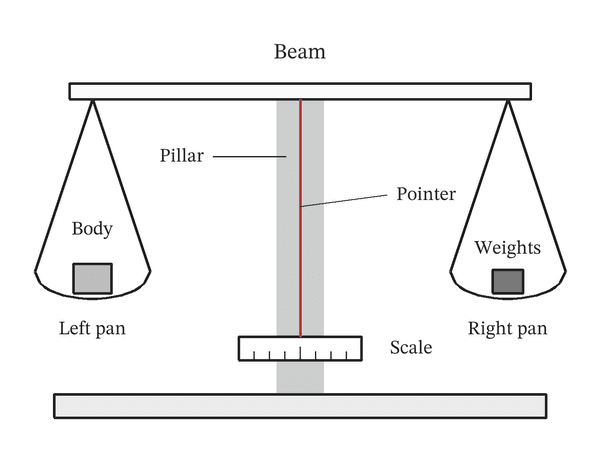
(i) With both pans empty, the zero resting point of the pointer on the scale is found from its turning points.
(ii) The body is put in the left pan and standard masses are added to the right pan, largest first, until the pointer swings evenly about a point near . Let the total of the standard masses be and the new resting point be .
(iii) The sensibility (mass per scale division) is found by adding to the right pan and noting the new resting point. The mass of the body is then .
Because both pans are pulled by the same , equal weights mean equal masses, so the balance measures mass.
Therefore, (a) one metre is the distance light travels in vacuum in s, and a long distance is found by parallax as ; (b) the kilogram is defined by the fixed Planck constant, is of the mass of a carbon-12 atom, and mass is measured by comparing the body with standard masses on a common balance.