
Question 573 marksMedium
(a) What are the fundamental and supplementary quantities in S.I. and their units?
(b) What are the advantages of S.I. units?
Confirming your payment
Sign up now and get 250 free tokens.
Units and Measurements - Accuracy and Errors · Question 57 of 63
(a) What are the fundamental and supplementary quantities in S.I. and their units?
(b) What are the advantages of S.I. units?
Solution:
Concept: S.I. is built on seven base (fundamental) quantities, each with its own unit; every other unit is derived from these by multiplying and dividing.
Step 1 — List the fundamental quantities. The seven fundamental quantities of S.I. and their units are given in the table.
| Base quantity | S.I. unit | Symbol |
|---|---|---|
| Length | metre | m |
| Mass | kilogram | kg |
| Time | second | s |
| Electric current | ampere | A |
| Thermodynamic temperature | kelvin | K |
| Amount of substance | mole | mol |
| Luminous intensity | candela | cd |
Step 2 — Give the supplementary quantities. The two quantities that were called supplementary are plane angle and solid angle. The figure shows how their units are defined.
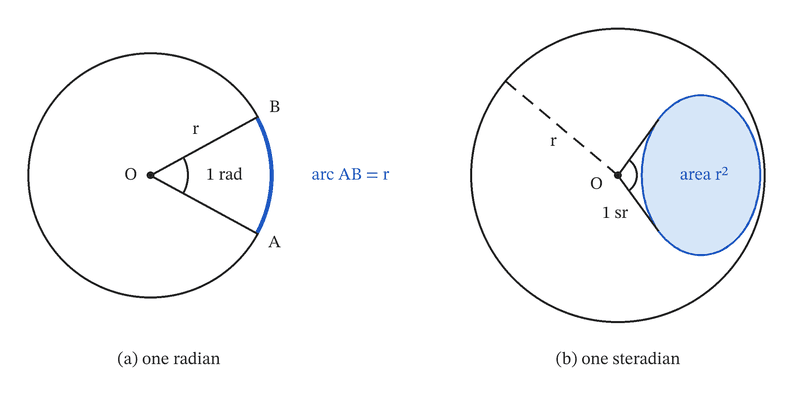
(i) Plane angle, unit radian (rad). One radian is the angle at the centre of a circle subtended by an arc equal in length to the radius. In general , and , so .
(ii) Solid angle, unit steradian (sr). One steradian is the solid angle which, with its vertex at the centre of a sphere, cuts off an area on the surface equal to that of a square whose side equals the radius. In general , and the whole sphere subtends at its centre.
Note: In 1995 the General Conference on Weights and Measures abolished the separate supplementary class of units. The radian and the steradian are now derived units with no dimensions, because each is a ratio (length/length or area/area); many syllabuses still list them under the old name.
Step 3 — List the advantages of S.I. The main advantages, answering part (b), are these:
(i) S.I. is a coherent system: every derived unit is obtained from the base units by multiplying and dividing, with no numerical factors (for example, ).
(ii) It is a rationalised system: each physical quantity has only one unit in every branch of science, for example the joule for mechanical, heat and electrical energy.
(iii) It is a comprehensive system: its seven base units cover all branches of science and technology.
(iv) It is a metric system: multiples and sub-multiples are powers of ten, written with prefixes such as kilo and milli.
(v) Its units are based on constants of nature (the speed of light, the caesium frequency, the Planck constant), so they do not change with time and can be reproduced in any laboratory.
Therefore, (a) the fundamental quantities are length (m), mass (kg), time (s), electric current (A), temperature (K), amount of substance (mol) and luminous intensity (cd), and the supplementary ones were plane angle (rad) and solid angle (sr); (b) S.I. is coherent, rationalised, comprehensive and metric, and its units are reproducible and do not change with time.