
Opening your dashboard
Class 11 Physics Chapter 2 Units and Measurements - Accuracy and Errors: Practice Questions
134 questions on Chapter 2, each worked through on its own page with the AI tutor. Class 11 Physics, ICSE 2026-27.
134 questions
1–4 marks · Mixed difficulty
- 11 mark
Question 1
(Hypothetical data.) A class invents two units of length: a span of and a stride of . A rope measures 48 spans. What is its length in strides?
- 23 marks
Question 2
A student suggests three everyday standards for measurement:
(i) the length of their own pencil as the unit of length;
(ii) the time between two of their own heartbeats as the unit of time;
(iii) the mass of one litre of tap water as the unit of mass.
For each, state one essential property of a good unit that the proposal fails to meet, and explain why it fails.
- 32 marks
Question 3
(Hypothetical data.) A tap delivers water at a steady rate of 12 litres per minute.
(i) Express this flow rate in the SI unit, .
(ii) How long, in minutes, does the tap take to fill an empty overhead tank of volume ?
- 41 mark
Question 4
The distance of a star from the Earth is . (Hypothetical data.) The distance is written in each of the units below, taking , and . In which unit is its numerical value the smallest?
- 52 marks
Question 5
A unit should be of a convenient size, neither far too large nor far too small for the quantity measured. From the units femtometre (fm), nanometre (nm), micrometre (m), kilometre (km), astronomical unit (AU) and light year (ly), choose the most convenient unit for each quantity below, and express the value in that unit. Take and .
(i) Radius of a gold nucleus,
(ii) Thickness of a human hair,
(iii) Mean distance of Mars from the Sun,
(iv) Distance of the Andromeda galaxy from the Earth,
- 61 mark
Question 6
Which one of the following is a base (fundamental) quantity in SI?
- 73 marks
Question 7
Express each of the following SI derived units in terms of the SI base units, showing the defining relation you use:
(i) the pascal (Pa), the unit of pressure;
(ii) the watt (W), the unit of power;
(iii) the volt (V), the unit of potential difference.
- 81 mark
Question 8
The impulse of a force is measured in newton second (N s). Written in SI base units, the unit N s is the same as
- 93 marks
Question 9
(Hypothetical data.) A phone battery is rated 4000 mAh (milliampere hour). This means it can deliver a steady current of 4000 mA for one hour.
(i) Electric charge is a derived quantity. Write the relation that defines it, and express the coulomb in SI base units.
(ii) Find the charge, in coulombs, that the battery can deliver.
(iii) How many electrons carry this charge? Take .
- 103 marks
Question 10
In the old gravitational (engineering) system of units, the base quantities were force, length and time, with the kilogram-force (kgf), the metre and the second as their units; mass was a derived quantity. Take .
(i) Using Newton's second law, write how the unit of mass is defined in this system.
(ii) Find the size of this unit of mass in kilograms.
(iii) A trolley has a mass of 49 kg. What is its mass in this system's unit of mass?
- 111 mark
Question 11
Which of the following is written correctly according to the SI rules for writing unit symbols?
- 123 marks
Question 12
(Hypothetical data.) The processor of a smartphone runs at a clock frequency of 2.4 GHz.
(i) Find the duration of one clock cycle in nanoseconds and in picoseconds.
(ii) How far does light travel in vacuum during one clock cycle? Give your answer in centimetres, taking .
- 131 mark
Question 13
In CGS units, the Young's modulus of steel is about ; Young's modulus has the same unit as pressure. Its value in SI units is
- 143 marks
Question 14
(Hypothetical data.) A snack packet's label says that one serving provides 250 kcal of energy. Take and .
(i) Express this energy in the SI unit, in kilojoules and in megajoules.
(ii) The SI is called a rationalised system because it uses only one unit for each physical quantity. Using this example, explain one advantage of measuring heat, work and food energy in the same unit.
(iii) If all this energy could be used to lift a 50 kg student against gravity, how high would the student rise?
- 151 mark
Question 15
Since the redefinition of the SI base units in 2019, the ampere has been defined by fixing the exact numerical value of
- 163 marks
Question 16
A vertical tower QP stands on level ground, but its foot Q cannot be reached because it lies inside a fenced yard. A surveyor finds that the angle of elevation of the top P from a point on the ground is . The surveyor walks straight towards the tower to a point , where the angle of elevation is . (Hypothetical data.) The points , and Q lie on one straight line, as shown in the figure.
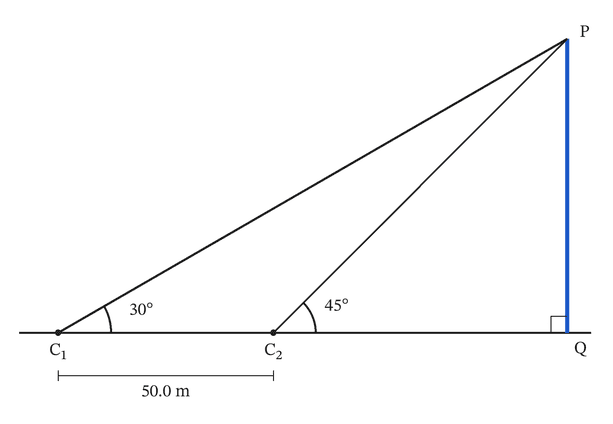
(i) Find the height of the tower.
(ii) Find the distance of from the foot of the tower.
- 174 marks
Question 17
(Hypothetical data.) A student uses a common balance whose pointer swings over a scale numbered 0 to 20 from left to right, as shown in the figure. For each setting the student notes three successive turning points on the left and two on the right.

Setting Left turning points Right turning points Both pans empty 5.0, 5.4, 5.8 15.2, 14.8 10 mg added to the right pan 3.0, 3.4, 3.8 12.4, 12.0 Body in the left pan, 23.45 g of weights in the right pan 4.4, 4.8, 5.2 13.8, 13.4 (i) Find the resting point for each setting.
(ii) Find the sensibility of the balance in milligrams per division.
(iii) Find the correct mass of the body.
- 181 mark
Question 18
The SI second is defined by taking the frequency of the radiation from a particular transition of the caesium-133 atom to be exactly . How many periods of this radiation fit into one millisecond?
- 193 marks
Question 19
(Hypothetical data.) A quartz wristwatch gains 15 s in 30 days.
(i) Find its fractional error, that is, the error per second of true time.
(ii) If the watch is set correctly today, after how many days will it be one minute fast?
(iii) A caesium atomic clock has a fractional error of . How many years would it take to be wrong by one second? Take 1 year .
- 203 marks
Question 20
(Hypothetical data.) To estimate the size of a molecule, a student dissolves of oleic acid in alcohol to make of solution. The student then dilutes of this solution with alcohol to . From a dropper, 25 drops of the final solution make . One drop is placed on water whose surface is dusted with fine powder. The alcohol dissolves in the water, and the oleic acid spreads into a circular film across, which is taken to be one molecule thick.
(i) Find the volume of oleic acid in one drop, in cubic metres.
(ii) Estimate the thickness of the film, which is roughly the size of an oleic acid molecule.
(iii) State one assumption made in this estimate.
- 211 mark
Question 21
You hold your thumb upright at arm's length, in front of your eyes, and look at it first with the left eye and then with the right eye. Your eyes are apart. (Hypothetical data.) Against a distant wall the thumb seems to jump sideways. The arrangement is shown in the figure.
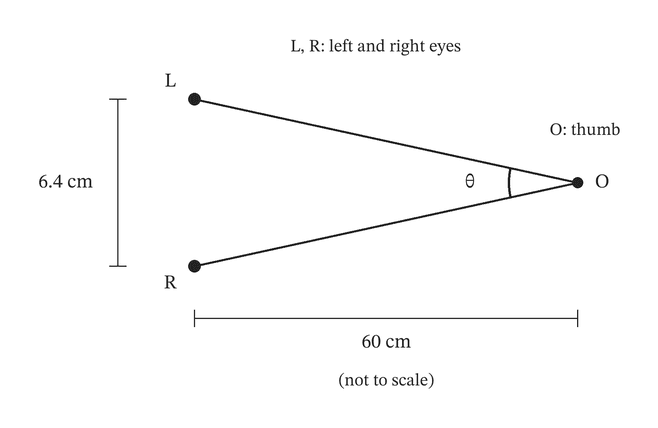
The parallax angle that the line joining your eyes subtends at the thumb is about
- 223 marks
Question 22
(Hypothetical data.) To find the distance of a mast on top of a far hill across a valley, two surveyors stand at points A and B, apart, on a line at right angles to the direction of the mast. The lines of sight from A and B to the top O of the mast meet at an angle of , as shown in the figure.

(i) Find the distance D of the mast from the line AB.
(ii) Explain why the angle must be changed into radians before using , and state the value of D a student would get by using the angle in degrees.
- 234 marks
Question 23
(Hypothetical data.) A star X lies in a direction at right angles to the line joining two positions and of the Earth, six months apart in its orbit round the Sun S. The angle that the Earth–Sun distance (1 AU) subtends at the star, called its annual parallax, is measured to be (seconds of arc), as shown in the figure.
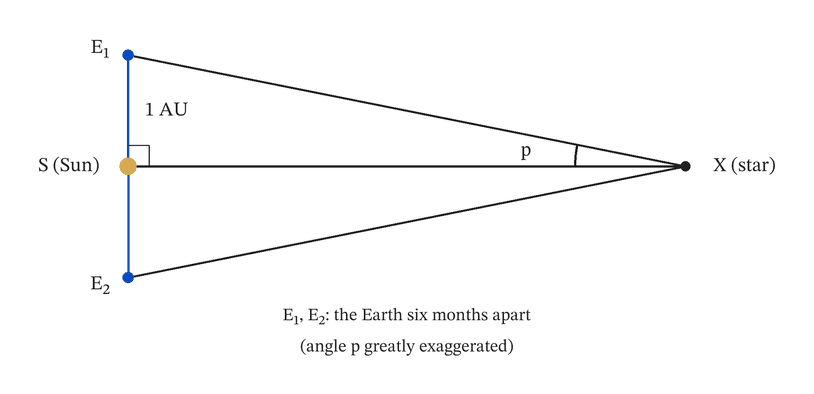
(i) Find the distance of the star in parsecs and in metres.
(ii) Express this distance in light years.
(iii) Suppose the smallest parallax angle that can be measured reliably with a ground-based telescope is . What is the greatest distance, in parsecs and in metres, that can be found by this method?
Take , and .
- 241 mark
Question 24
The Sun has a diameter of about and is from the Earth. The Moon has a diameter of about and is from the Earth. The ratio of the angular diameter of the Sun to that of the Moon, as seen from the Earth, is about
- 253 marks
Question 25
(Hypothetical data.) A laser pulse sent from an observatory is reflected back by a reflector placed on the Moon, and it returns after . Take .
(i) Find the distance of the Moon from the observatory.
(ii) The laser beam spreads out at an angle of . How wide is the patch of light it makes on the Moon?
(iii) The time of the returning pulse is uncertain by . What uncertainty does this give in the distance?
- 261 mark
Question 26
In a class activity on accuracy and precision, four students each throw five darts at identical targets. The centre of each target stands for the true value of a quantity, and each hit stands for one reading. The figure shows the hits on targets P, Q, R and S. (Hypothetical data.)
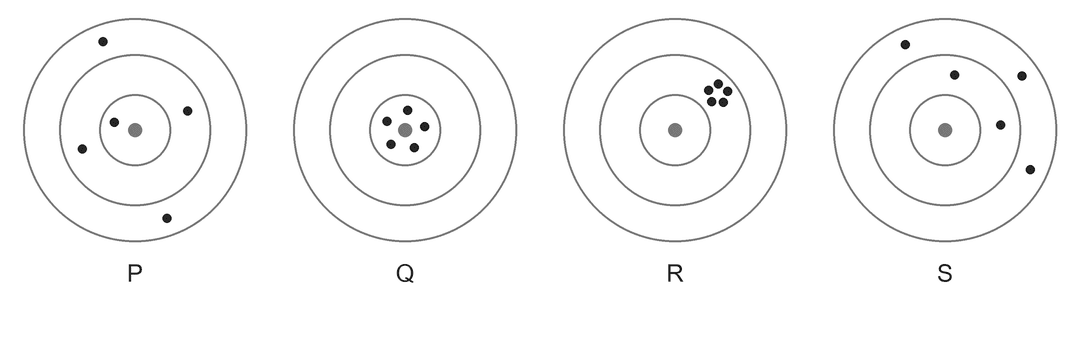
Which target shows readings that are precise but not accurate?
- 273 marks
Question 27
(Hypothetical data.) A student lays a steel strip beside a centimetre scale that has millimetre divisions, with the left end of the strip level with the zero mark, as shown in the figure.
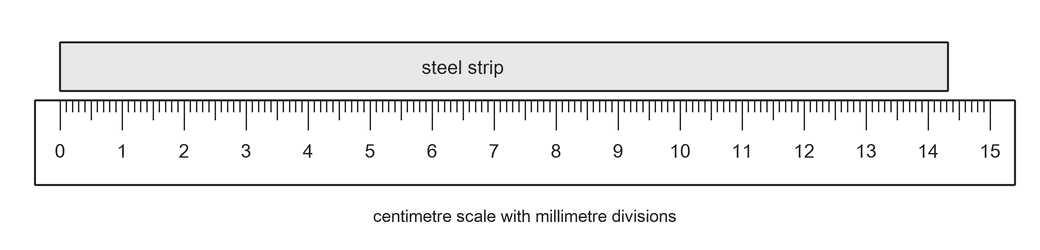
(a) Record the length of the strip as it should be written from this scale. State how many significant figures it has and which digit is doubtful.
(b) Write the same length in millimetres and in metres, and state the number of significant figures in each.
(c) The strip is then measured with vernier callipers of least count , which give . Why does this reading have more significant figures?
- 284 marks
Question 28
(Hypothetical data.) Two students, Arjun and Meera, each measure the acceleration due to gravity five times with a simple pendulum, in a laboratory where the accepted value is . Their results, in , are:
Arjun: 9.62, 9.65, 9.63, 9.64, 9.61
Meera: 9.70, 9.92, 9.79, 9.88, 9.76
(a) Find the mean value and the mean absolute error of each set.
(b) Whose result is more accurate, and whose is more precise? Explain.
(c) Arjun used the same pendulum for every trial and measured its length from the point of suspension to the top of the bob, instead of to its centre. Using , explain whether this can account for his results.
- 291 mark
Question 29
(Hypothetical data.) Four lengths were measured by different students, and each length is written to the least count of the instrument used. Which length was measured with vernier callipers of least count ?
- 303 marks
Question 30
(Hypothetical data.) A student must find the volume of a thin metal rod about long and thick. The student wants the uncertainty set by the least count to be no more than of each value measured. Three instruments are available: a metre scale (least count ), vernier callipers (least count ) and a screw gauge (least count ).
(a) Is the metre scale good enough for measuring the length?
(b) Which of the three instruments can be used for the diameter?
(c) Explain why the same instrument can be accurate enough for one of these measurements and not for the other.
- 311 mark
Question 31
(Hypothetical data.) A packet holds 250 identical sheets of paper, counted exactly. The thickness of the whole stack, measured with vernier callipers, is . Because the number of sheets is an exact count, it does not limit the number of significant figures in the result. The thickness of one sheet, written with the correct number of significant figures, is
- 322 marks
Question 32
(Hypothetical data.) A small immersion heater is connected to a supply. It draws a current of for a time of .
(a) Find the power of the heater, .
(b) Find the energy supplied, , and write it in standard form with the correct number of significant figures.
- 333 marks
Question 33
(Hypothetical data.) To find the thickness of the enamel coating on a copper wire, a student measures the diameter of the coated wire, scrapes off the enamel, and then measures the diameter of the bare wire. The thickness of the coating is half the difference of the two diameters.
(a) With a screw gauge of least count the two diameters are and . Find the thickness of the coating with the correct number of significant figures.
(b) With a finer gauge of least count the two diameters are and . Find the thickness again.
(c) Each diameter has three or four significant figures, yet the thicknesses have fewer. Explain why.
- 341 mark
Question 34
(Hypothetical data.) A resistor of resistance is joined in series with a connecting lead of resistance , and a current of flows through them. Using with the total resistance, the potential difference across the pair, written with the correct number of significant figures, is
- 353 marks
Question 35
(Hypothetical data.) The length of a simple pendulum is measured as . Its time period is calculated from .
(a) Find with the correct number of significant figures, taking .
(b) A classmate takes instead. How should the classmate's value of be written?
(c) Does the factor limit the number of significant figures in ? Explain.
- 361 mark
Question 36
(Hypothetical data.) A surveyor's steel measuring tape is correctly calibrated at . On a summer afternoon, when the tape is at , the surveyor uses it to measure a boundary wall about long. The error in this measurement is best described as
- 374 marks
Question 37
(Hypothetical data.) A ball is released from rest at the top of a ramp, and a student times its run to the bottom six times with a stopwatch. The readings, in seconds, are:
2.46, 2.51, 2.48, 3.48, 2.53, 2.50
(a) One reading is a gross error. Identify it and suggest a likely cause.
(b) Leaving that reading out, find the mean time and the mean absolute error.
(c) Find the percentage error, and write the result in the form (mean mean absolute error).
(d) By how much would the mean change if the gross error were kept?
- 381 mark
Question 38
(Hypothetical data.) A screw gauge has a positive zero error of : with its jaws closed it reads . Without applying any correction, a student takes 50 readings of the diameter of a wire and finds their mean. Compared with the true diameter, this mean will be
- 394 marks
Question 39
For each situation below, name the type of error: systematic (instrumental, environmental, observational, or due to imperfection of the set-up) or random. Then suggest how to remove or reduce it.
(i) With no current flowing, the pointer of an ammeter rests at instead of at zero.
(ii) A student reads the level of water in a measuring cylinder with their eye above the level of the water surface.
(iii) Repeated timings of the same event with a stopwatch differ slightly, some higher and some lower, because the moment the button is pressed varies a little each time.
(iv) In a calorimeter experiment, some heat is always lost to the surroundings.
- 401 mark
Question 40
(Hypothetical data.) A laboratory thermometer is wrongly calibrated: at standard atmospheric pressure it reads in melting ice and in steam from boiling water. Its scale is uniform. When it is placed in warm water it reads . The true temperature of the water is
- 411 mark
Question 41
(Hypothetical data.) A ball is dropped from rest from a height . Its speed just before landing is found from , with taken as exactly known. The percentage error in is about
- 423 marks
Question 42
(Hypothetical data.) To find the mass of a small amount of oil, a student weighs a beaker containing the oil, , and then the empty beaker, .
(a) Find the mass of the oil with its absolute error.
(b) Compare the percentage error in the mass of the oil with the percentage error in each weighing.
(c) Suggest one change that would reduce the percentage error in the mass of the oil.
- 433 marks
Question 43
(Hypothetical data.) A large public-address loudspeaker at an open-air event sends out sound power . Take the sound to spread out equally in all directions. The intensity at a distance is . A sound meter is placed at .
(a) Find the intensity at the meter.
(b) Find the maximum percentage error and the absolute error in , and write the result in the form .
- 443 marks
Question 44
(Hypothetical data.) A nurse counts 30 heartbeats of a patient and times them with a watch, getting ; the count of beats is exact.
(a) Find the heart rate in beats per minute, with its absolute error.
(b) If the nurse had counted only 10 beats, taking , what would the rate and its absolute error be?
(c) Which method is better, and why?
- 451 mark
Question 45
(Hypothetical data.) The useful power of a lift motor is found from , with taken as exactly known. The mass lifted is , it rises through , and the time taken is . The maximum percentage error in is
- 461 mark
Question 46
Use the rule that a quantity written as , with , has order of magnitude if and if . The order of magnitude of the number of seconds in one day is
- 472 marks
Question 47
(Hypothetical data.) A classroom is long, wide and high, and the density of the air in it is . Forty students, each of mass about , sit in the room. Ignore the space taken by the students and the furniture. Use the rule that a quantity written as , with , has order of magnitude if and if .
(a) Find the order of magnitude of the mass of air in the room.
(b) Find the order of magnitude of the total mass of the students, and say which mass is larger and by about how many orders of magnitude.
- 481 mark
Question 48
The Earth's diameter is about and a football is about across. Use the rule that a quantity written as , with , has order of magnitude if and if . By how many orders of magnitude is the Earth's diameter larger than the football's?
- 493 marks
Question 49
Light travels at . Use the rule that a quantity written as , with , has order of magnitude if and if . Find the order of magnitude of the time light takes to cross:
(a) a proton, of diameter about ;
(b) once around the Earth, a distance of about ;
(c) the distance from the Earth to Venus at its closest, about .
(d) By how many orders of magnitude does the longest of these times exceed the shortest?
- 502 marks
Question 50
(Hypothetical data.) Someone claims that if all the hairs on a person's head were joined end to end, they would stretch from Delhi to Mumbai, about by road. Take a head to have about hairs, each about long. Use the rule that a quantity written as , with , has order of magnitude if and if . Use orders of magnitude to test the claim.
- 512 marks
Question 51
What is the importance of measurement in scientific studies?
- 521 mark
Question 52
What is a physical quantity?
- 531 mark
Question 53
What is a fundamental quantity?
- 541 mark
Question 54
What are derived quantities?
- 551 mark
Question 55
Is angle a fundamental quantity or derived quantity?
- 561 mark
Question 56
What is a unit?
- 571 mark
Question 57
What is the distance from the Earth to the nearest star?
- 581 mark
Question 58
Define atomic mass unit (u).
- 591 mark
Question 59
What is time?
- 601 mark
Question 60
What is time interval?
- 611 mark
Question 61
Name the instruments used for measuring time in ancient times.
- 621 mark
Question 62
What is the triple point of water?
- 631 mark
Question 63
What is the S.I. unit of luminous intensity?
- 641 mark
Question 64
Name two factors on which accuracy depend.
- 651 mark
Question 65
What is the significance of 'significant figures'?
- 661 mark
Question 66
How many significant digits are there in ?
- 671 mark
Question 67
Round off to three significant figures: (i) 60.47 kg and (ii) 43.73 m.
- 681 mark
Question 68
What is a 'constant error'?
- 691 mark
Question 69
What is environmental error?
- 701 mark
Question 70
What is meant by order of magnitude?
- 711 mark
Question 71
What is the order of magnitude of (i) 13 and (ii) 197?
- 723 marks
Question 72
Relative density of a liquid is 0.8. What is its density in (i) C.G.S. system and (ii) S.I. unit?
- 733 marks
Question 73
Convert (i) into , (ii) into .
- 743 marks
Question 74
If year is taken as the unit of time and velocity of light is the unit of velocity, what is the unit of length?
- 753 marks
Question 75
(a) A new unit of length is chosen such that the speed of sound at room temperature is taken as unity. The sound of an explosion reaches a listener in 10 s. Find the distance between the listener and the place where explosion took place.
(b) Find the number of significant figures in the following:
(i) 1234 N
(ii) 0.012
(iii) m
- 763 marks
Question 76
What is the distance (in km) of a quasar from which light takes 3 billion years to reach us? km/s.
- 773 marks
Question 77
The mass of the Sun is kg and its radius is m. Find its mass density.
- 783 marks
Question 78
The length, breadth and thickness of rectangular sheet of wood are 3.230 m, 1.49 m and 1.99 cm, respectively. Give (i) the total surface area and (ii) volume of the sheet correct to the significant figures.
- 793 marks
Question 79
The mass of a box measured by grocer's balance is 4.2 kg. Two additional masses 10.20 g and 15.25 g are added to the box. What is the total mass of the box?
- 803 marks
Question 80
The mass of an electron is kg and the velocity of light is . Calculate the energy of the electron using Einstein's mass–energy relation , correct to the significant figures.
- 813 marks
Question 81
Each side of a cube is measured to be 6.203 m. What is the total surface area and the volume of cube to appropriate significant figures?
- 823 marks
Question 82
4.63 g of a substance occupies 1.1 cc. Express the density by keeping the significant figures in view.
- 833 marks
Question 83
The mass of a box measured by a grocer's balance is 2.3 kg. Two gold pieces of masses 20.15 and 20.17 g are added to the box. What is (a) the total mass of the box and (b) the difference in the masses of the pieces to correct significant figures?
- 843 marks
Question 84
Round off to three significant figures: (i) 9.745 g, (ii) 9.835 cm and (iii) 28457 m.
- 853 marks
Question 85
Solve the following with regard to the correct significant figures: (i) and (ii) .
- 863 marks
Question 86
The diameter of a sphere is 1.23 m. Find its volume with due regard to the significant figures.
- 873 marks
Question 87
A simple pendulum makes 100 oscillations in 25 s. What is the frequency of the pendulum correct to the significant figures?
- 883 marks
Question 88
Add and .
- 893 marks
Question 89
Two forces and are acting on the same body. If N and N, find their resultant when the two forces are (i) in the same direction and (ii) in opposite direction.
- 903 marks
Question 90
What is the difference between the temperature of two bodies, if their temperatures are °C and °C?
- 913 marks
Question 91
The length of a pencil is cm. A small piece of length is cut out so that the length of the remaining pencil is cm. What is the length of the small piece?
- 923 marks
Question 92
The length and breadth of a table are cm and cm, respectively. What is the area of the table?
- 933 marks
Question 93
The radius of a circle is measured to be m. Calculate the area of the circle.
- 943 marks
Question 94
Calculate the density of a body of mass g and volume , to the correct significant figures.
- 953 marks
Question 95
The resistance where V and A. The percentage error in is 5% and in is 2%. Find the total percentage error in .
- 963 marks
Question 96
The radius of a sphere is cm. What is the percentage error in volume?
- 973 marks
Question 97
One side of a square sheet is measured as 16.7 cm to an accuracy of 0.1 cm. What is the percentage error in area?
- 983 marks
Question 98
The diameter of a sphere is measured as 1.71 cm using an instrument with a least count 0.01 cm. What is the percentage error in its surface area?
- 993 marks
Question 99
The percentage error in the calculation of the volume of a sphere is 4.8%. What is the percentage error in the measurement of radius of the sphere.
- 1003 marks
Question 100
If the least count of a screw gauge is 0.001 cm and the diameter of a wire measured by it is 0.236 cm, find the permissible percentage error in the measurement.
- 1013 marks
Question 101
Find the order of magnitude of the number of atoms in of a solid. Given that the diameter of an atom is about m.
- 1021 mark
Question 102
Light year is a unit of
- 1031 mark
Question 103
Which of the following quantities has not been expressed in proper unit?
- 1041 mark
Question 104
A new unit of length is so chosen that the speed of light in vacuum is unity. Calculate the distance (in this new unit) between the Sun and the Earth if light takes 8 min and 20 seconds to reach the Earth from the Sun.
- 1051 mark
Question 105
Which of the following system of units is not based on units of mass, length and time alone?
- 1061 mark
Question 106
The unit of self inductance is
- 1071 mark
Question 107
Length cannot be measured by
- 1081 mark
Question 108
If the units of mass, length and time are doubled, unit of angular momentum will be
- 1091 mark
Question 109
Which one of the following units is not that of mutual inductance?
- 1101 mark
Question 110
If the time period of oscillation of a pendulum is measured as 2.5 second using a stopwatch with the least count 1/2 second, then the permissible error in the measurement is
- 1111 mark
Question 111
In an experiment, the angles are required to be measured using an instrument. 29 divisions of the main scale exactly coincide with the 30 divisions of the vernier scale. If the smallest division of the main scale is half-a-degree (), then the least count of the instrument is
- 1121 mark
Question 112
Two full turns of the circular scale of a screw gauge cover a distance of 1 mm on its main scale. The total number of divisions on the circular scale is 50. Further, it is found that the screw gauge has a zero error of mm. While measuring the diameter of a thin wire, a student notes the main scale reading of 3 mm and the number of circular scale divisions in line with the main scale as 35. The diameter of the wire is
- 1131 mark
Question 113
If the error in the measurement of radius of a sphere is 2%, then the error in the determination of volume of the sphere will be
- 1141 mark
Question 114
The density of a material in the shape of a cube is determined by measuring three sides of the cube and its mass. If the relative errors in measuring mass and length are 1.5% and 1%, respectively, the maximum error in determining the density is
- 1151 mark
Question 115
The period of oscillation of a simple pendulum is . Measured value of is 20.0 cm known to 1 mm accuracy and time for 100 oscillations of the pendulum is found to be 90 s using a wrist watch of 1 s resolution. The accuracy in the determination of is
- 1161 mark
Question 116
A student measured the diameter of a small steel ball using screw gauge of least count 0.001 cm. The main scale reading is 5 mm and zero of circular scale division coincides with 25 divisions above the reference level. If screw gauge has a zero error of cm, the correct diameter of the ball is
- 1171 mark
Question 117
The resistance where volts and amperes. What is the total error in ?
- 1181 mark
Question 118
The density of a material in CGS system of units is 4 g/cm. In a system of units in which unit of length is 10 cm and unit of mass is 100 g, the value of density of material will be
- 1191 mark
Question 119
A physical quantity is related to four observations , , and as follows, . The percentage errors of measurement in , , and are 1%, 3%, 2% and 2%, respectively. What is the percentage error in the quantity ?
- 1201 mark
Question 120
The respective number of significant figures for the numbers 23.023, 0.0003 and are
- 1211 mark
Question 121
The density of a material in SI units is 128 kg m. In certain units in which the unit of length is 25 cm and the unit of mass is 50 g, the numerical value of density of the material is
- 1221 mark
Question 122
The diameter and height of a cylinder are measured by a metre scale to be cm and cm, respectively. What will be the value of its volume in appropriate significant figures?
- 1231 mark
Question 123
The least count of the main scale of a screw gauge is 1 mm. The minimum number of divisions on its circular scale required to measure 5 m diameter of wire is
- 1241 mark
Question 124
In the density measurement of a cube, the mass and edge length are measured as kg and m, respectively. The error in the measurement of density is
- 1251 mark
Question 125
In an experiment, the percentage of error occurred in the measurement of physical quantities , , and are 1%, 2%, 3% and 4%, respectively. Then the maximum percentage of error in the measurement , where , will be
- 1261 mark
Question 126
If the screw on a screw gauge is given six rotations, it moves by 3 mm on the main scale. If there are 50 divisions on the circular scale, the least count of the screw gauge is
- 1271 mark
Question 127
A student measuring the diameter of a pencil of circular cross-section with the help of a vernier scale records the following four readings 5.50 mm, 5.55 mm, 5.45 mm and 5.65 mm. The average of these four readings is 5.5375 mm and the standard deviation of the data is 0.07395 mm. The average diameter of the pencil should therefore be recorded as
- 1281 mark
Question 128
A screw gauge has 50 divisions on its circular scale. The circular scale is 4 units ahead of the pitch scale marking, prior to use. Upon one complete rotation of the circular scale, a displacement of 0.5 mm is noticed on the pitch scale. The nature of zero error involved and the least count of the screw gauge, are respectively
- 1291 mark
Question 129
Taking into account of the significant figures, what is the value of 9.99 m 0.0099 m?
- 1301 mark
Question 130
The period of oscillation of a simple pendulum is . Measured value of is 1.0 m from metre scale having a minimum division of 1 mm and time of one complete oscillation is 1.95 s measured from stopwatch of 0.01 s resolution. The percentage error in the determination of will be
- 1311 mark
Question 131
In order to determine the Young's modulus of a wire of radius 0.2 cm (measured using a scale of least count = 0.001 cm) and length 1 m (measured using a scale of least count = 1 mm), weight of mass 1 kg (measured using a scale of least count = 1 g) was hanged to get the elongation of 0.5 cm (measured using a scale of least count 0.001 cm). What will be the fractional error in the value of Young's modulus determined by this experiment?
- 1321 mark
Question 132
A screw gauge gives the following readings when used to measure the diameter of a wire
Main scale reading: 0 mm
Circular scale reading: 52 divisions
Given that 1 mm on main scale corresponds to 100 divisions on the circular scale. The diameter of the wire from the above data is
- 1331 mark
Question 133
Vernier constant of a vernier scale mm on measuring diameter of a shaft. Main scale reading cm. If the main scale reading coincides with 5 divisions of vernier scale and the zero error is cm, the diameter of the shaft is
- 1341 mark
Question 134
If mass, length and time each has 5% error, then what is the error in the reading of torque?