
Opening your dashboard
Class 11 Maths Chapter 2: Relations and Functions Solutions
135 textbook questions with step-by-step answers, free to read, for ISC 2026-27.
Get talked through Ch 2, not just shown the answer
Reading a finished solution is not the same as being able to do it. The AI tutor takes one question at a time and works it with you, in your own words, until you can.
- Ask it out loud, in your own words
- It gives you the next step, not the answer
- Stuck on part (ii)? Start there
135 questions with solutions
1–3 marks · Mixed difficulty
The first 11 solutions are on this page. This chapter is a long one, so the rest open on their own page to keep this one quick to load.
- 13 marks
Question 1
and . Form all ordered pairs such that is a factor of and .
Solve with AIWritten solution
Solution:
Key idea: The pair is wanted when is a factor of (that is, divided by leaves no remainder) and is smaller than . We take each value of in turn and test every value of .
Step 1 — Test . We look for values of that are greater than 2 and divisible by 2.
4, 6, 18 and 54 are even, so each is divisible by 2; 27 is odd, so it is not.
All four even values are greater than 2, so we get , , and .
Step 2 — Test . We look for values of that are greater than 4 and divisible by 4.
is divisible by 4 but is not greater than 4, so it is left out.
, , and all leave a remainder, so no pair starts with 4.
Step 3 — Test . We look for values of that are greater than 6 and divisible by 6.
and , while 4 and 6 are not greater than 6 and 27 is odd.
This gives and .
Step 4 — Test . We look for values of that are greater than 9 and divisible by 9.
, and , while 4 and 6 are smaller than 9.
This gives , and .
Step 5 — Collect the pairs. We put together the pairs found in Steps 1 to 4. These steps give 4, 0, 2 and 3 pairs, so there are 9 pairs in all.
Therefore, the ordered pairs are .
- 23 marks
Question 2
Find the numbers and if .
Solve with AIWritten solution
Solution:
Key idea: Two ordered pairs are equal only when their first entries are equal and their second entries are equal. So one equation in pairs gives two ordinary equations.
Step 1 — Write the two equations. We equate the first entries and then the second entries of and .
Step 2 — Solve for . We add 2 to both sides of the first equation.
Step 3 — Solve for . We subtract 5 from both sides of the second equation and write 5 as so that the fractions can be combined.
Step 4 — Check. We substitute back: is , and is , so both entries match.
Therefore, and .
- 33 marks
Question 3
If and , find
(i)
(ii)
(iii)
(iv)
(v)
(vi)
(vii)
(viii) .
Solve with AIWritten solution
Solution:
Key idea: For sets and , the product is the set of all ordered pairs with and . If has elements and has elements, each of the first entries can be paired with each of the second entries, so .
Step 1 — Count the elements of and . We note the sizes of the given sets, since we need them for parts (v) to (viii).
, so .
, so .
Step 2 — List (i) . We pair each element of (first entry) with each element of (second entry), one first entry at a time.
Step 3 — List (ii) . We pair each element of with each element of ; the first entry always comes from .
Step 4 — List (iii) . We now take the first entry from and the second from , so every pair of (ii) appears reversed.
Step 5 — List (iv) . We pair each element of with each element of .
Step 6 — Count (v) . We multiply the number of choices for the first entry by the number for the second entry.
Step 7 — Count (vi) . We use and in the same rule.
Step 8 — Count (vii) . The order of the sets changes the pairs but not their number.
Step 9 — Count (viii) . We use twice.
These counts agree with the lists in Steps 2 to 5 (16, 12, 12 and 9 pairs).
Therefore, (i) to (iv) are the sets listed above, and (v) 16, (vi) 12, (vii) 12, (viii) 9.
- 43 marks
Question 4
Answer true or false:
(i) If and , then
(ii) is a product set.
(iii) If and and , then .
(iv) If and are non-empty sets, then is a non-empty set of ordered pairs such that and .
Solve with AIWritten solution
Solution:
Key idea: By definition : the first entry always comes from the first set and the second entry from the second set, and . A set of ordered pairs is a product set when it contains every such pair and nothing else.
Step 1 — Check statement (i). We write out in full, pairing each element of with each element of .
This product has 4 pairs, because each of the 2 first entries is paired with each of the 2 second entries. The statement lists only 2 of them; and are missing.
So statement (i) is false.
Step 2 — Check statement (ii). We collect the first entries and the second entries of the given pairs.
First entries: . Second entries: .
The product has 4 pairs (2 choices for the first entry times 2 for the second), and the given set lists exactly these four: .
So the set equals , and statement (ii) is true.
Step 3 — Check statement (iii). We use the counting rule, which does not depend on whether and share elements.
The condition is extra information that does not change the count, so statement (iii) is true.
Step 4 — Check statement (iv). We compare the statement with the definition of .
In the first entry comes from and the second entry comes from . The statement says and , which describes instead.
So statement (iv) is false.
Therefore, (i) False, (ii) True, (iii) True, (iv) False.
- 53 marks
Question 5
Given , , , test whether the following are true:
(i) .
(ii) .
Solve with AIWritten solution
Solution:
Key idea: To test whether two sets of ordered pairs are equal, we list (or count) the pairs on each side. If one side has a pair the other does not, the sets are different.
Step 1 — Find for part (i). We first join and , then pair each element of with each element of the union.
, which has 6 pairs.
Step 2 — Find for part (i). We form the two unions and count the pairs of their product.
and .
Step 3 — Compare the two sides of part (i). A set with 6 pairs cannot equal a set with 12 pairs. For example, belongs to , because and , but it is not in .
So the statement in part (i) is false.
Step 4 — Find the left side of part (ii). We first find ; since and have no common element, it is empty.
There is no pair because there is no possible second entry.
Step 5 — Find the right side of part (ii). We list both products and look for common pairs.
Every pair of ends in 3, and no pair of does, so they have no pair in common.
Step 6 — Compare the two sides of part (ii). Both sides are the empty set, so the statement in part (ii) is true.
Therefore, (i) is false and (ii) is true.
- 63 marks
Question 6
If , and , then find .
Solve with AIWritten solution
Solution:
Key idea: The union of two sets of ordered pairs contains every pair that is in either set, each written only once.
Step 1 — List . We pair each element of with each element of .
Step 2 — List . We pair each element of with each element of .
Step 3 — Form the union. We put all the pairs together; the pairs , and occur in both lists, so they are written only once.
Step 4 — Check the count. The union should equal , where , so it must have this many pairs:
Our list has 12 pairs, as expected.
Therefore, .
- 73 marks
Question 7
If , , , find
(i)
(ii)
(iii) and draw their graphs.
Solve with AIWritten solution
Solution:
Key idea: The graph of a cartesian product is drawn by plotting one point on a co-ordinate plane for each ordered pair. Because the sets are finite, the graph is a set of separate points, not a line.
Step 1 — List (i) . We pair each element of (first entry) with each element of (second entry); this gives 12 pairs (4 choices for the first entry times 3 for the second).
Step 2 — Graph . We take the first entry along the -axis and the second entry along the -axis and plot the 12 points; they lie in 3 rows (at heights 5, 7 and 9) of 4 points each.
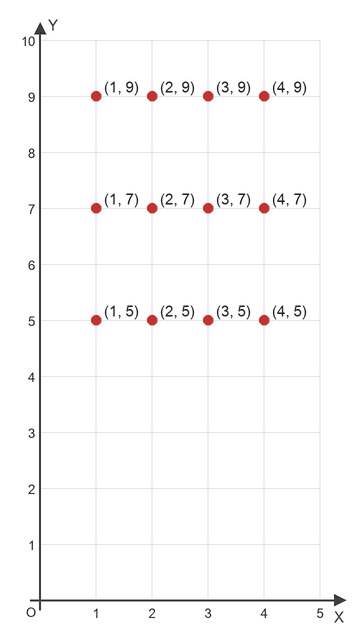
Step 3 — List (ii) . We pair each element of with each element of ; this gives 9 pairs (3 choices times 3 choices).
Step 4 — Graph . We plot the 9 points; they form 3 columns (at ) of 3 points each.
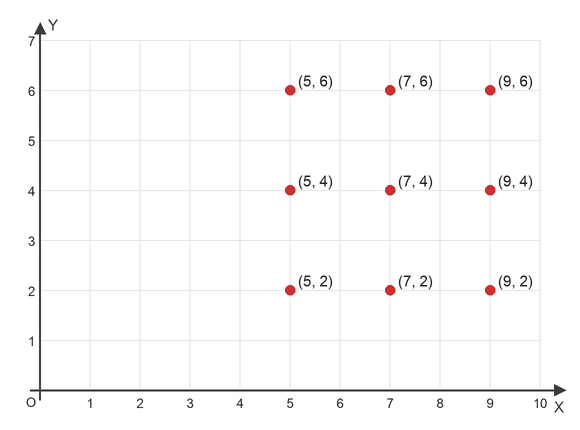
Step 5 — List (iii) . We pair each element of with each element of ; this gives 12 pairs (3 choices times 4 choices).
Step 6 — Graph . We plot the 12 points; they form 3 columns (at ) of 4 points each.
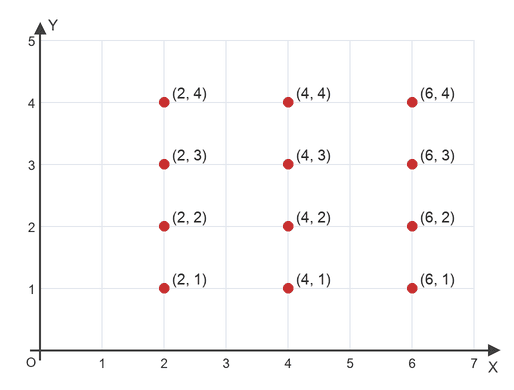
Watch out: Do not join the points. Only the listed pairs belong to the product, so each graph is a rectangular pattern of separate dots.
Therefore, and have 12 pairs each and has 9 pairs, as listed and plotted above.
- 83 marks
Question 8
Some elements of are , , . If , find the remaining elements of such that is least.
[Hint. Set must be ]
Solve with AIWritten solution
Solution:
Key idea: In every first entry belongs to and every second entry belongs to , and . To make least we must make as small as possible.
Step 1 — Find the elements that must be in . The given pairs , and have second entries , and , so these three must belong to .
Step 2 — Choose the smallest . Since is fixed, is least when has nothing more than these three elements.
Step 3 — List . We pair each of with each of .
Step 4 — Remove the given pairs. We strike out , and ; that leaves 9 of the 12 pairs.
Therefore, the remaining elements are .
- 93 marks
Question 9
The ordered pairs , , are among the elements in the set . If and have 3 elements each, how many elements in all does the set have? Also find the remaining elements.
Solve with AIWritten solution
Solution:
Key idea: In the first entries come from and the second entries come from , and .
Step 1 — Count the elements of . Each set has 3 elements, so we multiply.
Step 2 — Find . The first entries of , and are 1, 2 and 3, so all three lie in . Since has exactly 3 elements, nothing else can be in it.
Step 3 — Find . The second entries are also 1, 2 and 3, and has exactly 3 elements.
Step 4 — List and remove the given pairs. We pair each element of with each element of .
Leaving out the three given pairs , , leaves 6 pairs.
Therefore, has 9 elements, and the remaining ones are .
- 103 marks
Question 10
If , and , then verify that
(i)
(ii)
Solve with AIWritten solution
Solution:
Key idea: To verify an identity between sets of ordered pairs, we list the left-hand side (LHS) and the right-hand side (RHS) separately and check that they contain exactly the same pairs.
Step 1 — Find for part (i). We join and , writing the common elements 2 and 3 once.
Step 2 — List the LHS of part (i). We pair each element of with each element of .
Step 3 — List the RHS of part (i). We list the two products and then join them.
The pairs are common, so they are written once in the union.
Step 4 — Compare for part (i). Both sides contain the same 8 pairs, so LHS = RHS and part (i) is verified.
Step 5 — Find for part (ii). keeps the elements of that are not in ; neither 1 nor 4 is in .
Step 6 — List the LHS of part (ii). We pair each element of with each element of .
Step 7 — List the RHS of part (ii). We list and , then remove from every pair that is also in .
Every pair of starts with 1 or 4, and no pair of does, so nothing is removed.
Step 8 — Compare for part (ii). Both sides contain the same 6 pairs, so LHS = RHS and part (ii) is verified.
Therefore, both and are verified.
- 113 marks
Question 11
If , , show that .
Solve with AIWritten solution
Solution:
Key idea: A pair lies in both and exactly when and each lie in both and , that is, in . So we expect to be .
Step 1 — List the LHS. We pair each element of with each element of .
Step 2 — List . We pair each element of with each element of .
Step 3 — List . We pair each element of with each element of .
Step 4 — Find the common pairs. We keep only the pairs that appear in both lists. Any pair containing 1 is missing from , and any pair containing 4 is missing from , so only pairs made of 2 and 3 remain.
Step 5 — Compare. This is exactly the list found for in Step 1 (note that ).
Therefore, , as required.
- 123 marks
Question 12
Let and be two sets such that and . If , , are in , find and , where are distinct elements.
- 133 marks
Question 13
The Cartesian product has 9 elements among which are found and . Find the set and the remaining elements of .
- 143 marks
Question 14
Write down the relation shown by the arrow diagram, by listing the ordered pairs. State the domain, co-domain, and the range of the relation.
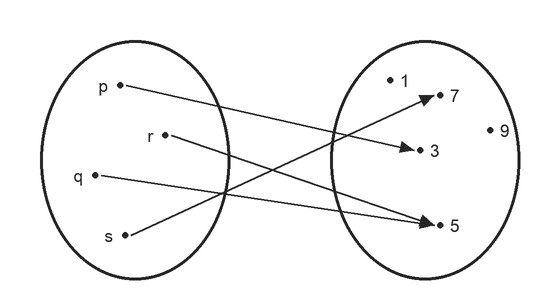
- 153 marks
Question 15
The figure shows the relationship between the sets P and Q. Write the relation (i) in set builder form, (ii) in roster form.
What are its domain and range?

- 163 marks
Question 16
Which of the following are relations from to , where and ?
(i)
(ii)
(iii)
(iv)
(v)
- 173 marks
Question 17
In each of the following, state which of the ordered pairs belong to the given relations?
(i) ;
(ii) ;
(iii) ;
- 183 marks
Question 18
Let be the set of natural numbers. Describe the following relations in words, giving their domain and the range.
(a)
(b)
(c) .
- 193 marks
Question 19
is the set of integers. Describe the following relation in set builder form, given its domain and range.
- 203 marks
Question 20
Write down the domain and range of the relation
(i) , and are natural numbers less than .
(ii) .
- 213 marks
Question 21
Determine the domain and range of the relation .
(a) . Draw the graph of .
(b) is a prime number less than .
(c) is an integer
(d)
- 223 marks
Question 22
Given , list the ordered pairs determined by each of the following relations applied on :
(i) = "is less than"
(ii) = "is the square of"
(iii) = "is the additive inverse of"
(iv) = "is equal to".
- 233 marks
Question 23
Given . List the elements of each of the following relations:
(i)
(ii)
(iii) is a divisor of and .
- 243 marks
Question 24
If and are integers and is a relation, then find the value of .
- 251 mark
Question 25
If is the set of even natural numbers less than 8 and is the set of prime numbers less than 7, then the number of relations from to is
- 261 mark
Question 26
Let be a finite set. The number of relations on where has 3 elements are:
- 271 mark
Question 27
Let . Then the number of all relations on is
- 283 marks
Question 28
Let , and . Are the following true?
(i) is a relation from to .
(ii) is a function from to .
Justify your answer in each case.
- 293 marks
Question 29
Let . Determine whether or not each relation is a function from into .
(i)
(ii)
(iii)
- 303 marks
Question 30
State for each of the following relations whether it is function or not. (Write Yes or No)
(i) .
(ii) is surname of where is the set of people in India and is the set of surnames.
(iii) is the area of a square of side where is the set of measurements of length.
(iv) is a passenger on where is the set of buses of a school and is the set of pupils of some schools.
(v) is sewn onto , where is the set of buttons and is the set of shirts.
- 313 marks
Question 31
The ordered pairs are represented by the points shown. For each diagram, state whether it represents a relation or a function. Justify your answer.

- 323 marks
Question 32
The domain and range of a function are subsets of and respectively, where and . List the elements of the function as ordered pairs.
- 331 mark
Question 33
Which of the four statements given below is different from others?
(a)
(b)
(c) is a mapping of into
(d) is a function of into
- 343 marks
Question 34
and
(i) List the domain of
(ii) List the range of
(iii) Is a function?
- 353 marks
Question 35
highest prime factor of .
(i) Find the range of when the domain is .
(ii) State a domain of five integers for which the range is .
(iii) A set of positive integers is called . What can be said about these integers if ?
- 363 marks
Question 36
What is the fundamental difference between a function and a relation? Let and . Determine which of the following sets are:
(i) relation (ii) function (iii) neither
(a)
(b)
(c)
(d)
- 373 marks
Question 37
A certain jet plane has an average speed of 500 km per hour. It can carry sufficient fuel for a 5 hour flight.
(i) Define the relation, as a set, between the distance (in km) and time (in hours) for this plane.
(ii) State the domain of the relation.
(iii) State the range of this relation.
(iv) Is this relation a function?
- 383 marks
Question 38
The domain of a function is the set of positive integers less than 12. If , find all ordered pairs satisfying the function. Graph the function.
- 393 marks
Question 39
Let and . How many different functions are there from into ?
- 403 marks
Question 40
A function given as .
Is this function one-one onto?
Interchange the order of the elements in the ordered pairs and form the new relation. Is this relation a function? If it is a function, is it one-one onto?
- 413 marks
Question 41
Determine if each function is one-one.
(i) To each person on the earth assign the number which corresponds to his age.
(ii) To each country in the world assign the latitude and longitude of its capital.
(iii) To each book written by only one author assign the author.
(iv) To each country in the world which has a prime minister assign its prime minister.
- 423 marks
Question 42
Let . Find , i.e., the range of , if is an onto function.
- 433 marks
Question 43
Show that the function given by for all , is neither one-one nor onto.
- 443 marks
Question 44
Let . Let functions , and of onto be defined by:
(1)
(2)
(3)
Which function, if any, is/are onto?
- 453 marks
Question 45
Given , , construct an example of each of the following.
(i) A one-one mapping from to
(ii) A mapping from to which is not one-one
(iii) A mapping from to .
- 463 marks
Question 46
Are the following sets of ordered pairs functions? If so, examine whether the mapping is onto or one-one.
(i)
(ii) .
- 473 marks
Question 47
Is the function ( is the set of natural numbers) defined by for all onto?
- 483 marks
Question 48
Let and . Give an example of a function from to . Can you define a function from to which is onto? Give reasons for your answer.
- 493 marks
Question 49
Prove that the function , is a many-one into function.
- 503 marks
Question 50
Let , and let be a function from to . Show that is one-one but not onto.
- 513 marks
Question 51
Show that the function is one-one onto and hence bijective.
- 523 marks
Question 52
Let be defined respectively by , , find
(i)
(ii)
(iii) .
- 533 marks
Question 53
If and be two functions defined over the domain , then find the value of
(i)
(ii)
(iii)
(iv)
- 543 marks
Question 54
If the function is defined by , then find .
- 553 marks
Question 55
If , find .
- 563 marks
Question 56
If , find .
- 573 marks
Question 57
The function '' which maps temperature in degree Celsius into temperature in degree Fahrenheit is defined by , find:
(i)
(ii)
(iii)
(iv) the value of , when .
- 583 marks
Question 58
If , find
- 593 marks
Question 59
Let be a function from to defined by for some integers and . Determine , .
- 603 marks
Question 60
If , find , and .
- 613 marks
Question 61
If , show that .
- 623 marks
Question 62
If , then show that .
- 633 marks
Question 63
If , then prove that
- 643 marks
Question 64
If , then show that .
- 653 marks
Question 65
If , then show that.
(i)
(ii)
- 663 marks
Question 66
If , find the value of
- 673 marks
Question 67
If , for all and if it is an even function, find .
- 683 marks
Question 68
If , for all and if it is an odd function, find .
- 693 marks
Question 69
Is there a function which is both even and odd?
- 703 marks
Question 70
Prove that is an even function.
[Hint. Show that ]
- 713 marks
Question 71
The range and domain of function are subsets of and respectively, where and . List the elements of the function as ordered pairs.
- 723 marks
Question 72
and .
(i) List the domain of
(ii) List the range of
(iii) Is a function?
- 733 marks
Question 73
highest prime factor of .
(i) Find the range of when the domain is .
(ii) State a domain of five integers for which the range is .
(iii) A set of positive integers is called . What can be said about these integers if ?
- 743 marks
Question 74
A function is defined on the set of integers as follows:
(i) Find the domain of the function
(ii) Find the range of the function
(iii) Find the value of .
- 753 marks
Question 75
Let be a function whose domain is the set of all real numbers. If , what is the range of ?
- 763 marks
Question 76
Write the domain of the following real functions
(i)
(ii)
(iii)
(iv)
(v)
(vi)
(vii)
(viii)
- 773 marks
Question 77
Find the range of each of the following real functions
(i)
(ii)
(iii)
(iv)
(v) ,
(vi) ;
(vii)
(viii)
(ix)
- 783 marks
Question 78
Find the domain and range of the function .
- 791 mark
Question 79
If the domain of the function be , then its range is
- 803 marks
Question 80
Graph the function .
- 813 marks
Question 81
Graph the function .
- 823 marks
Question 82
Graph the function .
- 833 marks
Question 83
Graph the function , .
- 843 marks
Question 84
Graph the function , .
- 853 marks
Question 85
Graph the function .
- 863 marks
Question 86
(i) Copy and complete this table of values :
(ii) Draw the graph on squared paper, for .
(iii) What features do the graphs of (drawn on page Ch 2-53) and have in common?
- 873 marks
Question 87
(i) Copy and complete this table.
(ii) Draw the graphs (See Solved Ex. 86) and , on the same diagram, for .
(iii) Which line is the axis of symmetry in the diagram?
- 883 marks
Question 88
A sketch of the graph is shown in Fig. 2.78. Find the values of and .

- 893 marks
Question 89
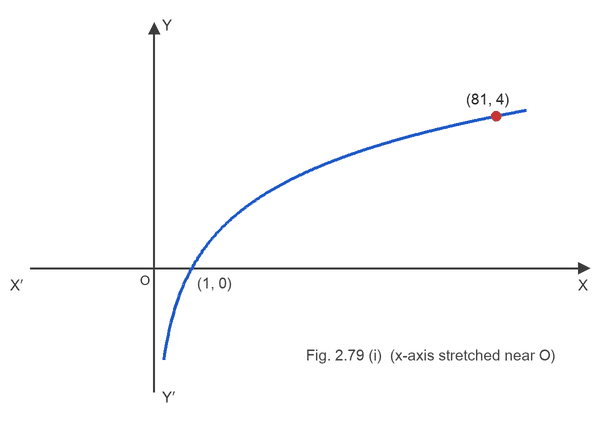
Figure (i) shows the curve . What is the value of ?
- 903 marks
Question 90
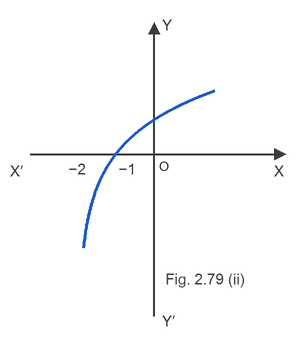
Fig 2.79 (ii) shows the curve . What is the value of ?
- 913 marks
Question 91
(i) Sketch the graphs and on the same diagram.
(ii) Find the point of intersection of the graphs by solving the equation .
- 923 marks
Question 92
The sketch shows part of the graph . [Fig. 2.80].
Find the values of and .

- 933 marks
Question 93
(i) Sketch the graphs and on the same diagram.
(ii) Write down an equation to find the -coordinate of the point of intersection of the graphs.
(iii) Show that satisfies .
(iv) From your graph find , correct to 2 decimal places.
- 943 marks
Question 94
Sketch the graphs.
(i)
(ii)
(iii)
- 953 marks
Question 95
Sketch the graphs.
(i)
(ii)
(iii)
- 963 marks
Question 96
For , draw the graph of . (use 1 cm unit on both axes).
Use this graph to solve .
- 973 marks
Question 97
(i) Complete the following table for . Enter the values of and correct to 1 decimal place.
Copy the table on your answer book and enter the values there.
(ii) Taking 4 cm unit on both axes, draw the graph of for
(iii) From your graph estimate .
- 983 marks
Question 98
Copy and complete the table, for the function , giving your answer correct to 1 d.p. Then draw the graph.
- 993 marks
Question 99
Sketch the graphs of the following rational functions
(i)
(ii)
(iii)
(iv)
(v)
- 1001 mark
Question 100
If , , and find
- 1011 mark
Question 101
find if
- 1021 mark
Question 102
Find the domains and range to the relation
- 1031 mark
Question 103
Tick the Correct Answer.
(i) Is the relation a function? Yes/ No
(ii) Is the relation a function? Yes/ No
- 1041 mark
Question 104
Name four different ways to represent a relation or function.
- 1051 mark
Question 105
Let . Define a relation from to by , where . Write down its codomain, domain and range.
- 1061 mark
Question 106
Explain whether the relation from A to B is a function, the relation from B to A is a function, or both are functions.
A B (i) Date of birth Person (ii) Thumbs print Person (iii) Area code State (iv) River Ganga City (v) Mother Her children - 1071 mark
Question 107
Use the vertical line test to determine whether each relation is a function
(i)
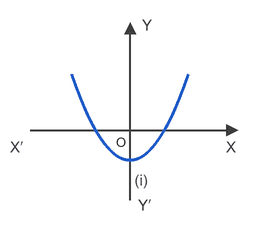
(ii)

(iii)

- 1081 mark
Question 108
Find , , for the function .
- 1091 mark
Question 109
If , find the value of
- 1101 mark
Question 110
Find the domain of the function
- 1111 mark
Question 111
If , find the image of and pre-image of .
- 1121 mark
Question 112
If and , find .
- 1131 mark
Question 113
If is defined by , the greatest integer function, find its domain, range and draw its graph.
- 1141 mark
Question 114
Find the range of the real function .
- 1151 mark
Question 115
If and are two non-empty finite sets having 3 and 4 elements respectively, then what would be the possible number of relations of ?
- 1161 mark
Question 116
If there are 2 elements in a set , then what would be the number of possible relations from the set to set A?
- 1171 mark
Question 117
If and , which statement is NOT true?
- 1181 mark
Question 118
If and be two elements such that consists of 6 elements. If three elements of are , , and , find .
- 1191 mark
Question 119
Let and , then the number of relations on A B is
- 1201 mark
Question 120
Let and be the relation on defined by , is an even number, then find the range of .
- 1211 mark
Question 121
Let and . which one of the following is not a relation from to ?
- 1221 mark
Question 122
is a relation on given by . Which of the following belongs to ?
- 1231 mark
Question 123
Let be defined by
then is
- 1241 mark
Question 124
Find whether the function is even or odd or neither.
- 1251 mark
Question 125
Domain of is
- 1261 mark
Question 126
Range of the function , R is
- 1271 mark
Question 127
If is a function defined by , then its range is given by
- 1281 mark
Question 128
If and total number of possible relations from set to set is , then is
- 1291 mark
Question 129
Let , and let be the relation 'is factor of' from to . Then the range of is the set
- 1301 mark
Question 130
For which of the following values of '' does the function have the real values?
- 1311 mark
Question 131
If , , then is equal to
- 1321 mark
Question 132
The domain of the function defined by is
- 1331 mark
Question 133
The domain of the function is
- 1341 mark
Question 134
Which of the following functions is neither even nor odd?
- 1351 mark
Question 135
If S is a set with 10 elements and , then the numbers of elements in A is
What Class 11 Maths Ch 2 covers
The sections of the chapter, in the order the book takes them. Every question above comes from one of these.
- 01Ordered Pairs and Cartesian Product
- 02Relations: Domain, Range and Inverse
- 03Functions: Definition, Domain and Range
- 04Types of Functions
- 05Algebra of Functions and Real Valued Functions
- 06Domain and Range of Real Functions
- 07Graphs of Real Functions
More ways to study this chapter
The same chapter asked three other ways. Practise it, revise it, and see what the board has set on Ch 2 before.
Class 11 Maths Ch 2 questions students ask
How many questions are there in Class 11 Maths Ch 2?
135 questions. Every one is solved step by step on this page.
Are these Class 11 Maths solutions free?
Yes. Every question and its full working is free to read, with no account needed.
Can I download the Class 11 Maths Ch 2 solutions as a PDF?
There is no PDF to download. Every solution is on this page instead, which means it is searchable, always the current syllabus, and readable on a phone. Use your browser's print option if you want it on paper.