
Opening your dashboard
Class 11 Maths Chapter 2 Relations and Functions: Competency-Based Questions (CBQ)
40 questions on Chapter 2, each worked through on its own page with the AI tutor. Class 11 Maths, ICSE 2026-27.
40 questions
1–5 marks · Mixed difficulty
- 13 marks
Question 1
Competency: Application
An examination room has 5 rows of desks, named A, B, C, D, E from the front, and 6 columns, numbered 1 to 6 from the left. Each seat is labelled by an ordered pair (row, column), so the set of seats is , where and . (Hypothetical data.)
For one test, no candidate may sit in the front row or in a seat next to a wall (columns 1 and 6). Let be the front-row seats and the seats next to a wall.
(a) How many seats does the room have? Is a seat label? Give a reason.
(b) Find in roster form.
(c) How many seats can be used for the test?
- 21 mark
Question 2
Competency: Application
In an inter-class chess event, every Class XI player plays exactly one game against every Class XII player, and players of the same class do not play each other. Each game is recorded as an ordered pair (Class XI player, Class XII player). The record has 48 games, and Class XII has 2 more players than Class XI. (Hypothetical data.)
How many players does Class XI have?
- 31 mark
Question 3
Competency: Analysis & Evaluation
For a debate practice, the school forms two teams and ; both teams have members and no student is in both. A practice round is recorded as an ordered pair (first speaker, second speaker). List 1 is (team speaks first) and List 2 is (team speaks first).
Assertion (A): List 1 and List 2 have no ordered pair in common.
Reason (R): For any sets : .
- 43 marks
Question 4
Competency: Analysis & Evaluation
A bus company runs direct buses from towns in to cities in . The arrow diagram shows the relation from to : an arrow from to means there is a direct bus from to . (Hypothetical data.)
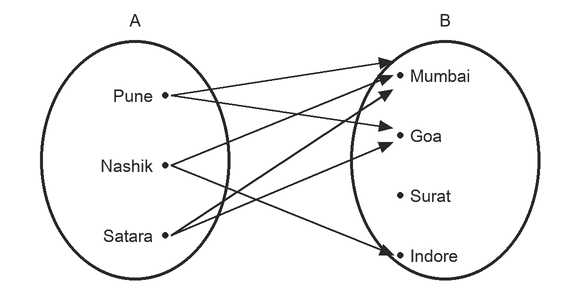
(a) Write in roster form and state its domain and range.
(b) Write in roster form, state its domain, and say in words what means.
(c) The company wants a new timetable whose relation from to has domain and range . What is the least number of direct routes (ordered pairs) it needs? Give a reason and one example.
- 51 mark
Question 5
Competency: Understanding
The 20 lockers in a school corridor are numbered 1 to 20 and stacked in 4 rows of 5: the bottom row is 1 to 5, the row above it 6 to 10, then 11 to 15, and the top row 16 to 20 (locker 6 is directly above locker 1). On , define the relation
.
The domain of is
- 61 mark
Question 6
Competency: Analysis & Evaluation
In a mentoring scheme, is the set of 3 senior students and the set of 2 junior students who take part. The scheme's record is the set of all ordered pairs (senior, junior) such that the senior mentors the junior; each pair is written once. (Hypothetical data.)
Assertion (A): The record can contain 7 pairs.
Reason (R): Every relation from to is a subset of .
- 73 marks
Question 7
Competency: Application
A school converts the marks (a whole number from 0 to 100) in a test into grades by this table. Let , and let be the rule 'marks grade'. (Hypothetical data.)
Marks 90–100 75–89 60–74 40–59 0–39 Grade A1 A2 B C D (a) Explain why is a function from to .
(b) A student says the reverse rule 'grade marks' is a function from to . Is she right? Give a reason.
(c) In one group the marks are . With this set as the domain, find the range of . Is it equal to the co-domain ?
- 81 mark
Question 8
Competency: Application
A courier service charges for a letter by its weight grams, where : ₹5 for a letter of weight up to 20 g, and ₹5 more for every additional 20 g or part of 20 g. Let be the charge in rupees. (Hypothetical data.)
The set of all weights for which is
- 91 mark
Question 9
Competency: Analysis & Evaluation
A mobile company's records show that each SIM's mobile number is registered to exactly one customer. Every customer has at least one SIM, and some customers have two SIMs. Let be the set of mobile numbers and the set of customers. (Hypothetical data.)
Assertion (A): The rule 'mobile number customer it is registered to' is a function from to , but the rule 'customer his or her mobile number' is not a function from to .
Reason (R): A relation from a set to a set is a function when every element of has exactly one image in ; two elements of may have the same image.
- 104 marks
Question 10
Competency: Analysis & Evaluation
For a school examination, 90 students with roll numbers 1 to 90 are seated in 3 halls, each with 30 seats numbered 1 to 30. Roll numbers 1–30 sit in Hall 1, 31–60 in Hall 2 and 61–90 in Hall 3, in order, so roll number 31 has seat 1 of Hall 2. (Hypothetical data.)
Let , and . The function gives each student's seat number only, and gives the ordered pair (hall, seat).
(a) Find , and the roll number with .
(b) Show that is not one-one. Is onto ?
(c) Show that is one-one and onto, that is, a bijection from to .
- 111 mark
Question 11
Competency: Analysis & Evaluation
On a school trip, 18 students stay in a hostel that has 25 single rooms. Each student is given one room and no two students share a room. Let be the function 'student room' from the set of 18 students to the set of 25 rooms. (Hypothetical data.)
Assertion (A): is one-one but not onto.
Reason (R): A function from a finite set to a finite set with cannot be onto.
- 121 mark
Question 12
Competency: Understanding
A vending machine has 6 buttons, , and its menu card lists 6 items, . Button 1 gives water, 2 gives lemonade, 3 gives iced tea, 4 gives water, 5 gives cola and 6 gives soda. No button gives juice. (Hypothetical data.)
The function , 'button item it gives', is
- 131 mark
Question 13
Competency: Analysis & Evaluation
A digital sensor receives a signal level , which can be any real number, and its display shows . (Hypothetical data.)
Assertion (A): Two different signal levels always give two different displayed values, that is, is one-one.
Reason (R): Every function whose graph passes through the origin is one-one.
- 144 marks
Question 14
Competency: Application
Two water tanks are watched for 16 minutes. Tank P starts with 800 litres and drains at 50 litres per minute; tank Q starts with 200 litres and is filled at 25 litres per minute. After minutes () the tanks hold
litres and litres. (Hypothetical data.)
(a) Find and . What does tell us?
(b) Find and the value of for which . Interpret it.
(c) Write and state its domain in this situation. Find when tank P holds twice as much water as tank Q.
- 153 marks
Question 15
Competency: Application
For the school drama show, the ticket price is ₹, where . The organisers expect to sell tickets at price ; the hall has 300 seats. Let . The revenue (money collected) is the product function . (Hypothetical data.)
(a) Write and find .
(b) At what ticket prices will the revenue be ₹19,200?
(c) Show that the revenue can never be more than ₹20,000.
- 161 mark
Question 16
Competency: Application
A mobile data plan costs ₹299 a month and includes 50 GB of data; extra data costs ₹10 per GB. For a month in which GB is used, the bill is , where and
(Hypothetical data.)
What is the bill for a month in which 62 GB is used?
- 171 mark
Question 17
Competency: Analysis & Evaluation
In a spreadsheet, a student types real numbers in column A. Column F computes , column G computes , and column H computes the product from the values in F and G.
Assertion (A): Column H shows the value 1 for every real number typed in column A.
Reason (R): The domain of is the intersection of the domains of and .
- 183 marks
Question 18
Competency: Application
A ball is thrown straight up from ground level. Its height after seconds is metres, until it lands back on the ground. (Hypothetical data.)
(a) When does the ball land? Hence write the domain of in this situation, and explain why does not describe the ball.
(b) Find the range of on this domain.
(c) For how many seconds is the ball higher than 15 m?
- 193 marks
Question 19
Competency: Analysis & Evaluation
A class hires a 40-seat bus for a trip for ₹6000, and the cost is shared equally by the students who go. The trip runs only if at least 10 students go. If students go, each pays rupees. (Hypothetical data.)
(a) Write the domain of in this situation and find .
(b) Find the greatest and the least share. Is the range of the interval ? Give a reason.
(c) Can a student's share be exactly ₹250? Exactly ₹220? Justify.
- 201 mark
Question 20
Competency: Application
A boat goes 24 km upstream in a river whose current flows at 4 km/h. If the boat's speed in still water is km/h, the time taken is hours. (Hypothetical data.)
For which set of values of does give the time of a trip that can actually be made?
- 211 mark
Question 21
Competency: Analysis & Evaluation
A parabolic arch over a school gate is 8 m wide at the ground and 4 m high at the middle. With the origin on the ground below the middle, the height of the arch at a distance m from the middle line is
, . (Hypothetical data.)
Assertion (A): The range of is .
Reason (R): for every in .
- 224 marks
Question 22
Competency: Application
A city taxi charges ₹60 for the first 2 km or part of it, and then ₹20 for every further kilometre or part of a kilometre. Let be the fare in rupees for a ride of km, where . (Hypothetical data.)
(a) Find , , and .
(b) Write piece by piece on the intervals , , , , and draw its graph.
(c) Write the range of . Using the graph, find the longest ride a passenger can take with ₹130.
- 234 marks
Question 23
Competency: Analysis & Evaluation
In a simplified tax scheme, a person with yearly income lakh rupees () pays no tax on the first ₹3 lakh, 5% on the part of income from ₹3 lakh to ₹7 lakh, and 10% on the part above ₹7 lakh. Let be the tax in thousands of rupees (₹1 lakh = ₹100 thousand). (Hypothetical data.)
(a) Find and .
(b) Write piece by piece and draw its graph for .
(c) Find the income of a person who pays ₹40,000 tax. Can the tax ₹0 tell us a person's income? Explain using the graph.
- 241 mark
Question 24
Competency: Analysis & Evaluation
A cyclist rides along a straight road at 5 m/s and passes a checkpoint at s. Her distance from the checkpoint at time seconds is metres, ; its graph is shown. A camera at the checkpoint records her whenever she is within 15 m of it (distance at most 15 m). (Hypothetical data.)
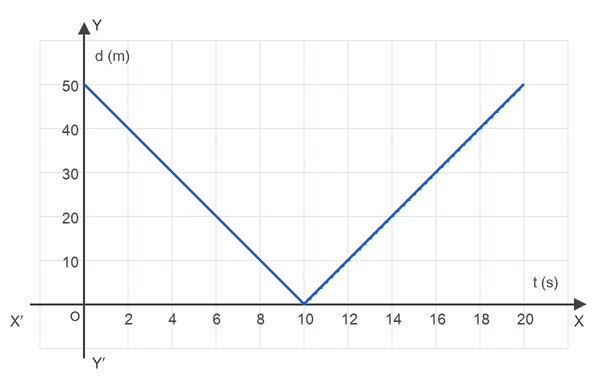
For which set of times is she recorded?
- 251 mark
Question 25
Competency: Analysis & Evaluation
After a patient takes an 80 mg dose of a medicine, the amount left in the blood hours later is modelled by mg, . (Hypothetical data.)
Assertion (A): The graph of lies above the -axis for every , so in this model the amount of medicine never becomes zero.
Reason (R): Every exponential function with , , is increasing.
- 264 marks
Question 26
Let be defined by .
(i) Find all real with . What does this tell you about whether is one-one?
(ii) Find the range of , and hence decide whether is onto.
(iii) Name the co-domain for which the same rule would give an onto function.
- 271 mark
Question 27
Competency: Analysis
A school quiz app gives each team a two-digit code, written as an ordered pair (first digit, second digit). Machine 1 makes every code with and , and Machine 2 makes every code with and , where
and .
So Machine 1's list is and Machine 2's list is . The two lists are merged into one master list, with each code written only once. (Hypothetical data.)
How many codes are on the master list, that is, what is ?
- 281 mark
Question 28
Competency: Analysis
A school has a set of 5 students and a set of 4 clubs: Chess, Music, Art and Drama. The club record is the relation from to given by
.
The record has 9 ordered pairs. Every student has joined at least one club. Music, Art and Drama each have at least one member, and Chess has no member. (Hypothetical data.)
Which statement about is true?
- 291 mark
Question 29
Competency: Analysis & Evaluation
A parking meter shows the number of complete hours a car has been parked. If the car has been parked for hours, the meter shows , the greatest integer less than or equal to . In this model can be any real number with , so is a function from to the set of whole numbers .
Assertion (A): The function is many-one and onto.
Reason (R): Every function from an infinite set onto an infinite set is one-one.
- 301 mark
Question 30
Competency: Analysis
Asha and Bilal save money every week. After weeks, Asha has saved rupees and Bilal has saved rupees. Their records show that, for every whole number ,
and . (Hypothetical data.)
How much has Asha saved after 6 weeks?
- 311 mark
Question 31
Competency: Application
A painter leans a 5 m ladder against a vertical wall on level ground. When the foot of the ladder is m from the wall, the top of the ladder is m above the ground. For safety, the foot must be at least 1 m from the wall, and the top must be at least 4.8 m above the ground.
Which set gives all the values of that satisfy both safety rules?
- 321 mark
Question 32
Competency: Analysis & Evaluation
A park has a circular jogging track of radius 50 m. On a plan with the centre of the track at the origin and distances in metres, the track is the curve .
Assertion (A): The track's curve does not represent as a function of ; no function has this whole circle as its graph.
Reason (R): A curve in the -plane represents as a function of exactly when every vertical line meets the curve at most once.
- 332 marks
Question 33
Competency: Application
A plumber charges a fixed visiting fee plus a fixed amount for every hour of work. A 2-hour job cost ₹550 and a 5-hour job cost ₹1,000. The charge for a -hour job is rupees. (Hypothetical data.)
(a) Find and , and say what each of them means.
(b) How many hours of work does a bill of ₹1,300 pay for?
- 342 marks
Question 34
Competency: Analysis
Four friends compare their marks in a test: Meera 78, Neel 85, Om 62 and Priya 85. On the set , a relation is defined by
. (Hypothetical data.)
(a) Write in roster form, and state its domain and range.
(b) Describe in words. Explain why neither (Neel, Priya) nor (Priya, Neel) belongs to or to .
- 352 marks
Question 35
Competency: Evaluation
A delivery app places its warehouse at 0 on a straight road. A shop at position km is east of the warehouse when and west of it when . The app uses the distance function , .
Riya says, “ is one-one, because two different shops are at two different places.”
(a) Show that Riya is wrong, and show also that is not onto .
(b) The app now serves only shops east of the warehouse or at it, so the domain becomes . Show that is one-one on this domain.
- 363 marks
Question 36
Competency: Creativity
A sports complex has 150 lockers. Each locker gets a code that is an ordered pair (letter, number), where the letter comes from a set of capital letters and the number from . So the set of possible codes is . Each letter and each number needs its own stencil, so the manager wants the total number of symbols, , to be as small as possible while there are still at least 150 different codes. (Hypothetical data.)
(a) If has the 10 letters from A to J, find the least value of .
(b) Show that every possible design needs .
(c) The manager now wants exactly 150 codes, with no spare code, using the fewest symbols. Design the sets and , and explain why your design is the best possible.
- 373 marks
Question 37
Competency: Analysis & Evaluation
A school prints its annual magazine. The press charges ₹15,000 for setting up and ₹40 for each copy, so the cost of copies is rupees, where is a natural number. Let . The cost per copy is the quotient function . (Hypothetical data.)
(a) Write in its simplest form, and find the cost per copy when 500 copies are printed.
(b) Find the least number of copies for which the cost per copy is at most ₹55.
(c) The editor says, “If we print enough copies, the cost per copy will come down to ₹40.” Is the editor right? Give a reason.
- 383 marks
Question 38
Competency: Analysis & Evaluation
Tap 1 alone fills a school's water tank in 6 hours. Tap 2 alone fills the same tank in hours, where . When both taps are open together, the tank fills in
hours. (Hypothetical data.)
(a) Find and say what it means.
(b) Show that , and hence find the range of for .
(c) Can the two taps together fill the tank in 4 hours? Can they take 6 hours? Justify each answer.
- 395 marks
Question 39
Competency: Analysis
A lift starts from the ground floor of an office building. The graph shows its height metres above the ground, seconds after it starts, for . The graph is made of straight pieces joining , , , and . (Hypothetical data.)

(a) Read and from the graph, and write the time intervals during which the lift is at rest.
(b) Write piece by piece for .
(c) Find the range of . Find all the times at which the lift is 21 m above the ground. Is one-one? Give a reason.
- 404 marks
Question 40
Competency: Analysis & Evaluation
A school has 400 students. The office records each student's birthday as a (day, month) pair. Let be the set of the 400 students and the set of all 366 possible birthdays, including 29 February. The rule gives each student's birthday. The office list shows that no birthday is shared by more than 6 students. (Hypothetical data.)
(a) Explain why is a function, and show that cannot be one-one.
(b) For a class of 30 students, can the birthday function of the class be onto ? What is the least number of students a group must have for its birthday function to be onto ?
(c) Use the office list to show that the range of has at least 67 elements. Could the range of have exactly 67 elements? Give a reason.