(i) Complete the following table for y=4x. Enter the values of x and y correct to 1 decimal place.
x
−2
−1
…
0.5
0.75
y
…
…
1
…
…
Copy the table on your answer book and enter the values there.
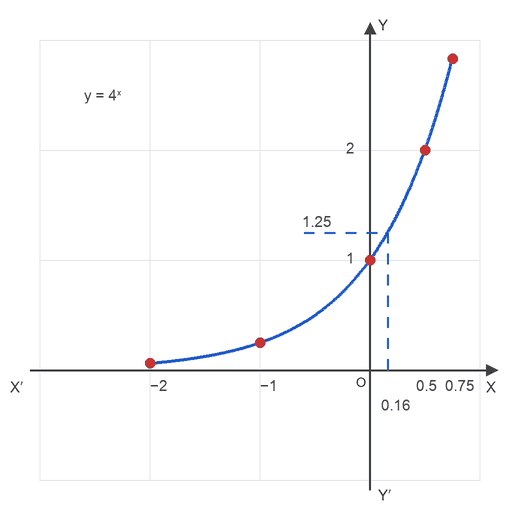
(ii) Taking 4 cm =1 unit on both axes, draw the graph of y=4x for 0.75≥x≥−2
(iii) From your graph estimate log41.25.
Solution:
Key idea: The statements log41.25=x and 4x=1.25 say the same thing; so on the graph of y=4x, the value of log41.25 is the x-coordinate of the point at height 1.25.
Step 1 — Part (i): work out the values of y=4x.
We use 4−n=4n1 and 41/2=4.
4−2=161
4−2=0.0625
4−1=41
4−1=0.25
40.5=4
40.5=2
40.75=22
40.75≈2.828
Since 40=1, the missing x-value is 0.
Step 2 — Part (i): complete the table.
We round each value to 1 decimal place, as the question asks.
x
−2
−1
0
0.5
0.75
y (exact)
161
41
1
2
22
y (1 d.p.)
0.1
0.3
1.0
2.0
2.8
Step 3 — Part (ii): draw the graph.
Using 4 cm for 1 unit on both axes, we plot the points for −2≤x≤0.75 and join them with a smooth curve.
Step 4 — Part (iii): read log41.25 from the graph.
We draw the horizontal line y=1.25 to meet the curve, and from the meeting point we drop a perpendicular to the x-axis. It meets the axis at about x=0.16.
Step 5 — Part (iii): check by calculation.
We use the change-of-base rule with common logarithms.
log41.25=log104log101.25
log41.25=0.60210.0969
log41.25≈0.161
This agrees with the reading from the graph.
Therefore, (i) the table reads y=0.1,0.3,1.0,2.0,2.8 for x=−2,−1,0,0.5,0.75; (iii) log41.25≈0.16.