
Question 1071 markEasy
Use the vertical line test to determine whether each relation is a function
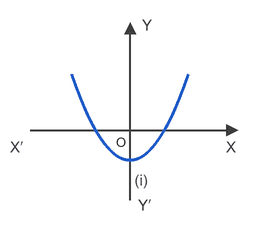
(i)
(ii)

(iii)

Confirming your payment
Sign up now and get 250 free tokens.
Relations and Functions · Question 107 of 135
Use the vertical line test to determine whether each relation is a function
(i)
(ii)
(iii)
Solution:
Key idea: The vertical line test says that a graph is the graph of a function exactly when no vertical line meets it in more than one point. If some vertical line cuts the graph twice, then one value of has two images, and a relation in which one input has two images is not a function.
Step 1 — Test graph (i).
We imagine sliding a vertical line across graph (i) from left to right. The curve is a U shape that opens upwards, and both arms keep moving away from the -axis as they rise, so the curve never comes back over an value it has already passed. Every vertical line therefore meets the curve at most once.
Graph (i) passes the test, so it is a function.
Step 2 — Test graph (ii).
We slide a vertical line across the wavy curve in the same way. The curve goes up and down, but as we trace it, it always moves to the right and never turns back to the left. So each vertical line meets it at most once.
Graph (ii) passes the test, so it is a function.
Step 3 — Test graph (iii).
We slide a vertical line across the V-shaped graph. To the left of the -axis only the left arm is present, to the right only the right arm, and on the -axis itself only the corner point at O. So each vertical line meets the graph exactly once.
Graph (iii) passes the test, so it is a function.
Watch out: A curve that rises and falls, like graph (ii), can still be a function. Only a curve that comes back over the same value, such as a circle or a parabola opening sideways, fails the test.
Note: The book's answer lists graph (i) as "Not a function", but the curve as printed passes the vertical line test, so it is a function.
Therefore, all three relations, (i), (ii) and (iii), are functions.