
Question 213 marksEasy
Determine the domain and range of the relation .
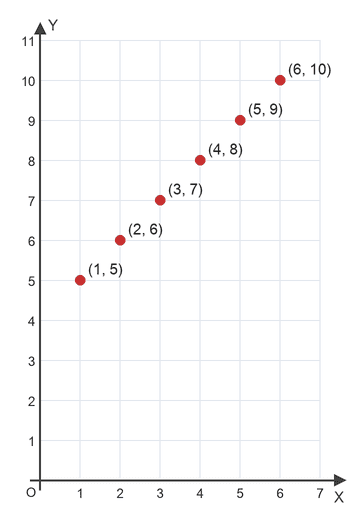
(a) . Draw the graph of .
(b) is a prime number less than .
(c) is an integer
(d)
Confirming your payment
Sign up now and get 250 free tokens.
Relations and Functions · Question 21 of 135
Determine the domain and range of the relation .
(a) . Draw the graph of .
(b) is a prime number less than .
(c) is an integer
(d)
Solution:
Key idea: We list the pairs of each relation from its rule. The domain is the set of first entries and the range is the set of second entries.
Step 1 — List the pairs for (a). We put in one at a time.
gives , gives , gives .
gives , gives , gives .
Step 2 — State the domain and range for (a). We collect the first and the second entries.
Domain
Range
Step 3 — Draw the graph for (a). We plot each of the six pairs as a point, first entry along the -axis and second entry along the -axis. The graph is these six separate points (they lie on the line , but the line itself is not part of the graph).
Step 4 — List the pairs for (b). The prime numbers less than 10 are 2, 3, 5 and 7, so we cube each one.
Step 5 — State the domain and range for (b). We collect the first and the second entries.
Domain
Range
Step 6 — Describe the relation (c). The difference of any two integers is again an integer, so the condition " is an integer" holds for every pair of integers. Hence every pair of integers belongs to and .
Domain
Range
Step 7 — List the pairs for (d). We put in .
Domain
Range
Therefore, (a) domain , range ; (b) domain , range ; (c) domain , range ; (d) domain , range .