
Question 993 marksMedium
Sketch the graphs of the following rational functions
(i)
(ii)
(iii)
(iv)
(v)
Confirming your payment
Sign up now and get 250 free tokens.
Relations and Functions · Question 99 of 135
Sketch the graphs of the following rational functions
(i)
(ii)
(iii)
(iv)
(v)
Solution:
Key idea: For a function of the form , the curve does not exist where the denominator is ; this gives the vertical asymptote . As , the value approaches ; this gives the horizontal asymptote (the -axis when the numerator has no ). We draw the asymptotes as dotted lines, mark the intercepts and a few points, and draw the two branches.
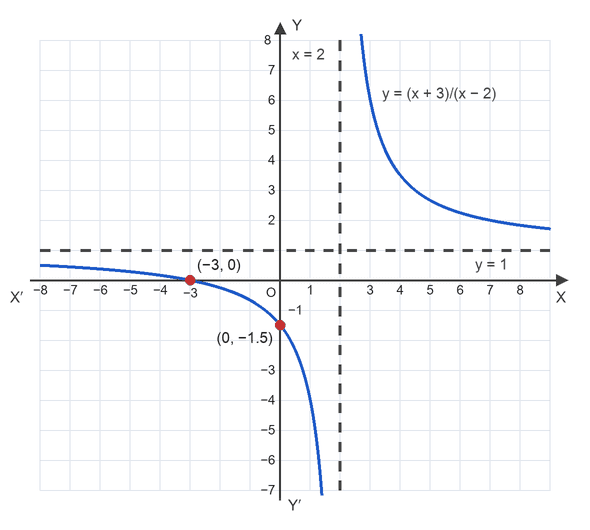
Step 1 — Part (i): find the asymptotes of .
The denominator is at , and the ratio of the -coefficients is .
The vertical asymptote is , and the horizontal asymptote is .
Step 2 — Part (i): find the intercepts and some points, then sketch.
We find where the curve meets the axes and work out a few more points on each side of the vertical asymptote.
The numerator is at , so the -intercept is .
At the value is , so the -intercept is .
Step 3 — Part (ii): find the asymptotes of .
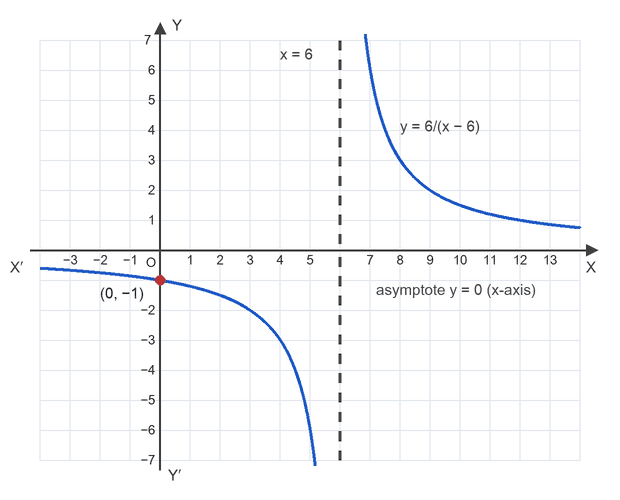
The denominator is at , and the numerator has no .
The vertical asymptote is , and the horizontal asymptote is the -axis.
Step 4 — Part (ii): find the intercepts and some points, then sketch.
We find where the curve meets the axes and work out a few more points on each side of the vertical asymptote.
The numerator is never , so the curve has no -intercept.
At the value is , so the -intercept is .
Step 5 — Part (iii): find the asymptotes of .
The denominator is at , and the numerator has no .
The vertical asymptote is , and the horizontal asymptote is the -axis.
Step 6 — Part (iii): find the intercepts and some points, then sketch.
We find where the curve meets the axes and work out a few more points on each side of the vertical asymptote.
The numerator is never , so the curve has no -intercept.
At the value is , so the -intercept is .

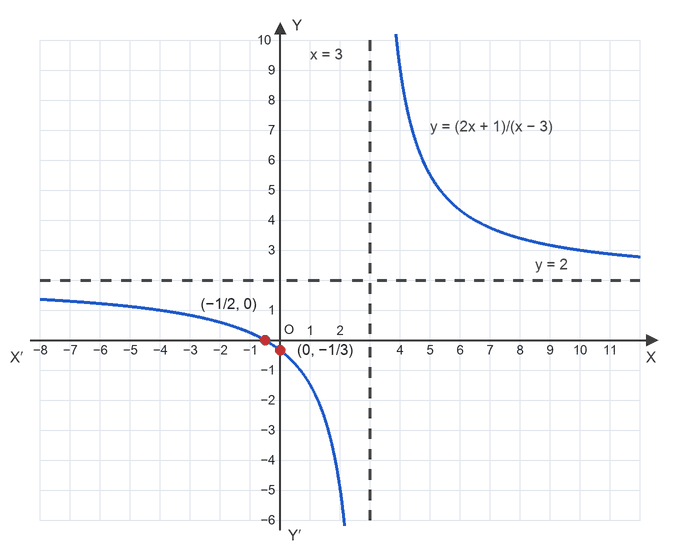
Step 7 — Part (iv): find the asymptotes of .
The denominator is at , and the ratio of the -coefficients is .
The vertical asymptote is , and the horizontal asymptote is .
Step 8 — Part (iv): find the intercepts and some points, then sketch.
We find where the curve meets the axes and work out a few more points on each side of the vertical asymptote.
The numerator is at , so the -intercept is .
At the value is , so the -intercept is .
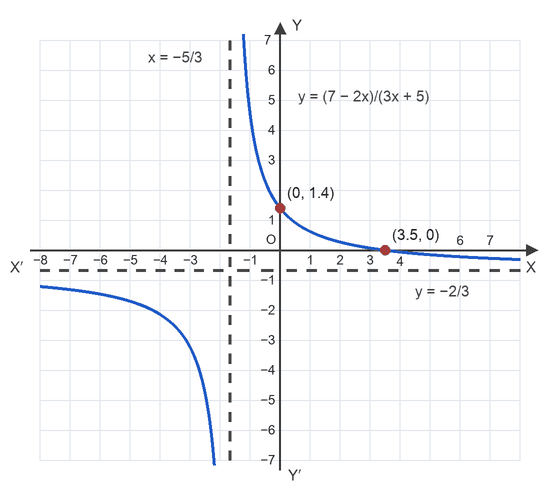
Step 9 — Part (v): find the asymptotes of .
The denominator is at , and the ratio of the -coefficients is .
The vertical asymptote is , and the horizontal asymptote is .
Step 10 — Part (v): find the intercepts and some points, then sketch.
We find where the curve meets the axes and work out a few more points on each side of the vertical asymptote.
The numerator is at , so the -intercept is .
At the value is , so the -intercept is .
Step 11 — Describe the common shape.
In every part the graph is a rectangular hyperbola: its two branches lie in opposite corners formed by the two asymptotes and approach them without meeting them.
Therefore, the asymptotes are (i) and ; (ii) and the -axis; (iii) and the -axis; (iv) and ; (v) and , and each graph is a hyperbola with these asymptotes.