
Opening your dashboard
Class 11 Maths Chapter 1: Sets Solutions
136 textbook questions with step-by-step answers, free to read, for ISC 2026-27.
Get talked through Ch 1, not just shown the answer
Reading a finished solution is not the same as being able to do it. The AI tutor takes one question at a time and works it with you, in your own words, until you can.
- Ask it out loud, in your own words
- It gives you the next step, not the answer
- Stuck on part (ii)? Start there
136 questions with solutions
1–3 marks · Mixed difficulty
The first 14 solutions are on this page. This chapter is a long one, so the rest open on their own page to keep this one quick to load.
- 13 marks
Question 1
Which of the collections are sets?
(i) The collection of all the months of a year, beginning with the letter J.
(ii) The collection of ten most talented writers of India.
(iii) The collection of all natural numbers less than 100.
(iv) A collection of most dangerous animals of the world.
Solve with AIWritten solution
Solution:
Key idea: A collection is a set only if it is well-defined. This means that for every object we can say clearly, without any opinion, whether it belongs to the collection or not.
Step 1 — Test collection (i).
We list the months that begin with J and check whether anyone could disagree. The months are January, June and July. Every person gets the same three months, so the collection is well-defined.
Collection (i) is a set.
Step 2 — Test collection (ii).
We ask whether "most talented" can be decided without opinion. It cannot: different people will choose different writers, so we cannot say for certain whether a given writer belongs.
Collection (ii) is not a set.
Step 3 — Test collection (iii).
We check whether membership is decided by a clear rule. The natural numbers less than 100 are , and for any number we can say at once whether it is one of them.
Collection (iii) is a set.
Step 4 — Test collection (iv).
We ask whether "most dangerous" can be decided without opinion. It is again a matter of judgement, so the collection is not well-defined.
Collection (iv) is not a set.
Therefore, the collections in (i) and (iii) are sets, and those in (ii) and (iv) are not.
- 23 marks
Question 2
Let . Insert the appropriate symbol or in the blank spaces.
(i)
(ii)
(iii)
(iv)
Solve with AIWritten solution
Solution:
Key idea: The symbol means "is an element of" and means "is not an element of". We look at the list of to see whether each number appears in it.
Step 1 — Write down the elements of A.
We read the elements straight from the roster form, so that each number can be compared with them.
Step 2 — Check the numbers 5 and 8.
The number 5 appears in the list of , so we write . The number 8 does not appear in the list, so we write .
Step 3 — Check the numbers 0 and 4.
The list of starts at 1, so 0 is not in it and we write . The number 4 appears in the list, so we write .
Therefore, (i) , (ii) , (iii) , (iv) .
- 33 marks
Question 3
Write down a description of each of the following sets. (There could be different suitable descriptions.)
(i)
(ii)
(iii)
Solve with AIWritten solution
Solution:
Key idea: To describe a set in words, we look for one rule that every element obeys and that no other number in the range obeys. More than one correct description is possible.
Step 1 — Describe the set in (i).
We notice that 2, 4, 6 and 8 are all even, and that they are all the even numbers lying between 1 and 9. The next even number, 10, is not in the set, so the range must be stated.
The set in (i) is the set of even natural numbers less than 10.
Step 2 — Describe the set in (ii).
We divide each element by 7 to see the pattern. The elements are , , , and , so they are the first five multiples of 7.
The set in (ii) is the set of the first five multiples of 7.
Step 3 — Describe the set in (iii).
We check whether each element divides 12 exactly, and whether any divisor of 12 is missing. The factor pairs of 12 are , and , which give exactly 1, 2, 3, 4, 6 and 12.
The set in (iii) is the set of factors of 12.
Therefore, (i) the set of even natural numbers less than 10, (ii) the set of the first five multiples of 7, (iii) the set of factors of 12.
- 43 marks
Question 4
List the following sets in roster form.
(i) The set of square numbers less than 40.
(ii) The set of colours of the rainbow.
(iii) (a) The set of factors of 144.
(b) The set of prime factors of 144.
(iv) The set of natural numbers less than 50.
(v) The set of consonants before in the English alphabet.
(vi) The set of letters in the word 'Satellite'.
Solve with AIWritten solution
Solution:
Key idea: Roster form lists every element once, inside braces , separated by commas. A repeated object is written only once.
Step 1 — Find the square numbers less than 40 for (i).
We square the natural numbers in turn and stop as soon as the square passes 40.
The next square is , which is more than 40, so we stop here.
Step 2 — List the colours of the rainbow for (ii).
The rainbow always shows the same seven colours, so we write each of them once.
Step 3 — Find the factors of 144 for (iii)(a).
We write 144 as a product of factor pairs, starting from 1, and stop when the two factors meet. Each pair gives two factors.
Each of these products equals 144, and 5, 7, 10 and 11 do not divide 144.
Collecting every factor once gives 15 factors.
Step 4 — Find the prime factors of 144 for (iii)(b).
We write 144 as a product of primes. Only the primes that appear in this product are prime factors.
The only primes that appear are 2 and 3.
Step 5 — List the natural numbers less than 50 for (iv).
The natural numbers start at 1 and go up one at a time. The last one below 50 is 49, so we show the pattern and the last element.
Step 6 — Find the consonants before i for (v).
We list the letters that come before i in the alphabet and then remove the vowels a and e.
The letters before i are a, b, c, d, e, f, g, h. Removing a and e leaves the consonants.
Step 7 — List the letters of 'Satellite' for (vi).
We spell the word letter by letter and keep each different letter only once. The letters are S, a, t, e, l, l, i, t, e, so t, e and l are repeated.
Therefore, (i) , (ii) , (iii)(a) , (iii)(b) , (iv) , (v) , (vi) .
- 53 marks
Question 5
Rewrite the following sets in the indicated notation.
(i) ; (a) Words; (b) Set-builder notation
(ii) Positive multiples of 11; Roster form
(iii) ; Set-builder notation
(iv) Even numbers between 27 and 39; (a) Roster form; (b) Set-builder notation
(v) ; (a) Words; (b) Roster form
(vi) The set shown by the dots on this number line; Roster form

(vii) Negative multiples of 3; Set-builder form
(viii) The set shown by the dot on this number line; Set-builder form

(ix) Numbers more than 2 units from 8; Set-builder form
(x) and ; Set-builder form
(xi) ; Roster form
(xii) ; Roster form
Solve with AIWritten solution
Solution:
Key idea: Roster form lists the elements. Set-builder form states the rule that every element obeys and no other object obeys. Interval notation and words are other ways to give the same rule.
Step 1 — Describe in words and in set-builder form for (i).
We see that every element is a negative even integer, and that the list stops at . The next negative even integer, , is left out, so the description must include a bound that keeps it out.
(a) In words: the set of negative even integers greater than .
(b) In set-builder form:
Note: The phrase "the set of negative even integers" alone would also contain , which are not in the given set, so the bound is needed.
Step 2 — Write the positive multiples of 11 in roster form for (ii).
We multiply 11 by in turn. The list never ends, so we show the pattern and three dots.
Step 3 — Write in set-builder form for (iii).
We notice that the elements are all the odd integers from up to , so we state "odd integer" together with both end points.
Step 4 — Write the even numbers between 27 and 39 in two forms for (iv).
We list the even numbers that come after 27 and before 39. "Between" means 27 and 39 themselves are not included, and both are odd anyway.
(a) In roster form:
(b) In set-builder form:
Step 5 — Describe in words and in roster form for (v).
We read the rule in words first. Then we ask whether the elements can be listed one after another.
(a) In words: the set of all real numbers greater than 0 and less than 1.
(b) Between 0 and 1 there are infinitely many numbers, and there is no "next" number after any of them. So the elements cannot be listed one by one, and the set cannot be written in roster form.
Step 6 — Read the dots on the first number line for (vi).
We read the number under each filled dot. The dots are at , and , and no other point is marked.
Step 7 — Write the negative multiples of 3 in set-builder form for (vii).
We see that the negative multiples of 3 are . Each of them is times a natural number. So we state the rule using .
Step 8 — Read the dot on the second number line for (viii).
We read the number under the only filled dot: it is 2. The set has just this one element.
Step 9 — Write "numbers more than 2 units from 8" in set-builder form for (ix).
We measure distance from 8 with the modulus: the distance of from 8 is . "More than 2 units" means this distance is greater than 2.
Opening the modulus shows the numbers lie to the left of 6 or to the right of 10.
Note: The set , written as , contains the numbers exactly 2 units from 8, not the numbers more than 2 units from 8.
Step 10 — Write " and " in set-builder form for (x).
We put both conditions inside the rule, joined by "and", so that 5 is removed from the numbers up to 10.
The same set can be written as .
Step 11 — Write in roster form for (xi).
The stem does not say what kind of number is. We take to be a natural number, which is the usual reading, and put into . Each value of is then a natural number.
1 3 2 8 3 13 4 18 The values go up by 5 each time and never end.
Step 12 — Write the set in (xii) in roster form.
We put each whole number into and simplify each value.
All six values are different, so each is written once.
Therefore, (i) the negative even integers greater than , ; (ii) ; (iii) ; (iv) , ; (v) the real numbers between 0 and 1, not possible in roster form; (vi) ; (vii) ; (viii) ; (ix) ; (x) ; (xi) ; (xii) .
- 63 marks
Question 6
State whether each of the following sets is finite or infinite.
(i) The set of lines which are parallel to the -axis.
(ii) The set of letters in the English alphabet.
(iii) The set of numbers which are multiples of 5.
(iv) The set of animals living on the earth.
(v) The set of circles through the origin .
(vi) The set of whole numbers greater than 5.
(vii) The set of natural numbers less than one billion.
(viii) The set of integers between and .
(ix) The set of rational numbers between 0 and 1.
Solve with AIWritten solution
Solution:
Key idea: A set is finite if its elements can be counted and the counting comes to an end, however large the number. Otherwise it is infinite.
Step 1 — Decide (i), the lines parallel to the x-axis.
Every line , for any real number , is parallel to the -axis. There are infinitely many real numbers , so there is no end to such lines.
The set in (i) is infinite.
Step 2 — Decide (ii), the letters of the English alphabet.
We count the letters: there are exactly 26, so the counting ends.
The set in (ii) is finite.
Step 3 — Decide (iii), the multiples of 5.
The multiples of 5 are , and we can always add 5 to get another one. The list never ends.
The set in (iii) is infinite.
Step 4 — Decide (iv), the animals living on the earth.
The number of animals is very large, but at any moment it is a definite number which could, in principle, be counted to the end.
The set in (iv) is finite.
Step 5 — Decide (v), the circles through the origin.
A circle through can have any radius and its centre can lie in any direction from the origin. There are infinitely many such choices.
The set in (v) is infinite.
Step 6 — Decide (vi), the whole numbers greater than 5.
These are , and every whole number has a next one, so the list never ends.
The set in (vi) is infinite.
Step 7 — Decide (vii), the natural numbers less than one billion.
These are . The list is long, but it stops at a definite last number.
The set in (vii) is finite.
Step 8 — Decide (viii), the integers between and .
We list them: . That is 7 integers, so the counting ends.
The set in (viii) is finite.
Step 9 — Decide (ix), the rational numbers between 0 and 1.
Between any two rational numbers there is always another one (for example, their average), so we can never finish listing them.
The set in (ix) is infinite.
Therefore, the sets in (ii), (iv), (vii) and (viii) are finite, and the sets in (i), (iii), (v), (vi) and (ix) are infinite.
- 73 marks
Question 7
Which of the following sets are empty sets?
(i)
(ii)
(iii)
(iv)
(v)
Solve with AIWritten solution
Solution:
Key idea: An empty set (null set), written , has no element at all. A set that contains even one element, such as the number 0, is not empty.
Step 1 — Examine set A.
We ask whether any human being lives on Mars. None does, so no object satisfies the rule.
has no element, so is empty.
Step 2 — Examine set B.
Every number divisible by 2 is even, by definition. An odd number is one that is not divisible by 2, so no number can be both odd and divisible by 2.
has no element, so is empty.
Step 3 — Examine set C.
Two parallel lines never meet, however far they are drawn, so they have no point in common.
has no element, so is empty.
Step 4 — Examine set D.
We read the roster form: contains the number 0. Zero is an element, so has exactly one element.
is not empty; it is a singleton set.
Step 5 — Examine set E.
A number less than 5 lies to the left of 5 on the number line, and a number greater than 7 lies to the right of 7. No number can be on both sides at once.
has no element, so is empty.
Therefore, the sets in (i), (ii), (iii) and (v) are empty sets, and in (iv) is not empty.
- 83 marks
Question 8
Are the following sets equal? Give reasons.
(i) ;
(ii) ;
Solve with AIWritten solution
Solution:
Key idea: Two sets are equal when they have exactly the same elements. The order of listing and any repetition do not matter.
Step 1 — Find the elements of B in (i).
We solve the quadratic by factorising it. The numbers 2 and 3 multiply to 6 and add to 5.
So .
Step 2 — Compare A and B in (i).
We compare the elements. contains positive numbers, while contains negative numbers, so the elements are different.
Both sets have two elements, so they are equivalent sets, but they are not equal sets.
Step 3 — Write the letters of FOLLOW and WOLF in (ii).
We spell each word and keep each different letter only once. FOLLOW has the letters F, O, L, L, O, W, and WOLF has the letters W, O, L, F.
Step 4 — Compare A and B in (ii).
Both sets contain exactly the letters F, O, L and W; only the order of listing differs, and order does not matter in a set.
Therefore, (i) , because ; (ii) , because both are .
- 93 marks
Question 9
Which of the following are singleton sets?
(i)
(ii)
(iii)
Solve with AIWritten solution
Solution:
Key idea: A singleton set has exactly one element. We find all the elements of each set, keeping only those that belong to the stated number system.
Step 1 — Find the elements of A.
We solve . A number whose distance from 0 is 5 is either 5 or .
Only 5 is a natural number, so . It has one element.
is a singleton set.
Step 2 — Find the elements of B.
We factorise . The numbers 3 and 8 multiply to 24 and add to 11.
Both 3 and 8 are natural numbers, so . It has two elements.
is not a singleton set.
Step 3 — Find the elements of C.
We take the cube root of both sides of . The cube of a negative number is negative, and .
A real number has only one real cube root, and is an integer, so .
is a singleton set.
Therefore, and are singleton sets, and is not.
- 103 marks
Question 10
State the value of for each of the following sets.
(i)
(ii)
(iii)
(iv)
Solve with AIWritten solution
Solution:
Key idea: The cardinal number of a finite set is the number of different elements in .
Step 1 — Count the months for (i).
We count the months of the year, January to December. There are 12 of them.
Step 2 — Count the planets for (ii).
We list the planets of our solar system: Mercury, Venus, Earth, Mars, Jupiter, Saturn, Uranus and Neptune. Pluto has been classed as a dwarf planet since 2006, so it is not counted.
Step 3 — Count the integers from to 3 for (iii).
Both end points are included because the signs are . We count the negative integers, zero and the positive integers separately.
The negative integers are ; there are 8 of them. Then there is 0, and the positive integers 1, 2, 3 are 3 numbers.
Step 4 — Consider the even numbers for (iv).
The even numbers never end, so they cannot be counted to a finish. is an infinite set.
An infinite set has no finite cardinal number, so cannot be given as a number.
Therefore, (i) , (ii) , (iii) , (iv) is infinite, so is not a finite number.
- 113 marks
Question 11
Use interval notation to represent each set of numbers.
(i)
(ii)
(iii)
(iv)
(v) or
(vi)
(vii)
(viii)
(ix)
Solve with AIWritten solution
Solution:
Key idea: In interval notation a round bracket means the end point is not included, and a square bracket means it is included. The symbols and are not numbers, so they always take a round bracket. Two separate pieces are joined with the union sign .
Step 1 — Write (i) and (ii).
In (i) both signs are strict (), so both end points are excluded and both brackets are round. In (ii) both signs are , so both end points are included and both brackets are square.
Step 2 — Write (iii) and (iv).
In (iii) is excluded () and 4 is included (). In (iv) is included () and 7 is excluded ().
Step 3 — Write (v), which has two separate pieces.
We write each piece on its own and then join them. The piece has no left end and includes 3. The piece excludes 5 and includes 9.
Step 4 — Write (vi).
The set contains 99 and every number above it, with no upper end.
Step 5 — Write (vii) and (ix).
In each case every real number is included except one point, so the number line is split at that point into two pieces, and the point itself is excluded from both.
Step 6 — Consider (viii).
The set contains separate points with gaps between them; for example 2 is not in it although it lies between 1 and 3. An interval contains every real number between its end points, so this set cannot be written as an interval or a union of a few intervals.
Therefore, (i) , (ii) , (iii) , (iv) , (v) , (vi) , (vii) , (viii) not possible in interval notation, (ix) .
- 123 marks
Question 12
Use interval notation to represent the set of numbers shown on each of the following number lines.
(i)

(ii)

(iii)

(iv)

(v)
 Solve with AI
Written solution
Solution:
Key idea: On a number line a filled dot means the end point is included (square bracket), and a hollow dot means it is excluded (round bracket). An arrow on the thick line means it goes on for ever, which is written with or and a round bracket.
Step 1 — Read number line (i).
We follow the thick line. It has an arrow at the left end, so it has no left end point, and it stops at with a filled dot, so is included.
Step 2 — Read number line (ii).
The thick line starts at 2 with a hollow dot, so 2 is excluded, and it has an arrow at the right end, so it goes on for ever.
Step 3 — Read number line (iii).
The thick line runs from 1 to 4 and both dots are hollow, so both end points are excluded.
Step 4 — Read number line (iv).
The thick line runs from to 3 and both dots are filled, so both end points are included.
Step 5 — Read number line (v).
There are two thick pieces, so we write each one and join them with . The first runs from to with both dots filled. The second starts at 2 with a hollow dot and ends in an arrow on the right.
Therefore, (i) , (ii) , (iii) , (iv) , (v) .
- 133 marks
Question 13
Find the subsets of
(i)
(ii)
(iii)
(iv)
Solve with AIWritten solution
Solution:
Key idea: A set with elements has subsets. They are the empty set , the subsets with 1 element, the subsets with 2 elements, and so on up to the set itself. The empty set is a subset of every set, and every set is a subset of itself.
Step 1 — Find the subsets of for (i).
The set has one element, so it has subsets. They are the empty set and the set itself.
Step 2 — Find the subsets of for (ii).
The set has two elements, so it has subsets. We take none, each one alone, and both together.
Step 3 — Find the subsets of for (iii).
The empty set has no element, so it has subset. That one subset is the empty set itself.
Step 4 — Find the subsets of for (iv).
We first count the elements carefully. The set has two elements: the number 5 and the set , which counts as one single element. So there are subsets.
Watch out: The subset containing only the element is written , with two pairs of braces. Writing alone would not be a subset, because 7 is not an element of the given set.
Therefore, (i) , ; (ii) , , , ; (iii) ; (iv) , , , .
- 143 marks
Question 14
Let .
(i) List all the subsets of .
(ii) List all the proper subsets of .
Solve with AIWritten solution
Solution:
Key idea: A set with 3 elements has subsets. A proper subset of is a subset of that is not equal to , so there are proper subsets.
Step 1 — List the subsets of A by size for (i).
We list the subsets in groups by the number of elements, so that none is missed. There is one with 3 elements, three with 2 elements, three with 1 element and one with no element.
With 3 elements:
With 2 elements: , ,
With 1 element: , ,
With no element:
Step 2 — Check the count for (i).
We add the group sizes to make sure all subsets are present.
This agrees with .
Step 3 — List the proper subsets for (ii).
We leave out only itself. The empty set is not equal to , so it stays in the list as a proper subset.
Note: If is also left out, the 6 non-empty proper subsets are , , , , and .
Therefore, (i) the 8 subsets are , , , , , , , ; (ii) the 7 proper subsets are all of these except .
- 153 marks
Question 15
Let .
(i) List the subset .
(ii) List the subset .
(iii) List the subset .
(iv) List the subset .
(v) List the subset .
- 163 marks
Question 16
Tell in each of the following, whether the first set is a subset of the second set or not.
(i) = Set of letters in the word 'LATE'; = Set of letters in the word 'PLATE'
(ii) = Set of even prime numbers;
(iii) = Set of digits in the number 1590; = Set of digits in the number 178902
(iv) = Set of all triangles having 4 sides; = Set of digits in the number '100'
- 173 marks
Question 17
Write the proper subsets of the following sets.
(i)
(ii)
(iii)
(iv)
- 183 marks
Question 18
How many subsets do the following sets have?
(i) A set having 5 elements.
(ii) The set of letters of the word 'CENTENARY'.
- 193 marks
Question 19
How many proper subsets do the following sets have?
(i) The set of factors of 12.
(ii) The set .
- 203 marks
Question 20
Answer True or False.
(i)
(ii)
(iii)
(iv)
(v)
(vi)
(vii) For any two sets and either or .
(viii) Every set has a proper subset.
(ix) Every subset of a finite set is finite.
(x) Every subset of an infinite set is infinite.
- 213 marks
Question 21
Find the power set of each of the following sets.
(i)
(ii)
(iii)
(iv)
- 223 marks
Question 22
Suggest a universal set for each of the following.
(i)
(ii)
(iii)
(iv)
(v)
- 233 marks
Question 23
What universal set may be proposed for the following sets?
(i) The set of parallelograms
(ii) The set of irrational numbers
(iii) The set of positive even numbers
- 243 marks
Question 24
Solve the following equations.
(i)
(ii)
(iii)
(iv)
(v)
- 253 marks
Question 25
,
List the members of
(i)
(ii)
- 263 marks
Question 26
,
Place the ten numbers in the correct places on the diagram.
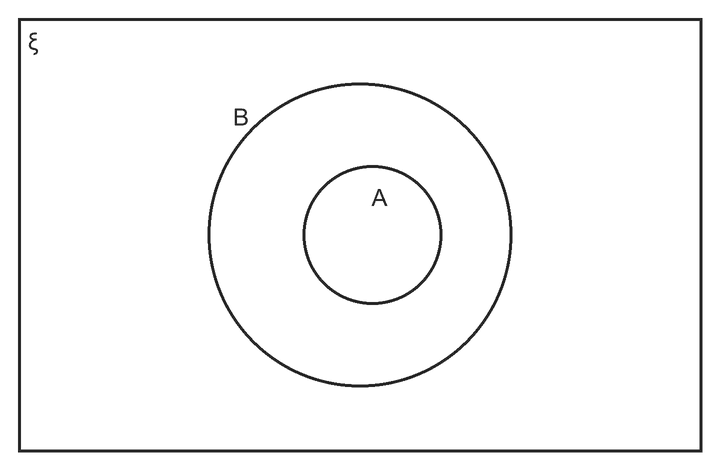
- 273 marks
Question 27
, , . Draw a Venn diagram to illustrate the relationship between these sets.
- 283 marks
Question 28
Draw a Venn diagram to show the relationship between the following sets:
, , ,
Show in your diagram the region that represents the set of squares.
- 293 marks
Question 29
Using , and , represent the following statement as a Venn diagram: 'Some novels are not detective novels'.
- 303 marks
Question 30
Answer true or false. Refer to the figure.
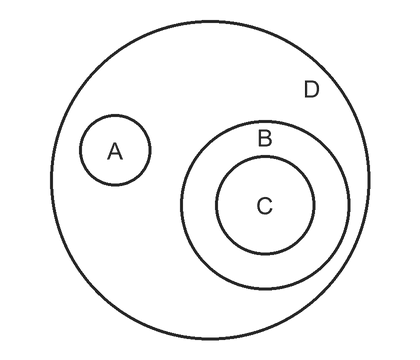
(i)
(ii)
(iii)
(iv)
(v)
- 313 marks
Question 31
Find if
(i) ,
(ii) ,
(iii) = set of letters in the word 'INDIA', = set of letters in the word 'DRAIN'
- 323 marks
Question 32
Find if
(i) ,
(ii) ,
(iii) ,
(iv) ,
- 333 marks
Question 33
If , , and ; find:
(i)
(ii)
(iii)
(iv)
(v)
(vi)
(vii)
- 343 marks
Question 34
If , , , then find and and verify that .
- 353 marks
Question 35
Given , and , find
(i)
(ii)
(iii)
- 363 marks
Question 36
Find if
(i) ,
(ii) ,
(iii) ,
- 373 marks
Question 37
Find if
(i) ,
(ii) ,
(iii) ,
- 383 marks
Question 38
If , , , , find
(i)
(ii)
(iii)
(iv)
(v)
(vi)
(vii)
(viii)
- 393 marks
Question 39
If , , , prove that
(i)
(ii)
- 403 marks
Question 40
If , , and , find
(i)
(ii)
(iii)
(iv)
(v)
(vi)
- 413 marks
Question 41
Which of the following pairs of sets are disjoint?
(i) and
(ii) and
(iii) and
(iv) and
- 423 marks
Question 42
Let , . Find out whether and are disjoint sets or not.
- 433 marks
Question 43
In the given Venn diagram, shade the region .

- 441 mark
Question 44
If and are two sets, then is equal to
- 451 mark
Question 45
If sets and are defined as
, . Then
- 463 marks
Question 46
If and , find
(i)
(ii)
- 473 marks
Question 47
If , , then find
(i)
(ii)
- 483 marks
Question 48
If , , , find
(i)
(ii)
(iii)
(iv)
- 493 marks
Question 49
If and , show that .
- 503 marks
Question 50
If is the set of real numbers and the set of rational numbers, then what is ?
- 513 marks
Question 51
If , and , then verify that .
- 523 marks
Question 52
With the help of Venn diagram, show that for all sets , and
(i)
(ii)
(iii)
- 533 marks
Question 53
Find if , .
- 543 marks
Question 54
Find if , .
- 553 marks
Question 55
Find if , .
- 563 marks
Question 56
Find if , .
- 573 marks
Question 57
Find if , .
- 583 marks
Question 58
Find if , .
- 593 marks
Question 59
If and , then verify that .
- 603 marks
Question 60
If , find the complement of the following sets:
(i)
(ii)
(iii)
(iv)
- 613 marks
Question 61
If , , , then list the elements of
(i)
(ii)
(iii)
(iv)
(v)
(vi)
Also show that and .
- 623 marks
Question 62
, , and , then list the elements of the following sets.
(i)
(ii)
(iii)
(iv)
(v)
(vi)
(vii)
(viii)
(ix)
- 633 marks
Question 63
Taking the set of natural numbers as the universal set, write down the complement of the following sets:
(i)
(ii)
(iii)
(iv)
(v)
(vi)
(vii)
(viii)
- 643 marks
Question 64
Let be the set of all triangles in a plane. If is the set of all triangles with at least one angle different from , what is ?
- 653 marks
Question 65
Shade the region as directed in each Venn diagram:
(i) Complement of set

(ii)
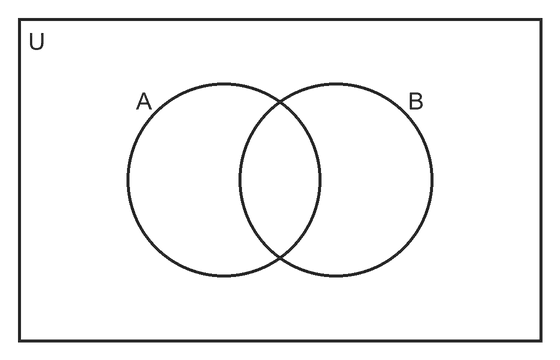
(iii)
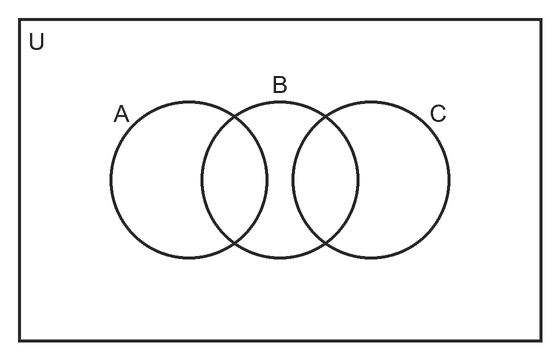
- 663 marks
Question 66
Describe the shaded regions in the following diagrams.
(i)
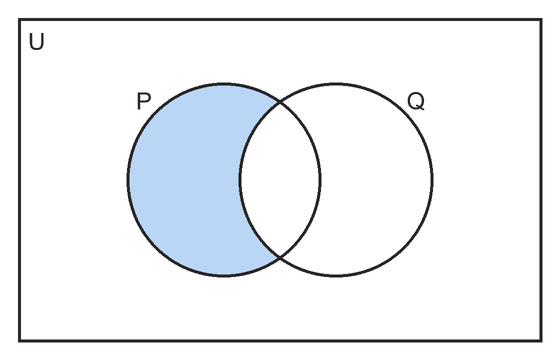
(ii) Circle lies inside circle .

(iii)

(iv)
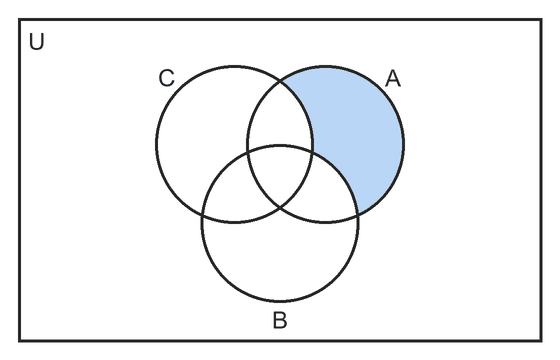
(v)
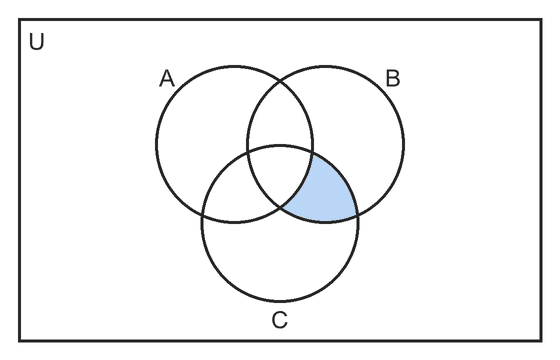
(vi)
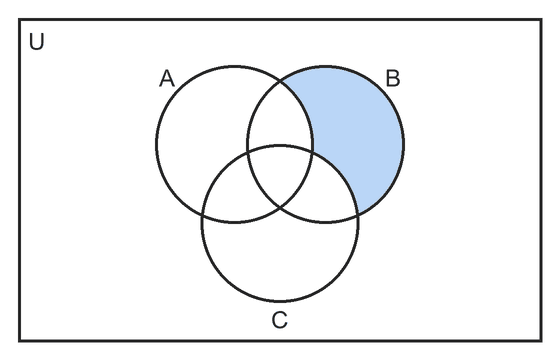
- 673 marks
Question 67
Use the given diagram to shade the region .
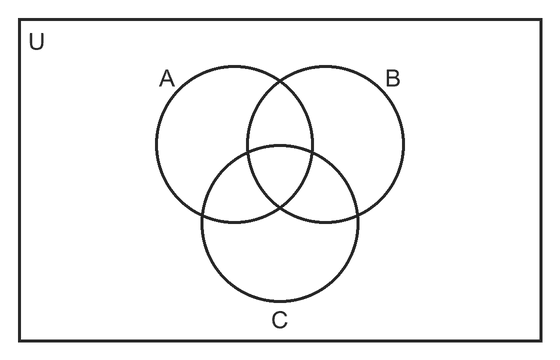
- 683 marks
Question 68
If , , and , draw a Venn diagram to find:
(i)
(ii)
(iii)
(iv)
(v)
(vi)
- 693 marks
Question 69
If , , , draw a Venn diagram to find:
(i)
(ii)
(iii)
(iv)
(v)
- 703 marks
Question 70
Given , , and . Draw a Venn diagram to illustrate this information. Hence find .
- 713 marks
Question 71
The Venn diagram below shows:
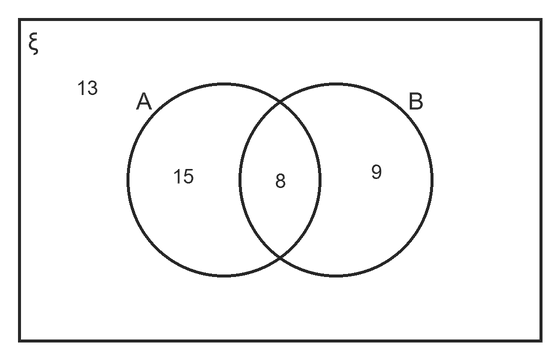
How many pupils:
(i) are in class 8?
(ii) play cricket?
(iii) play basketball?
(iv) play both cricket and basketball?
(v) play neither cricket nor basketball?
- 723 marks
Question 72
In the Venn diagram below:
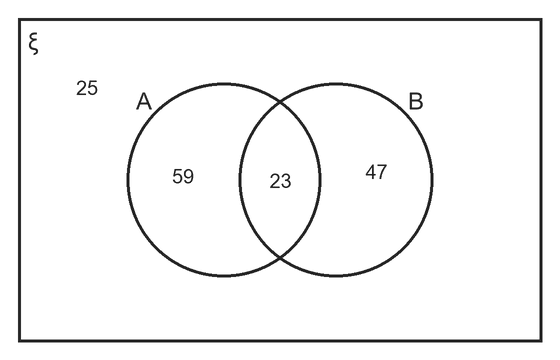
Write down the number who:
(i) asked for tea
(ii) asked for tea and watched the ballet
(iii) neither asked for tea nor watched the ballet
(iv) attended the function
- 733 marks
Question 73
If and are two sets such that has elements, has elements and has elements, how many elements does have?
- 743 marks
Question 74
If and are two sets such that has elements, has elements and has elements, how many elements does have?
- 753 marks
Question 75
If and are two sets such that has elements, has elements and has elements, how many elements does have?
- 763 marks
Question 76
In a class of students, like to play cricket and like to play football. Also each student likes to play at least one of the two games. How many students like to play both cricket and football?
- 773 marks
Question 77
In a group of people, like coffee, like tea and each person likes at least one of the two drinks. How many people like both coffee and tea?
- 783 marks
Question 78
In a group of students, students know Hindi, know English and know both. Each of the students knows either Hindi or English. How many students are there in the group?
- 793 marks
Question 79
In a survey of students in a school, were listed as taking apple juice, as taking orange juice and were listed as taking both apple as well as orange juice. Find how many students were taking neither apple juice nor orange juice.
- 803 marks
Question 80
In a college students study Mathematics and study Economics. If students study both the subjects, find the total number of students enrolled in these two subjects.
- 813 marks
Question 81
In a group of people, speak Tamil, speak English and all the people speak at least one language. Find:
(i) How many speak both the languages?
(ii) How many speak only Tamil?
(iii) How many speak only English?
- 823 marks
Question 82
Out of candidates who appeared in an entrance test in English and Mathematics, passed in at least one subject. If passed in English and in Mathematics, find:
(i) How many passed in both the subjects?
(ii) How many passed in English only?
(iii) How many failed in Mathematics?
- 833 marks
Question 83
In a group of people, play squash and play tennis. How many play both games, provided everyone plays at least one game?
- 843 marks
Question 84
In a class of students, like History, like Geography and like both subjects. Draw a Venn diagram and find the number of students who
(i) do not like History
(ii) do not like Geography
(iii) like neither History nor Geography
- 853 marks
Question 85
candidates appear in a written test in Mathematics and General Awareness for a Government job. passed in at least one subject. If passed in Mathematics and in General Awareness find:
(i) How many passed in both the subjects?
(ii) How many passed in Mathematics only?
(iii) How many failed in General Awareness?
- 863 marks
Question 86
In a group of people, like Indian food, like Chinese food and do not like any kind of these foods. Draw a Venn diagram to find:
(i) How many like both kinds of food?
(ii) How many like only the Indian food?
(iii) How many like only the Chinese food?
- 873 marks
Question 87
In a group of people, two-sevenths speak Bengali only and three-sevenths speak Hindi only. If people speak none of these languages and speak both, find using a Venn diagram the total number of people in the group.
- 883 marks
Question 88
A firm has workers working in the factory premises, working in its office and working in both the places. How many workers are there in the firm? How many are working in the
(i) factory alone
(ii) office alone
- 893 marks
Question 89
There are individuals with a skin disorder; had been exposed to the chemical , to chemical , and to both the chemicals and . Find the number of individuals exposed to
(i) Chemical but not chemical
(ii) Chemical but not chemical
(iii) Chemical or chemical
- 903 marks
Question 90
Out of car owners investigated, owned car and owned car , owned both and cars. Is this data correct?
- 911 mark
Question 91
A survey shows that of the people watch a news channel whereas watch another channel. If of the people watch both channels, then
- 923 marks
Question 92
In a survey it was found that 21 people liked product , 26 liked product and 29 liked product . If 14 people liked products and , 12 people liked products and , 14 people liked products and and 8 liked all the three products, find how many liked product only.
- 933 marks
Question 93
In a survey of 200 students of a school, it was found that 120 study Mathematics, 90 study Physics and 70 study Chemistry, 40 study Mathematics and Physics, 30 study Physics and Chemistry, 50 study Chemistry and Mathematics and 20 none of these subjects.
(i) Find the number of students who study all the three subjects.
(ii) Also, find the number of students who study Mathematics only.
- 943 marks
Question 94
In a group of 500 persons, 300 take tea, 150 take coffee, 250 take cold drink, 90 take tea and coffee, 110 take tea and cold drink, 80 take coffee and cold drink and 50 take all the three drinks.
(i) Find the number of persons who take none of the three drinks.
(ii) Find the number of persons who take only tea.
(iii) Find the number of persons who take coffee and cold drink but not tea.
- 953 marks
Question 95
In a group of 50 students, the number of students studying French, English, Sanskrit were found to be as follows: French 17, English 13, Sanskrit 15, French and English 9, English and Sanskrit 4, French and Sanskrit 5, English, French and Sanskrit 3. Find the number of students who study
(i) Only French.
(ii) Only English.
(iii) Only Sanskrit.
(iv) English and Sanskrit but not French.
(v) French and Sanskrit but not English.
(vi) French and English but not Sanskrit.
(vii) At least one of the three languages.
(viii) None of the three languages.
- 963 marks
Question 96
In a survey it was found that 21 persons liked product , 26 liked product and 29 liked product . If 14 persons liked products and , 12 persons liked products and , 14 persons liked products and and 8 liked all the three products, then how many liked only one product?
- 973 marks
Question 97
In a survey of 100 persons it was found that 28 read magazine , 30 read magazine , 42 read magazine , 8 read magazines and , 10 read magazines and , 5 read magazines and and 3 read all the three magazines.
(i) How many persons read none of the three magazines?
(ii) How many persons read magazine only?
- 981 mark
Question 98
Tell whether the collection of ten most talented writers of India is a set or not.
- 991 mark
Question 99
Write the set in set builder form.
- 1001 mark
Question 100
Write the set in set builder form.
- 1011 mark
Question 101
Write the set in Roster form.
- 1021 mark
Question 102
Write the solution set of the equation in Roster form.
- 1031 mark
Question 103
Write all subsets of set .
- 1041 mark
Question 104
Write all subsets of set .
- 1051 mark
Question 105
Write the number of subsets of a set having elements.
- 1061 mark
Question 106
Write the power set of .
- 1071 mark
Question 107
The number of elements in the power set of is ...
- 1081 mark
Question 108
When , the number of elements in is ...
- 1091 mark
Question 109
If = the set of letters in the word 'PEAR' and = the set of letters in the word 'REAP', is ?
- 1101 mark
Question 110
Are the two sets and equal, if and ?
- 1111 mark
Question 111
, , then find
(i)
(ii)
(iii)
- 1121 mark
Question 112
If and ; then find .
- 1131 mark
Question 113
Let and , find .
- 1141 mark
Question 114
If , , , find .
- 1151 mark
Question 115
From the diagram below, determine the following sets:
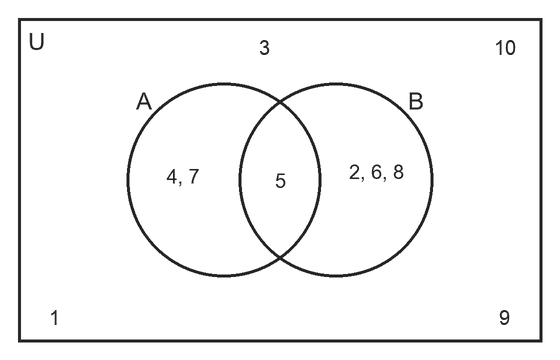
(i)
(ii)
- 1161 mark
Question 116
In the Venn diagram below, shade the following sets:

(i)
(ii)
- 1171 mark
Question 117
If and then is equal to
- 1181 mark
Question 118
If and , then is equal to
- 1191 mark
Question 119
Two sets and have 27 and 33 elements respectively. If contains 48 elements, then how many elements are there in ?
- 1201 mark
Question 120
A set is given as . Which of these would be true about the set ?
- 1211 mark
Question 121
Write the set builder form of .
- 1221 mark
Question 122
If a set has 4 elements, then the total number of proper subsets of set is
- 1231 mark
Question 123
If , and then is equal to
- 1241 mark
Question 124
The shaded region in the figure below represents
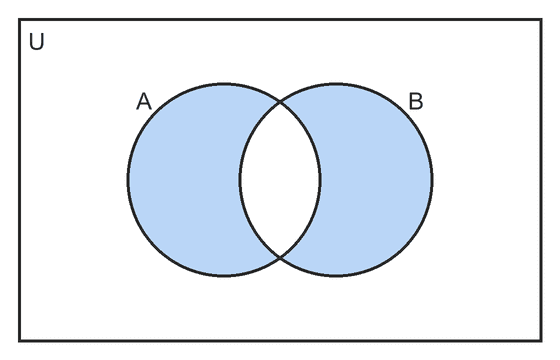
- 1251 mark
Question 125
If and is a set of even natural numbers, then what is the cardinality of ?
- 1261 mark
Question 126
Let = set of points inside the square, = set of points inside the triangle and = set of points inside the circle. If the triangle and circle intersect each other and are contained in a square, then
- 1271 mark
Question 127
What does the shaded region in the figure below represent?
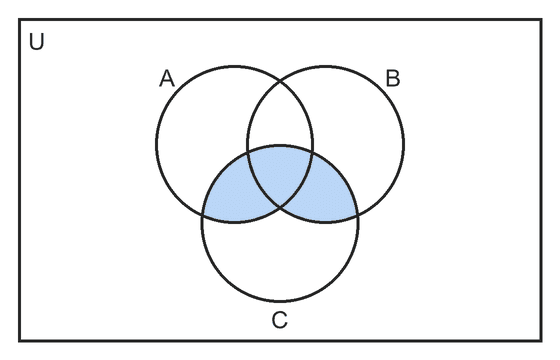
- 1281 mark
Question 128
, and are three sets and is the universal set such that , , and , then what is the value of ?
- 1291 mark
Question 129
The set is equal to
- 1301 mark
Question 130
If and , then
- 1311 mark
Question 131
Let be the universal set, being the set of natural numbers. If and , then what is the complement of ?
- 1321 mark
Question 132
Two finite sets have and elements, the number of subsets of the first set is 112 more than that of the second set. The values of and are respectively
- 1331 mark
Question 133
If then the power set of is
- 1341 mark
Question 134
In a class of 60 students, if 25 students play cricket, 20 students play tennis and 10 students play both the games, then the number of students who play neither is
- 1351 mark
Question 135
If and are two sets, then is
- 1361 mark
Question 136
and are subsets of universal set such that , , and . The number of elements in the set is
What Class 11 Maths Ch 1 covers
The sections of the chapter, in the order the book takes them. Every question above comes from one of these.
- 01What is a Set? Representation of a Set
- 02Types of Sets
- 03Intervals
- 04Subsets and Power Set
- 05Venn Diagrams
- 06Union and Intersection of Sets
More ways to study this chapter
The same chapter asked three other ways. Practise it, revise it, and see what the board has set on Ch 1 before.
Class 11 Maths Ch 1 questions students ask
How many questions are there in Class 11 Maths Ch 1?
136 questions. Every one is solved step by step on this page.
Are these Class 11 Maths solutions free?
Yes. Every question and its full working is free to read, with no account needed.
Can I download the Class 11 Maths Ch 1 solutions as a PDF?
There is no PDF to download. Every solution is on this page instead, which means it is searchable, always the current syllabus, and readable on a phone. Use your browser's print option if you want it on paper.