
Question 663 marksMedium
Describe the shaded regions in the following diagrams.
(i)
(ii) Circle lies inside circle .

(iii)

(iv)
(v)
(vi)
Confirming your payment
Sign up now and get 250 free tokens.
Sets · Question 66 of 136
Describe the shaded regions in the following diagrams.
(i)
(ii) Circle lies inside circle .
(iii)
(iv)
(v)
(vi)
Solution:
Key idea: To name a shaded region, ask which circles it lies inside and which it lies outside. Being inside a set gives , being outside gives the complement , and "inside this and outside that" is joined with .
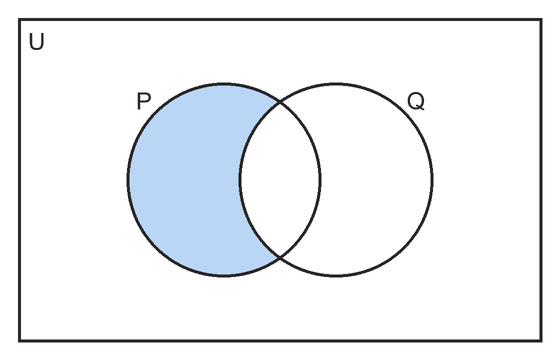
Step 1 — Diagram (i).
The shaded part lies inside circle but outside circle , so it is the intersection of with the complement of . This is the same as the difference .
Region:
This set is also written .
Step 2 — Diagram (ii).
Circle lies inside circle , and the shaded ring is inside but outside . So it is with removed.
Region:
This set is also written .
Step 3 — Diagram (iii).
The shaded part lies outside all three circles. It is outside , outside and outside , so it is the complement of their union (De Morgan's law gives the second form).
Region:
By De Morgan's law this set is also written .
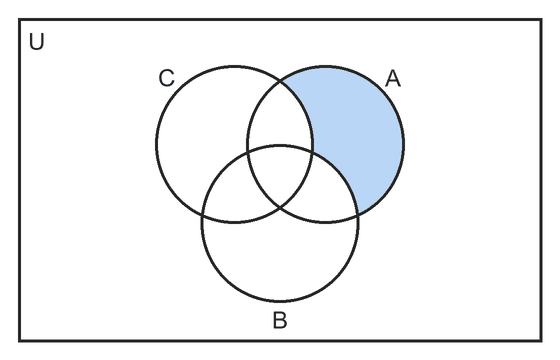
Step 4 — Diagram (iv).
The shaded part lies inside circle but outside circle and outside circle .
Region:
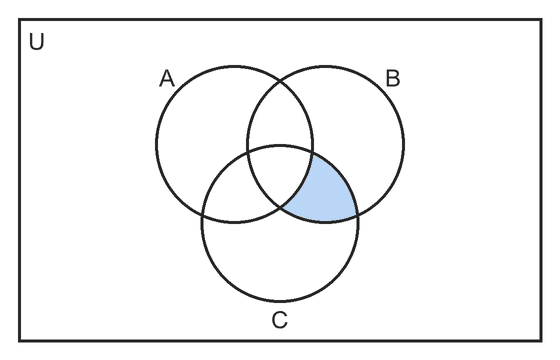
Step 5 — Diagram (v).
The shaded part lies inside circle and inside circle , but outside circle .
Region:
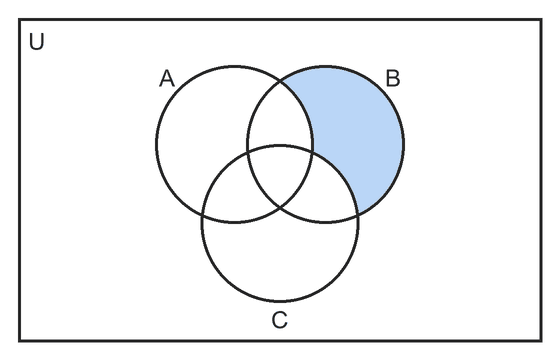
Step 6 — Diagram (vi).
The shaded part lies inside circle but outside circle and outside circle .
Region:
Answer: (i) ; (ii) ; (iii) ; (iv) ; (v) ; (vi)