Solution:
Key idea: A three-set Venn diagram has eight regions. We fill it from the centre outwards: first all three sets, then each "two sets but not the third" region, then each "one set only" region. For three sets,
n(A∪B∪C)=n(A)+n(B)+n(C)−n(A∩B)−n(B∩C)−n(A∩C)+n(A∩B∩C)
Step 1 — Write down the data.
Let A, B and C be the sets of persons who read magazines A, B and C.
n(A)=28, n(B)=30, n(C)=42
n(A∩B)=8, n(A∩C)=10, n(B∩C)=5
n(A∩B∩C)=3
Step 2 — Find how many read at least one magazine.
We put every value into the formula for three sets.
n(A∪B∪C)=28+30+42−8−10−5+3
n(A∪B∪C)=100−23+3
n(A∪B∪C)=80
Step 3 — Part (i): find how many read none.
The persons who read none lie outside all three circles, so we subtract 80 from 100.
100−80=20
Step 4 — Part (ii): find how many read magazine C only.
From the 42 readers of C we subtract both pairs that include C. This removes the 3 who read all three twice, so we add 3 back once.
n(C only)=42−10−5+3
n(C only)=30
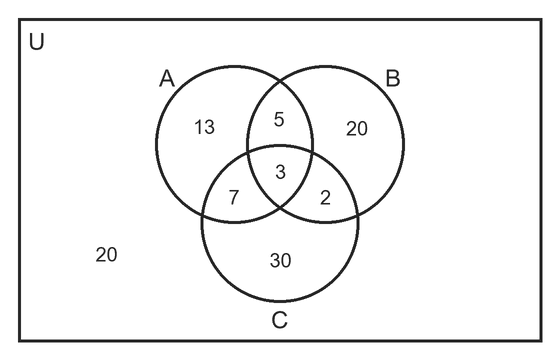
Check: The eight regions in the figure add up to the 100 persons surveyed.
13+5+20+7+3+2+30+20
=100
Answer: (i) 20 persons read none of the magazines, (ii) 30 persons read magazine C only.
