Solution:
Key idea: A three-set Venn diagram has eight regions. We fill it from the centre outwards: first all three sets, then each "two sets but not the third" region, then each "one set only" region. For three sets,
n(M∪P∪C)=n(M)+n(P)+n(C)−n(M∩P)−n(P∩C)−n(M∩C)+n(M∩P∩C)
Step 1 — Name the sets and write the data.
Let M, P and C be the sets of students who study Mathematics, Physics and Chemistry.
n(M)=120, n(P)=90, n(C)=70
n(M∩P)=40, n(P∩C)=30, n(M∩C)=50
Step 2 — Find how many study at least one subject.
The 20 students who study none of the subjects lie outside all three circles, so we remove them from 200.
n(M∪P∪C)=200−20
n(M∪P∪C)=180
Step 3 — Part (i): find how many study all three.
We let x=n(M∩P∩C) and put every value into the formula for three sets.
180=(120+90+70)−(40+30+50)+x
180=280−120+x
180=160+x
Now we subtract 160 from both sides.
x=180−160
x=20
Step 4 — Part (ii): find how many study Mathematics only.
From the 120 Mathematics students we subtract both pairs that include Mathematics. This removes the 20 who study all three twice, so we add 20 back once.
n(M only)=120−40−50+20
n(M only)=50
Step 5 — Check with the full Venn diagram.
We fill all eight regions and check that they add up to 200. First the regions for two subjects only, removing the 20 who study all three:
M and P only: 40−20=20
P and C only: 30−20=10
M and C only: 50−20=30
Next the regions for one subject only (Mathematics only is 50 from Step 4):
P only: 90−20−10−20=40
C only: 70−30−10−20=10
Now we add the seven inside regions and the 20 who study none.
50+40+10+20+10+30+20+20
=200
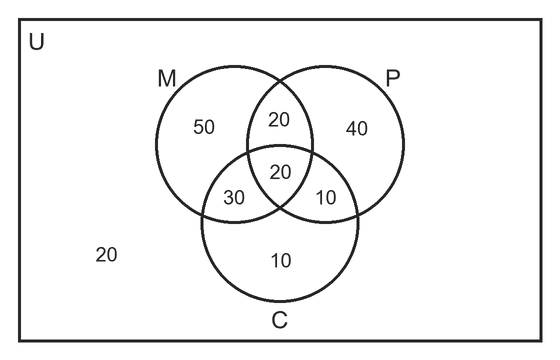
Answer: (i) 20 students study all three subjects, (ii) 50 students study Mathematics only.
