
Question 713 marksEasy
The Venn diagram below shows:
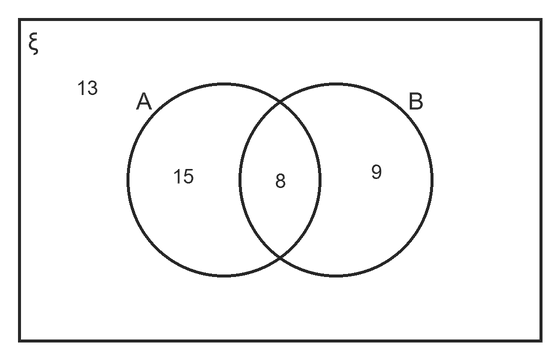
How many pupils:
(i) are in class 8?
(ii) play cricket?
(iii) play basketball?
(iv) play both cricket and basketball?
(v) play neither cricket nor basketball?
Confirming your payment
Sign up now and get 250 free tokens.
Sets · Question 71 of 136
The Venn diagram below shows:
How many pupils:
(i) are in class 8?
(ii) play cricket?
(iii) play basketball?
(iv) play both cricket and basketball?
(v) play neither cricket nor basketball?
Solution:
Key idea: In a Venn diagram, the number written in each region counts only the pupils in that region. To count a whole set, we add the numbers in all the regions that make up that set.
Step 1 — Read the four regions.
We read the number in each region of the diagram.
Only cricket (inside , outside ): 15
Both games (inside and ): 8
Only basketball (inside , outside ): 9
Neither game (outside both circles): 13
Step 2 — Part (i): pupils in class 8.
The whole class is the rectangle , so we add all four regions.
Step 3 — Part (ii): pupils who play cricket.
Circle is made of the "only cricket" region and the overlap.
Step 4 — Part (iii): pupils who play basketball.
Circle is made of the overlap and the "only basketball" region.
Step 5 — Part (iv): pupils who play both games.
Pupils who play both lie in the overlap of the two circles, so we read that region directly. There are 8 such pupils.
Step 6 — Part (v): pupils who play neither game.
Pupils who play neither lie outside both circles, so we read that region directly. There are 13 such pupils.
Watch out: The number 15 is not the number of cricket players. It counts only those who play cricket and not basketball; the 8 who play both must be added.
Answer: (i) 45, (ii) 23, (iii) 17, (iv) 8, (v) 13