
Opening your dashboard
Class 11 Chemistry Chapter 14: Hydrocarbons Solutions
128 textbook questions with step-by-step answers, free to read, for ISC 2026-27.
Get talked through Ch 14, not just shown the answer
Reading a finished solution is not the same as being able to do it. The AI tutor takes one question at a time and works it with you, in your own words, until you can.
- Ask it out loud, in your own words
- It gives you the next step, not the answer
- Stuck on part (ii)? Start there
128 questions with solutions
1–5 marks · Mixed difficulty
The first 48 solutions are on this page. This chapter is a long one, so the rest open on their own page to keep this one quick to load.
- 11 mark
Question 1
Which one of the following conformations of cyclohexane is chiral?
Solve with AIAnswer
(A) Boat
- Correct
(B) Twist boat
(C) Rigid
(D) Chair
Answer: (B) Twist boat
Key idea: A molecule (or a conformation) is chiral when it cannot be superimposed on its mirror image. Any shape that has a plane of symmetry or a centre of symmetry is achiral, so we look for the conformation that has neither.
Step 1 — List the symmetry of the chair and the boat. The chair form has a centre of symmetry and three planes of symmetry, and the boat form has two planes of symmetry, so both are superimposable on their mirror images.
Step 2 — Look at the twist boat. When the boat twists slightly, its two planes of symmetry are lost; only three two-fold rotation axes remain. A shape with rotation axes only is not superimposable on its mirror image.
Step 3 — Decide. The twist boat therefore exists as two mirror-image forms (left-handed and right-handed twists), so it is the chiral conformation. The two forms interconvert rapidly, so cyclohexane itself is never optically active.
Why the other options are wrong:
- (A) The boat form has two planes of symmetry, so it is achiral.
- (C) There is no conformation of cyclohexane called "rigid"; the ring is flexible, and its named forms are the chair, half-chair, twist boat and boat.
- (D) The chair form, the most stable one, has a centre of symmetry and planes of symmetry, so it is achiral.
Therefore, the twist boat conformation of cyclohexane is chiral.
- 21 mark
Question 2
Increasing order of stability among the three main conformations (i.e., Eclipse, Anti, Gauche) of 2-fluoroethanol is
Solve with AIAnswer
- Correct
(A) Eclipse, Anti, Gauche
(B) Anti, Gauche, Eclipse
(C) Eclipse, Gauche, Anti
(D) Gauche, Eclipse, Anti
Answer: (A) Eclipse, Anti, Gauche
Key idea: In conformations about a C–C bond, the eclipsed form is always least stable because of torsional strain (bonds lined up face to face). For a simple molecule such as butane the anti form is most stable. In 2-fluoroethanol, , the gauche form is the most stable instead. This preference of two electronegative groups on neighbouring carbons for the gauche position is called the gauche effect.
Step 1 — Place the eclipsed form. The eclipsed form has the F and OH groups (and the H atoms) lined up face to face, so it has the highest energy and is the least stable.
Step 2 — Explain why gauche beats anti. In the gauche form (F and OH 60° apart) each C–H bond on one carbon lies anti to the C–F or C–O bond on the other carbon. A C–H bond can then share some of its electron density with the electron-poor C–F and C–O bonds (hyperconjugation), which lowers the energy. In the anti form the C–F bond lies anti to the C–O bond instead, so this extra stabilisation is smaller.
Step 3 — Add the hydrogen-bond effect. In the gauche form the OH and F groups are also close enough for a weak intramolecular attraction, , which is the reason most textbooks give. In the anti form they are 180° apart and cannot interact. Both effects favour the gauche form, so its energy is below that of the anti form.
Step 4 — Write the increasing order. Least stable first: eclipsed, then anti, then gauche.
Why the other options are wrong:
- (B) This order makes the eclipsed form the most stable, but the eclipsed form has the most torsional strain and is the least stable.
- (C) This is the order for butane, where no such effect acts; in 2-fluoroethanol the gauche effect and the weak O–H···F attraction make gauche more stable than anti.
- (D) This order puts gauche as the least stable form, ignoring its extra stabilisation, and puts eclipsed above gauche.
Therefore, the increasing order of stability is eclipsed < anti < gauche.
- 31 mark
Question 3
Of the five isomeric hexanes, the isomer which can give two monochlorinated compounds is
Solve with AIAnswer
(A) 2-methylpentane
(B) 2, 2-dimethylbutane
- Correct
(C) 2, 3-dimethylbutane
(D) n-hexane
Answer: (C) 2, 3-dimethylbutane
Key idea: Free radical chlorination can replace any hydrogen atom. The number of different monochloro compounds equals the number of different kinds (environments) of hydrogen in the alkane; hydrogens related by the molecule's symmetry give the same product.
Step 1 — Look at 2,3-dimethylbutane. Its structure is . The molecule is symmetrical about its central C–C bond, so all four groups are alike and the two CH hydrogens are alike.
Step 2 — Count its products. There are two kinds of hydrogen: twelve methyl (1°) hydrogens and two tertiary (3°) hydrogens. Replacing one of each kind gives
Step 3 — Compare with the other hexanes. Counting the hydrogen environments of each isomer in the same way gives 3 for n-hexane, 5 for 2-methylpentane, 4 for 3-methylpentane and 3 for 2,2-dimethylbutane. Only 2,3-dimethylbutane gives exactly two.
Why the other options are wrong:
- (A) 2-Methylpentane, , has five kinds of hydrogen (the two alike groups on C-2, the C-2 H, the C-3 , the C-4 and the C-5 ), so it gives five monochloro compounds.
- (B) 2,2-Dimethylbutane, , has three kinds of hydrogen (the three alike groups on C-2, the and the end ), so it gives three.
- (D) n-Hexane has three kinds of hydrogen (C-1/C-6, C-2/C-5 and C-3/C-4), so it gives three.
Therefore, 2,3-dimethylbutane is the hexane that gives two monochlorinated compounds.
- 41 mark
Question 4
Reaction of one molecule of HBr with one molecule of 1, 3-butadiene at 40°C gives predominantly
Solve with AIAnswer
(A) 1-bromo-2-butene under kinetically controlled conditions
(B) 3-bromobutene under thermodynamically controlled conditions
- Correct
(C) 1-bromo-2-butene under thermodynamically controlled conditions
(D) 3-bromobutene under kinetically controlled conditions
Answer: (C) 1-bromo-2-butene under thermodynamically controlled conditions
Key idea: HBr adds to a conjugated diene through an allylic carbocation, whose positive charge is shared by C-2 and C-4. Bromide can attack either carbon, giving a 1,2-adduct or a 1,4-adduct. At low temperature the product that forms faster wins (kinetic control); at higher temperature, such as 40 °C, the addition is reversible and the more stable product wins (thermodynamic control).
Step 1 — Form the allylic carbocation. The proton adds to C-1, giving a carbocation that is stabilised by resonance.
Step 2 — Write the two possible products. Bromide attack at C-2 gives the 1,2-adduct, 3-bromobut-1-ene; attack at C-4 gives the 1,4-adduct, 1-bromobut-2-ene.
Step 3 — Decide which one is stable. The 1,4-adduct has a disubstituted (internal) double bond, while the 1,2-adduct has a monosubstituted (terminal) one, so the 1,4-adduct is the more stable product.
Step 4 — Apply the temperature. At 40 °C the reaction comes to equilibrium, so the more stable 1,4-adduct, 1-bromo-2-butene, is the main product; this is thermodynamic control.
Why the other options are wrong:
- (A) Under kinetic control (low temperature, about −80 °C) the main product is the 1,2-adduct, not 1-bromo-2-butene.
- (B) 3-Bromobutene (3-bromobut-1-ene) is the less stable product, so it is not the main product under thermodynamic control.
- (D) 3-Bromobutene is indeed the kinetic product, but kinetic control holds at low temperature, not at 40 °C.
Therefore, at 40 °C the main product is 1-bromo-2-butene, formed under thermodynamic control.
- 51 mark
Question 5
Butene-1 may be converted to butane by reaction with
Solve with AIAnswer
(A)
(B)
- Correct
(C)
(D)
Answer: (C)
Key idea: An alkene becomes an alkane by catalytic hydrogenation: hydrogen gas adds across the C=C bond on the surface of a finely divided metal catalyst such as Pd, Pt or Ni (the Sabatier–Senderens reaction uses Ni at about 523–573 K).
Step 1 — Write the change needed. Butene-1 is and butane is , so one molecule of must add across the double bond.
Step 2 — Write the reaction. With hydrogen over palladium the addition takes place readily.
Why the other options are wrong:
- (A) Tin and hydrochloric acid reduce nitro compounds to amines; they do not reduce an isolated C=C bond.
- (B) Zinc amalgam (used with HCl in the Clemmensen reduction) reduces a C=O group to ; it does not add hydrogen to an alkene.
- (D) Zinc and hydrochloric acid can reduce alkyl halides to alkanes, but they do not reduce a C=C bond.
Therefore, butene-1 is converted to butane by in the presence of Pd.
- 61 mark
Question 6
The treatment of with produces
Solve with AIAnswer
(A)
(B)
(C)
- Correct
(D)
Answer: (D)
Key idea: A Grignard reagent, , behaves as a source of the very strong base . It removes any acidic hydrogen (from water, alcohols or a terminal alkyne) and the R group leaves as the hydrocarbon RH.
Step 1 — Find the acidic hydrogen. Propyne, , is a terminal alkyne. Its ≡C–H hydrogen is attached to an sp carbon (50% s-character), so it is weakly acidic.
Step 2 — Let the methyl group take this proton. The methyl group of picks up the proton and is released as methane; the alkyne becomes an alkynyl Grignard reagent.
Why the other options are wrong:
- (A) Propene would need hydrogen to be added across the triple bond; a Grignard reagent does not reduce an alkyne.
- (B) But-2-yne forms when sodium propynide reacts with a methyl halide; here the Grignard reagent only removes a proton, so no new C–C bond is made.
- (C) But-2-ene would need both a new C–C bond and a partial reduction, and neither takes place.
Therefore, the reaction produces methane, .
- 71 mark
Question 7
Toluene is nitrated and the resulting product is reduced with tin and hydrochloric acid. The product so obtained is diazotised and then heated with cuprous bromide. The reaction mixture so formed contains
Solve with AIAnswer
- Correct
(A) mixture of o- and p-bromotoluenes
(B) mixture of o- and p-dibromobenzenes
(C) mixture of o- and p-bromoanilines
(D) mixture of o- and m-bromotoluenes
Answer: (A) mixture of o- and p-bromotoluenes
Key idea: The methyl group of toluene is an ortho–para director (it releases electrons by its +I effect and hyperconjugation). The nitro group introduced at the ortho and para positions is carried through each later step: , while the methyl group stays in place.
Step 1 — Nitrate toluene. The nitrating mixture (conc. + conc. ) puts the nitro group mainly ortho and para to the methyl group.
Step 2 — Reduce with tin and hydrochloric acid. The nitro group is reduced to an amino group, giving o- and p-toluidine.
Step 3 — Diazotise. With and HCl at 0–5 °C the amino group becomes a diazonium group.
Step 4 — Heat with cuprous bromide (Sandmeyer reaction). The diazonium group is replaced by bromine and nitrogen gas is given off.
Step 5 — Name the products. Since the ring positions came from the first step, the mixture contains o-bromotoluene and p-bromotoluene.
Why the other options are wrong:
- (B) Dibromobenzenes would need the methyl group to be replaced by bromine, but the methyl group is untouched in every step.
- (C) Bromoanilines would keep the group, but diazotisation and the Sandmeyer reaction remove it as ; also no methyl group would be left in them.
- (D) The meta isomer is formed only in a very small amount (about 4%) because the methyl group directs ortho and para.
Therefore, the final mixture contains o- and p-bromotoluenes.
- 81 mark
Question 8
The compound formed as a result of oxidation of ethyl benzene by is
Solve with AIAnswer
(A) benzyl alcohol
(B) benzophenone
(C) acetophenone
- Correct
(D) benzoic acid
Answer: (D) benzoic acid
Key idea: Hot alkaline (or acidic) oxidises any alkyl side chain on a benzene ring that has at least one hydrogen on the carbon next to the ring (the benzylic carbon). The whole chain, however long, is cut down to a single –COOH group; the benzene ring itself is not attacked.
Step 1 — Look at the side chain. Ethylbenzene, , has a benzylic group, so its side chain can be oxidised.
Step 2 — Write the oxidation. The benzylic carbon becomes –COOH and the end carbon is lost as carbon dioxide (the acid is set free on acidifying the potassium salt).
Why the other options are wrong:
- (A) Benzyl alcohol, , has only one side-chain carbon and is not an end product; under these conditions any such alcohol would be oxidised further to benzoic acid.
- (B) Benzophenone, , has two benzene rings, but ethylbenzene has only one.
- (C) Acetophenone, , is obtained by mild, controlled oxidation; hot breaks the side chain down completely to –COOH.
Therefore, oxidation of ethylbenzene by gives benzoic acid.
- 91 mark
Question 9
The reaction of ethyl magnesium bromide with water would give
Solve with AIAnswer
- Correct
(A) Ethane
(B) Ethyl alcohol
(C) Ethyl bromide
(D) Ethyl ether
Answer: (A) Ethane
Key idea: In a Grignard reagent the carbon bonded to magnesium carries a partial negative charge, so it behaves like the base . Water gives it a proton, and the alkyl group comes off as an alkane (RH). This is a method of preparing alkanes.
Step 1 — Identify R. In ethyl magnesium bromide, , the alkyl group is ethyl, .
Step 2 — Write the reaction with water. The ethyl group takes H from water, and magnesium is left as the basic bromide.
Why the other options are wrong:
- (B) Ethyl alcohol would need an oxygen atom to join the ethyl group; water only supplies a proton to it. (Alcohols come from Grignard reagents and carbonyl compounds, or with oxygen.)
- (C) Ethyl bromide is the starting material used to make the Grignard reagent; water does not turn it back.
- (D) Ethyl ether (diethyl ether) is the dry solvent in which the Grignard reagent is prepared, not a product of its reaction with water.
Therefore, ethyl magnesium bromide and water give ethane.
- 101 mark
Question 10
In commercial gasoline the type of hydrocarbons which are more desirable, is
Solve with AIAnswer
- Correct
(A) branched hydrocarbons
(B) straight-chain hydrocarbons
(C) aromatic hydrocarbons such as toluene
(D) linear unsaturated hydrocarbons
Answer: (A) branched hydrocarbons
Key idea: A good petrol must burn smoothly in the engine without knocking (part of the compressed fuel–air mixture igniting by itself, too early, before the spark flame reaches it). Its quality is measured by the octane number: 2,2,4-trimethylpentane (iso-octane), a highly branched alkane, is given 100 and n-heptane, a straight-chain alkane, is given 0.
Step 1 — Compare straight and branched chains. Branched alkanes resist self-ignition when the fuel–air mixture is compressed and heated, so they burn smoothly and have high octane numbers; straight-chain alkanes self-ignite easily and knock badly.
Step 2 — Choose the main desirable type. Refiners therefore convert straight-chain alkanes into branched ones (isomerisation) and build branched alkanes from small molecules (alkylation, which gives iso-octane). Branched alkanes are the hydrocarbon type most wanted in good-quality petrol.
Why the other options are wrong:
- (B) Straight-chain alkanes knock badly (n-heptane has an octane number of 0), so they are the least desirable.
- (C) Toluene does have a high octane number, but aromatic hydrocarbons give smoke and toxic emissions (benzene is a carcinogen), so their share in petrol is capped by law (about 35 % by volume in Euro 6 and BS-VI petrol); they are a limited blending component, not the type refiners try to increase.
- (D) Straight-chain alkenes slowly oxidise and polymerise on storage to form gums that clog the engine, so they are not wanted.
Note: the printed key is branched hydrocarbons; toluene is also a high-octane component, but its amount in petrol is restricted.
Therefore, branched hydrocarbons are the most desirable in gasoline.
- 111 mark
Question 11
The most stable conformation of n-butane is
Solve with AIAnswer
(A) skew boat
(B) gauche
- Correct
(C) staggered-anti
(D) eclipsed
Answer: (C) staggered-anti
Key idea: Rotation about the C2–C3 bond of butane gives conformations of different energy. Energy rises with torsional strain (eclipsed bonds) and steric strain (bulky groups close together). The most stable conformation has the least of both.
Step 1 — Look at the anti form. In the staggered-anti form the bonds are staggered and the two groups are 180° apart, as far from each other as possible, so both kinds of strain are at their minimum.
Step 2 — Compare with the others. The gauche form is also staggered but has the groups 60° apart (about 3.8 kJ mol⁻¹ higher), and the fully eclipsed form, with the methyl groups lined up, is the highest in energy (about 19 kJ mol⁻¹ above anti).
Why the other options are wrong:
- (A) Skew boat is a name used for ring conformations such as those of cyclohexane; butane is an open chain and has no boat forms.
- (B) The gauche form is staggered, but its methyl groups are only 60° apart, so it has some steric strain and is less stable than anti.
- (D) The eclipsed forms have the most torsional strain, and the one with the two methyl groups eclipsed is the least stable of all.
Therefore, the staggered-anti conformation of n-butane is the most stable.
- 121 mark
Question 12
Which one of the following reactions is expected to readily give a hydrocarbon product in good yields?
Solve with AIAnswer
- Correct
(A)
(B)
(C)
(D)
Answer: (A)
Key idea: In Kolbe's electrolytic method, a concentrated aqueous solution of the sodium or potassium salt of a carboxylic acid is electrolysed. At the anode the carboxylate ion loses an electron and , and two alkyl radicals join to give the alkane R–R in good yield.
Step 1 — Write the anode reaction. Each carboxylate ion gives an alkyl radical; two radicals combine.
Step 2 — Write the overall reaction for an example. For potassium acetate the hydrocarbon formed is ethane; hydrogen and KOH form at the cathode.
Why the other options are wrong:
- (B) Silver carboxylates with bromine undergo the Hunsdiecker reaction, which gives an alkyl bromide, RBr, with and AgBr, not a hydrocarbon.
- (C) Ethane and chlorine in light give chloroethane (with some polychloro products), , which is a haloalkane, not a hydrocarbon.
- (D) tert-Butyl chloride in ethanol reacts mainly by substitution to give the ether ; only a minor part eliminates to 2-methylpropene, so the hydrocarbon yield is poor.
Therefore, Kolbe's electrolysis of RCOOK gives a hydrocarbon in good yield.
- 131 mark
Question 13
In the free radical chlorination of methane, the chain initiating step involves the formation of
Solve with AIAnswer
- Correct
(A) Chlorine free radical
(B) Hydrogen chloride
(C) Methyl radical
(D) Chloromethyl radical
Answer: (A) Chlorine free radical
Key idea: Free radical chlorination runs as a chain with three stages: initiation (radicals are first made), propagation (radicals react with molecules and regenerate radicals) and termination (radicals combine).
Step 1 — Find the weakest bond. The Cl–Cl bond (about 243 kJ mol⁻¹) is weaker than the C–H bond of methane (about 435 kJ mol⁻¹), so light (hν) or heat breaks it first.
Step 2 — Write the initiation step. The chlorine molecule splits evenly (homolysis) into two chlorine free radicals.
Step 3 — See what follows. Only in the next (propagation) step does a chlorine radical take H from methane.
Why the other options are wrong:
- (B) Hydrogen chloride is formed in the first propagation step, not in initiation.
- (C) The methyl radical is also formed in the first propagation step, when a chlorine radical removes H from methane.
- (D) The chloromethyl radical, , forms only later, when chloromethane itself is attacked on the way to .
Therefore, the initiating step forms chlorine free radicals.
- 141 mark
Question 14
The IUPAC name of the compound having the formula is :
Solve with AIAnswer
(A) 1-butyn-3-ene
(B) but-1-yne-3-ene
- Correct
(C) 1-butene-3-yne
(D) 3-butene-1-yne
Answer: (C) 1-butene-3-yne
Key idea: For a chain with both a double and a triple bond, the name ends in -yne with "en" placed before it (en-yne). Number the chain to give the multiple bonds, taken together, the lowest locants; if there is still a choice, the double bond gets the lower number.
Step 1 — Count the chain. has four carbons, so the parent is "but".
Step 2 — Try both numberings. From the left, the triple bond starts at C-1 and the double bond at C-3, giving locants {1, 3}. From the right, the double bond starts at C-1 and the triple bond at C-3, again {1, 3}. The sets are equal.
Step 3 — Break the tie. The rule gives the lower number to the double bond, so we number from the end: double bond at C-1, triple bond at C-3.
Step 4 — Write the name. The name is but-1-en-3-yne, which option (C) writes in the older style as 1-butene-3-yne.
Why the other options are wrong:
- (A) In "1-butyn-3-ene" the ending is "-ene", but when both bonds are present the name must end in "-yne", and the tie-break gives the double bond locant 1.
- (B) "But-1-yne-3-ene" also ends in "-ene" and gives the lower locant to the triple bond.
- (D) "3-Butene-1-yne" gives the triple bond the lower locant, but in a tie the double bond takes the lower number.
Therefore, the IUPAC name is 1-butene-3-yne (but-1-en-3-yne).
- 151 mark
Question 15
Which of the following compounds will exhibit cis-trans (geometrical) isomerism?
(a) Butanol
(b) 2-Butyne
(c) 2-Butenol
(d) 2-Butene
Solve with AIWritten solution
Solution:
Key idea: Cis–trans (geometrical) isomerism needs restricted rotation (a C=C bond or a ring) and two different groups on each of the two doubly bonded carbons.
Step 1 — Check (a), butanol. Butanol, , has only single bonds, about which the groups rotate freely, so it shows no cis–trans isomerism.
Step 2 — Check (b), 2-butyne. In the four carbon atoms lie on a straight line and each triple-bonded carbon carries only one group, so there is no "same side" or "opposite side". It shows no cis–trans isomerism.
Step 3 — Check (c), 2-butenol. This name has the double bond at C-2: but-2-en-1-ol, . Its C-2 carries H and , and its C-3 carries H and , so it exists as cis and trans forms (cis- and trans-but-2-en-1-ol). So (c) is correct.
Step 4 — Check (d), 2-butene. In each doubly bonded carbon carries H and , so it exists as cis-but-2-ene and trans-but-2-ene. So (d) is correct.
Note: this item has more than one correct choice. The printed answer gives only (d); 2-butenol (but-2-en-1-ol) also shows cis–trans isomerism. If 2-butanol was intended in choice (c), only (d) would be correct, since 2-butanol has no double bond.
Therefore, cis–trans isomerism is shown by (c) 2-butenol and (d) 2-butene.
- 161 mark
Question 16
(predominantly) is:
Solve with AIAnswer
(A)
- Correct
(B)
(C)
(D)
Answer: (B)
Key idea: HBr adds to an alkene through a carbocation. The proton adds so as to give the more stable carbocation (Markovnikov's rule), and a carbocation next to a more substituted carbon can rearrange by a 1,2-hydride shift to a still more stable (tertiary) carbocation before bromide attacks.
Step 1 — Add the proton. The alkene is 3-methylbut-1-ene. The proton adds to C-1 (the end), giving a secondary carbocation at C-2.
Step 2 — Let the carbocation rearrange. The hydrogen on the neighbouring carbon (C-3) moves with its electron pair to C-2. The positive charge moves to C-3, which carries two methyl groups, so the new carbocation is tertiary and more stable.
Step 3 — Add bromide. Bromide ion joins the tertiary carbon, giving 2-bromo-2-methylbutane.
Why the other options are wrong:
- (A) This is 1-bromo-3-methylbutane, the anti-Markovnikov product; it forms only with HBr in the presence of a peroxide, which the stem does not mention.
- (C) This is 2-bromo-3-methylbutane, the product of bromide attack on the unrearranged secondary carbocation; it is only a minor product because the carbocation rearranges first.
- (D) This is the same compound as (C), 2-bromo-3-methylbutane, written from the other end of the chain, so it is also only a minor product.
Note: options (C) and (D) as printed are the same compound.
Therefore, the main product A is 2-bromo-2-methylbutane, .
- 171 mark
Question 17
Which of the compounds with molecular formula yields acetone on ozonolysis?
Solve with AIAnswer
(A) 3-methyl-1-butene
(B) cyclopentane
(C) 2-methyl-1-butene
- Correct
(D) 2-methyl-2-butene
Answer: (D) 2-methyl-2-butene
Key idea: Ozonolysis cuts a C=C bond and turns each doubly bonded carbon into a C=O group. To get acetone, , one carbon of the double bond must carry two methyl groups.
Step 1 — Find the alkene with a end. 2-Methyl-2-butene is ; its C-2 carries two methyl groups.
Step 2 — Write the ozonolysis. Ozone adds to give the ozonide, which zinc and water split into two carbonyl compounds.
Step 3 — Name the products. The products are acetone and acetaldehyde, so this alkene yields acetone.
Why the other options are wrong:
- (A) 3-Methyl-1-butene, , gives 2-methylpropanal, , and formaldehyde.
- (B) Cyclopentane has no double bond, so ozone does not cleave it.
- (C) 2-Methyl-1-butene, , gives butanone, , and formaldehyde; its substituted carbon carries a methyl and an ethyl group, not two methyls.
Therefore, 2-methyl-2-butene yields acetone on ozonolysis.
- 181 mark
Question 18
Which one of the following alkenes will react faster with under catalytic hydrogenation conditions?
(R = Alkyl Substituent)
 Solve with AI
Answer
- Correct
(A) Alkene (a)
(B) Alkene (b)
(C) Alkene (c)
(D) Alkene (d)
Answer: (A) Alkene (a)
Key idea: In catalytic hydrogenation the alkene must lie flat on the metal surface for to add to one face of the C=C bond. The fewer alkyl groups on the double bond, the more easily it reaches the surface and the faster it reacts. A less stable alkene (a larger heat of hydrogenation) also reacts more readily.
Step 1 — Count the alkyl groups on each double bond. From the figure: (a) has one R on each carbon, on the same side (a cis-disubstituted alkene, RCH=CHR); (b) has both R groups on one carbon (, also disubstituted); (c) has three R groups (trisubstituted); (d) has four (tetrasubstituted).
Step 2 — Rule out (c) and (d). With three or four bulky groups round the double bond, these alkenes reach the catalyst surface with difficulty and react most slowly; (d) is the slowest.
Step 3 — Compare the two disubstituted alkenes. The cis alkene is the less stable of the two: for example, the heat of hydrogenation of cis-but-2-ene (about 120 kJ mol⁻¹) is a little larger than that of 2-methylpropene (about 119 kJ mol⁻¹). So alkene (a) is taken as the fastest.
Why the other options are wrong:
- (B) is also disubstituted and reacts nearly as fast, but it is slightly more stable than the cis alkene, so it is placed after (a).
- (C) The trisubstituted alkene has three alkyl groups crowding the double bond, so it reacts more slowly.
- (D) The tetrasubstituted alkene is the most crowded and the most stable, so it is hydrogenated most slowly of all.
Note: the rates of the two disubstituted alkenes (a) and (b) are close and depend on the catalyst; the printed answer picks the less stable cis alkene.
Therefore, alkene (a), the cis-disubstituted alkene, reacts fastest.
- 191 mark
Question 19
Reaction of HBr with propene in the presence of peroxide gives
Solve with AIAnswer
(A) isopropyl bromide
(B) 3-bromo propane
(C) allyl bromide
- Correct
(D) n-propyl bromide
Answer: (D) n-propyl bromide
Key idea: In the presence of a peroxide, HBr adds to an unsymmetrical alkene against Markovnikov's rule (the peroxide effect or Kharasch effect). The reaction goes by free radicals: the bromine radical adds first, to the end carbon, so that the more stable secondary radical is formed.
Step 1 — Form the bromine radical. The peroxide gives radicals that take H from HBr, leaving .
Step 2 — Add the bromine radical to the end. This gives a secondary radical, which is more stable than the primary one.
Step 3 — Complete the chain. The radical takes H from another HBr molecule, giving the product and a new bromine radical.
Step 4 — Write the overall result. Adding the two propagation steps gives the overall anti-Markovnikov addition.
Why the other options are wrong:
- (A) Isopropyl bromide (2-bromopropane) is the Markovnikov product, formed when no peroxide is present.
- (B) "3-Bromo propane" is not an acceptable name: the chain must be numbered from the end nearer the bromine, which makes it 1-bromopropane, the same compound as (D); the correctly named option (D) is the answer.
- (C) Allyl bromide, , keeps the double bond; it forms by substitution (for example with N-bromosuccinimide), not by addition of HBr.
Therefore, propene and HBr with peroxide give n-propyl bromide.
- 201 mark
Question 20
The compound on reaction with in the presence of gives
Solve with AIAnswer
(A)
(B)
- Correct
(C)
(D)
Answer: (C)
Key idea: Sodium periodate with a little potassium permanganate is an oxidative cleaving reagent for C=C bonds. Each doubly bonded carbon becomes a C=O group: a carbon carrying two alkyl groups ends up as a ketone, and a carbon carrying one H is oxidised all the way to a carboxylic acid (the aldehyde first formed does not survive).
Step 1 — Split the double bond. The compound is 2-methylbut-2-ene, . Its left carbon carries two methyl groups; its right carbon carries H and .
Step 2 — Write the product from each half. The half gives acetone. The half gives acetaldehyde, which is oxidised further to acetic acid.
Step 3 — Write the overall change. Three oxygen atoms are used: one to make each C=O group from the double bond and one to oxidise the aldehyde to the acid.
Why the other options are wrong:
- (A) Carbon dioxide comes only from a terminal group, which this alkene does not have, and the dimethyl-substituted carbon cannot become acetaldehyde.
- (B) Acetone accounts for only one half of the molecule; the other half must give a two-carbon product as well.
- (D) Acetone and acetaldehyde are the products of reductive ozonolysis (, then Zn/); the periodate–permanganate reagent oxidises the aldehyde on to acetic acid.
Therefore, the products are acetone and acetic acid, .
- 211 mark
Question 21
Geometrical isomers differ in
Solve with AIAnswer
(A) position of functional group
(B) position of atoms
- Correct
(C) spatial arrangement of atoms
(D) length of carbon chain
Answer: (C) spatial arrangement of atoms
Key idea: Geometrical isomers are stereoisomers: they have the same molecular formula and the same sequence of bonded atoms, but the groups are arranged differently in space about a bond that cannot rotate (such as C=C).
Step 1 — Take an example. cis-But-2-ene and trans-but-2-ene both have the structure ; every atom is joined to the same neighbours.
Step 2 — See what differs. In the cis form the two methyl groups are on the same side of the double bond; in the trans form they are on opposite sides. Only their arrangement in space differs.
Why the other options are wrong:
- (A) Compounds that differ in the position of a functional group (such as propan-1-ol and propan-2-ol) are position isomers, a kind of structural isomer.
- (B) A change in which atoms are bonded to which (the order of attachment) gives structural isomers, not geometrical isomers; geometrical isomers keep the same order.
- (D) Compounds that differ in the carbon chain (such as butane and 2-methylpropane) are chain isomers.
Therefore, geometrical isomers differ in the spatial arrangement of atoms.
- 221 mark
Question 22
Which alkene on ozonolysis gives and
Solve with AIAnswer
- Correct
(A)
(B)
(C)
(D)
Answer: (A)
Key idea: Ozonolysis replaces the C=C bond by two C=O groups. To find the alkene, we work backwards: remove the O atoms of the two carbonyl products and join their carbonyl carbons by a double bond.
Step 1 — Take the two products. Propanal is and acetone is .
Step 2 — Join the carbonyl carbons. Removing both oxygen atoms and joining the two carbons with a double bond gives the alkene.
Step 3 — Check forwards. Ozonolysis of 2-methylpent-2-ene gives back exactly these two products.
Why the other options are wrong:
- (B) Hex-3-ene is symmetrical, so it gives two molecules of propanal and no acetone.
- (C) Pent-2-ene gives propanal and acetaldehyde, , not acetone.
- (D) 2-Methylbut-2-ene gives acetone and acetaldehyde, not propanal.
Therefore, the alkene is (2-methylpent-2-ene).
- 231 mark
Question 23
In preparation of alkene from alcohol using which is effective factor?
Solve with AIAnswer
- Correct
(A) Temperature
(B) Concentration
(C) Surface area of
(D) Porosity of
Answer: (A) Temperature
Key idea: When alcohol vapour is passed over heated alumina, , it loses water. Whether one molecule loses water (giving an alkene) or two molecules lose one water between them (giving an ether) is decided by the temperature.
Step 1 — Look at the two possible products for ethanol. At about 513–523 K the main product is diethyl ether; at about 623 K the main product is ethene.
Step 2 — Decide the controlling factor. Since the same catalyst gives either the ether or the alkene depending only on how hot it is, temperature is the effective factor for preparing the alkene.
Why the other options are wrong:
- (B) The alcohol is passed as a vapour over a solid catalyst, so there is no acid concentration to adjust (concentration matters in the conc. method, not here).
- (C) A larger surface area of alumina speeds the reaction, but it does not decide whether alkene or ether is formed.
- (D) The porosity of alumina also affects only how fast the vapour reacts, not which product forms.
Therefore, temperature is the effective factor.
- 241 mark
Question 24
Which of the following reagents convert propene to 1-propanol?
Solve with AIAnswer
(A)
(B) aqueous KOH
(C)
- Correct
(D)
Answer: (D)
Key idea: Hydroboration–oxidation adds water to an alkene in the anti-Markovnikov sense: boron attaches to the less substituted carbon, and is then replaced by OH. So a terminal alkene gives a primary alcohol.
Step 1 — Hydroborate. Diborane adds B–H across the double bond, with boron on the end carbon, giving tripropylborane.
Step 2 — Oxidise. Alkaline hydrogen peroxide replaces each boron–carbon bond by a C–OH bond.
Step 3 — Name the product. The product is propan-1-ol (1-propanol), as required.
Why the other options are wrong:
- (A) Acid-catalysed hydration follows Markovnikov's rule, so propene gives propan-2-ol, not propan-1-ol.
- (B) Aqueous KOH converts alkyl halides into alcohols; it does not add water to an alkene.
- (C) Sodium borohydride reduces aldehydes and ketones to alcohols; it does not react with an isolated C=C bond, and is only a drying agent.
Therefore, followed by converts propene to 1-propanol.
- 251 mark
Question 25
Correct order of stability is:
Solve with AIAnswer
(A) cis-2-butene > 1-butene > trans-2-butene
- Correct
(B) trans-2-butene > cis-2-butene > 1-butene
(C) 1-butene > cis-2-butene > trans-2-butene
(D) cis-2-butene > trans-2-butene > 1-butene
Answer: (B) trans-2-butene > cis-2-butene > 1-butene
Key idea: The stability of isomeric alkenes is judged from their heats of hydrogenation: all three butenes give the same butane, so the one that releases the least heat started at the lowest energy and is the most stable. Two rules follow: more alkyl groups on the C=C make it more stable (hyperconjugation), and a trans alkene is more stable than its cis isomer (less crowding).
Step 1 — Compare 1-butene with the 2-butenes. 1-Butene has one alkyl group on its double bond; the 2-butenes have two. So 1-butene is the least stable; its heat of hydrogenation is about 127 kJ mol⁻¹.
Step 2 — Compare cis and trans. In cis-2-butene the two methyl groups are on the same side and crowd each other; in trans-2-butene they are far apart. The heats of hydrogenation are about 120 kJ mol⁻¹ (cis) and 116 kJ mol⁻¹ (trans), so trans is more stable by about 4 kJ mol⁻¹.
Step 3 — Write the order. Most stable first: trans-2-butene, then cis-2-butene, then 1-butene.
Why the other options are wrong:
- (A) This puts trans-2-butene last, although it releases the least heat on hydrogenation and is the most stable.
- (C) This order is exactly reversed: 1-butene is the least stable, not the most.
- (D) This puts cis above trans, but the crowded methyl groups make the cis isomer less stable.
Therefore, the correct order is trans-2-butene > cis-2-butene > 1-butene.
- 261 mark
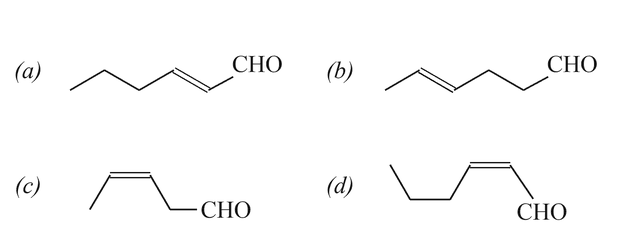
Question 26
The correct structure of trans-2 hexenal is
 Solve with AI
Answer
- Correct
(A) Structure (a)
(B) Structure (b)
(C) Structure (c)
(D) Structure (d)
Answer: (A) Structure (a)
Key idea: In a skeletal (line) structure every corner and line end is a carbon atom. The name trans-2-hexenal (hex-2-enal) means: six carbons, the CHO carbon is C-1, the double bond lies between C-2 and C-3, and the two chain parts on the double bond (CHO on C-2 and the rest of the chain on C-3) are on opposite sides.
Step 1 — Count the carbons and find the double bond in (a). Starting from CHO (C-1), structure (a) has five more carbons in the line, six in all, and the double bond is the first one next to CHO, between C-2 and C-3.
Step 2 — Check the geometry of (a). The CHO group points up from C-2 and the chain (C-4) points down from C-3, so the two groups are on opposite sides of the double bond: this is the trans form.
Step 3 — Check the other structures in the same way. Each of the others fails on the position of the double bond, the number of carbons or the geometry.
Why the other options are wrong:
- (B) Counting from CHO, structure (b) has its double bond between C-4 and C-5, so it is trans-hex-4-enal.
- (C) Structure (c) has only five carbons and its double bond between C-3 and C-4, with both chain parts on the same side: it is cis-pent-3-enal.
- (D) Structure (d) has six carbons and the double bond between C-2 and C-3, but CHO and the chain are on the same side, so it is cis-2-hexenal.
Therefore, structure (a) is trans-2-hexenal.
- 271 mark
Question 27
A hydrocarbon ‘A’ on chlorination gives ‘B’ which on heating with alcoholic potassium hydroxide changes into another hydrocarbon ‘C’. The latter decolourises Baeyer’s reagent and on ozonolysis forms formaldehyde only ‘A’ is
Solve with AIAnswer
- Correct
(A) Ethane
(B) Butane
(C) Methane
(D) Ethene
Answer: (A) Ethane
Key idea: We work backwards from C. Decolourising Baeyer's reagent (cold dilute alkaline ) shows C has a C=C bond. An alkene that gives only formaldehyde on ozonolysis must have on both ends of the double bond, so C is ethene. Dehydrohalogenation with alcoholic KOH makes an alkene from a haloalkane with the same number of carbons.
Step 1 — Identify C. Only gives formaldehyde alone.
Step 2 — Identify B. Alcoholic KOH removes HCl from chloroethane to give ethene, so B is chloroethane.
Step 3 — Identify A. Chlorination (in light) of ethane gives chloroethane, so A is ethane.
Why the other options are wrong:
- (B) Butane would give chlorobutanes and then butenes; but-1-ene gives formaldehyde and propanal, and but-2-ene gives acetaldehyde, never formaldehyde alone.
- (C) Methane gives chloromethane, which has no hydrogen on a neighbouring carbon, so alcoholic KOH cannot form an alkene from it.
- (D) Ethene adds chlorine to give 1,2-dichloroethane, and alcoholic KOH then gives vinyl chloride, , which does not give formaldehyde only; ethene is C, not A.
Therefore, A is ethane.
- 281 mark
Question 28
In reaction sequence
molecule ‘M’ and reagent ‘R’ respectively are
Solve with AIAnswer
(A) and NaOH
(B) and
- Correct
(C) and aqueous
(D) ethylene oxide (oxirane, the three-membered ring of two groups and one O atom) and heat
Answer: (C) and aqueous
Key idea: Hypochlorous acid, HOCl (chlorine water), adds across a C=C bond as and , giving a chlorohydrin. Mild aqueous alkali then replaces the Cl by OH, giving a diol (glycol).
Step 1 — Add HOCl to ethene. The product M is 2-chloroethanol (ethylene chlorohydrin).
Step 2 — Hydrolyse M. Boiling with aqueous sodium hydrogencarbonate (a mild base) replaces Cl by OH, giving ethane-1,2-diol.
Step 3 — Match the pair. M is and R is aqueous , which is option (C).
Why the other options are wrong:
- (A) HOCl adds both Cl and OH, so it cannot give chloroethane; and chloroethane with NaOH gives ethanol, not a diol.
- (B) HOCl does not give ethanol, and ethanol with gives ethene or diethyl ether, not glycol.
- (D) Option (D) is ethylene oxide (epoxyethane). It is made from the chlorohydrin with a strong base, and it gives glycol when heated with water containing a little acid; heat alone does not turn it into glycol, and it is not the direct product of HOCl.
Therefore, M is and R is aqueous .
- 291 mark
Question 29
In the presence of platinum catalyst, hydrocarbon A adds hydrogen to form n-hexane. When hydrogen bromide is added to A instead of hydrogen, only a single bromo compound is formed. Which of the following is A?
Solve with AIAnswer
- Correct
(A)
(B)
(C)
(D)
Answer: (A)
Key idea: Hydrogenation to n-hexane tells us A is an unbranched six-carbon alkene. An alkene gives one bromo compound only, whichever way H and Br add, when it is symmetrical about its double bond (the same groups on both doubly bonded carbons).
Step 1 — Use the hydrogenation clue. All four options have a straight six-carbon chain, so all would give n-hexane with ; the HBr clue must decide.
Step 2 — Test hex-3-ene, option (A). Each doubly bonded carbon carries an ethyl group, so H can go to either carbon and Br to the other: both ways give the same compound.
Step 3 — Name the product. The single product is 3-bromohexane, so A is hex-3-ene.
Why the other options are wrong:
- (B) This is hex-2-ene; its two doubly bonded carbons carry different groups (methyl and propyl), so HBr can give both 2-bromohexane and 3-bromohexane.
- (C) This is also hex-2-ene, written from the other end of the chain, so it too gives two bromo compounds.
- (D) Hex-1-ene is unsymmetrical: HBr adds mainly by Markovnikov's rule to give 2-bromohexane, but 1-bromohexane is also possible (and is the main product with peroxides), so it is not the alkene that can give only one bromo compound.
Note: options (B) and (C) as printed are the same compound, hex-2-ene.
Therefore, A is hex-3-ene, .
- 301 mark
Question 30
Which of the following will not show cis-trans isomerism?
Solve with AIAnswer
(A)
(B)
- Correct
(C)
(D)
Answer: (C)
Key idea: An alkene shows cis–trans isomerism only when each doubly bonded carbon carries two different groups. If either carbon carries two identical groups, swapping them gives the same molecule.
Step 1 — Check (C). In 2-methylpent-2-ene, , C-2 carries two methyl groups. Two identical groups on one carbon mean no cis or trans form, so (C) does not show the isomerism.
Step 2 — Check the rest. In (A), (B) and (D) each doubly bonded carbon carries one H and one alkyl group, so each of them has cis and trans forms.
Why the other options are wrong:
- (A) But-2-ene has H and on each doubly bonded carbon, so it exists as cis- and trans-but-2-ene.
- (B) Hex-3-ene has H and on each doubly bonded carbon, so it shows cis–trans isomerism.
- (D) 2-Methylhex-3-ene has H and an isopropyl group on C-3, and H and an ethyl group on C-4, so it shows cis–trans isomerism.
Note: option (C) is printed with "CH" for the carbon carrying the methyl branch, which would give that carbon five bonds; it is read as C, giving 2-methylpent-2-ene.
Therefore, will not show cis–trans isomerism.
- 311 mark
Question 31
When 3, 3-dimethyl -2-butanol is heated with , the major product obtained is
Solve with AIAnswer
- Correct
(A) 2, 3-dimethyl -2-butene
(B) 3, 3-dimethyl -1-butene
(C) 2, 3-dimethyl -1-butene
(D) cis & trans isomers of 2, 3-dimethyl -2-butene
Answer: (A) 2, 3-dimethyl -2-butene
Key idea: Acid-catalysed dehydration of an alcohol goes through a carbocation. If a methyl group (or H) on the next carbon can move to give a more stable carbocation, it does (1,2-shift). The proton is then lost so as to form the most substituted alkene (Saytzeff rule).
Step 1 — Form the carbocation. The alcohol is . The OH is protonated and leaves as water, giving a secondary carbocation.
Step 2 — Rearrange. A methyl group moves from C-3 to C-2, leaving a more stable tertiary carbocation on C-3.
Step 3 — Lose a proton. Loss of the H from the neighbouring CH gives the tetrasubstituted alkene, the most stable one.
Step 4 — Name it. The main product is 2,3-dimethylbut-2-ene.
Why the other options are wrong:
- (B) 3,3-Dimethylbut-1-ene comes from the unrearranged secondary carbocation and is only a minor product, because the carbocation rearranges first.
- (C) 2,3-Dimethylbut-1-ene comes from the rearranged carbocation losing a proton from a methyl group; it is only disubstituted, so it is the minor (Hofmann-type) product.
- (D) 2,3-Dimethylbut-2-ene carries two methyl groups on each doubly bonded carbon, so it has no cis and trans isomers.
Therefore, the major product is 2,3-dimethyl-2-butene.
- 321 mark
Question 32
The alkene reacts readily with and formed the product B which on oxidation with alkaline hydrogen peroxides produces
Solve with AIAnswer
(A)
- Correct
(B)
(C)
(D)
Answer: (B)
Key idea: In hydroboration–oxidation, boron adds to the less substituted carbon of the C=C bond and hydrogen to the other. Alkaline then replaces boron by OH with no change in position. The net result is anti-Markovnikov addition of water, giving a primary alcohol from a terminal alkene.
Step 1 — Form the trialkylborane B. Boron goes to the terminal carbon.
Step 2 — Oxidise B. Each C–B bond becomes a C–OH bond.
Why the other options are wrong:
- (A) An aldehyde, , comes from hydroboration–oxidation of a terminal alkyne, where the enol formed tautomerises; an alkene gives an alcohol.
- (C) The methyl ketone comes from Markovnikov hydration of the alkyne (), not from an alkene with diborane.
- (D) The diol forms when an alkene is oxidised by cold dilute alkaline (Baeyer's reagent); hydroboration adds only one OH.
Therefore, the product is the primary alcohol .
- 331 mark
Question 33
Which of the following compounds has the lowest boiling point?
Solve with AIAnswer
(A)
(B)
(C)
- Correct
(D)
Answer: (D)
Key idea: Hydrocarbons are held together only by weak van der Waals (dispersion) forces. These forces grow with the size (molar mass and surface area) of the molecule, so among similar hydrocarbons the one with fewer carbon atoms boils lowest.
Step 1 — Count the carbons. Options (A), (B) and (C) are five-carbon compounds (pentane, pent-2-ene and penta-1,3-diene); option (D), butane, has only four carbons.
Step 2 — Compare the boiling points. The five-carbon compounds boil at about 36–42 °C (pentane 36 °C, pent-2-ene about 36–37 °C, penta-1,3-diene about 42 °C), while butane boils at about −0.5 °C and is a gas at room temperature.
Why the other options are wrong:
- (A) Pentane is a larger molecule than butane, with stronger dispersion forces, and boils at about 36 °C.
- (B) Pent-2-ene also has five carbons and boils at about 36–37 °C.
- (C) Penta-1,3-diene has five carbons and a conjugated (more polarisable) system, and boils at about 42 °C.
Therefore, (butane) has the lowest boiling point.
- 341 mark
Question 34
When hydrochloric acid gas is treated with propene in presence of benzoyl peroxide, it gives
Solve with AIAnswer
- Correct
(A) 2-Chloropropane
(B) Allyl chloride
(C) No reaction
(D) n-Propyl chloride
Answer: (A) 2-Chloropropane
Key idea: The peroxide effect (anti-Markovnikov addition) is shown by HBr only. With HCl the free radical chain does not work, because the H–Cl bond (about 431 kJ mol⁻¹) is too strong for a carbon radical to break it quickly, so HCl adds by the ordinary ionic path and follows Markovnikov's rule even when a peroxide is present.
Step 1 — Add the proton. The proton goes to the end, giving the more stable secondary carbocation.
Step 2 — Add chloride. Chloride ion joins the positive carbon, giving 2-chloropropane.
Step 3 — Write the overall change. The peroxide takes no part, so the overall equation is the ordinary Markovnikov addition.
Why the other options are wrong:
- (B) Allyl chloride, , forms by substitution when propene reacts with chlorine at high temperature, not by adding HCl.
- (C) HCl does add to propene; the peroxide simply has no effect on the way it adds.
- (D) n-Propyl chloride would be the anti-Markovnikov product, which forms with HBr and peroxide but not with HCl.
Therefore, the product is 2-chloropropane.
- 351 mark
Question 35
The restricted rotation about carbon carbon double bond in 2-butene is due to
Solve with AIAnswer
(A) Overlap of one s- and sp- hybridized orbitals
(B) Overlap of two sp- hybridized orbitals
(C) Overlap of one p- and one sp- hybridized orbitals
- Correct
(D) Sideways overlap of two p- orbitals
Answer: (D) Sideways overlap of two p- orbitals
Key idea: A C=C bond is one σ bond (end-on overlap of two orbitals) plus one π bond (sideways overlap of the two unhybridised p orbitals, one on each carbon). The π bond can form only while the two p orbitals stay parallel.
Step 1 — See what rotation would do. Twisting one carbon relative to the other turns its p orbital away from the other p orbital, so the sideways overlap falls and, at 90°, the π bond is broken.
Step 2 — Explain the restriction. Breaking the π bond needs about 250 kJ mol⁻¹, far more than is available at room temperature, so rotation about the C=C bond is restricted. This is why cis- and trans-2-butene are separate compounds.
Why the other options are wrong:
- (A) The overlap of a hydrogen 1s orbital with a carbon orbital forms a C–H σ bond, which does not stop rotation about the C=C bond.
- (B) The overlap of two orbitals forms the C–C σ bond; a σ bond is symmetrical about the bond axis, so by itself it allows free rotation.
- (C) A p orbital and an orbital on the two carbons are at right angles, so they do not form a bond in 2-butene.
Therefore, the restricted rotation is due to the sideways overlap of two p orbitals (the π bond).
- 361 mark
Question 36
When chlorine is passed through propene at 400° C, which of the following is formed?
Solve with AIAnswer
(A) PVC
- Correct
(B) Allyl chloride
(C) Alkyl chloride
(D) 1, 2-Dichloroethane
Answer: (B) Allyl chloride
Key idea: At room temperature chlorine adds across the C=C bond of propene. At high temperature (about 400–500 °C) addition is reversed and substitution takes over at the allylic group (the carbon next to the double bond), by a free radical path, because the allylic radical is stabilised by resonance.
Step 1 — Write the high-temperature reaction. One H of the methyl group is replaced by Cl; the double bond is kept.
Step 2 — Name the product. is 3-chloropropene, called allyl chloride.
Why the other options are wrong:
- (A) PVC is poly(vinyl chloride), a polymer made from vinyl chloride, , not from propene and chlorine.
- (C) A saturated chloride, 1,2-dichloropropane, forms when chlorine adds to propene at room temperature; at 400 °C substitution keeps the C=C bond, so the product is not an alkyl chloride.
- (D) 1,2-Dichloroethane has only two carbons; it is made by adding chlorine to ethene.
Therefore, allyl chloride is formed.
- 371 mark
Question 37
Which one of the following can exhibit cis-trans isomerism?
Solve with AIAnswer
(A)
(B)
- Correct
(C)
(D)
Answer: (C)
Key idea: Cis–trans isomerism needs a bond about which rotation is restricted (C=C or a ring) and two different groups on each of its two carbons.
Step 1 — Find a restricted bond. Of the four compounds, only (C), 1,2-dichloroethene, has a C=C bond; (A) and (D) have only single bonds, and (B) has a triple bond in a linear molecule.
Step 2 — Check the groups on each carbon of (C). Each carbon of the C=C bond carries H and Cl, two different groups. So the two Cl atoms can be on the same side (cis) or on opposite sides (trans).
Why the other options are wrong:
- (A) 2-Chloropropanoic acid has a chiral carbon (H, , Cl and COOH on one carbon), so it shows optical isomerism, but it has no C=C bond for cis–trans isomerism.
- (B) Chloroethyne is a linear molecule and each triple-bonded carbon carries only one group, so there are no cis and trans forms.
- (D) 1,2-Dichloroethane has only single bonds; free rotation gives conformations (anti, gauche), not separate cis and trans isomers.
Therefore, exhibits cis–trans isomerism.
- 381 mark
Question 38
Base strength of :
(P)
(Q) and
(R)
is in the order of :
Solve with AIAnswer
(A) (Q) > (P) > (R)
(B) (R) > (Q) > (P)
(C) (P) > (R) > (Q)
- Correct
(D) (P) > (Q) > (R)
Answer: (D) (P) > (Q) > (R)
Key idea: A carbanion is a base because of its lone pair. The more s-character in the orbital holding the lone pair, the closer the pair is held to the nucleus, the more stable the carbanion and the weaker it is as a base. The s-character is 25% for , 33% for and 50% for .
Step 1 — Find the hybridisation of each carbanion carbon. In P (ethyl carbanion) the charged carbon is ; in Q (vinyl carbanion) it is ; in R (acetylide ion) it is .
Step 2 — Rank the stability. R holds its lone pair most tightly (50% s), Q next (33% s) and P least (25% s). So the stability is R > Q > P.
Step 3 — Turn stability into base strength. The least stable carbanion is the strongest base. This matches the acidity of the parent hydrocarbons: ethyne (pKa about 25) is far more acidic than ethene (about 44), which is more acidic than ethane (about 50).
Why the other options are wrong:
- (A) This makes the vinyl carbanion stronger than the ethyl carbanion, but the ethyl carbanion holds its lone pair least tightly and is the strongest base.
- (B) This is the order of stability (and of the acidity of the parent hydrocarbons), which is the reverse of the order of base strength.
- (C) This puts the acetylide ion above the vinyl carbanion, but the acetylide ion, with 50% s-character, is the weakest base of the three.
Note: the book labels the three species (A), (B) and (C); they are labelled P, Q and R here so that they are not confused with the option letters.
Therefore, the order of base strength is P > Q > R.
- 391 mark
Question 39
Predict the product C obtained in the following reaction of butyne-1.
Solve with AIAnswer
(A)
(B)
- Correct
(C)
(D)
Answer: (C)
Key idea: Hydrogen halides add to alkynes in two steps, each by Markovnikov's rule: the hydrogen goes to the carbon that already has more hydrogens. In the second step the halogen already present stabilises the carbocation on its own carbon (its lone pair is shared with the positive carbon), so both halogens end up on the same carbon (a gem-dihalide).
Step 1 — Add HCl to but-1-yne. H goes to the terminal CH carbon and Cl to C-2, giving 2-chlorobut-1-ene (B).
Step 2 — Add HI to B. H goes to the end; the carbocation forms on C-2, where it is stabilised by the chlorine atom, so iodide joins C-2.
Step 3 — Name C. The product is 2-chloro-2-iodobutane.
Why the other options are wrong:
- (A) This is 1-chloro-1-iodobutane, with both halogens on the end carbon; it would need H to add to C-2 twice, against Markovnikov's rule.
- (B) This is 1-chloro-2-iodobutane; it would need HCl to add with Cl on the terminal carbon, which is anti-Markovnikov.
- (D) This is 3-chloro-1-iodobutane, with the halogens on C-1 and C-3; C-3 was not part of the triple bond, so no halogen can reach it.
Therefore, C is 2-chloro-2-iodobutane, .
- 401 mark
Question 40
Products of the following reaction:
are :
Solve with AIAnswer
(A)
- Correct
(B)
(C)
(D)
Answer: (B)
Key idea: Ozonolysis of an alkyne followed by hydrolysis cuts the triple bond. Each carbon of the triple bond becomes the carbon of a –COOH group (an internal alkyne gives two carboxylic acids; a terminal ≡CH gives ).
Step 1 — Split the triple bond. Pent-2-yne, , has a methyl group on one triple-bonded carbon and an ethyl group on the other.
Step 2 — Turn each half into an acid. The methyl half gives acetic acid and the ethyl half gives propanoic acid.
Why the other options are wrong:
- (A) Carbon dioxide comes only from a terminal ≡CH carbon; pent-2-yne has none, and the ethyl half must give a three-carbon acid.
- (C) Two aldehydes are the products of reductive ozonolysis of an alkene (pent-2-ene), not of an alkyne.
- (D) Acetone would need a carbon carrying two methyl groups; each triple-bonded carbon here carries only one alkyl group.
Therefore, the products are acetic acid and propanoic acid, .
- 411 mark
Question 41
A compound is treated with to give sodium salt. Identify the compound
Solve with AIAnswer
- Correct
(A)
(B)
(C)
(D)
Answer: (A) (acetylene, ethyne)
Key idea: Sodamide, , is a very strong base. Its amide ion, , can pull off a hydrogen as only from a C–H bond that is more acidic than ammonia (p of ≈ 38). A hydrogen on a triple-bonded (sp) carbon is acidic enough (p ≈ 25); hydrogens on sp² or sp³ carbons are not.
Step 1 — Find the acidic hydrogen. In each hydrogen is joined to an sp-hybridised carbon. An sp orbital has 50 % s-character, so it holds the bonding electrons close to the carbon nucleus, and the C–H bond gives up fairly easily.
Step 2 — Write the reaction. The amide ion removes one acidic hydrogen and ammonia is set free; the sodium salt formed is sodium acetylide (sodium ethynide).
Step 3 — Check that the reaction goes forward. An acid–base reaction goes towards the weaker acid. Acetylene (p ≈ 25) is a much stronger acid than ammonia (p ≈ 38), so the salt forms readily.
Why the other options are wrong:
- (B) In benzene the hydrogens sit on sp² carbons (33 % s-character); its p is about 43, so it is a far weaker acid than ammonia and gives no salt.
- (C) In ethane the hydrogens sit on sp³ carbons (25 % s-character); with p about 50 it is the weakest acid of the four and forms no sodium salt.
- (D) In ethylene the hydrogens sit on sp² carbons; with p about 44 it is still much weaker than ammonia, so no salt forms.
Therefore, the compound is acetylene, .
- 421 mark
Question 42
Reduction of 2-butyne with sodium in liquid ammonia gives predominantly
Solve with AIAnswer
(A) cis-2-butene
(B) No reaction
- Correct
(C) trans-2-butene
(D) n-butane
Answer: (C) trans-2-butene
Key idea: An alkyne can be reduced to an alkene in two ways. Hydrogen with Lindlar's catalyst adds both H atoms from the same side (syn addition), giving the cis-alkene. Sodium (or lithium) in liquid ammonia adds the two H atoms from opposite sides (anti addition), giving the trans-alkene.
Step 1 — Write the reaction. 2-Butyne (but-2-yne) takes up two hydrogen atoms: the electrons come from sodium and the protons from ammonia.
Step 2 — Explain the stereochemistry. Sodium gives one electron to the triple bond, forming a radical anion, and this takes a proton from ammonia to give a vinyl radical. In the vinyl radical the two methyl groups settle on opposite sides of the C=C unit, where they crowd each other least (the trans arrangement). A second electron from sodium turns this radical into a vinyl anion that keeps the trans shape, and the anion takes a second proton from ammonia. So the two methyl groups end up on opposite sides of the double bond.

Step 3 — Explain why it stops at the alkene. A simple alkene has no low-lying orbital to take up an electron from sodium, so it is not reduced further and no butane forms.
Why the other options are wrong:
- (A) The cis isomer comes from hydrogen gas over Lindlar's catalyst (Pd poisoned with lead acetate on ), which adds both hydrogens from the same side.
- (B) Sodium in liquid ammonia does reduce internal alkynes such as 2-butyne; this is the standard way to make trans-alkenes.
- (D) n-Butane needs complete hydrogenation, for example excess hydrogen over Ni, Pt or Pd; sodium in liquid ammonia stops at the alkene.
Therefore, sodium in liquid ammonia gives trans-2-butene.
- 431 mark
Question 43
The reagent is
Solve with AIAnswer
(A) Na
(B) HCl in
- Correct
(C) KOH in
(D) Zn in alcohol
Answer: (C) KOH in (alcoholic KOH)
Key idea: The starting compound is a gem-dihalide (both Cl atoms on the same carbon) with a group next to it. Removing two molecules of HCl from it, one after the other, creates two π bonds between the same two carbons, that is, a triple bond. Removing HX (dehydrohalogenation) needs a strong base in alcohol.
Step 1 — Remove the first HCl. Alcoholic KOH takes an H from the group and a Cl leaves from the next carbon, giving a vinyl chloride.
Step 2 — Remove the second HCl. The base removes HCl again from the same two carbons, so the double bond becomes a triple bond.
Watch out: The second step, from a vinyl halide, is slow; it needs excess alcoholic KOH and strong heating, and in the laboratory sodamide () is often used for it.
Why the other options are wrong:
- (A) Sodium removes halogen atoms and joins carbon chains together (Wurtz-type coupling); it does not remove HCl to make a triple bond.
- (B) Aqueous HCl is an acid and provides no base to remove HCl; it can at most add to a multiple bond, never create one.
- (D) Zinc in alcohol removes two halogen atoms from neighbouring carbons (a vicinal dihalide) to give an alkene; it removes no hydrogen, so it cannot turn this gem-dichloride into an alkyne.
Therefore, the reagent is KOH in ethanol (alcoholic KOH).
- 441 mark
Question 44
Which is the most suitable reagent among the following to distinguish compound (3) from rest of the compounds?
(1)
(2)
(3)
(4)
Solve with AIAnswer
(A) Bromine in carbon tetrachloride
(B) Bromine in acetic acid
(C) Alk.
- Correct
(D) Ammoniacal silver nitrate.
Answer: (D) Ammoniacal silver nitrate
Key idea: Compound (3), but-1-yne, is a terminal alkyne: it has a hydrogen on a triple-bonded carbon (). That hydrogen is acidic, so it is replaced by silver when the compound is treated with ammoniacal silver nitrate (Tollens' reagent), and a white precipitate appears. No other compound in the list has such a hydrogen.
Step 1 — Classify the four compounds. The four compounds belong to different classes: (1) is but-2-yne, an internal alkyne with no ; (2) is butane, a saturated alkane; (3) is but-1-yne, a terminal alkyne; (4) is propene, an alkene.
Step 2 — Write the test reaction for (3). The silver–ammonia complex ion replaces the acidic hydrogen, giving insoluble silver but-1-ynide.
Step 3 — Check the other three. But-2-yne, butane and propene have no hydrogen on a triple-bonded carbon, so they give no precipitate. Only (3) responds.
Why the other options are wrong:
- (A) Bromine in carbon tetrachloride is decolourised by every unsaturated compound, so (1), (3) and (4) all respond and (3) is not singled out.
- (B) Bromine in acetic acid also adds across both double and triple bonds, so it again responds to (1), (3) and (4) alike.
- (C) Cold alkaline (Baeyer's reagent) loses its purple colour with all three unsaturated compounds, so it cannot pick out (3).
Therefore, ammoniacal silver nitrate distinguishes compound (3), the terminal alkyne.
- 451 mark
Question 45
Acetylenic hydrogens are acidic because
Solve with AIAnswer
- Correct
(A) Sigma electron density of C – H bond in acetylene is nearer to carbon, which has 50% s-character
(B) Acetylene has only open hydrogen in each carbon
(C) Acetylene contains least number of hydrogens among the possible hydrocarbons having two carbons
(D) Acetylene belongs to the class alkynes with molecular formula,
Answer: (A) The σ-electron density of the C–H bond lies nearer to carbon, which has 50 % s-character
Key idea: The more s-character a hybrid orbital has, the closer its electrons are held to the nucleus, so the more electronegative that carbon behaves. The s-character is 50 % for sp, 33 % for sp² and 25 % for sp³ carbon.
Step 1 — Look at the C–H bond in acetylene. Each carbon in is sp-hybridised. The shared electron pair of the C–H bond is pulled towards this carbon, so the hydrogen carries a small positive charge and can leave as .
Step 2 — Look at the anion left behind. After leaves, the lone pair of the acetylide ion sits in an sp orbital close to the nucleus, where it is held tightly. A stable anion means a more acidic C–H bond.
Step 3 — Compare with other hydrocarbons. Ethylene (sp², p ≈ 44) and ethane (sp³, p ≈ 50) hold their C–H electrons less tightly, so they are far weaker acids than acetylene (p ≈ 25).
Why the other options are wrong:
- (B) Having one hydrogen on each carbon does not make a C–H bond acidic: benzene also has one hydrogen on each carbon, yet its hydrogens (on sp² carbons) are not acidic in this way.
- (C) Acetylene does have the fewest hydrogens of the two-carbon hydrocarbons, but the number of hydrogens does not decide acidity; the hybridisation of the carbon does.
- (D) Belonging to the class is not the reason: but-2-yne, , also has this formula but has no hydrogen on a triple-bonded carbon and is not acidic.
Therefore, acetylenic hydrogens are acidic because the sp carbon (50 % s-character) holds the C–H bonding electrons close to itself.
- 461 mark
Question 46
Benzene reacts with in the presence of anhydrous to form:
Solve with AIAnswer
(A) chlorobenzene
(B) benzylchloride
(C) xylene
- Correct
(D) toluene
Answer: (D) toluene
Key idea: This is Friedel–Crafts alkylation. The Lewis acid pulls the chlorine off the alkyl halide and produces an alkyl cation, which is the electrophile. The cation replaces one hydrogen of the benzene ring (electrophilic substitution).
Step 1 — Form the electrophile. Anhydrous aluminium chloride takes a chloride ion from methyl chloride, giving the methyl carbocation.
Note: a free methyl cation is far too unstable to exist in the reaction mixture. Methyl chloride and really form a strongly polarised complex, , whose methyl group is passed to the ring just as would be. Writing is the usual textbook model of this electrophile.
Step 2 — Substitute the ring. The methyl cation attacks the π-electron cloud of benzene; the ring then loses , which joins to give HCl and regenerate . The overall equation is shown below.
Step 3 — Name the product. is methylbenzene, called toluene.
Why the other options are wrong:
- (A) Chlorobenzene is made by ring chlorination with and a Lewis acid such as ; here the chlorine of leaves as HCl and does not join the ring.
- (B) Benzyl chloride, , is made by chlorinating the side chain of toluene with in light or on heating; it is not formed from benzene and .
- (C) Xylene (dimethylbenzene) forms only as a by-product when a second methyl group is added to toluene; one methyl group per ring gives toluene.
Therefore, benzene and with anhydrous give toluene.
- 471 mark
Question 47
Which one of the following is most reactive towards electrophilic attack?
 Solve with AI
Answer
(A)
(B)
- Correct
(C)
(D)
Answer: (C) (phenol)
Key idea: An electrophile looks for electrons, so a substituent that pushes electrons into the ring makes the ring react faster (an activating group), and one that pulls electrons out makes it react slower (a deactivating group). A group that has a lone pair on the atom joined directly to the ring can push electrons in by resonance (+M or +R effect).
Step 1 — Look at the –OH group of phenol. The oxygen is joined directly to the ring and has two lone pairs. One lone pair is delocalised into the ring (+M effect), which raises the electron density, especially at the ortho and para positions. This effect is much stronger than oxygen's electron-withdrawing –I effect, so –OH is a strong activating group.
Step 2 — Compare with the other three. None of the other groups pushes electrons into the ring as strongly, as the bullets below show, so phenol is the most reactive. (Phenol even reacts with bromine water at room temperature without a catalyst.)
Why the other options are wrong:
- (A) In benzyl alcohol the oxygen is separated from the ring by a group (an sp³ carbon), so its lone pairs cannot be delocalised into the ring; the group changes the ring's reactivity only slightly.
- (B) The group withdraws electrons from the ring by both its –M and –I effects, so nitrobenzene is strongly deactivated and reacts much more slowly than benzene.
- (D) In chlorobenzene the –I effect of chlorine outweighs its weak +M effect, so the ring is slightly deactivated (though substitution still goes ortho/para).
Therefore, phenol is the most reactive towards electrophilic attack.
- 481 mark
Question 48
The order of decreasing reactivity towards an electrophilic reagent, for the following would be
(P) benzene
(Q) toluene
(R) chlorobenzene
(S) phenol
Solve with AIAnswer
(A) Q > S > P > R
(B) S > R > Q > P
- Correct
(C) S > Q > P > R
(D) P > Q > R > S
Answer: (C) S > Q > P > R (phenol > toluene > benzene > chlorobenzene)
Key idea: The reactivity of a substituted benzene towards electrophiles depends on how much its substituent raises or lowers the electron density of the ring. Benzene itself is the reference point.
Step 1 — Rank the substituents. The four rings carry –OH, , –H and –Cl, and each has a different effect.
- –OH (phenol, S): strong +M effect, strongly activating.
- (toluene, Q): weak +I effect and hyperconjugation, mildly activating.
- –H (benzene, P): the reference.
- –Cl (chlorobenzene, R): –I effect stronger than +M, mildly deactivating.
Step 2 — Write the order. Putting the compounds in decreasing reactivity gives S, then Q, then P, then R.
Why the other options are wrong:
- (A) This order puts toluene above phenol, but the methyl group activates the ring far less than –OH does (phenol reacts with bromine water without a catalyst; toluene needs a Lewis acid).
- (B) This order puts chlorobenzene above toluene and benzene, but chlorine deactivates the ring, so chlorobenzene is the slowest of the four.
- (D) This order puts benzene first and phenol last, which reverses the effects of –OH and ; both of these make the ring more reactive than benzene.
Therefore, the order is phenol > toluene > benzene > chlorobenzene.
- 491 mark
Question 49
Using anhydrous as catalyst, which one of the following reactions produces ethylbenzene (PhEt)?
- 501 mark
Question 50
Which one of the following is a free-radical substitution reaction?
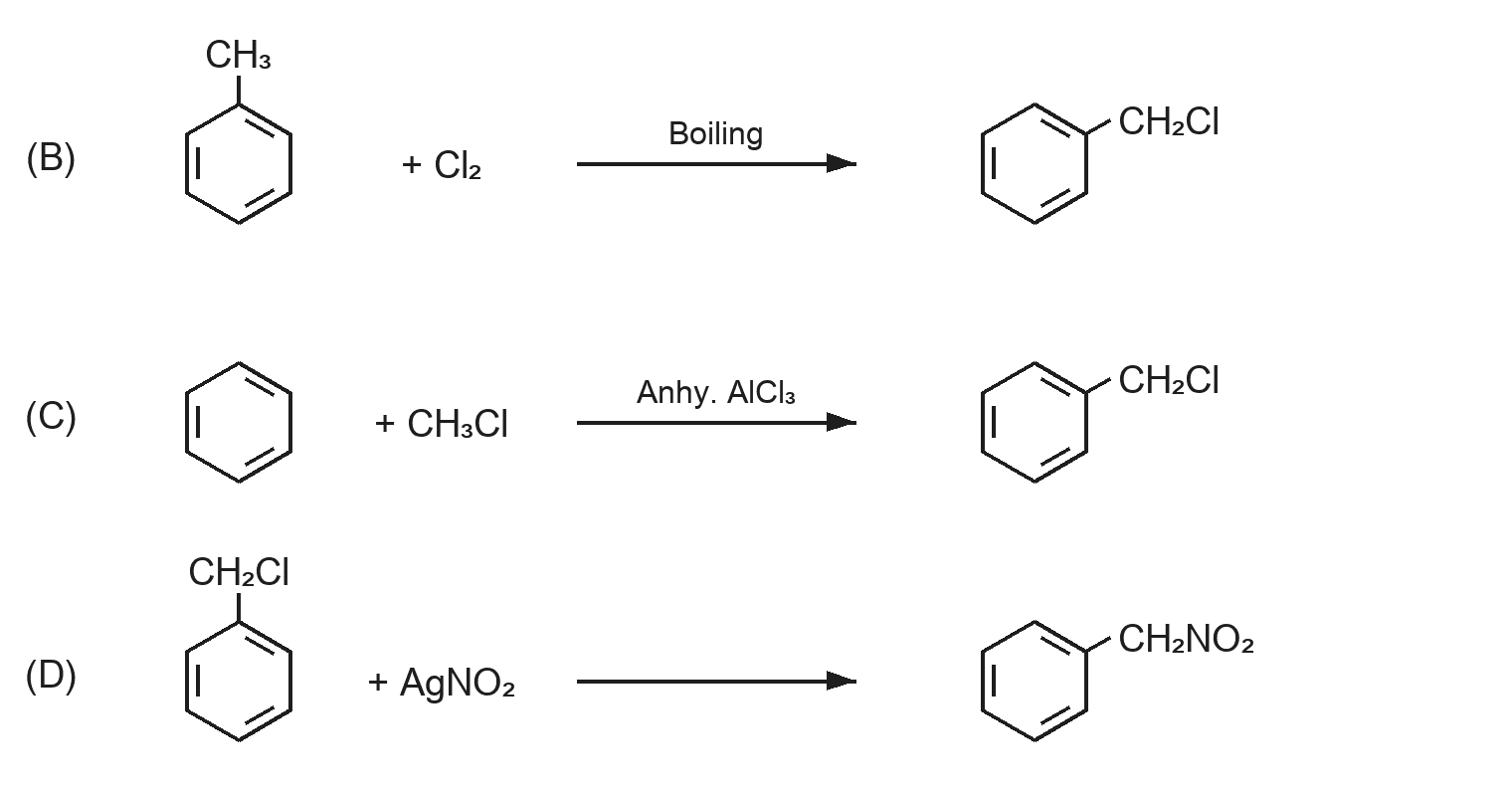
- 511 mark
Question 51
The correct order of reactivity towards the electrophilic substitution of the compounds aniline (I), benzene (II) and nitrobenzene (III) is
- 521 mark
Question 52
For the formation of toluene by Friedel–Crafts reaction, reactants used in presence of anhydrous are
- 531 mark
Question 53
Which of the following compounds reacts slower in electrophilic substitution?
- 541 mark
Question 54
Which one of the following compounds will be most easily attacked by an electrophile?
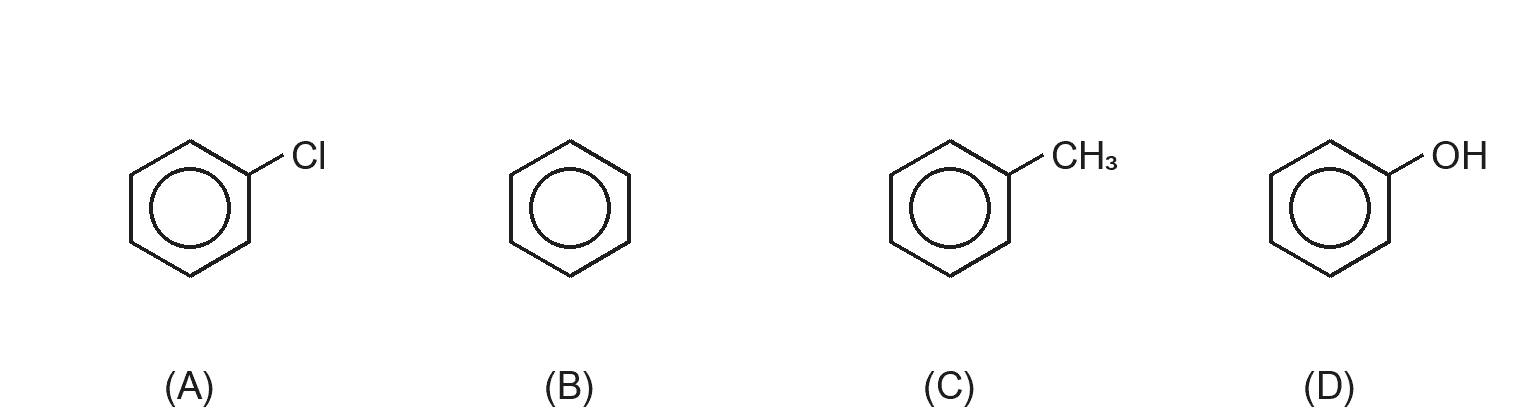
- 551 mark
Question 55
Which one of these is not compatible with arenes?
- 561 mark
Question 56
Among the following compounds (I-III), the ease of their reaction with electrophiles is,
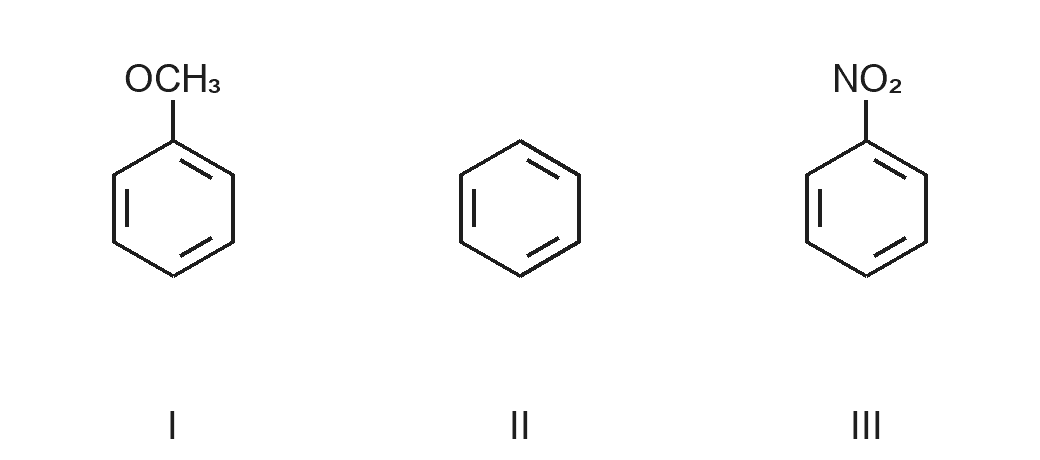
- 571 mark
Question 57
Hückel's rule states that a monocyclic conjugated compound will be aromatic if it contains
- 581 mark
Question 58
When and are used in Friedel-Crafts reaction, the electrophile is
- 591 mark
Question 59
An example of electrophilic substitution reaction is
- 601 mark
Question 60
Benzene reacts with n-propyl chloride in the presence of anhydrous to give
- 611 mark
Question 61
Which is the correct symbol relating the two Kekule structures of benzene?
- 621 mark
Question 62
Select the true statement about benzene amongst the following
- 631 mark
Question 63
The most reactive compound for electrophilic nitration is
- 641 mark
Question 64
The reaction between benzene and ICl in presence of anhyd. yields ______.
- 651 mark
Question 65
Kolbe's electrolysis of ______ produces n-hexane at anode.
- 661 mark
Question 66
Intramolecular dehydration of alcohols is carried out with ______ to give ______.
- 671 mark
Question 67
To prepare p-bromonitrobenzene, the benzene is first subjected to ______ and then ______.
- 681 mark
Question 68
o-Xylene on reductive ozonolysis gives ______, ______ and ______.
- 691 mark
Question 69
reacts with methanol to give ______ and ______.
- 701 mark
Question 70
Compounds of the type are known as ______.
- 711 mark
Question 71
Sodalime is a mixture of ______ and ______ in the ratio ______.
- 721 mark
Question 72
Fluorination of alkenes takes place ______ and may result in the rupture of ______ bond.
- 731 mark
Question 73
The conversion of n-hexane to benzene involves ______ and ______.
- 741 mark
Question 74
______ is a better dehydrohalogenating agent as compared to ______.
- 751 mark
Question 75
Alkenes and alkynes burn with a ______ flame.
- 761 mark
Question 76
The best method for locating the position of double bond in an unknown alkene is ______.
- 771 mark
Question 77
Out of benzene, ethylene and acetylene, the carbon-carbon bond length is longest in ______.
- 781 mark
Question 78
The reaction of benzene with acetic anhydride in presence of anhydrous is called ______ reaction and yields ______.
- 791 mark
Question 79
Acidity of acetylene, water and ammonia decreases in the order : ______.
- 801 mark
Question 80
In the reaction,
the products X and Y are ______ and ______ respectively.
- 811 mark
Question 81
In presence of peroxides, the addition of HBr to propene occurs according to ______ rule and gives ______ as the major product but in absence of peroxides, addition occurs according ______ rule and gives ______ as the major product.
- 821 mark
Question 82
______ on reductive ozonolysis gives ethanal, methanal and carbon dioxide.
- 831 mark
Question 83
The dihedral angle between the H-atoms in staggered conformation of ethane is ______.
- 841 mark
Question 84
Ethylene glycol predominantly exists in the ______ conformation.
- 851 mark
Question 85
Alkanes are also referred to as ______ and have the general formula ______.
- 861 mark
Question 86
Methane molecule is ______ in shape with all bond angles equal to ______.
- 871 mark
Question 87
The carbon-carbon triple bond in acetylene comprises of one ______ and two ______ bonds.
- 881 mark
Question 88
Reforming is the process of converting ______ and ______ alkanes into corresponding ______ hydrocarbons.
- 891 mark
Question 89
The knocking behaviour of fuel with octane number 60 is the same as the mixture containing ______ % iso-octane and ______ % n-heptane.
- 901 mark
Question 90
In presence of UV light, benzene reacts with chlorine forming ______.
- 911 mark
Question 91
In chlorobenzene, chlorine is ______ but ______ directing.
- 921 mark
Question 92
Addition of water to phenylacetylene in presence of dil. and give ______.
- 931 mark
Question 93
Out of three isomeric pentanes, ______ has the maximum b.p. and ______ has the maximum m.p.
- 941 mark
Question 94
The cyclopentadienyl cation is ______ while cyclopentadienyl anion is ______.
- 951 mark
Question 95
Reduction of 2-butyne with Lindlar's catalyst gives ______ while reduction with sodium in liquid ammonia gives ______.
- 961 mark
Question 96
Write the ozonolysis products of mesitylene.
- 971 mark
Question 97
Is it possible to isolate pure staggered ethane or pure eclipsed ethane at room temperature? Explain.
- 981 mark
Question 98
Give the IUPAC name of an isomer of hexane which has only two different sets of structurally equivalent hydrogen atoms.
- 991 mark
Question 99
Suggest a route for the preparation of nitrobenzene starting from acetylene?
- 1001 mark
Question 100
Indicate the primary, secondary, tertiary and quaternary carbon atoms in the following :
(i) 3-Ethyl-2-methylhexane
(ii) 2, 2, 4-Trimethylpentane.
- 1011 mark
Question 101
Alkynes on reduction with sodium in liquid ammonia form trans alkenes. Will the butene thus formed on reduction of 2-butyne show the geometrical isomerism?
- 1021 mark
Question 102
Write structural formulas of the following compounds.
(i) 3, 4, 4, 5-Tetramethylheptane
(ii) 2, 5-Dimethylhexane.
- 1031 mark
Question 103
Why do the C—C bonds rather than C—H bonds break during cracking of alkanes?
- 1041 mark
Question 104
Write IUPAC names of the following compounds
(i)
(ii)
(iii) Tetra-tert-butylmethane.
- 1051 mark
Question 105
What are the main constituents of LPG?
- 1061 mark
Question 106
How will you distinguish between but-1-yne and but-2-yne?
- 1072 marks
Question 107
Write the structures and names of products obtained in the reaction of sodium with a mixture of 1-iodo-2-methylpropane and 2-iodopropane.
- 1082 marks
Question 108
Predict which of the following systems would be aromatic and why?
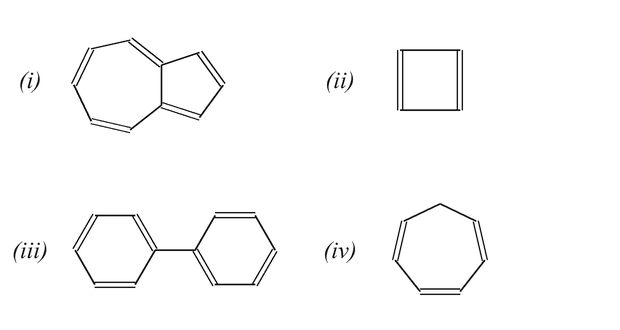
- 1092 marks
Question 109
Which of the following has larger dipole moment? Explain.
1-Butyne or 1-Butene
- 1102 marks
Question 110
Write structures for each of the following compounds. Why are the given names incorrect? Write correct IUPAC names:
(i) 2-Ethylpentane
(ii) 5-Ethyl-3-methylheptane.
- 1112 marks
Question 111
Suggest a route to prepare ethyl hydrogensulphate () starting from ethanol ().
- 1122 marks
Question 112
Starting with ethyne, how will you prepare pentan-2-one?
- 1132 marks
Question 113
Predict the products of the following reaction
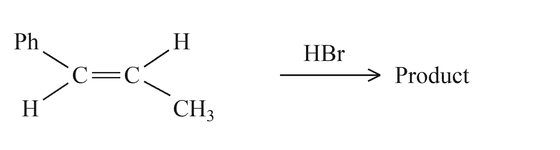
- 1142 marks
Question 114
How many monobromo derivatives are obtained when 2-methylbutane is subjected to photobromination?
- 1152 marks
Question 115
Use Markovnikov's rule to predict the product of the following reactions :
(i) HCl with and
(ii) HCl with .
- 1162 marks
Question 116
Predict product formed when benzene is treated with iodine chloride in presence of anhydrous aluminium chloride.
- 1172 marks
Question 117
What is Birch reduction? What is it used for?
- 1185 marks
Question 118
Write short notes on
(a) Theories of petroleum origin
(b) Wurtz synthesis.
(c) Octane number
(d) Cetane number
(e) Antiknock compounds
- 1195 marks
Question 119
How is octane number of fuel increased?
- 1205 marks
Question 120
Give reasons for the following:
(a) The boiling point of -pentane is higher than that of neopentane while melting point of neopentane is higher than that of -pentane.
(b) does not react with in the dark.
(c) Hydrocarbons are insoluble in water but soluble in non-polar solvents like benzene.
(d) Alkanes are inert towards chemical reactions under ordinary conditions.
(e) Increase in melting points is much more in moving from an alkane having odd number of carbon atoms to the higher alkane than in moving from an alkane having even number of carbon atoms to the higher alkane.
(f) When alkanes are heated, the C – C bonds rather than the C – H bonds break.
- 1215 marks
Question 121
State with balanced equations, what happens when:
(a) Sodium acetate is heated with soda lime.
(b) A mixture of sodium acetate and soda lime is heated and the product treated with excess of chlorine in presence of bright sunlight.
- 1225 marks
Question 122
How will you convert:
(a) Ethane into acetylene
(b) Propene into -propyl alcohol
(c) Propene into isopropyl alcohol
(d) Propene into 2-bromopropane
(e) Propene into 1-bromopropene.
- 1235 marks
Question 123
What happens when?
(i) Ethylene is passed through alkaline solution of (Baeyer's reagent).
(ii) A mixture of ozone and ethene is bubbled through an inert solvent.
(iii) Propene is bubbled through chlorine water.
(iv) But-2-ene is treated with ozone and the resulting solution is boiled with water in presence of zinc metal.
(v) Ethyl alcohol is heated at 170°C with excess of conc. .
(vi) Liquefied ethylene is subjected to high pressure at 200°C.
(vii) Unsaturated hydrocarbon is mixed with bromine water solution.
(viii) Propene is bubbled through a hot aqueous solution of .
(ix) is passed through propene.
- 1245 marks
Question 124
Give reasons for the following:
(i) Unsaturated hydrocarbons have higher boiling point than saturated hydrocarbons.
(ii) Cis-alkenes have higher boiling points than trans-alkenes.
(iii) Propene reacts with HBr to give isopropyl bromide and not -propyl bromide.
- 1255 marks
Question 125
How will you distinguish between
(a) Ethane and ethene
(b) Cyclohexane and cyclohexene.
- 1265 marks
Question 126
How will you prepare:
(a) Acetylene from
(b) from acetylene
(c) Benzene from acetylene
(d) Ethyl alcohol from acetylene
(e) Ethylene from acetylene
(f) Acetone from acetylene
(g) Acetylene from chloroform
(h) Ethylidene chloride from acetylene
(i) Dichloroacetaldehyde from acetylene.
- 1275 marks
Question 127
How would you distinguish the following
(a) But-1-ene and But-1-yne
(b) But-2-yne and But-1-yne
(c) and ?
(d) Ethene and ethyne.
(e) and .
- 1285 marks
Question 128
What happens when:
(a) Acetylene is passed through ammoniacal solution of .
(b) Water is added to calcium carbide
(c) Water is added to aluminium carbide.
What Class 11 Chemistry Ch 14 covers
The sections of the chapter, in the order the book takes them. Every question above comes from one of these.
- 01Classification and Nomenclature of Hydrocarbons
- 02Alkanes: Preparation and Physical Properties
- 03Alkanes: Chemical Properties and Free Radical Halogenation
- 04Conformations of Ethane
- 05Alkenes: Structure, Isomerism and Preparation
More ways to study this chapter
The same chapter asked three other ways. Practise it, revise it, and see what the board has set on Ch 14 before.
Class 11 Chemistry Ch 14 questions students ask
How many questions are there in Class 11 Chemistry Ch 14?
128 questions. Every one is solved step by step on this page.
Are these Class 11 Chemistry solutions free?
Yes. Every question and its full working is free to read, with no account needed.
Can I download the Class 11 Chemistry Ch 14 solutions as a PDF?
There is no PDF to download. Every solution is on this page instead, which means it is searchable, always the current syllabus, and readable on a phone. Use your browser's print option if you want it on paper.