
Opening your dashboard
Class 11 Chemistry Chapter 14 Hydrocarbons: Practice Questions
193 questions on Chapter 14, each worked through on its own page with the AI tutor. Class 11 Chemistry, ICSE 2026-27.
193 questions
1–4 marks · Mixed difficulty
- 11 mark
Question 1
A hydrocarbon has the molecular formula . To which one of the following classes of hydrocarbons can it NOT belong?
- 23 marks
Question 2
Give the IUPAC names of the following hydrocarbons.
(a)
(b)
(c)
- 33 marks
Question 3
A student wants to write the alkane with the fewest carbon atoms that contains both a quaternary carbon atom and a tertiary carbon atom.
(a) Explain why such an alkane must contain at least seven carbon atoms.
(b) Write its condensed structural formula and molecular formula.
(c) Give its IUPAC name.
- 41 mark
Question 4
What is the correct IUPAC name of the alkane ?
- 53 marks
Question 5
A concentrated aqueous solution containing 8.20 g of sodium ethanoate, , is electrolysed until all the salt has reacted (Kolbe's electrolysis). (Hypothetical data.) Assume that none of the gases dissolves in or reacts with the solution. (Na = 23, C = 12, O = 16, H = 1; molar volume at STP = 22.4 L.)
(a) Write the overall equation and name the gas(es) formed at each electrode.
(b) Calculate the volume of gas collected at the anode and at the cathode at STP.
(c) Find the ratio of these two volumes.
- 61 mark
Question 6
Which sodium salt, when heated with soda lime, gives 2-methylpropane, , as the alkane?
- 71 mark
Question 7
Which of the following shows the correct order of INCREASING boiling point of these four alkanes: heptane, hexane, 2-methylpentane and 2,2-dimethylbutane?
- 83 marks
Question 8
A laboratory needs a small sample of 2,2-dimethylpropane, .
(a) Explain why it cannot be prepared by the catalytic hydrogenation of any alkene.
(b) Name an alkyl halide that can be reduced to it by zinc and dilute hydrochloric acid, and write the equation.
(c) Give one reason why the Wurtz reaction is a poor method for preparing it.
- 94 marks
Question 9
2-Methylpropane, , is chlorinated in sunlight at 25 °C to give monochloro products only. At this temperature a chlorine atom removes a tertiary hydrogen atom 5.0 times as fast as a primary hydrogen atom.
(a) Write the structures and IUPAC names of the two monochloro products.
(b) Calculate the percentage of each product in the mixture.
(c) Explain why the tertiary hydrogen is removed faster, even though the tertiary product is not the major one.
- 101 mark
Question 10
Methane reacts with chlorine in sunlight, but iodomethane cannot be made in a useful yield by heating methane with iodine alone. Which statement gives the correct reason?
- 113 marks
Question 11
A sample of LPG contains 60 % butane and 40 % propane by volume. (Hypothetical data.) 1.00 L of this gas is burnt completely in air, and all volumes are measured at the same temperature and pressure, with the water formed condensing to liquid.
(a) Calculate the volume of oxygen needed.
(b) Calculate the volume of air needed, if air contains 21 % oxygen by volume.
(c) Calculate the volume of carbon dioxide formed.
- 122 marks
Question 12
Write balanced equations, with conditions, for what happens when:
(a) a mixture of methane and oxygen (about 9 : 1 by volume) is passed through a heated copper tube at 523 K and 100 atm;
(b) methane and steam are passed over a heated nickel catalyst at about 1273 K.
- 131 mark
Question 13
How many conformations can an ethane molecule have?
- 144 marks
Question 14
The figure shows the Newman projection of an ethane molecule in which the dihedral angle between the front hydrogen and the back hydrogen is 40°.

The potential energy of ethane, relative to the staggered form, is given by kJ mol⁻¹, where is this dihedral angle.
(a) Name the type of conformation shown.
(b) Through what smallest angle must the back carbon be rotated to reach (i) the nearest staggered conformation and (ii) the nearest eclipsed conformation?
(c) Calculate the potential energy of the conformation shown.
(d) How many energy maxima are passed when the back carbon makes one complete turn of 360°?
- 153 marks
Question 15
The figure shows the Sawhorse projection of an ethane molecule, with the front carbon at the lower left and the back carbon at the upper right.
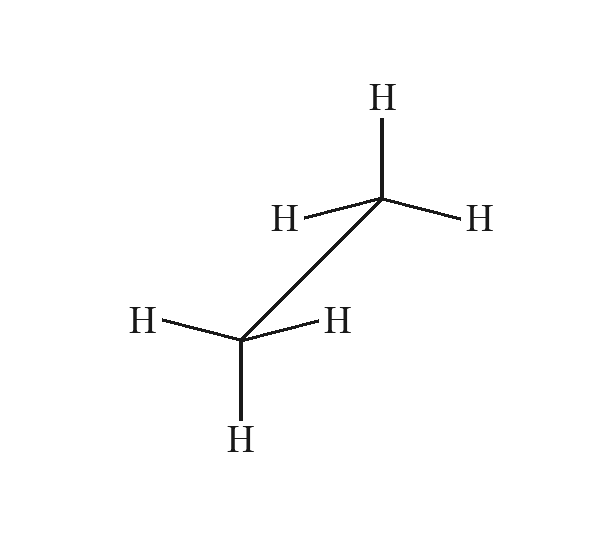
(a) Name the conformation shown, giving a reason.
(b) Draw the Newman projection of the same conformation, viewed along the C–C bond from the front carbon.
(c) How many pairs of hydrogen atoms, one on each carbon, are at a dihedral angle of 180° in this conformation?
- 161 mark
Question 16
In the staggered conformation of ethane, one carbon atom is held fixed while the other is rotated through 180° about the C–C bond. The conformation obtained is
- 174 marks
Question 17
Write the structures and IUPAC names of all the alkenes with the molecular formula , including geometrical isomers. How many such alkenes are there?
- 181 mark
Question 18
2-Bromo-2-methylpentane, , is heated with alcoholic potassium hydroxide. What is the major organic product?
- 193 marks
Question 19
Two isomers X and Y of 1,2-dichloroethene, , have the properties below.
Isomer Dipole moment Boiling point Melting point X 0 D 48 °C −50 °C Y 1.9 D 60 °C −80 °C (a) Identify X and Y as the cis or trans isomer, explaining their dipole moments.
(b) Explain why Y has the higher boiling point.
(c) Explain why X has the higher melting point.
- 203 marks
Question 20
0.700 g of an alkene X exactly decolourises 2.00 g of bromine dissolved in an inert solvent, the two reacting in a 1 : 1 mole ratio. (Hypothetical data.) X shows geometrical isomerism. (Br = 80, C = 12, H = 1.)
(a) Find the molar mass and molecular formula of X.
(b) Identify X.
(c) Name the product and find its mass.
- 211 mark
Question 21
In propene, , the σ bond between the carbon and the carbon next to it is formed by the overlap of
- 221 mark
Question 22
Which alkene gives the same major product with HBr whether the reaction is carried out in the dark without peroxide or in the presence of benzoyl peroxide?
- 234 marks
Question 23
2-Methylbut-1-ene, , is treated with hydrogen bromide.
(a) Write the major product formed in the dark without peroxide, and explain its formation by a mechanism.
(b) Write the major product formed in the presence of benzoyl peroxide, and give the chain-propagation steps that explain it.
- 241 mark
Question 24
1-Methylcyclopentene is warmed with dilute sulphuric acid (acid-catalysed hydration). What is the major product?
- 252 marks
Question 25
In iodine monochloride, ICl, the bond is polar, with iodine as the positive end. Predict the major product when ICl adds to propene, , and explain your answer.
- 261 mark
Question 26
2-Methylpenta-1,4-diene, , is treated with excess ozone, and the ozonide formed is then warmed with zinc dust and water. Which organic products are formed from one mole of the diene?
- 273 marks
Question 27
Cyclohexene, , is treated separately with two forms of potassium permanganate.
(a) Name the organic product formed with cold, dilute, alkaline , and write the equation using [O] for the oxygen supplied by the permanganate.
(b) Name the organic product formed with hot, acidified , and write the equation in the same way.
(c) State what is seen in the permanganate solution in each case.
- 281 mark
Question 28
A sample of polypropene, made by addition polymerisation of propene (), has an average molar mass of 1.26 × 10⁵ g mol⁻¹. (Hypothetical data.) Taking C = 12 and H = 1, what is the average number of propene units in one polymer chain?
- 293 marks
Question 29
But-1-ene, , is treated with ozone in an inert solvent at a low temperature, and the ozonide formed is then hydrolysed.
(a) Name the two organic products when the hydrolysis is carried out with zinc dust and water.
(b) Explain the role of the zinc dust, with an equation.
(c) Name the organic products if the ozonide is hydrolysed with water alone, and explain why they are different.
- 304 marks
Question 30
Poly(chloroethene), PVC, is made by heating chloroethene (vinyl chloride, ) with a small amount of an organic peroxide, R–O–O–R, which splits on heating into two free radicals, RO•.
(a) Write the initiation steps.
(b) Write a propagation step.
(c) Write a termination step.
(d) Explain why the polymer chain is built up from regular –CH₂–CHCl– units joined head to tail.
- 311 mark
Question 31
Which statement correctly describes the two π bonds of the carbon–carbon triple bond in ethyne, ?
- 324 marks
Question 32
Propyne can be prepared from propene in two stages.
(a) Write the equation for the first stage, in which propene adds bromine dissolved in tetrachloromethane.
(b) The product of (a) is warmed first with alcoholic KOH and then with sodamide, . Write equations for the two elimination steps, and explain why the stronger base is needed for the second step.
(c) When an excess of is used, the mixture must finally be treated with water to obtain propyne. Explain why, with equations.
- 333 marks
Question 33
When propyne gas is passed over heated sodium metal, hydrogen gas is given off. Propene gives no hydrogen under the same conditions.
(a) Write a balanced equation for the reaction of propyne with sodium.
(b) Explain, in terms of hybridisation, why propyne behaves as an acid towards sodium while propene does not.
(c) Which hydrogen atom of propyne is replaced by sodium? Explain why the three hydrogens of the group are not replaced.
- 341 mark
Question 34
1.08 g of an alkyne X reacts completely with excess methylmagnesium bromide, , and gives 448 mL of methane measured at S.T.P. (Hypothetical data.) Each molecule of X reacts with one molecule of . Taking the molar volume at S.T.P. as 22.4 L, C = 12 and H = 1, X is
- 351 mark
Question 35
Propyne is bubbled through excess bromine dissolved in tetrachloromethane until no further reaction occurs. What is the final organic product?
- 361 mark
Question 36
Which alkyne gives only one ketone when it is hydrated with dilute sulphuric acid in the presence of mercury(II) sulphate?
- 372 marks
Question 37
Ethyne has two π bonds while ethene has only one, yet ethyne reacts more slowly than ethene with bromine dissolved in tetrachloromethane. Give two reasons.
- 384 marks
Question 38
A 2.24 L sample of a mixture of ethene and ethyne, measured at S.T.P., needs 3.92 L of hydrogen, also measured at S.T.P., to convert it completely into ethane over a nickel catalyst. (Hypothetical data.)
(a) Write balanced equations for the hydrogenation of each gas.
(b) Calculate the volume of each gas in the mixture.
(c) Calculate the mass of ethane formed.
(Molar volume at S.T.P. = 22.4 L; C = 12, H = 1.)
- 391 mark
Question 39
The enthalpy of hydrogenation of cyclohexene (one C=C bond) to cyclohexane is −120 kJ mol⁻¹, and that of benzene to cyclohexane is −208 kJ mol⁻¹. Taking an imaginary cyclohexa-1,3,5-triene with three separate C=C bonds as the reference, what is the resonance (stabilisation) energy of benzene?
- 403 marks
Question 40
Kekulé's structure of benzene has a ring of six carbon atoms joined by fixed, alternating single and double bonds.
(a) Using Kekulé's structure, explain why two different 1,2-dichlorobenzenes would be expected.
(b) Only one 1,2-dichlorobenzene is known. Explain this using the resonance model of benzene.
(c) All six C–C bonds in benzene are 139 pm long, while a C–C single bond is 154 pm and a C=C double bond is 134 pm. How does this support your answer to (b)?
- 413 marks
Question 41
Cyclooctatetraene, , is a ring of eight carbon atoms with four alternating C=C bonds. It is tub-shaped (not flat) and behaves like an ordinary alkene, for example by decolourising bromine. When it is treated with potassium metal it gains two electrons and forms the dianion , which is flat and is aromatic.
(a) Count the π electrons in and in .
(b) Using Hückel's rule and the other conditions for aromaticity, explain why is not aromatic but is.
- 421 mark
Question 42
How many structural isomers with the molecular formula are possible if all three halogen atoms are attached to one benzene ring?
- 434 marks
Question 43
Benzene reacts with bromine only in the presence of a catalyst such as anhydrous iron(III) bromide, , and gives bromobenzene.
(a) Write the overall equation for the reaction.
(b) Show, with equations, how the electrophile is formed, how it attacks the ring to form the arenium ion (σ-complex), and how bromobenzene is formed with regeneration of the catalyst.
(c) Explain why the arenium ion loses , instead of adding as the carbocation formed from an alkene would.
- 443 marks
Question 44
Predict the main product(s) of mononitration (concentrated with concentrated ) of each compound below. For each, say whether the substituent activates or deactivates the ring and give the reason.
(a) Ethylbenzene,
(b) Benzaldehyde,
(c) Methoxybenzene (anisole),
- 454 marks
Question 45
A student heats benzene with chloromethane and anhydrous , using one mole of chloromethane for each mole of benzene, hoping to make only toluene. The product contains toluene together with dimethylbenzenes (xylenes) and some trimethylbenzenes.
(a) Write the equation for the formation of toluene and show how produces the electrophile.
(b) Explain why further methylation takes place.
(c) Suggest how the student can obtain mainly toluene, and explain why your method works.
(d) Explain why Friedel–Crafts acylation of benzene with ethanoyl chloride does not give a similar mixture of multiply substituted products.
- 461 mark
Question 46
4-Nitrotoluene (a benzene ring carrying a group and a group para to each other) is treated with bromine in the presence of anhydrous . What is the main monobromo product?
- 471 mark
Question 47
Which compound, formed when coal, wood, tobacco or meat is burnt or charred, is a well-known potent carcinogen?
- 483 marks
Question 48
Benzene and toluene have very similar structures. Yet benzene is a known human carcinogen, while toluene is far less toxic and is often used in its place as a solvent. Explain this difference in terms of how the body tries to get rid of each compound, and write an equation for the oxidation of toluene, using [O] for the oxygen supplied by the body's enzymes.
- 492 marks
Question 49
Benzo[a]pyrene itself does not react with DNA, yet it causes cancer. Explain how the body converts it into the substance that damages DNA, and how this damage can lead to cancer.
- 504 marks
Question 50
During a laboratory demonstration, 1.0 mL of liquid benzene (density 0.876 g mL⁻¹) is spilled and evaporates completely into a closed laboratory measuring 5.0 m × 4.0 m × 3.0 m at 25 °C and 1 atm. (Hypothetical data.) Assume the vapour spreads evenly through the air and ignore ventilation.
(a) Calculate the amount of benzene in moles.
(b) Calculate the volume this benzene vapour would occupy on its own at 25 °C and 1 atm.
(c) Calculate the concentration of benzene vapour in the room in parts per million (ppm) by volume, and compare it with a workplace limit of 1 ppm.
(C = 12, H = 1; R = 0.0821 L atm K⁻¹ mol⁻¹; 1 m³ = 1000 L.)
- 511 mark
Question 51
Ozonolysis of an organic compound ‘A’ produces acetone and propionaldehyde in equimolar mixture. Identify ‘A’ from the following compounds:
- 521 mark
Question 52
Which branched chain isomer of the hydrocarbon with molecular mass 72 u gives only one isomer of mono substituted alkyl halide?
- 531 mark
Question 53
Consider the following sequence of reactions
Compound ‘C’ is
- 541 mark
Question 54
The hydration of propyne results in formation of
- 551 mark
Question 55
In the given reaction,

the product ‘A’ is
- 561 mark
Question 56
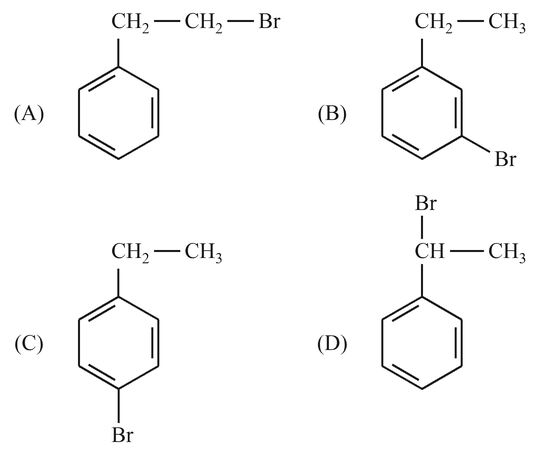
The product of the reaction between ethyl benzene and N-bromosuccinimide is
- 571 mark
Question 57
Arrange in the correct order of stability (decreasing order) for the following molecules:

- 581 mark
Question 58
The addition of HI in the presence of peroxide catalyst does not follow anti-Markovnikov's rule because :
- 591 mark
Question 59
Which of the following would not give 2-phenylbutane as the major product in a Friedel-Crafts alkylation reaction?
- 601 mark
Question 60
Which one of the following class of compounds is obtained by polymerization of acetylene?
- 611 mark
Question 61
The major product obtained in the photo catalysed bromination of 2-methylbutane is:
- 621 mark
Question 62
The gas liberated by the electrolysis of dipotassium succinate solution is:
- 631 mark
Question 63
In the presence of peroxide, HCl and HI do not give anti-Markownikoff's addition of alkenes because:
- 641 mark
Question 64
Which of the following compounds will exhibit geometrical isomerism?
- 651 mark
Question 65
In the following sequence of reactions:
the product C is:
- 661 mark
Question 66
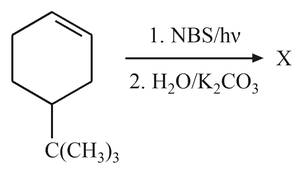
The product of the reaction given below is:

- 671 mark
Question 67
3-Methyl-pent-2-ene on reaction with HBr in presence of peroxide forms an addition product. The number of possible stereoisomers for the product is:
- 681 mark
Question 68
Which of the following compounds is most reactive to an aqueous solution of sodium carbonate?

- 691 mark
Question 69
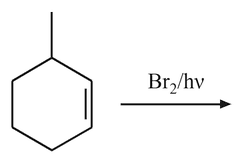
The major product of the following reaction is:
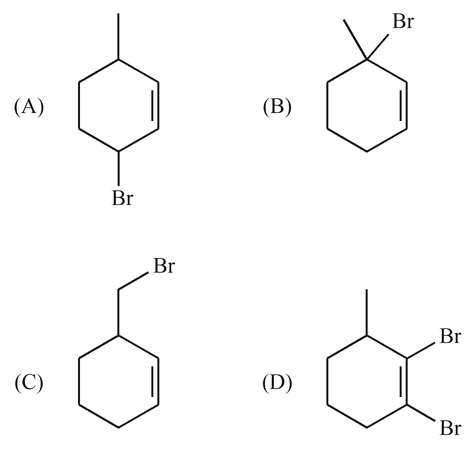
- 701 mark
Question 70
In the following structure, the double bonds are marked as I, II, III and IV
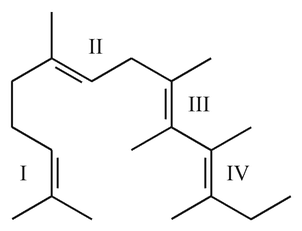
Geometrical isomerism is not possible at site(s):
- 711 mark
Question 71
Which of the following compounds will show highest dipole moment?
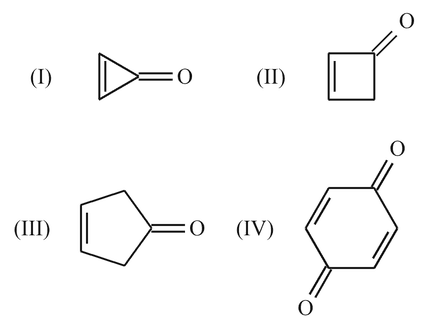
- 721 mark
Question 72
Which of the following compounds will not undergo Friedel Craft’s reaction with benzene?
- 731 mark
Question 73
The trans-alkenes are formed by the reduction of alkynes with:
- 741 mark
Question 74
When 2-butyne is treated with /Lindlar’s catalyst, compound X is produced as the major product and when treated with Na/liq. it produces Y as the major product. Which of the following statements is correct?
- 751 mark
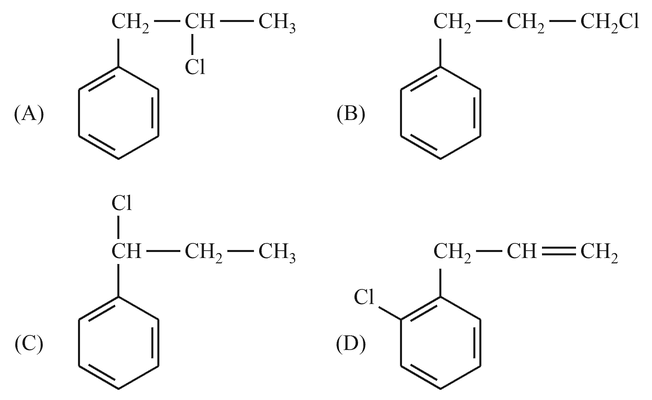
Question 75
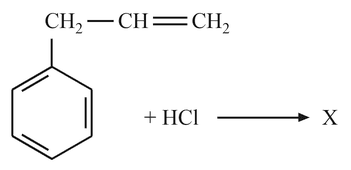
X is:
- 761 mark
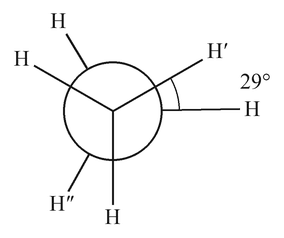
Question 76
In the following skew conformation of ethane, H′ – C – C – H″ dihedral angle is :
- 771 mark
Question 77
25 g of an unknown hydrocarbon upon burning produces 88 g and 9 g of . This unknown hydrocarbon contains:
- 781 mark
Question 78
At 300 K and 1 atmospheric pressure, 10 mL of a hydrocarbon required 55 mL of for complete combustion, and 40 mL of is formed. The formula of the hydrocarbon is:
- 791 mark
Question 79
Which of these factors does not govern the stability of a conformation in acyclic compounds?
- 801 mark
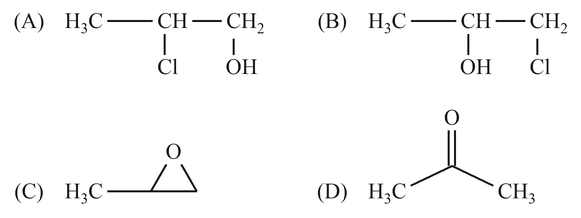
Question 80
The major product of the following addition reaction is
- 811 mark
Question 81
But-2-ene on reaction with alkaline at elevated temperature followed by acidification will give:
- 821 mark
Question 82
Which one of the following alkenes when treated with HCl yields majorly an anti Markovnikov product?
- 831 mark
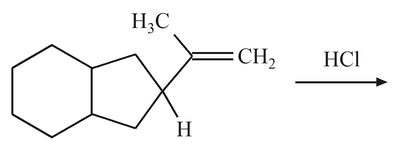
Question 83
The major product of the following reaction is :
- 841 mark
Question 84
Consider the following reaction:
‘A’ is:
- 851 mark
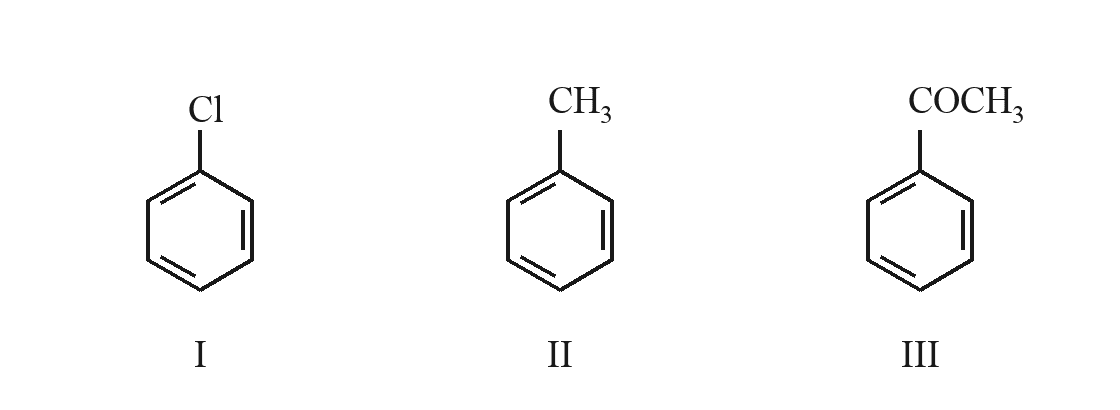
Question 85
The increasing order of the reactivity of the following compounds towards electrophilic aromatic substitution reactions is:
- 861 mark
Question 86
The major product of the following reaction is :
- 871 mark
Question 87
The correct order for acid strength of compounds , and is as follows:
- 881 mark
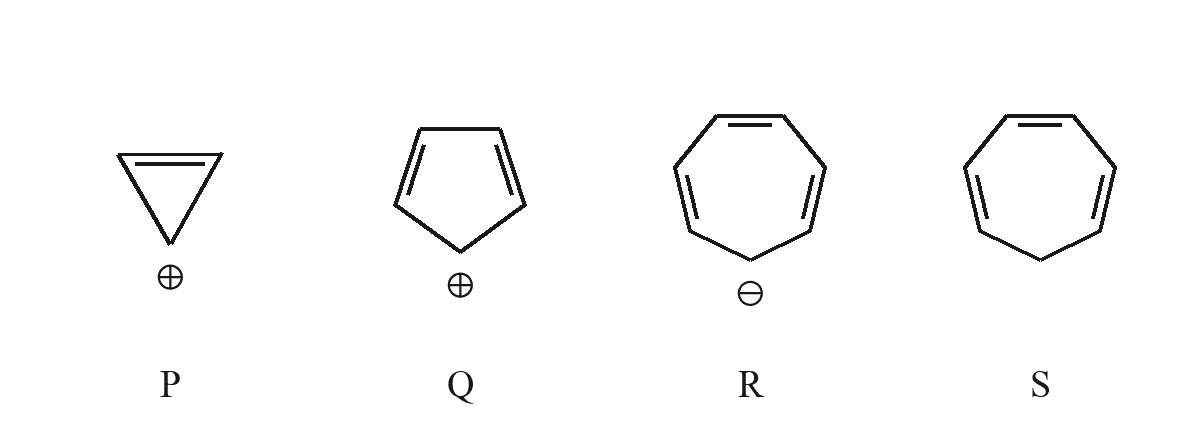
Question 88
Which compound(s) out of the following is/are not aromatic?
- 891 mark
Question 89
The major product of the following reaction is:

- 901 mark
Question 90
Which of the following compounds shows geometrical isomerism?
- 911 mark
Question 91
The increasing order of the boiling point of the major products A, B and C of the following reactions will be:

- 921 mark
Question 92
The major product formed in the following reaction is:
- 931 mark
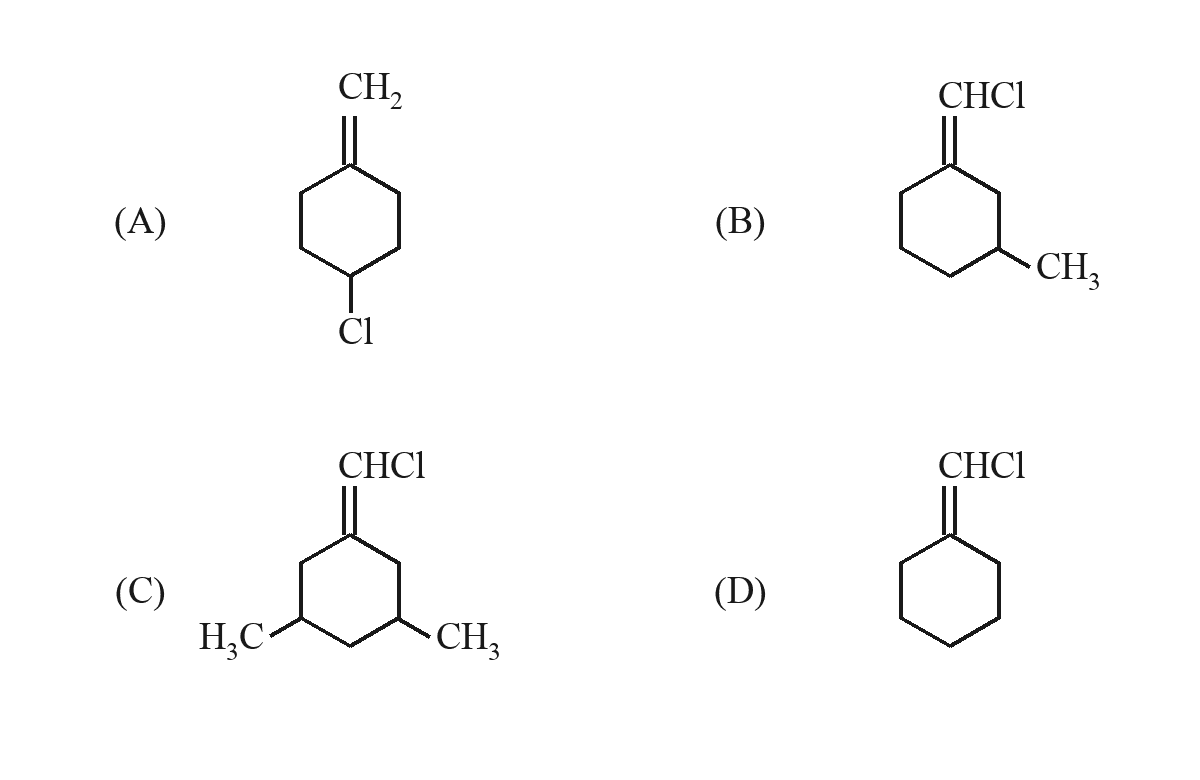
Question 93
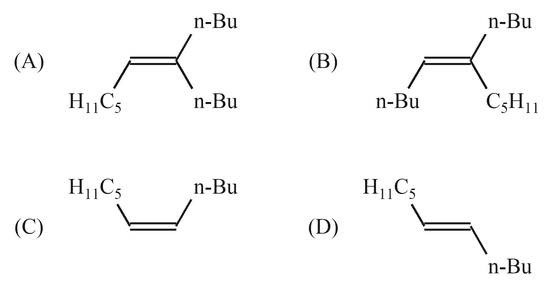
Among following compounds, geometrical isomerism is exhibited by:
(a) Structure (A)
(b) Structure (B)
(c) Structure (C)
(d) Structure (D)
- 941 mark
Question 94
Which of the following compounds produces an optically inactive compound on hydrogenation?

- 951 mark
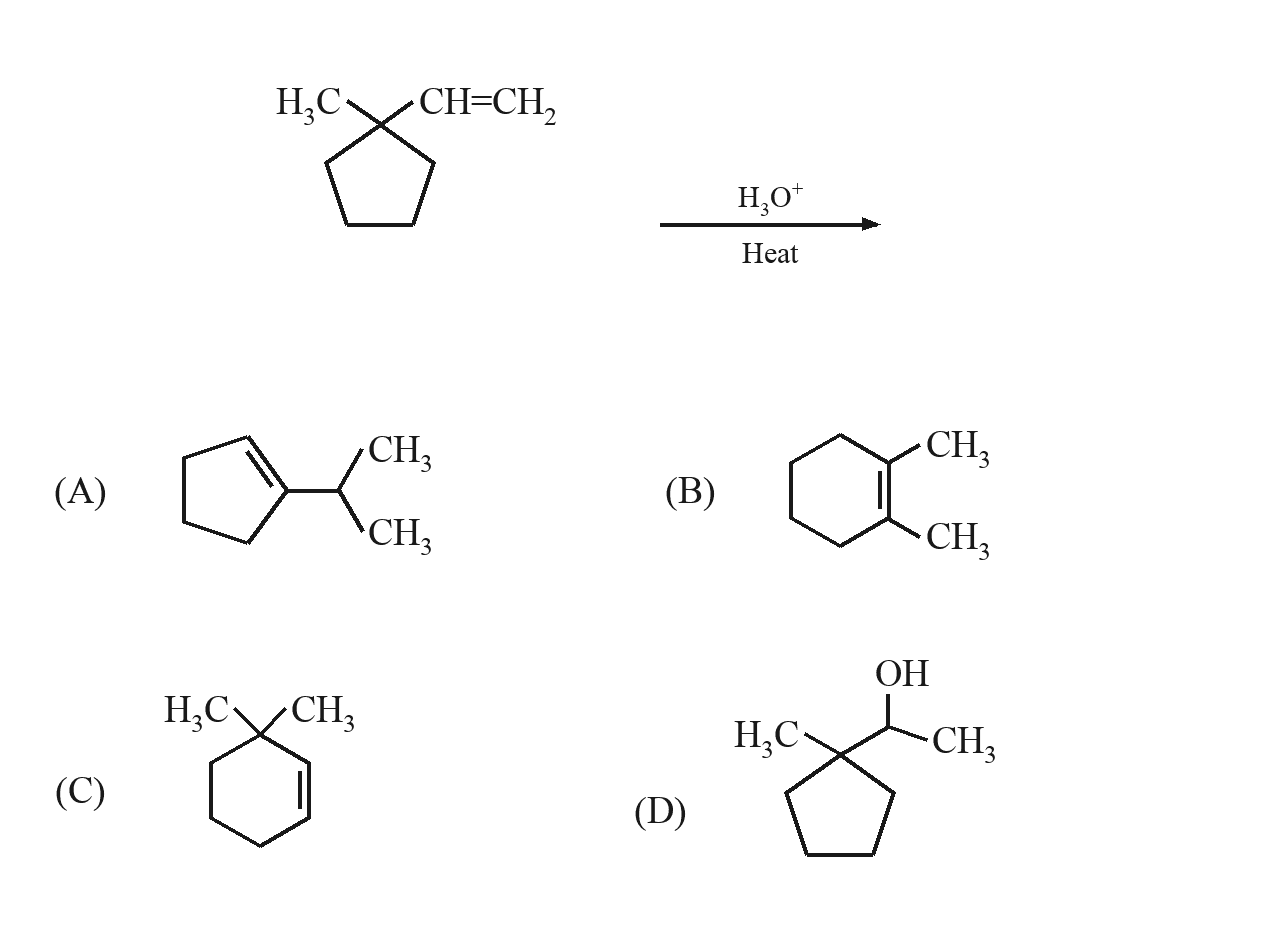
Question 95
The major product in the following reaction is:
- 961 mark
Question 96
The correct order of heat of combustion for following alkadienes is:

- 971 mark
Question 97
Which of the following has the shortest C–Cl bond?
- 981 mark
Question 98
Which of the following reactions will not produce a racemic product?
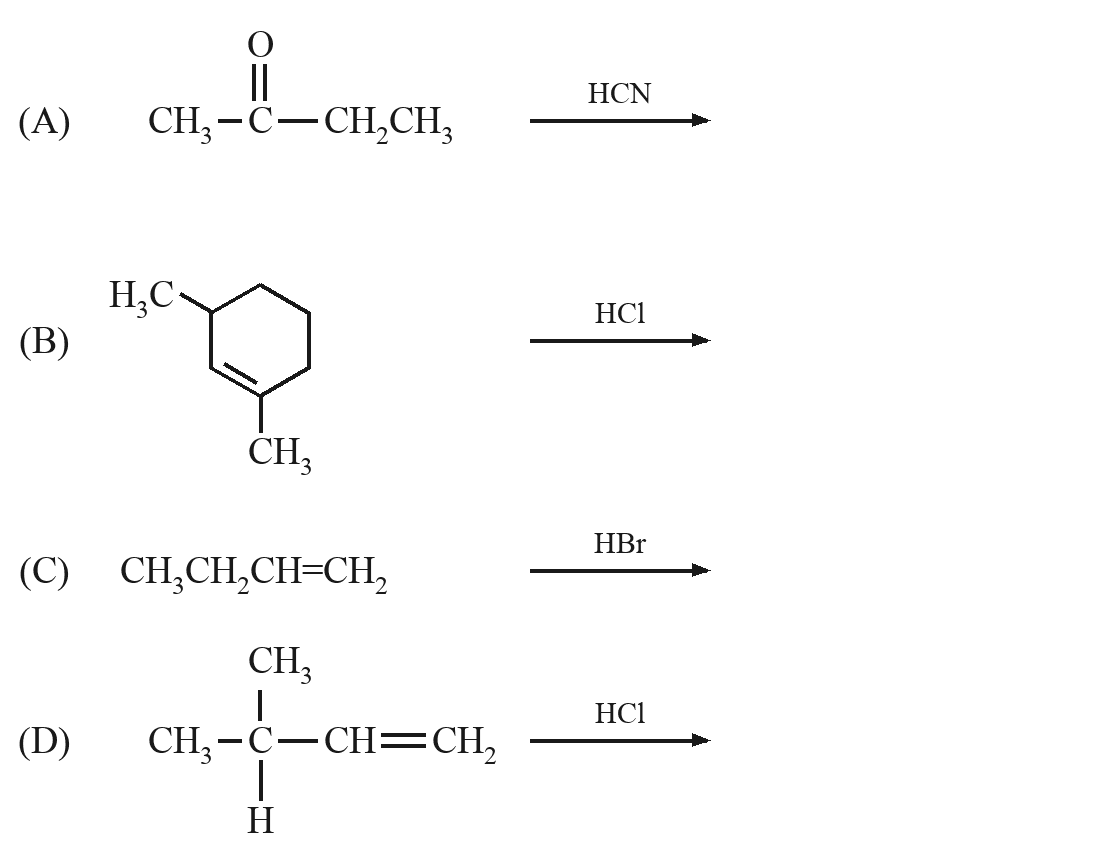
- 991 mark
Question 99
The major products A and B in the following reactions are:
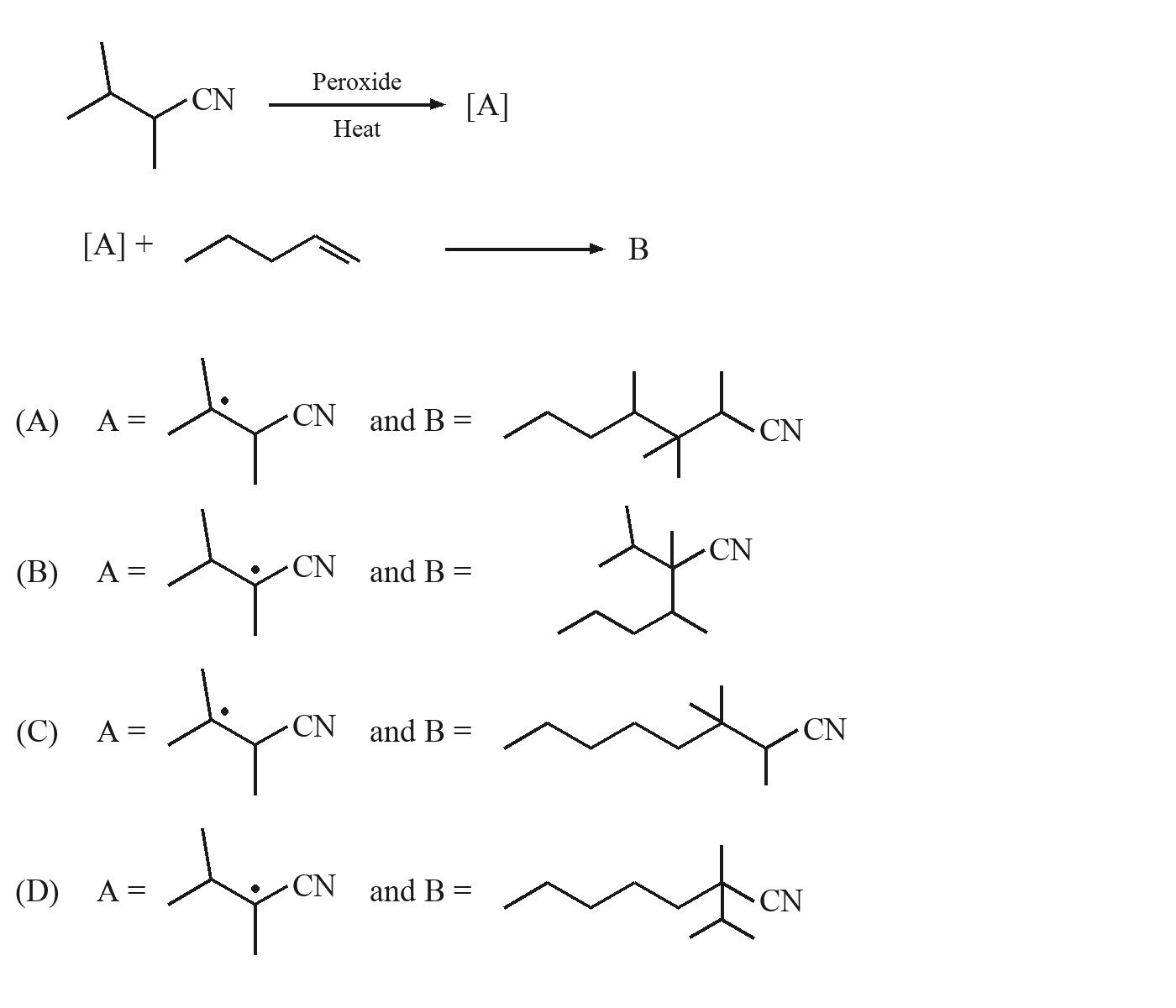
- 1001 mark
Question 100
The major product obtained from the following reaction is:

- 1011 mark
Question 101
The major product (Y) in the following reactions is:
- 1021 mark
Question 102
The number of hybrid orbitals in a molecule of benzene is:
- 1031 mark
Question 103
Consider the following reactions:

Which of these reactions are possible?
- 1041 mark
Question 104
Arrange the following conformational isomers of n-butane in order of their increasing potential energy:

- 1051 mark
Question 105
The dihedral angle in staggered form of Newman projection of 1,1,1-Trichloroethane is _______ degree. (Round off to the nearest integer)
- 1061 mark
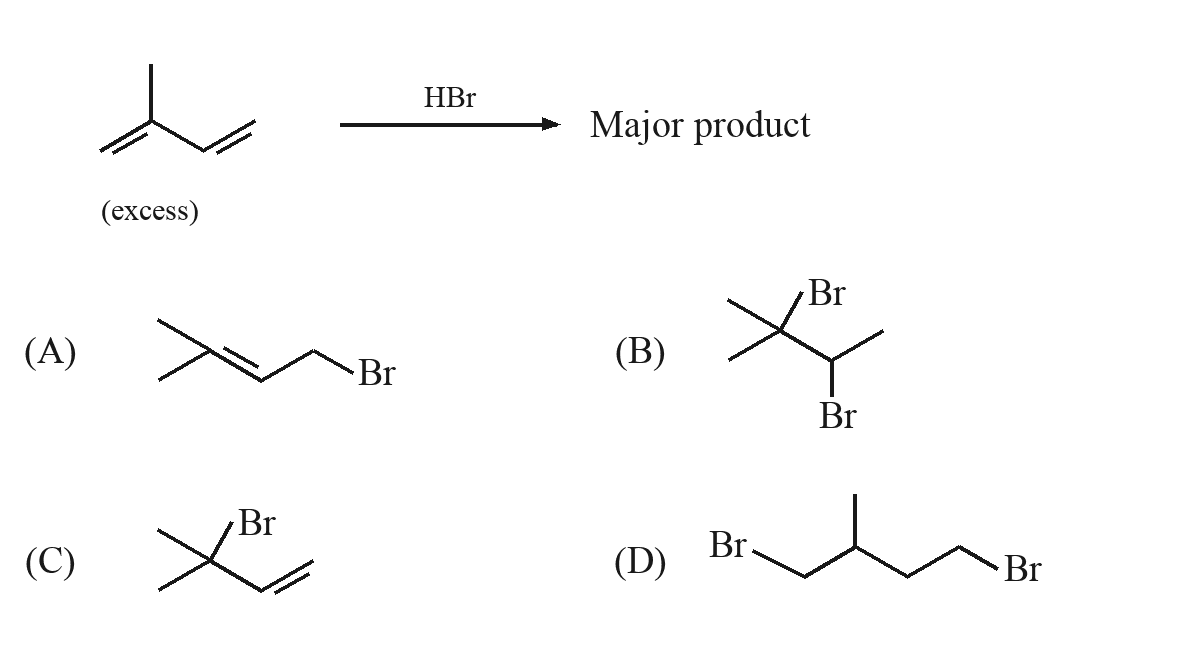
Question 106
The major product formed in the following reaction is:
- 1071 mark
Question 107
An organic compound ‘A’ on treatment with yields compound ‘B’ .
Compound ‘A’ also yield compound ‘B’ on ozonolysis. Compound ‘A’ is:
- 1081 mark
Question 108
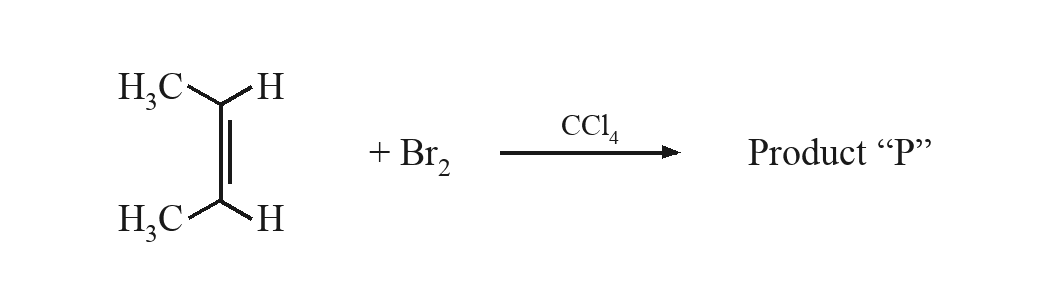
Consider the above chemical reaction. The total number of stereoisomers possible for product ‘P’ is
- 1091 mark
Question 109
Which of the following molecules does not show stereo isomerism?
- 1101 mark
Question 110
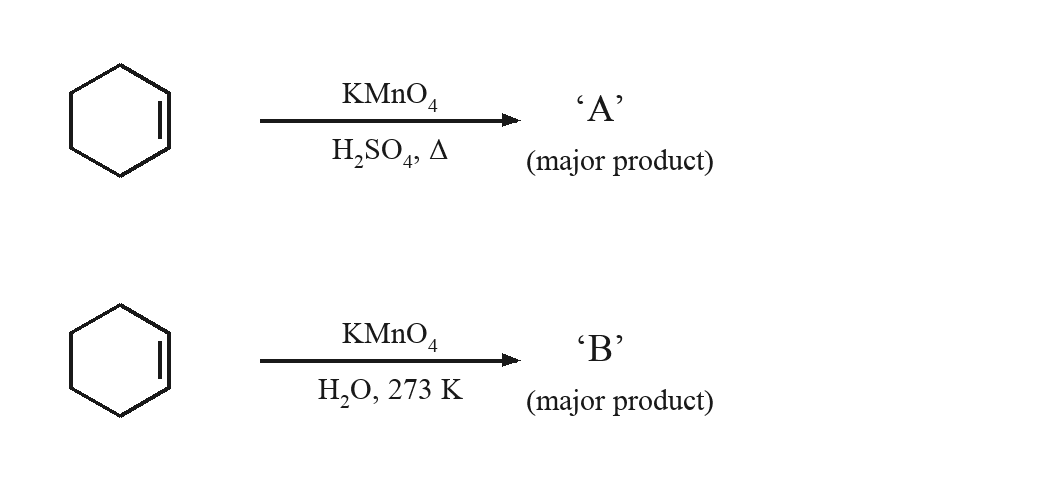
For above chemical reactions, identify the correct statement from the following:
- 1111 mark
Question 111
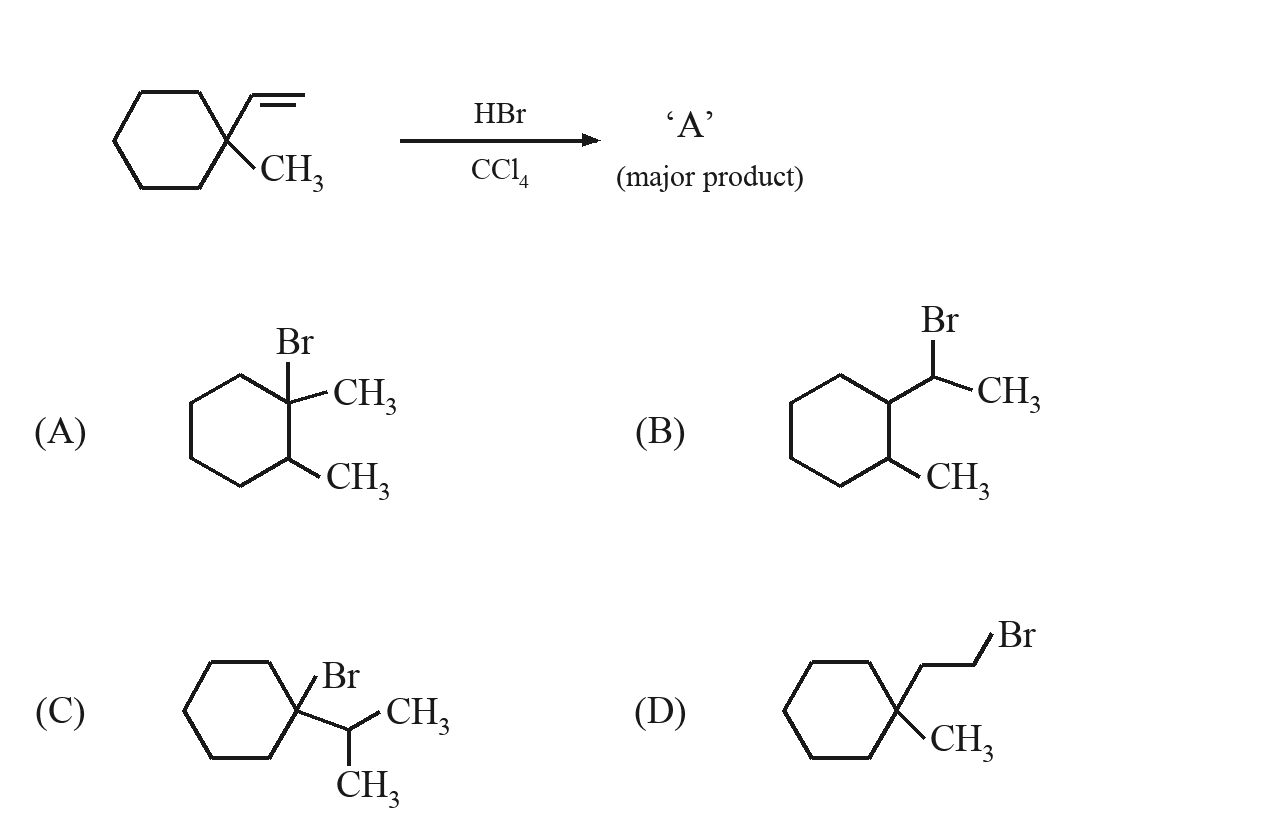
Product “A” in the above chemical reaction is
- 1121 mark
Question 112
Choose the correct statement regarding the formation of carbocation A and B given
- 1131 mark
Question 113
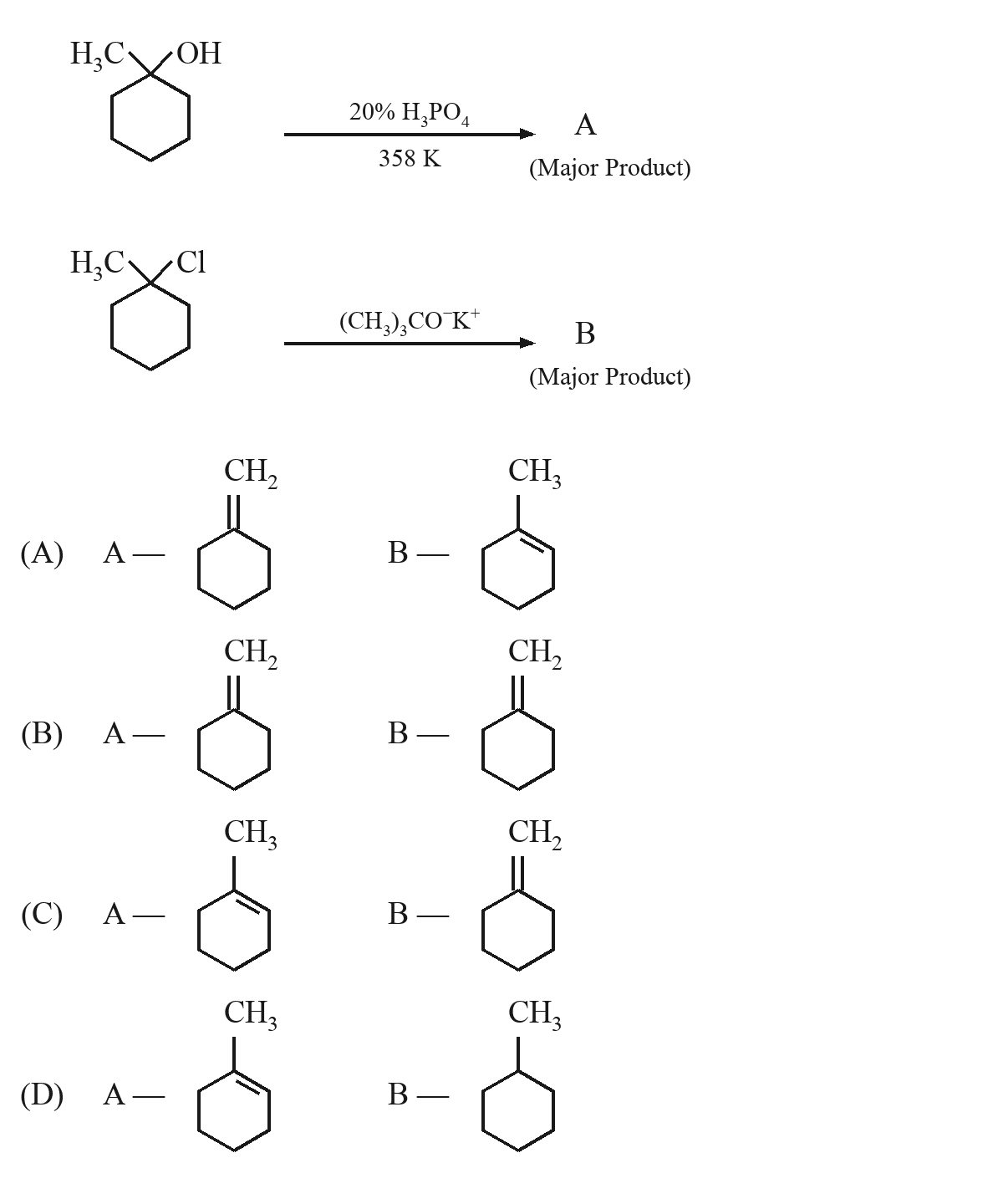
The products “A” and “B” formed in above reactions are
- 1141 mark
Question 114
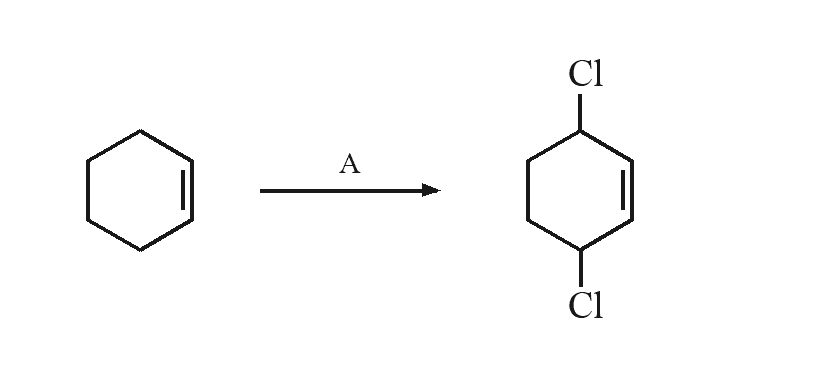
Identify the reagents(s) ‘A’ and condition(s) for the reaction
- 1151 mark
Question 115
In molecule, the hybridization of carbon 1, 2, 3 and 4 respectively, are:
- 1161 mark
Question 116
The number of sigma bonds in
is ______ .
- 1171 mark
Question 117
An unsaturated hydrocarbon X on ozonolysis gives A. Compound A when warmed with ammoniacal silver nitrate forms a bright silver mirror along the sides of the test tube. The unsaturated hydrocarbon X is:
- 1181 mark
Question 118
Consider the following chemical reaction.
The number of hybridized carbon atom(s) present in the product is ________.
- 1191 mark
Question 119
Which one of the following compounds is aromatic in nature?
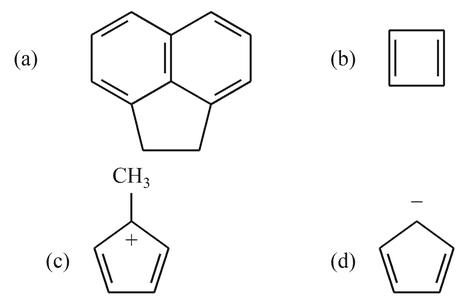
- 1201 mark
Question 120
Identify correct A, B and C in the reaction sequence given below:

- 1211 mark
Question 121
Which one of the following compounds is not aromatic?
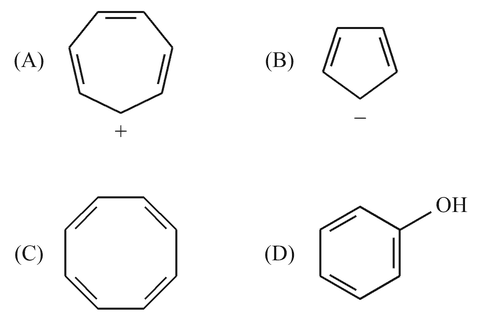
- 1221 mark
Question 122
Benzene on nitration gives nitrobenzene in presence of and mixture, where:
- 1231 mark
Question 123
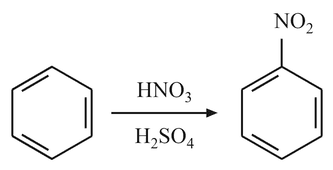
In the above reaction, 3.9 g of benzene on nitration gives 4.92 g. of nitrobenzene. The percentage yield of nitrobenzene in the above reaction is ________ %. (Round off to the Nearest Integer) (Given atomic mass: C: 12.0 u, H: 1.0 u, O: 16.0 u, N: 14.0 u)
- 1241 mark
Question 124
For the given reaction
(major product). What is 'A'?
- 1251 mark
Question 125
The correct sequence of reagents used in the preparation of 4-bromo-2-nitroethyl benzene from benzene is :
- 1261 mark
Question 126
Which among the following pairs of the structures will give different products on ozonolysis?
(Consider the double bonds in the structures are rigid and not delocalized.)
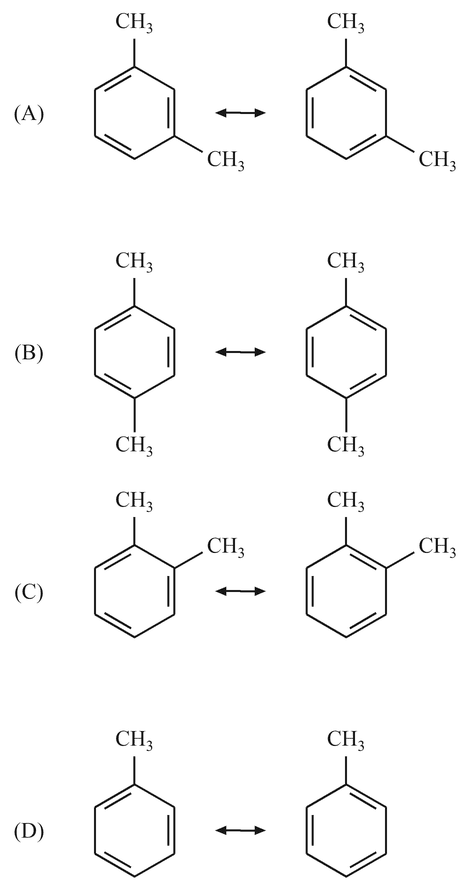
- 1271 mark
Question 127
Total number of isomers (including stereoisomers) obtained on monochlorination of methylcyclohexane is ________.
- 1281 mark
Question 128
The total number of monobromo derivatives formed by the alkanes with molecular formula is (excluding stereoisomers) ________.
- 1291 mark
Question 129
In the following structures, which one is having staggered conformation with maximum dihedral angle?

- 1301 mark
Question 130
Choose the correct option for the following reactions.
- 1311 mark
Question 131
Major product 'B' of the following reaction sequence is :
- 1321 mark
Question 132
A compound 'A' on reaction with 'X' and 'Y' produces the same major product but different byproduct 'a' and 'b'. Oxidation of 'a' gives a substance produced by ants.
'X' and 'Y' respectively are
- 1331 mark
Question 133
A hydrocarbon 'X' is found to have molar mass of 80. A 10.0 mg of compound 'X' on hydrogenation consumed 8.40 mL of gas (measured at STP). Ozonolysis of compound 'X' yields only formaldehyde and dialdehyde. The total number of fragments/molecules produced from the ozonolysis of compound 'X' is ________.
- 1341 mark
Question 134
Two isomers 'A' and 'B' with molecular formula give different products on oxidation with in acidic medium. Isomer 'A' on reaction with results in effervescence of a gas and gives ketone. The compound 'A' is
- 1351 mark
Question 135
'A' and 'B' respectively are :
- 1361 mark
Question 136
Consider the above reaction and identify the intermediate 'X'
- 1371 mark
Question 137
The products formed in the following reaction.
- 1381 mark
Question 138
The major product 'A' of the following given reaction has ________ hybridized carbon atoms.
- 1391 mark
Question 139
Given below are two statements.
Statement I: The presence of weaker π-bonds make alkenes less stable than alkanes.
Statement II: The strength of the double bond is greater than that of carbon-carbon single bond.
In the light of the above statements, choose the correct answer from the options given below.
- 1401 mark
Question 140
What will be the major product of following sequence of reactions?
- 1411 mark
Question 141
Given below are two statements. One is labelled as Assertion A and the other is labelled as Reason R.
Assertion A: [6] Annulene. [8] Annulene and cis –[10] Annulene, are respectively aromatic, not-aromatic and aromatic.
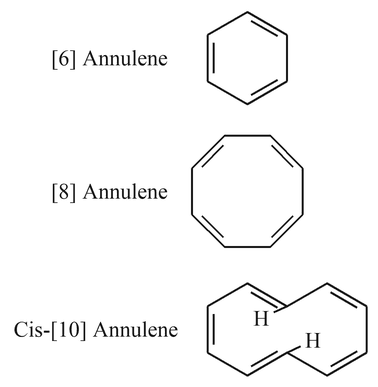
Reason R: Planarity is one of the requirements of aromatic systems.
In the light of the above statements, choose the most appropriate answer from the options given below.
- 1421 mark
Question 142
Which of the following compounds is not aromatic?

- 1431 mark
Question 143
In the presence of sunlight, benzene reacts with to give product, X. The number of hydrogens in X is ________.
- 1441 mark
Question 144
Which of the following is not an example of benzenoid compound?
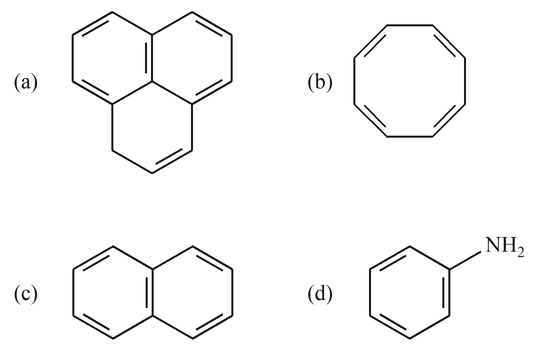
- 1451 mark
Question 145
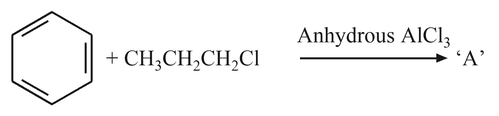
The stable carbocation formed in the above reaction is :
- 1461 mark
Question 146
Which of the following structures are aromatic in nature?
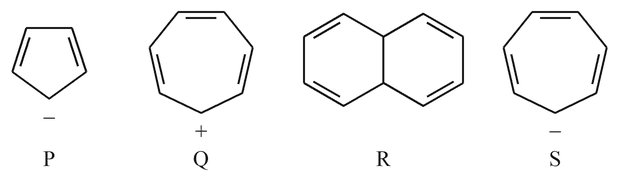
- 1471 mark
Question 147
Given below are two statements : One is labelled as Assertion A and the other is labelled as Reason R.
Assertion A: A mixture contains benzoic acid and naphthalene. The pure benzoic acid can be separated out by the use of benzene.
Reason R: Benzoic acid is soluble in hot water.
In the light of the above statements, choose the most appropriate answer from the options given below.
- 1481 mark
Question 148
In the following the most stable conformation of -butane is:
- 1491 mark
Question 149
Which of the following conformers for ethylene glycol is most stable?
- 1501 mark
Question 150
Liquid hydrocarbons can be converted to a mixture of gaseous hydrocarbons by:
- 1511 mark
Question 151
The IUPAC name of the compound is
- 1521 mark
Question 152
The reaction of toluene with in presence of gives ‘X’ and reaction in presence of light gives ‘Y’. Thus, ‘X’ and ‘Y’ are:
- 1531 mark
Question 153
In the following reaction,
the product ‘X’ is
- 1541 mark
Question 154
Which one is most reactive towards electrophilic reagent?
- 1551 mark
Question 155
In the following reaction,
(i)
(ii)
the major products (A) and (C) are respectively:
- 1561 mark
Question 156
Which one of the following is most reactive towards electrophilic reagent?
- 1571 mark
Question 157
In the following reaction:
The major product (B) is:
- 1581 mark
Question 158
Which of the following reagents will be able to distinguish between 1-butyne and 2-butyne?
- 1591 mark
Question 159
Among the following compounds the one that is most reactive towards electrophilic nitration is:
- 1601 mark
Question 160
Given

I and II are
- 1611 mark
Question 161
In the following reaction:
Product ‘P’ will not give
- 1621 mark
Question 162
The radical,
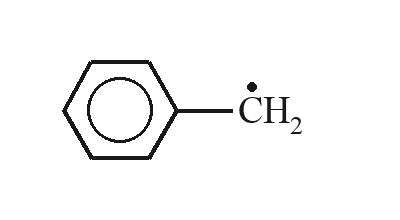
is aromatic because it has:
- 1631 mark
Question 163
Which of the following chemical system is non aromatic?
- 1641 mark
Question 164
Some meta-directing substituents in aromatic substitution are given. Which one is most deactivating?
- 1651 mark
Question 165
Which of the following compounds will not undergo Friedel-Craft's reaction easily :
- 1661 mark
Question 166
Which of the following organic compounds has same hybridization as its combustion product ()?
- 1671 mark
Question 167
What products are formed when the following compound is treated with in the presence of ?

- 1681 mark
Question 168
2,3-Dimethyl-2-butene can be prepared by heating which of the following compounds with a strong acid?
- 1691 mark
Question 169
In the reaction with HCl, an alkene reacts in accordance with the Markovnikov's rule, to give a product 1-chloro-1-methylcyclohexane. The possible alkene is :
- 1701 mark
Question 170
A single compound of the structure:
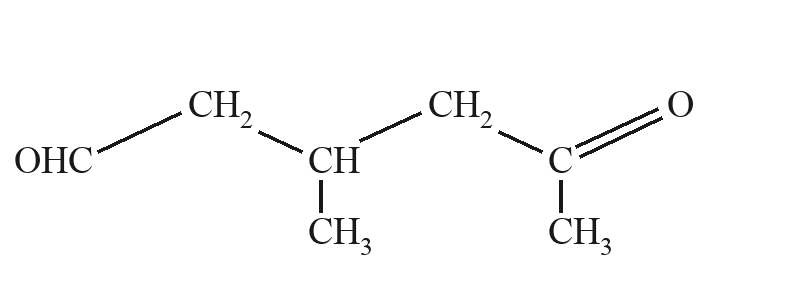
is obtainable from ozonolysis of which of the following cyclic compounds?
- 1711 mark
Question 171
The total number of π-bond electrons in the following structure is:
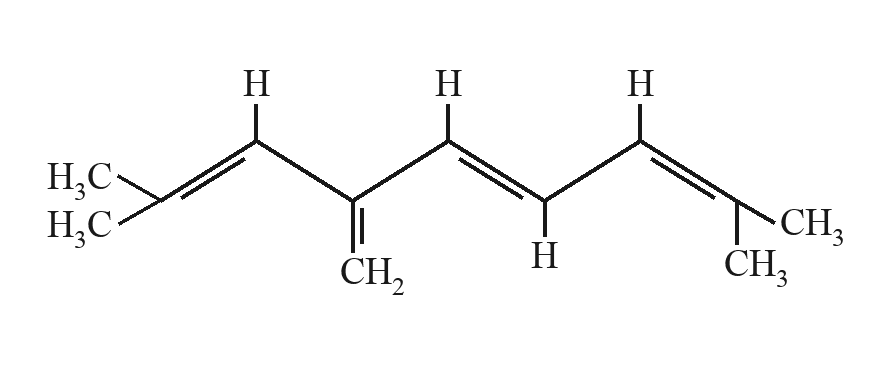
- 1721 mark
Question 172
The reaction of with HBr produces:
- 1731 mark
Question 173
Given
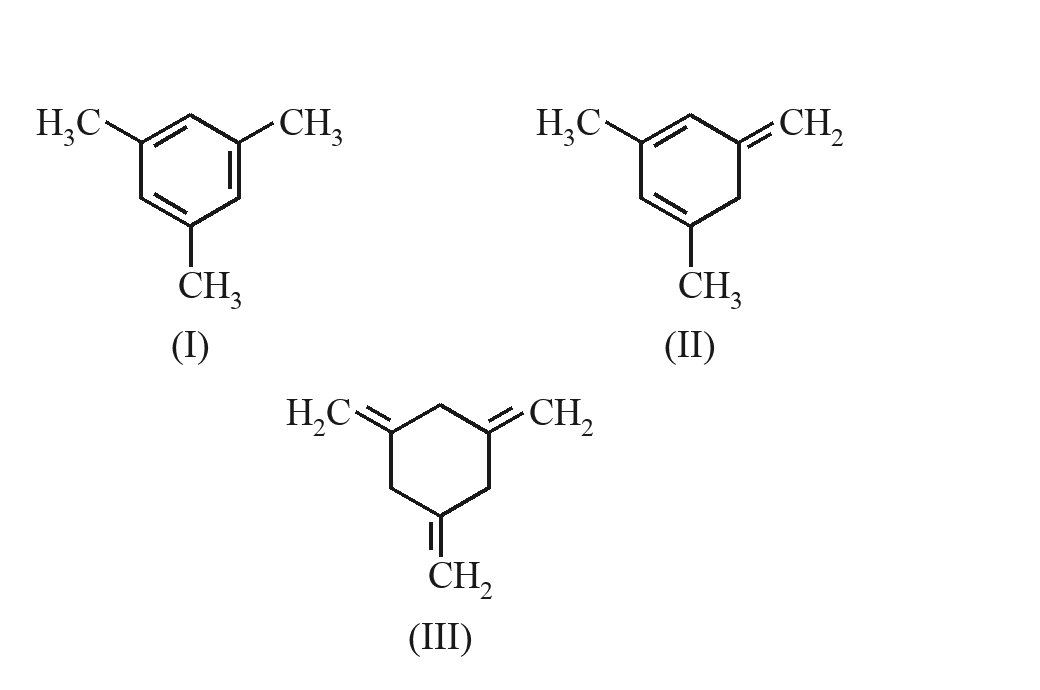
The enthalpy of the hydrogenation of these compounds will be in the order as:
- 1741 mark
Question 174
The oxidation of benzene by in presence of air produces:
- 1751 mark
Question 175
The correct statement regarding the comparison of staggered and eclipsed conformation of ethane, is
- 1761 mark
Question 176
In the reaction
X and Y are
- 1771 mark
Question 177
Consider the nitration of benzene using mixed conc. of and . If a large amount of is added to the mixture, the rate of nitration will be
- 1781 mark
Question 178
With respect to the conformers of ethane, which of the following statements is true?
- 1791 mark
Question 179
Which one is the correct order of acidity?
- 1801 mark
Question 180
Predict the correct intermediate and product in the following reaction :
- 1811 mark
Question 181
Hydrocarbon (A) reacts with bromine by substitution to form an alkyl bromide which by Wurtz reaction is converted to gaseous hydrocarbon containing less than four carbon atom (A) is
- 1821 mark
Question 182
The compound undergoes the following reactions:
The product ‘C’ is
- 1831 mark
Question 183
The alkane that gives only one mono-chloro product on chlorination with in presence of diffused sunlight is
- 1841 mark
Question 184
An alkene “A” on reaction with and Zn – gives propanone and ethanal in equimolar ratio. Addition of HCl to alkene “A” gives “B” as the major product. The structure of product “B” is :
- 1851 mark
Question 185
In the following reaction,
the number of sigma (σ) bonds present in the product A, is
- 1861 mark
Question 186
The most suitable reagent for the following conversion, is:

- 1871 mark
Question 187
An alkene on ozonolysis gives methanal as one of the product. Its structure is
- 1881 mark
Question 188
Which of the following compound is most reactive in electrophilic aromatic substitution?
- 1891 mark
Question 189
Dihedral angle of least stable conformer of ethane is :
- 1901 mark
Question 190
Consider the above reaction and identify the missing reagent/chemical.
- 1911 mark
Question 191
The major product of the following chemical reaction is :
- 1921 mark
Question 192
Compound X on reaction with followed by Zn/ gives formaldehyde and 2-methyl propanal as products. The compound X is :
- 1931 mark
Question 193
Which compound amongst the following is not an aromatic compound?