
Question 501 markMCQEasy
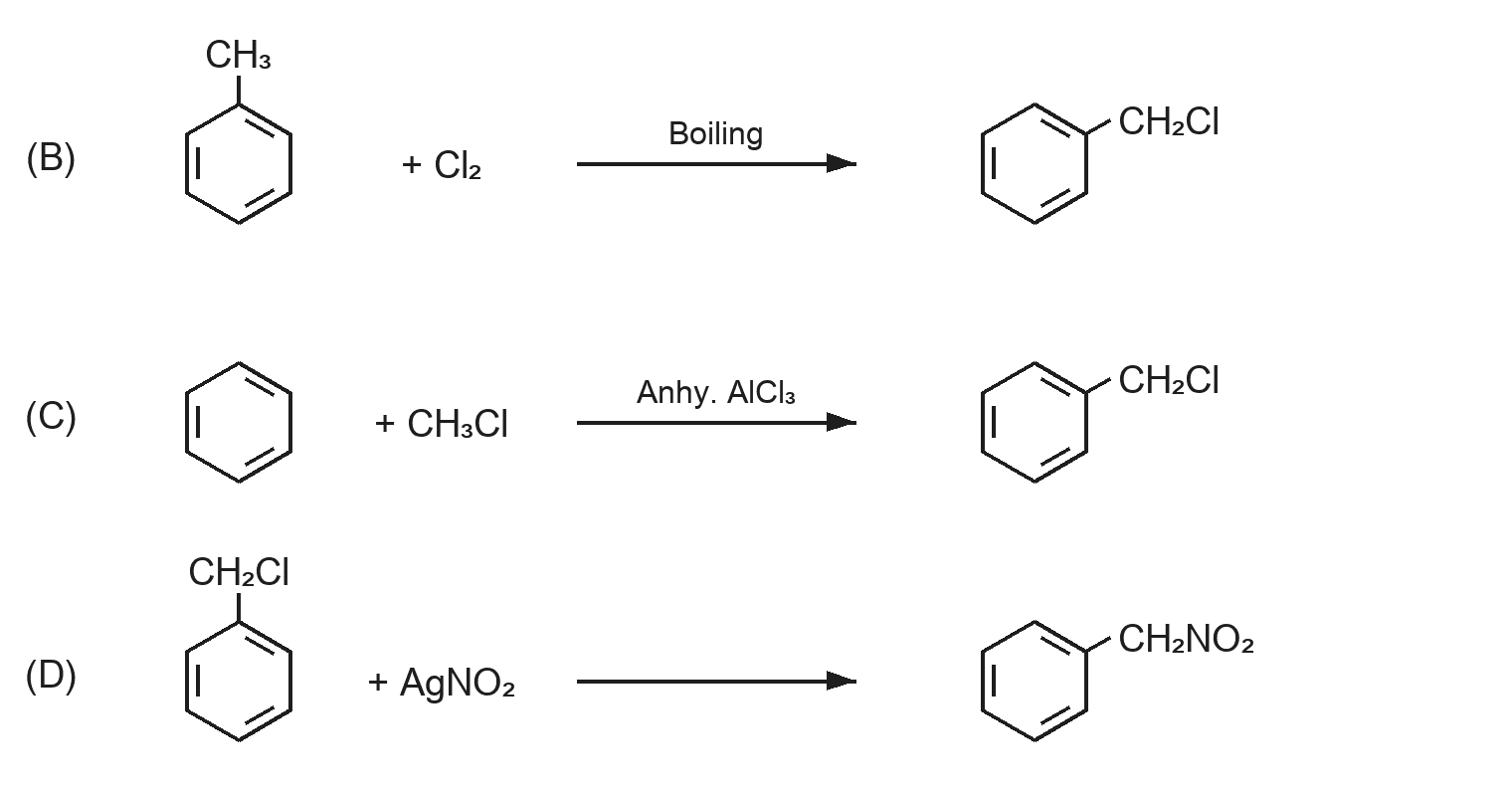
Which one of the following is a free-radical substitution reaction?
Confirming your payment
Sign up now and get 250 free tokens.
Hydrocarbons · Question 50 of 128
Which one of the following is a free-radical substitution reaction?
(A)
(B)
(C)
(D)
Answer: (B) Chlorination of toluene in the side chain on boiling
Key idea: In a free-radical substitution a halogen molecule is split into atoms (radicals) by heat or light, and a halogen atom replaces a hydrogen in a chain reaction. With at the boiling point of toluene (or in sunlight) and no Lewis acid, the substitution happens in the side chain, not on the ring.
Step 1 — Start the chain (initiation). Heat or light breaks the Cl–Cl bond evenly, giving two chlorine atoms, each with one unpaired electron.
Step 2 — Carry the chain (propagation). A chlorine atom removes a hydrogen from the group. The benzyl radical formed is stabilised by resonance with the ring, which is why the side chain reacts. This radical then takes a Cl atom from a fresh molecule and a new Cl atom is released.
Step 3 — Write the overall change. Adding the two propagation steps gives the balanced equation; the printed option leaves out the HCl formed.
Why the other options are wrong:
Therefore, the side-chain chlorination of toluene on boiling, option (B), is the free-radical substitution.