
Question 681 markMedium
o-Xylene on reductive ozonolysis gives ______, ______ and ______.
Confirming your payment
Sign up now and get 250 free tokens.
Hydrocarbons · Question 68 of 128
o-Xylene on reductive ozonolysis gives ______, ______ and ______.
Solution:
Key idea: Ozonolysis cuts every C=C double bond and turns each of its two carbons into a C=O group. Benzene rings are not real cyclohexatrienes, but ozone reacts with them as if the double bonds were in the positions of the Kekulé structures. o-Xylene (1,2-dimethylbenzene) has two different Kekulé structures, and the products of both are found, which is evidence for resonance in benzene.
Step 1 — Number the ring. Call the carbons carrying the groups C1 and C2, and number the rest C3 to C6 round the ring, as in the figure.
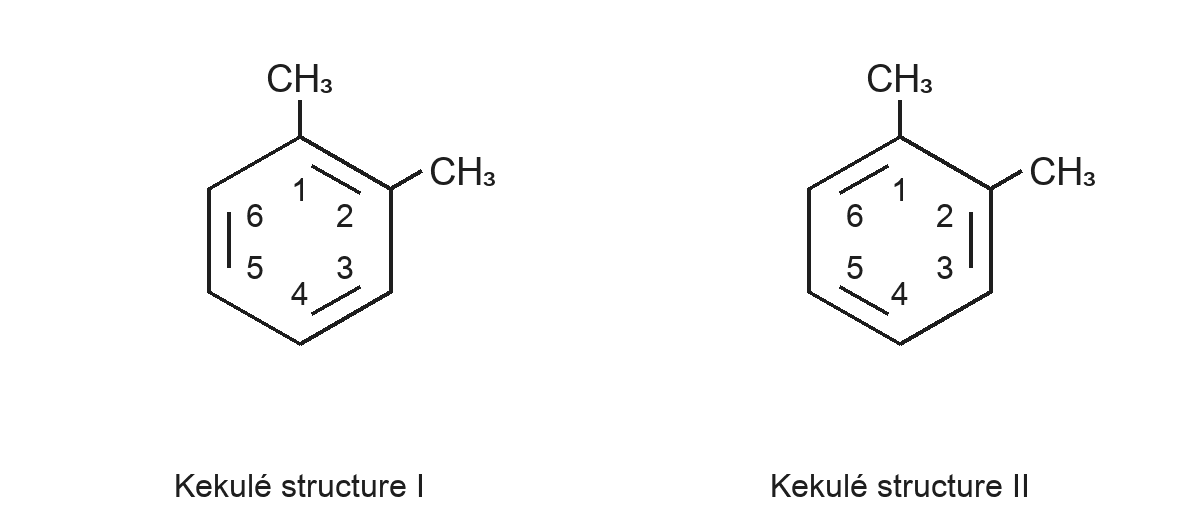
Step 2 — Use Kekulé structure I. Its double bonds are C1=C2, C3=C4 and C5=C6. After ozonolysis the single bonds C2–C3, C4–C5 and C6–C1 remain, each joining two new C=O groups. C2–C3 and C6–C1 each carry one methyl group and give methylglyoxal, ; C4–C5 gives glyoxal, .
Step 3 — Use Kekulé structure II. Its double bonds are C2=C3, C4=C5 and C6=C1. Of the single bonds that remain, C1–C2 (which carries both methyl groups) gives dimethylglyoxal, , while C3–C4 and C5–C6 each give glyoxal.
Step 4 — Combine the two. Adding both sets, the three products appear in the mole ratio glyoxal : methylglyoxal : dimethylglyoxal = 3 : 2 : 1.
Note: the dimethyl product is called dimethylglyoxal or butane-2,3-dione; the locants "1,2-" sometimes put in front of "dimethylglyoxal" are not part of a correct name.
Therefore, o-xylene gives glyoxal (ethanedial), methylglyoxal (2-oxopropanal) and dimethylglyoxal (butane-2,3-dione).