
Question 1082 marksMedium
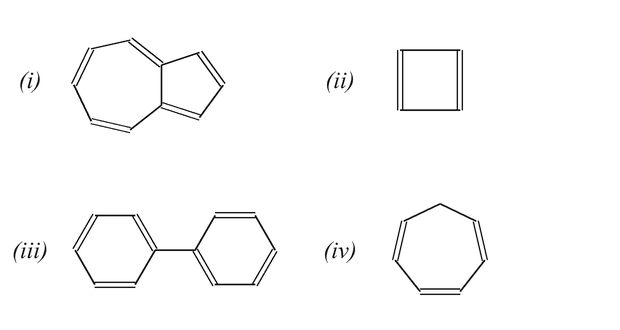
Predict which of the following systems would be aromatic and why?
Confirming your payment
Sign up now and get 250 free tokens.
Hydrocarbons · Question 108 of 128
Predict which of the following systems would be aromatic and why?
Solution:
Key idea: By Hückel's rule a molecule is aromatic when it is cyclic, planar, and fully conjugated (every ring atom has a p orbital in one continuous ring), and its ring holds π-electrons, where = 0, 1, 2, … A cyclic, planar, fully conjugated ring with π-electrons is antiaromatic. A ring that is not fully conjugated is non-aromatic.
Step 1 — (i) Azulene. All ten carbons are sp² and lie in one plane; its five C=C bonds run round the whole 10-carbon perimeter, so the conjugation is continuous. It has 5 × 2 = 10 π-electrons, which fits with equal to 2. So azulene is aromatic.
Step 2 — (ii) Cyclobutadiene. It is cyclic and fully conjugated, but it has 2 × 2 = 4 π-electrons. This is a count (with equal to 1), so cyclobutadiene is antiaromatic; it is extremely unstable and exists only at very low temperatures.
Step 3 — (iii) Biphenyl. Each ring is a benzene ring: cyclic, planar, fully conjugated, with 6 π-electrons ( equal to 1). The single bond joining the rings does not change this. So biphenyl is aromatic (both rings are aromatic).
Step 4 — (iv) Cyclohepta-1,3,5-triene. The top carbon is a group: it is sp³ and has no p orbital, so the conjugation of the three C=C bonds is broken at that point. Although the ring has 6 π-electrons, they are not in a continuous cyclic system. So cycloheptatriene is non-aromatic.
Watch out: Counting 6 π-electrons is not enough; the ring must also be fully conjugated. Removing from the group gives the tropylium ion, , which is aromatic.
Therefore, (i) azulene and (iii) biphenyl are aromatic; (ii) cyclobutadiene is antiaromatic (4 π-electrons) and (iv) cycloheptatriene is non-aromatic (its sp³ carbon breaks the cyclic conjugation).