
Question 561 markMCQEasy
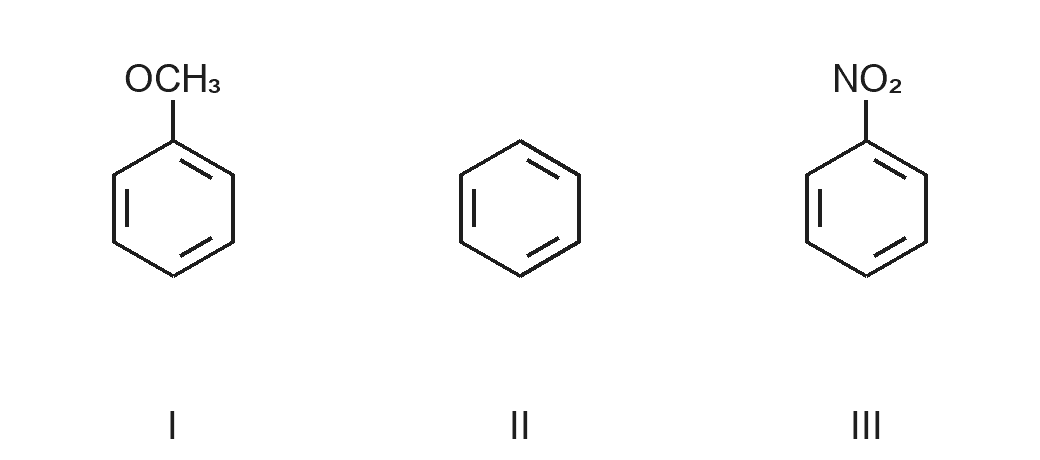
Among the following compounds (I-III), the ease of their reaction with electrophiles is,
Confirming your payment
Sign up now and get 250 free tokens.
Hydrocarbons · Question 56 of 128
Among the following compounds (I-III), the ease of their reaction with electrophiles is,
(A) II > III > I
(B) III > II > I
(C) II > I > III
(D) I > II > III
Answer: (D) I > II > III
Key idea: The figure shows anisole (I, ring with ), benzene (II) and nitrobenzene (III). An electron-donating substituent makes the ring react faster with electrophiles than benzene does; an electron-withdrawing one makes it react more slowly.
Step 1 — Look at the group. The oxygen joined to the ring has lone pairs that are delocalised into the ring (+M effect, stronger than its –I effect). The ring becomes electron-rich, so anisole is more reactive than benzene.
Step 2 — Look at the group. It withdraws electrons from the ring by –M and –I effects, so nitrobenzene is less reactive than benzene.
Step 3 — Write the order. Anisole is the most reactive and nitrobenzene the least, with benzene between them.
Why the other options are wrong:
Therefore, the ease of reaction with electrophiles is I > II > III.