
Opening your dashboard
Class 11 Biology Chapter 8: Morphology of Flowering Plants Solutions
80 textbook questions with step-by-step answers, free to read, for ISC 2026-27.
Get talked through Ch 8, not just shown the answer
Reading a finished solution is not the same as being able to do it. The AI tutor takes one question at a time and works it with you, in your own words, until you can.
- Ask it out loud, in your own words
- It gives you the next step, not the answer
- Stuck on part (ii)? Start there
80 questions with solutions
1–5 marks · Mixed difficulty
- 11 mark
Question 1
What are adventitious roots?
Solve with AIWritten solution
Solution:
Concept: the primary root of a plant grows from the radicle of the embryo; every other root is named by where it arises.
Step 1 — What is asked: the meaning of the term adventitious root.
Step 2 — The fact used: roots that grow from any part of the plant other than the radicle — the base of the stem (grasses), the nodes (sugarcane, bamboo), stem cuttings (rose) or branches (banyan) — are adventitious.
Therefore, adventitious roots are roots that develop from any part of the plant other than the radicle.
- 21 mark
Question 2
Where is the region of elongation present in a root?
Solve with AIWritten solution
Solution:
Concept: a young root tip has four regions one behind the other: root cap, region of meristematic activity, region of elongation and region of maturation.
Step 1 — What is asked: the position of the region of elongation.
Step 2 — The fact used: the cells formed by the meristem just behind the root cap then lengthen rapidly, so this zone lies just above the region of meristematic activity and below the region of maturation; it gives the root its growth in length.
Therefore, the region of elongation lies just above the region of meristematic activity, below the region of maturation.
- 31 mark
Question 3
Which plant has the prop roots and what is their function?
Solve with AIWritten solution
Solution:
Concept: prop roots are adventitious roots that grow from aerial branches and act as pillars.
Step 1 — The plant: the banyan tree is the common example.
Step 2 — Their function: the massive roots grow vertically down from the horizontal branches into the soil and thicken, so they support the heavy spreading branches and the tree as a whole.
Therefore, the banyan tree has prop roots, which support its heavy branches like pillars.
- 41 mark
Question 4
What is an organ of perennation?
Solve with AIWritten solution
Solution:
Concept: perennation means surviving from one year to the next through an unfavourable season.
Step 1 — What is asked: the meaning of an organ of perennation.
Step 2 — The fact used: such an organ, usually an underground stem full of stored food, stays dormant through unfavourable conditions and then gives rise to new aerial shoots or plants when conditions become favourable — e.g. rhizome of ginger, bulb of onion, tuber of potato.
Therefore, an organ of perennation is a plant part that survives year after year through unfavourable conditions and gives rise to new plants in favourable conditions.
- 51 mark
Question 5
Give two important characteristics and one example of rhizome.
Solve with AIWritten solution
Solution:
Concept: a rhizome is an underground stem modified for storage and perennation.
Step 1 — First characteristic: it is a thick, fleshy stem that grows horizontally just below the soil surface.
Step 2 — Second characteristic: being a stem, it has distinct nodes and internodes with dry scale leaves, axillary and terminal buds, and adventitious roots on its lower side.
Step 3 — Example: ginger (also banana, Iris).
Therefore, a rhizome is a thick horizontal underground stem with nodes, scale leaves and buds, e.g. ginger.
- 61 mark
Question 6
What is a tuber? Give one example.
Solve with AIWritten solution
Solution:
Concept: a tuber is an underground stem modification that stores food.
Step 1 — Definition: it is the swollen terminal portion of an underground branch, packed with stored food (starch).
Step 2 — Proof that it is a stem: its 'eyes' are nodes, each with a bud in the axil of a scale-leaf scar.
Step 3 — Example: potato.
Therefore, a tuber is the swollen tip of an underground stem branch that stores food, e.g. potato.
- 71 mark
Question 7
How does Jasmine plant propagate?
Solve with AIWritten solution
Solution:
Concept: many weak-stemmed plants spread by sub-aerial stems (runner, sucker, stolon, offset), which are means of vegetative propagation.
Step 1 — The structure used: jasmine forms a stolon — a weak, slender lateral branch from the base of the stem.
Step 2 — How a new plant forms: the stolon arches down; where it touches the ground it gives out adventitious roots, and its terminal bud grows into a new shoot, which becomes independent when the link breaks.
Therefore, jasmine propagates vegetatively by stolons.
- 81 mark
Question 8
Are thorns and prickles almost similar in plants? Give reason.
Solve with AIWritten solution
Solution:
Concept: both thorns and prickles are hard, sharp structures that protect a plant, so they look alike, but their origin is different.
Step 1 — Thorn: a thorn is a modified axillary or terminal bud (a stem structure), e.g. Duranta, lemon.
Step 2 — Prickle: a prickle is only a superficial outgrowth of the epidermis of the stem, not a modified organ, so it can be broken off easily, e.g. rose.
Therefore, thorns and prickles are not similar: a thorn is a modified bud, while a prickle is a superficial epidermal outgrowth.
- 91 mark
Question 9
What is the importance of a cladode? In which plant is it present?
Solve with AIWritten solution
Solution:
Concept: a cladode is a short green branch of limited growth (one or two internodes) that looks like a leaf and arises in the axil of a reduced scale leaf.
Step 1 — Its importance: because the true leaves are reduced to scales, the green cladode takes over photosynthesis for the plant.
Step 2 — Example: Asparagus (cylindrical cladodes); also Ruscus (flat cladodes that bear flowers).
Therefore, a cladode carries out photosynthesis in place of leaves; it is present in Asparagus.
- 101 mark
Question 10
What type of venation is present in a palm leaf?
Solve with AIWritten solution
Solution:
Concept: venation is the arrangement of veins and veinlets in the lamina; it is reticulate (network) or parallel.
Step 1 — What is asked: the venation of a palm leaf.
Step 2 — The fact used: in a palm leaf many strong veins arise from the tip of the petiole and run parallel to one another towards the margin, without forming a network.
Therefore, a palm leaf has parallel palmate venation.
- 111 mark
Question 11
How is a compound leaf different from a simple leaf?
Solve with AIWritten solution
Solution:
Concept: a leaf is simple or compound depending on whether its lamina (blade) is undivided or divided.
Step 1 — Simple leaf: it has a single lamina; any incisions do not reach the midrib, and there is an axillary bud in the axil of the leaf.
Step 2 — Compound leaf: its lamina is divided into leaflets because the incisions reach the midrib; the leaflets have no axillary buds — a bud is present only in the axil of the whole leaf.
Therefore, a compound leaf has its lamina divided into leaflets without buds in their axils, while a simple leaf has one undivided lamina with a bud in its axil.
- 121 mark
Question 12
What is phyllotaxy? Name the kind of phyllotaxy in China rose and Oleander.
Solve with AIWritten solution
Solution:
Concept: leaves are arranged on the stem so that each gets enough sunlight and they are not overcrowded.
Step 1 — Definition: phyllotaxy is the arrangement of leaves on a stem or branch.
Step 2 — China rose: a single leaf at each node — alternate phyllotaxy.
Step 3 — Oleander: more than two leaves at each node in a circle — whorled phyllotaxy.
Therefore, phyllotaxy is the arrangement of leaves on a stem; China rose is alternate and oleander is whorled.
- 131 mark
Question 13
What is heterophylly? Give one example.
Solve with AIWritten solution
Solution:
Concept: the shape of leaves is usually fixed for a species, but some plants produce more than one leaf form.
Step 1 — Definition: heterophylly is the presence of more than one type of leaf on the same plant; it is an adaptive character, for example for life in different conditions of water.
Step 2 — Example: Limnophila.
Therefore, heterophylly is having more than one type of leaf on the same plant, e.g. Limnophila.
- 141 mark
Question 14
What is inflorescence? Name the kind of inflorescence present in Coleus.
Solve with AIWritten solution
Solution:
Concept: flowers are often not solitary but grouped on a common stalk called the peduncle.
Step 1 — Definition: an inflorescence is a cluster of flowers on the same stalk (peduncle); it may be terminal or axillary.
Step 2 — Coleus: it has a verticillaster — a special inflorescence made of two clusters, one in the axil of each of the two opposite leaves at a node; each cluster is a dichasial cyme of sessile flowers, so the flowers look like a ring around the node.
Therefore, an inflorescence is a cluster of flowers on a peduncle, and Coleus has a verticillaster inflorescence.
- 151 mark
Question 15
Define the terms (i) Diadelphous and (ii) Gynandrous. Give one example of each.
Solve with AIWritten solution
Solution:
Concept: stamens may be joined to one another (cohesion) or to other floral whorls (adhesion).
Step 1 — Diadelphous: the filaments of the stamens are united into two bundles while the anthers stay free, e.g. pea (nine filaments in one bundle and one free).
Step 2 — Gynandrous: the stamens are attached to the carpels (pistil), e.g. Calotropis.
Therefore, diadelphous means filaments in two bundles (pea), and gynandrous means stamens fused with the pistil (Calotropis).
- 161 mark
Question 16
Name the essential whorls of a flower.
Solve with AIWritten solution
Solution:
Concept: a flower has four whorls; the outer two (calyx, corolla) only protect the flower or attract pollinators.
Step 1 — What is asked: the whorls directly concerned with reproduction.
Step 2 — The fact used: the androecium (stamens, the male part, producing pollen) and the gynoecium (carpels, the female part, bearing ovules) take part directly in reproduction.
Therefore, the essential whorls are the androecium (stamens) and the gynoecium (carpels).
- 171 mark
Question 17
What is a zygomorphic flower? Give one example.
Solve with AIWritten solution
Solution:
Concept: flowers are described by symmetry — the number of vertical planes that divide them into equal halves.
Step 1 — Definition: a zygomorphic flower can be divided into two equal halves by only one vertical plane.
Step 2 — Example: pea flower.
Therefore, a zygomorphic flower is divisible into two equal halves in one vertical plane only, e.g. pea.
- 181 mark
Question 18
What is a perigynous flower?
Solve with AIWritten solution
Solution:
Concept: flowers are hypogynous, perigynous or epigynous according to the position of the floral parts on the thalamus relative to the ovary.
Step 1 — What is asked: the meaning of perigynous.
Step 2 — The fact used: the thalamus grows into a cup-shaped structure; sepals, petals and stamens arise from its rim around the ovary, at about the same level, so the ovary is half-inferior — e.g. rose, plum.
Therefore, a perigynous flower has a cup-shaped thalamus bearing sepals, petals and stamens on its rim, with a half-inferior ovary.
- 191 mark
Question 19
What is pericarp? Name its various parts.
Solve with AIWritten solution
Solution:
Concept: after fertilisation the ovary becomes the fruit, and the ovary wall becomes the fruit wall.
Step 1 — Definition: the pericarp is the wall of the mature ovary, i.e. the fruit wall.
Step 2 — Its parts: epicarp (outer skin), mesocarp (middle layer, fleshy and edible in mango) and endocarp (innermost layer, hard and stony in mango).
Therefore, the pericarp is the fruit wall, made of epicarp, mesocarp and endocarp.
- 201 mark
Question 20
Why is apple called a false fruit?
Solve with AIWritten solution
Solution:
Concept: a true fruit develops only from the ovary; if another floral part forms the fruit, it is a false fruit.
Step 1 — What is asked: the reason apple is a false fruit.
Step 2 — The fact used: in apple the fleshy edible part develops from the thalamus (receptacle), not from the ovary wall; the ovary forms only the central core.
Therefore, apple is a false fruit because its edible part is the thalamus, not the ovary wall.
- 211 mark
Question 21
What is a parthenocarpic fruit?
Solve with AIWritten solution
Solution:
Concept: normally a fruit develops after fertilisation, and fertilised ovules become seeds.
Step 1 — What is asked: the meaning of parthenocarpic fruit.
Step 2 — The fact used: a fruit that develops without fertilisation is parthenocarpic; so it is seedless or has non-viable seeds, e.g. seedless varieties of banana and grapes.
Therefore, a parthenocarpic fruit is a fruit that develops without fertilisation.
- 221 mark
Question 22
What is an aggregate fruit? Give one example.
Solve with AIWritten solution
Solution:
Concept: fruits are simple, aggregate or multiple according to how many carpels and flowers form them.
Step 1 — Definition: in an aggregate fruit, the many free carpels of a single flower each develop into a small fruitlet, and together they form a cluster on a common base.
Step 2 — Example: blackberry (also raspberry).
Therefore, an aggregate fruit is a cluster of fruitlets formed from the free carpels of one flower, e.g. blackberry.
- 231 mark
Question 23
What are albuminous seeds?
Solve with AIWritten solution
Solution:
Concept: seeds are grouped by whether the endosperm (food tissue) remains in the mature seed.
Step 1 — What is asked: the meaning of albuminous seeds.
Step 2 — The fact used: in albuminous (endospermic) seeds the endosperm is not used up during seed development, so food stays stored in the endosperm and the cotyledons are small, thin and papery — e.g. castor, maize, rice, coconut.
Therefore, albuminous seeds are seeds that store food in the endosperm and have thin, papery cotyledons.
- 241 mark
Question 24
What is nucellus?
Solve with AIWritten solution
Solution:
Concept: an ovule is made of a central mass of tissue wrapped in protective layers.
Step 1 — What is asked: the meaning of nucellus.
Step 2 — The fact used: the multilayered main body of the ovule is the nucellus; it is enclosed by one or two protective layers called integuments and holds the embryo sac.
Therefore, the nucellus is the multilayered main body of the ovule, enclosed by the integuments.
- 251 mark
Question 25
What is the function of scutellum?
Solve with AIWritten solution
Solution:
Concept: the scutellum is the single shield-shaped cotyledon of the maize (grass) embryo, pressed against the endosperm.
Step 1 — What is asked: the job of the scutellum.
Step 2 — The fact used: through its epithelium layer it digests and absorbs the food stored in the endosperm and passes it to the growing embryo, especially during germination.
Therefore, the scutellum digests and absorbs the endosperm's food and supplies it to the growing embryo.
- 262 marks
Question 26
What is the difference between fibrous and adventitious roots?
Solve with AIWritten solution
Solution:
Concept: a root is adventitious if it does not come from the radicle; fibrous describes the form of a root system made of many thin roots.
Step 1 — Fibrous roots: in monocots such as wheat and maize the primary root is short-lived and is replaced by a bunch of thin roots of about equal size arising from the base of the stem; they spread near the surface.
Step 2 — Adventitious roots: any root arising from a part other than the radicle — stem base, nodes, branches or leaves — is adventitious; such roots may be thin (fibrous) or modified (prop roots of banyan, stilt roots of maize, tuberous roots of sweet potato).
Step 3 — The link: the roots of a fibrous root system are themselves adventitious, but many adventitious roots are not fibrous.
Therefore, fibrous roots are a cluster of thin roots from the stem base, while adventitious roots are any roots not arising from the radicle; all fibrous roots are adventitious, but not all adventitious roots are fibrous.
- 272 marks
Question 27
Name various regions of the root from root tip towards the base in a sequence.
Solve with AIWritten solution
Solution:
Concept: the tip of a root is divided into zones, each with a different job.
Step 1 — Root cap: a thimble-like cap at the very tip that protects the tender apex as the root pushes through soil.
Step 2 — Region of meristematic activity: a few millimetres behind the cap; small, thin-walled cells with dense cytoplasm divide repeatedly.
Step 3 — Region of elongation: the new cells lengthen rapidly, giving growth in length.
Step 4 — Region of maturation: the cells differentiate; some epidermal cells form root hairs that absorb water and minerals.
Therefore, from the tip upward the regions are: root cap → region of meristematic activity → region of elongation → region of maturation.
- 282 marks
Question 28
Name four modifications of adventitious roots with one example of each.
Solve with AIWritten solution
Solution:
Concept: adventitious roots are often modified for storage, support or special functions.
Step 1 — Prop roots: pillar-like roots from aerial branches for support — banyan.
Step 2 — Stilt roots: short roots from the lower nodes that grow obliquely into the soil as stilts — maize (also sugarcane).
Step 3 — Tuberous roots: single swollen roots storing food — sweet potato.
Step 4 — Fasciculated roots: a cluster of swollen food-storing roots from the base of the stem — Dahlia.
Therefore, four modifications are prop roots (banyan), stilt roots (maize), tuberous roots (sweet potato) and fasciculated roots (Dahlia).
- 292 marks
Question 29
In potato and sweet potato, which parts are modified for storage of food? Give scientific names for these modifications.
Solve with AIWritten solution
Solution:
Concept: food may be stored in stems or in roots; a stem shows nodes and buds, a root does not.
Step 1 — Potato: the stem stores food — the swollen tip of an underground branch forms a stem tuber; its eyes are nodes with buds.
Step 2 — Sweet potato: the root stores food — a swollen adventitious root forms a tuberous root (root tuber); it has no nodes, buds or scale leaves.
Step 3 — Scientific names: the modifications are named stem tuber (in Solanum tuberosum, potato) and tuberous adventitious root (in Ipomoea batatas, sweet potato).
Therefore, potato stores food in a stem tuber and sweet potato in a tuberous (adventitious) root.
- 302 marks
Question 30
What is the function of sub-aerial stems? Name the basic types of sub-aerial stems.
Solve with AIWritten solution
Solution:
Concept: sub-aerial stems are weak stems that grow partly on and partly under the ground.
Step 1 — Function: they serve mainly for vegetative propagation: they root at the nodes, and each rooted part becomes a new plant when it separates (suckers also help in perennation).
Step 2 — Types: runner (grass, Oxalis, strawberry), sucker (Chrysanthemum), stolon (jasmine) and offset (Pistia, water hyacinth).
Therefore, sub-aerial stems help in vegetative propagation; their types are runner, sucker, stolon and offset.
- 312 marks
Question 31
What is the meaning of reticulate and parallel venation? In which type of plants are they generally present?
Solve with AIWritten solution
Solution:
Concept: venation is the arrangement of veins and veinlets in the lamina.
Step 1 — Reticulate venation: the veinlets branch irregularly and form a network in the lamina; it is found in dicots, e.g. mango, China rose (exception: Calophyllum, a dicot with parallel venation).
Step 2 — Parallel venation: the veins run parallel to one another and do not form a network; it is found in monocots, e.g. Canna, banana, grasses (exceptions: Smilax and yam, monocots with reticulate venation).
Therefore, reticulate venation is a network of veins (dicots) and parallel venation is veins running parallel (monocots).
- 322 marks
Question 32
Name various types of phyllotaxy with an example of each.
Solve with AIWritten solution
Solution:
Concept: phyllotaxy is the arrangement of leaves on a stem; it depends on how many leaves arise at each node.
Step 1 — Alternate: one leaf at each node — China rose, mango.
Step 2 — Opposite: two leaves at each node facing each other: decussate when successive pairs are at right angles (Calotropis, tulsi) and superposed when all pairs lie in the same plane (guava).
Step 3 — Whorled: more than two leaves at each node in a circle — oleander (Nerium).
Therefore, phyllotaxy is alternate (China rose), opposite — decussate (Calotropis) or superposed (guava) — or whorled (oleander).
- 332 marks
Question 33
Give importance of studying leaf morphology.
Solve with AIWritten solution
Solution:
Concept: leaves vary greatly in shape, margin, apex, venation and modification, and these features carry useful information.
Step 1 — Identification and classification: a botanist can identify and classify a plant accurately only by knowing the forms and modifications of its vegetative parts, especially leaves.
Step 2 — Crop productivity: leaf thickness, shape, area and orientation to light affect yield, so plant physiologists study them.
Step 3 — Physiological maturity: leaf shape shows the stage of a plant — e.g. Eucalyptus and cotton leaves change between the non-flowering and flowering stages.
Step 4 — Adaptation and horticulture: it explains adaptations such as heterophylly (Limnophila), helps select ornamental leaf types, and shows leaf-based propagation (Bryophyllum).
Therefore, leaf morphology is important for identification, crop productivity, judging maturity and understanding adaptations.
- 342 marks
Question 34
What is corymb inflorescence? Name various types along with one example of each.
Solve with AIWritten solution
Solution:
Concept: a racemose inflorescence has a main axis of unlimited growth with flowers in acropetal order; corymb is one of its types.
Step 1 — Corymb: the main axis is short, and the lower flowers have longer pedicels than the upper ones, so all flowers come to the same level — e.g. candytuft.
Step 2 — Reading the second part: 'various types' is taken as the types of racemose inflorescence, to which corymb belongs.
Step 3 — Main axis elongated: raceme (stalked flowers) — mustard; spike (sessile flowers) — Achyranthes; catkin (pendulous axis, unisexual flowers) — mulberry; spadix (fleshy axis with spathes) — banana.
Step 4 — Main axis shortened or flattened: corymb — candytuft; umbel (equal pedicels from one point) — coriander (compound umbel); head or capitulum (flattened receptacle) — sunflower.
Therefore, a corymb has a short axis with flowers brought to one level by unequal pedicels (candytuft); the racemose types are raceme, spike, catkin, spadix, corymb, umbel and head.
- 352 marks
Question 35
What are the main functions of a fruit?
Solve with AIWritten solution
Solution:
Concept: a fruit is the ripened ovary that holds the seeds.
Step 1 — Food: fruits are a source of food and energy for animals, from their fleshy edible parts.
Step 2 — Chemicals: they supply sugars, pectin, organic acids, vitamins and minerals.
Step 3 — Protection: they protect the seeds from unfavourable climate and animals.
Step 4 — Dispersal and nutrition: fleshy and dry fruits help in dispersal of seeds to distant places, and in some cases provide nutrition to the developing seedling.
Therefore, fruits give food and chemicals, protect seeds, help disperse them and may nourish the seedling.
- 362 marks
Question 36
What is seed coat? Name various structures present on a seed coat.
Solve with AIWritten solution
Solution:
Concept: the seed coat develops from the integuments of the ovule after fertilisation.
Step 1 — Seed coat: the outermost covering of the seed, which protects the embryo (and endosperm) from mechanical injury, unfavourable conditions and attack by bacteria, fungi and insects; it has an outer thick testa and an inner thin tegmen.
Step 2 — Structures on it: hilum — the scar where the seed was attached to its stalk (funicle); micropyle — a small pore just below the hilum through which water enters at germination; raphe — a ridge beside the hilum (seen in gram), formed by the stalk fused with the testa.
Therefore, the seed coat (testa and tegmen) is the protective covering of the seed and bears the hilum, micropyle and raphe.
- 372 marks
Question 37
What is the difference in an apocarpous and syncarpous condition?
Solve with AIWritten solution
Solution:
Concept: a gynoecium made of two or more carpels can have them free or joined.
Step 1 — Apocarpous: the carpels are free from one another — e.g. rose.
Step 2 — Syncarpous: the carpels are wholly or partly fused — e.g. China rose, mustard.
Therefore, apocarpous means free carpels (rose) and syncarpous means fused carpels (China rose).
- 382 marks
Question 38
Give two important changes in an ovule after fertilisation.
Solve with AIWritten solution
Solution:
Concept: after fertilisation the ovule develops into the seed.
Step 1 — Change 1: the zygote (fertilised egg) divides by mitosis and grows into the embryo.
Step 2 — Change 2: the two integuments develop into the two seed coats (testa and tegmen).
Step 3 — Also: the endosperm nucleus forms the endosperm, and the ovule as a whole becomes the seed.
Therefore, after fertilisation the zygote becomes the embryo and the integuments become the seed coats (and the endosperm nucleus forms the endosperm).
- 392 marks
Question 39
What does a mature embryo consist of?
Solve with AIWritten solution
Solution:
Concept: the embryo is the young plant inside the seed, formed by mitotic divisions of the zygote.
Step 1 — Embryonal axis: an axis with the radicle at one end (future root) and the plumule at the other (future shoot); the part between radicle and cotyledons is the hypocotyl, and between plumule and cotyledons the epicotyl.
Step 2 — Cotyledons: one (monocots) or two (dicots) cotyledons attached at the side of the embryonal axis.
Therefore, a mature embryo consists of an embryonal axis (radicle, plumule, hypocotyl, epicotyl) and one or two cotyledons.
- 402 marks
Question 40
What is a floral diagram and a floral formula?
Solve with AIWritten solution
Solution:
Concept: a flower is described for classification by a floral diagram (a picture) and a floral formula (symbols).
Step 1 — Floral diagram: the ground plan of a flower as seen in a cross-section of the bud; concentric circles show the number, arrangement, aestivation and cohesion/adhesion of calyx, corolla, androecium and gynoecium (with placentation), drawn in relation to the mother axis (a dot at the top).
Step 2 — Floral formula: a short line of symbols for the same facts: Br (bracteate), ⊕ or % (symmetry), ⚥ (bisexual), K, C, A, G with numbers; brackets show union and a line under G shows a superior ovary. Example, Petunia:
In symbols: Br ⊕ ⚥
Therefore, a floral diagram is a ground plan of the flower's parts, and a floral formula is the same information written in symbols.
- 413 marks
Question 41
How will you identify an underground stem from a root?
Solve with AIWritten solution
Solution:
Concept: some underground stems (rhizome, bulb, corm, tuber) look like roots, but they keep the basic features of a stem.
Step 1 — Nodes and internodes: an underground stem has distinct nodes and internodes; a root never has them.
Step 2 — Scale leaves: the nodes bear scale leaves (dry or fleshy) or their scars; roots bear no leaves.
Step 3 — Buds: it bears axillary and terminal buds (e.g. the eyes of potato) that grow into shoots; roots have a root cap instead of a terminal bud and have no buds.
Step 4 — Examples: rhizome of ginger, tuber of potato, bulb of onion, corm of Colocasia.
Therefore, an underground stem is identified by its nodes and internodes, scale leaves and buds, which a root never has.
- 423 marks
Question 42
Why are epiphytic roots not called parasitic? What are pneumatophores?
Solve with AIWritten solution
Solution:
Concept: an epiphyte grows on another plant only for support, while a parasite draws food from its host.
Step 1 — Epiphytic roots: epiphytes such as the orchid Vanda grow on tree branches; their aerial roots hang freely in the air and do not enter the host or draw food from it. They absorb moisture from the air, dew and rain with a spongy tissue called velamen, and are often green and photosynthetic.
Step 2 — Why not parasitic: a parasite such as Cuscuta sends sucking roots (haustoria) into the host to take food; epiphytic roots do nothing of the kind, so they are not parasitic.
Step 3 — Pneumatophores: respiratory roots of mangroves (e.g. Avicennia, Sonneratia) growing in marshy, salty soil, where the mud has little oxygen. Branches of the underground roots grow vertically upward above the mud as conical spikes with many pores, through which air enters for the respiration of the buried roots.
Therefore, epiphytic roots are not parasitic because they take no food from the host, and pneumatophores are upward-growing breathing roots of mangroves.
- 433 marks
Question 43
How do monocots and dicots differ in the venation of leaves? Name some basic types of underground stems with one example of each.
Solve with AIWritten solution
Solution:
Concept: venation is the arrangement of veins in the lamina; underground stems store food and perennate.
Step 1 — Monocots: parallel venation — veins run parallel without a network, e.g. Canna, banana, grasses (exceptions Smilax, yam).
Step 2 — Dicots: reticulate venation — veinlets form a network, e.g. mango, China rose (exception Calophyllum).
Step 3 — Underground stems: rhizome — ginger; bulb — onion; corm — Colocasia (also Gladiolus); tuber — potato.
Therefore, monocots have parallel and dicots reticulate venation; underground stems include rhizome (ginger), bulb (onion), corm (Colocasia) and tuber (potato).
- 443 marks
Question 44
Name some modifications of root for mechanical support. Give one important feature and one example of each.
Solve with AIWritten solution
Solution:
Concept: plants with heavy branches, weak stems or huge trunks use adventitious roots for extra support.
Step 1 — Prop roots: massive roots grow down vertically from aerial branches into the soil and act as pillars — banyan.
Step 2 — Stilt roots: clusters of roots arise from the lower nodes and grow obliquely into the soil, holding the stem like stilts — maize, sugarcane, screwpine (Pandanus).
Step 3 — Climbing roots: roots from the nodes of a weak stem cling to a support, helped by a sticky juice that dries — betel.
Step 4 — Buttress roots: stout, plank-like roots spread out around the base of a huge trunk and grow obliquely down — silk-cotton tree.
Therefore, roots for support are prop (banyan), stilt (maize), climbing (betel) and buttress (silk-cotton) roots.
- 453 marks
Question 45
How are leaves modified in a pitcher plant and bladderwort?
Solve with AIWritten solution
Solution:
Concept: pitcher plant and bladderwort are insectivorous: their leaves are modified to trap and digest insects, which gives them extra nutrients (especially nitrogen).
Step 1 — Pitcher plant (Nepenthes) — parts: the flat leaf-like part is the leaf base, the long coiled tendril-like part is the petiole, the pitcher is the modified lamina, and the lid is an outgrowth of the leaf apex.
Step 2 — Pitcher plant — trapping: insects that fall into the pitcher are digested by the fluid inside.
Step 3 — Bladderwort (Utricularia): a free-floating aquatic plant whose segmented leaves are partly modified into tiny bladders; each bladder has a valve that opens only inwards, so small water insects enter but cannot escape and are digested.
Therefore, in the pitcher plant the leaf lamina forms a pitcher (petiole = tendril, apex = lid), and in bladderwort leaf segments form bladders with inward-opening valves.
- 463 marks
Question 46
Explain the inflorescence present in Ficus plant.
Solve with AIWritten solution
Solution:
Concept: Ficus (fig, banyan, peepal) has a special inflorescence called the hypanthodium.
Step 1 — Receptacle: the main axis forms a fleshy, hollow, cup-shaped receptacle with a small opening at the top.
Step 2 — Flowers: tiny unisexual flowers line the inner wall of the cavity: male flowers near the opening and female flowers lower down.
Step 3 — Result: the flowers are completely enclosed in the cup, so pollinating insects must enter through the opening; the whole structure later ripens into the fig 'fruit'.
Therefore, Ficus has a hypanthodium: a cup-shaped receptacle with an apical opening, bearing male and female flowers on its inner wall.
- 473 marks
Question 47
What is the difference between dehiscent and indehiscent fruits? What is a true fruit? Give one difference between simple and aggregate fruit.
Solve with AIWritten solution
Solution:
Concept: dry fruits are classified by whether they open to release seeds; fruits in general by how many ovaries form them.
Step 1 — Dehiscent vs indehiscent: dehiscent dry fruits burst open on their own and release the seeds (legume of pea, siliqua of mustard, capsule of lady's finger); indehiscent fruits do not open, and the seed comes out only when the fruit wall decays (caryopsis of wheat, nut of cashew).
Step 2 — True fruit: a fruit that develops only from the ripened ovary of a flower, e.g. mango, tomato, pea.
Step 3 — Simple vs aggregate: a simple fruit develops from the single ovary (one carpel or several fused carpels) of one flower, e.g. mango; an aggregate fruit develops from the many free carpels of one flower, each forming a fruitlet, e.g. blackberry.
Therefore, dehiscent fruits open and indehiscent ones do not; a true fruit comes only from the ovary; a simple fruit comes from one ovary, an aggregate fruit from many free carpels of one flower.
- 483 marks
Question 48
Where is the food stored in a non-endospermic seed? Give a basic structure of this seed.
Solve with AIWritten solution
Solution:
Concept: in non-endospermic (exalbuminous) seeds, the developing embryo uses up the endosperm, so the food moves into the cotyledons. The gram seed is a typical example.
Step 1 — Food storage: food is stored in the two thick, fleshy cotyledons.
Step 2 — Seed coat: an outer thick testa and an inner thin tegmen; on it are the hilum (scar of the stalk), the micropyle (pore just below the hilum) and the raphe (a ridge).
Step 3 — Embryo: an embryonal axis between the cotyledons: the pointed radicle projecting outside the cotyledons (future root) and the leafy plumule hidden between them (future shoot).
Therefore, a non-endospermic seed such as gram stores food in its two cotyledons and consists of a seed coat (with hilum and micropyle) and an embryo of two cotyledons, radicle and plumule.
- 493 marks
Question 49
Give important differences between a monocot and a dicot seed.
Solve with AIWritten solution
Solution:
Concept: the maize grain (monocot) and the gram seed (dicot) are the usual examples.
Step 1 — What is compared: number of cotyledons, food store, seed coat and protective sheaths.
Step 2 — Comparison:
Feature Monocot seed (maize) Dicot seed (gram) Cotyledons one (the scutellum) two Food store usually in the endosperm (endospermic) often in the cotyledons (non-endospermic, as in gram; castor is endospermic) Seed coat fused with the fruit wall (grain) free from the fruit wall; hilum and micropyle clear Sheaths plumule in coleoptile, radicle in coleorhiza no such sheaths Therefore, a monocot seed has one cotyledon, usually an endosperm and coleoptile/coleorhiza sheaths, while a dicot seed has two cotyledons that often store the food.
- 503 marks
Question 50
Why is apple called a false fruit? List various parts of a pericarp of a fruit.
Solve with AIWritten solution
Solution:
Concept: a true fruit develops only from the ovary; a fruit in which other floral parts form the edible part is a false fruit.
Step 1 — Apple: its fleshy edible part develops from the thalamus (receptacle), not from the ovary wall; the ovary forms only the core, so apple is a false fruit (a pome).
Step 2 — Pericarp: the fruit wall formed from the ovary wall.
Step 3 — Its parts: epicarp — the outer skin; mesocarp — the middle, fleshy edible layer in mango; endocarp — the innermost layer, hard and stony around the seed in mango.
Therefore, apple is a false fruit because its edible part is the thalamus; the pericarp consists of epicarp, mesocarp and endocarp.
- 513 marks
Question 51
What do you understand by the term complete flower? What is the difference between a bisexual and a unisexual flower?
Solve with AIWritten solution
Solution:
Concept: a typical flower has four whorls: calyx, corolla, androecium and gynoecium.
Step 1 — Complete flower: a flower that has all four whorls; a flower missing any whorl is incomplete.
Step 2 — Bisexual flower: it has both stamens and carpels in the same flower — most flowers, e.g. China rose.
Step 3 — Unisexual flower: it has either stamens only (staminate, male) or carpels only (pistillate, female), e.g. the flowers of maize or papaya.
Therefore, a complete flower has all four whorls; a bisexual flower has both stamens and carpels, while a unisexual flower has only one of them.
- 523 marks
Question 52
What is the meaning of epipetalous condition? In which flower and family is it found?
Solve with AIWritten solution
Solution:
Concept: stamens may be attached (adhesion) to other floral whorls.
Step 1 — Meaning: in the epipetalous condition the stamens are attached to the petals by their filaments, while the anthers remain free; the stamens appear to arise from the corolla tube.
Step 2 — Flower and family: it is found in Petunia and brinjal of the family Solanaceae, where the five stamens are attached to the corolla tube and alternate with the corolla lobes (it is also seen in sunflower).
Step 3 — In the floral formula: it is shown by an arc joining C and A.
Therefore, epipetalous means stamens attached to the petals; it is found in Petunia (family Solanaceae).
- 533 marks
Question 53
On the basis of which conditions will you place a flower into family fabaceae?
Solve with AIWritten solution
Solution:
Concept: the family Fabaceae (pea family) is recognised mainly by its flower.
Step 1 — Corolla: the flower is zygomorphic with a papilionaceous corolla in vexillary aestivation: one large posterior standard, two lateral wings and two anterior keel petals united like a boat.
Step 2 — Androecium: ten stamens, diadelphous — nine filaments united in a tube and one free, written (9) + 1.
Step 3 — Gynoecium: monocarpellary, superior, one-chambered ovary with marginal placentation, developing into a legume (pod).
Step 4 — Supporting features: pinnately compound leaves with a pulvinus, and roots with nodules.
Therefore, a flower with a papilionaceous corolla, diadelphous (9) + 1 stamens and a monocarpellary ovary with marginal placentation belongs to Fabaceae.
- 543 marks
Question 54
With which family and/or flower will you associate the features listed below?
(i) Epicalyx
(ii) diadelphous condition
(iii) parietal placentation
(iv) monoadelphous condition
(v) cruciform petals
(vi) obliquely placed ovary.
Solve with AIWritten solution
Solution:
Concept: each feature is typical of a flower or family studied in the chapter.
Step 1 — Epicalyx: an extra whorl of sepal-like bracts outside the calyx — China rose.
Step 2 — Diadelphous condition: stamens in two bundles, (9) + 1 — pea, family Fabaceae.
Step 3 — Parietal placentation: ovules on the inner wall of the ovary — mustard.
Step 4 — Monoadelphous condition: all filaments united into one tube — China rose.
Step 5 — Cruciform petals: four free petals arranged like a cross — mustard.
Step 6 — Obliquely placed ovary: the bicarpellary ovary set at an angle to the median plane — Petunia, family Solanaceae.
Therefore: (i) China rose, (ii) pea – Fabaceae, (iii) mustard, (iv) China rose, (v) mustard, (vi) Petunia – Solanaceae.
- 553 marks
Question 55
How many stamens are found in Pisum? What type of aestivation is seen in a papilionaceous corolla?
Solve with AIWritten solution
Solution:
Concept: Pisum sativum (pea) belongs to Fabaceae; aestivation is the way the sepals or petals are arranged in the bud relative to one another.
Step 1 — Stamens: Pisum has ten stamens, diadelphous — nine filaments united into a tube and the posterior one free, (9) + 1.
Step 2 — Aestivation: the papilionaceous corolla shows vexillary aestivation.
Step 3 — What vexillary means: the large posterior standard is outermost and overlaps the two wings, which in turn overlap the two smallest anterior keel petals.
Therefore, Pisum has ten diadelphous stamens, and a papilionaceous corolla has vexillary aestivation.
- 562 marks
Question 56
Tap root and Fibrous root system
Solve with AIWritten solution
Solution:
Concept: a root system is tap or fibrous according to whether the primary root from the radicle persists.
Step 1 — What is asked: we must compare the tap root system with the fibrous root system point by point, using the same feature for both in each row.
Step 2 — Comparison:
Feature Tap root system Fibrous root system Primary root persists and grows as a distinct main root short-lived; replaced by many roots Origin from the radicle, with lateral branches roots arise from the base of the stem (adventitious) Spread goes deep into the soil spreads near the surface Found in dicots — mustard, carrot monocots — wheat, maize Step 3 — Key point: the most important difference is the primary root: in the tap root system it is ‘persists and grows as a distinct main root’, whereas in the fibrous root system it is ‘short-lived; replaced by many roots’.
Therefore, the tap root system and the fibrous root system differ mainly in primary root, and also in the other features listed in the table.
- 572 marks
Question 57
Tap root and Adventitious root
Solve with AIWritten solution
Solution:
Concept: a root's name depends on where it arises — from the radicle or from some other part.
Step 1 — What is asked: we must compare the tap root with the adventitious root point by point, using the same feature for both in each row.
Step 2 — Comparison:
Feature Tap root Adventitious root Origin from the radicle from any part other than the radicle Primary root distinct and persistent primary root shrivels or is absent Position always underground underground or aerial (prop, stilt roots) Branching fine lateral roots along the main root often a cluster from one point Step 3 — Key point: the most important difference is the origin: in the tap root it is ‘from the radicle’, whereas in the adventitious root it is ‘from any part other than the radicle’.
Therefore, the tap root and the adventitious root differ mainly in origin, and also in the other features listed in the table.
- 582 marks
Question 58
Rhizome and Tuber
Solve with AIWritten solution
Solution:
Concept: both are underground stems that store food, but they differ in form.
Step 1 — What is asked: we must compare the rhizome with the tuber point by point, using the same feature for both in each row.
Step 2 — Comparison:
Feature Rhizome Tuber Form branched, horizontal stem unbranched, swollen tip of an underground branch Food stored in the whole stem the terminal part only Nodes seen as rings with dry scale leaves seen as 'eyes' with buds Example ginger potato Step 3 — Key point: the most important difference is the form: in the rhizome it is ‘branched, horizontal stem’, whereas in the tuber it is ‘unbranched, swollen tip of an underground branch’.
Therefore, the rhizome and the tuber differ mainly in form, and also in the other features listed in the table.
- 592 marks
Question 59
Corm and Bulb
Solve with AIWritten solution
Solution:
Concept: both are short vertical underground stems; the difference is where the food is stored.
Step 1 — What is asked: we must compare the corm with the bulb point by point, using the same feature for both in each row.
Step 2 — Comparison:
Feature Corm Bulb Stem short, solid, rounded with a flat base reduced to a small disc Food stored in the stem itself fleshy scale leaves Scale leaves thin, dry, no food inner ones fleshy, storing food Example Colocasia, Gladiolus onion, garlic Step 3 — Key point: the most important difference is the stem: in the corm it is ‘short, solid, rounded with a flat base’, whereas in the bulb it is ‘reduced to a small disc’.
Therefore, the corm and the bulb differ mainly in stem, and also in the other features listed in the table.
- 602 marks
Question 60
Rhizome and Corm
Solve with AIWritten solution
Solution:
Concept: both are fleshy underground stems with nodes, scale leaves and buds.
Step 1 — What is asked: we must compare the rhizome with the corm point by point, using the same feature for both in each row.
Step 2 — Comparison:
Feature Rhizome Corm Direction of growth horizontal vertical Shape elongated, branched rounded, unbranched Renewal new parts from axillary buds; old part lasts years a new corm forms each year; the old one dies Example ginger, banana Colocasia, Gladiolus Step 3 — Key point: the most important difference is the direction of growth: in the rhizome it is ‘horizontal’, whereas in the corm it is ‘vertical’.
Therefore, the rhizome and the corm differ mainly in direction of growth, and also in the other features listed in the table.
- 612 marks
Question 61
Runner and Sucker
Solve with AIWritten solution
Solution:
Concept: both are sub-aerial stems that give new plants.
Step 1 — What is asked: we must compare the runner with the sucker point by point, using the same feature for both in each row.
Step 2 — Comparison:
Feature Runner Sucker Position green, on the soil surface non-green, mostly under the soil Growth long internodes, runs parallel to the ground grows obliquely up to form a leafy shoot Function vegetative propagation only vegetative propagation and perennation Example grass, strawberry Chrysanthemum Step 3 — Key point: the most important difference is the position: in the runner it is ‘green, on the soil surface’, whereas in the sucker it is ‘non-green, mostly under the soil’.
Therefore, the runner and the sucker differ mainly in position, and also in the other features listed in the table.
- 622 marks
Question 62
Thorn and Prickle
Solve with AIWritten solution
Solution:
Concept: both are sharp protective structures on stems, but of different origin.
Step 1 — What is asked: we must compare the thorn with the prickle point by point, using the same feature for both in each row.
Step 2 — Comparison:
Feature Thorn Prickle Origin modified axillary or terminal bud superficial outgrowth of the epidermis Shape straight, longer usually curved, smaller Other features may bear leaves or flowers; may be branched bears nothing; unbranched; easily broken off Example Duranta, lemon rose Step 3 — Key point: the most important difference is the origin: in the thorn it is ‘modified axillary or terminal bud’, whereas in the prickle it is ‘superficial outgrowth of the epidermis’.
Therefore, the thorn and the prickle differ mainly in origin, and also in the other features listed in the table.
- 632 marks
Question 63
Phylloclade and Cladode
Solve with AIWritten solution
Solution:
Concept: both are green stems that photosynthesise in place of reduced leaves.
Step 1 — What is asked: we must compare the phylloclade with the cladode point by point, using the same feature for both in each row.
Step 2 — Comparison:
Feature Phylloclade Cladode Growth unlimited limited Internodes many nodes and internodes one or two internodes What is modified main stem and its branches a branch in the axil of a scale leaf Example Opuntia Asparagus, Ruscus Step 3 — Key point: the most important difference is the growth: in the phylloclade it is ‘unlimited’, whereas in the cladode it is ‘limited’.
Therefore, the phylloclade and the cladode differ mainly in growth, and also in the other features listed in the table.
- 642 marks
Question 64
Stems and Roots
Solve with AIWritten solution
Solution:
Concept: the stem develops from the plumule and the root from the radicle.
Step 1 — What is asked: we must compare the stem with the root point by point, using the same feature for both in each row.
Step 2 — Comparison:
Feature Stem Root Direction grows up, towards light grows down, into the soil Nodes, leaves, buds has nodes, internodes, leaves and buds none of these Tip terminal bud root cap Hairs and branches multicellular hairs; branches exogenous unicellular root hairs; lateral roots endogenous Step 3 — Key point: the most important difference is the direction: in the stem it is ‘grows up, towards light’, whereas in the root it is ‘grows down, into the soil’.
Therefore, the stem and the root differ mainly in direction, and also in the other features listed in the table.
- 652 marks
Question 65
Pinnate and Palmate leaf
Solve with AIWritten solution
Solution:
Concept: a compound leaf is pinnate or palmate according to how the leaflets are attached.
Step 1 — What is asked: we must compare the pinnately compound leaf with the palmately compound leaf point by point, using the same feature for both in each row.
Step 2 — Comparison:
Feature Pinnately compound leaf Palmately compound leaf Attachment of leaflets along the sides of the rachis (midrib) all at the tip of the petiole Rachis present absent Look like a feather like the fingers of a palm Example Cassia, rose silk-cotton (Bombax) Step 3 — Key point: the most important difference is the attachment of leaflets: in the pinnately compound leaf it is ‘along the sides of the rachis (midrib)’, whereas in the palmately compound leaf it is ‘all at the tip of the petiole’.
Therefore, the pinnately compound leaf and the palmately compound leaf differ mainly in attachment of leaflets, and also in the other features listed in the table.
- 662 marks
Question 66
Reticulate and Parallel venation
Solve with AIWritten solution
Solution:
Concept: venation is the arrangement of veins and veinlets in the lamina.
Step 1 — What is asked: we must compare the reticulate venation with the parallel venation point by point, using the same feature for both in each row.
Step 2 — Comparison:
Feature Reticulate venation Parallel venation Pattern veins irregularly distributed veins in parallel rows Network veinlets form a network no network Found in dicots monocots Example mango, China rose Canna, banana Step 3 — Key point: the most important difference is the pattern: in the reticulate venation it is ‘veins irregularly distributed’, whereas in the parallel venation it is ‘veins in parallel rows’.
Therefore, the reticulate venation and the parallel venation differ mainly in pattern, and also in the other features listed in the table.
- 672 marks
Question 67
Simple and Compound leaf
Solve with AIWritten solution
Solution:
Concept: a leaf is simple or compound according to whether its lamina is undivided or divided.
Step 1 — What is asked: we must compare the simple leaf with the compound leaf point by point, using the same feature for both in each row.
Step 2 — Comparison:
Feature Simple leaf Compound leaf Lamina single, undivided divided into leaflets Incisions do not reach the midrib reach the midrib Axillary bud in the axil of the leaf only in the axil of the whole leaf, not of leaflets Example mango, peepal rose, Cassia Step 3 — Key point: the most important difference is the lamina: in the simple leaf it is ‘single, undivided’, whereas in the compound leaf it is ‘divided into leaflets’.
Therefore, the simple leaf and the compound leaf differ mainly in lamina, and also in the other features listed in the table.
- 682 marks
Question 68
Simple leaf and Leaflet
Solve with AIWritten solution
Solution:
Concept: a leaflet is one segment of a compound leaf, so it can look like a simple leaf.
Step 1 — What is asked: we must compare the simple leaf with the leaflet point by point, using the same feature for both in each row.
Step 2 — Comparison:
Feature Simple leaf Leaflet Borne on a node of the stem or branch the rachis or petiole of a compound leaf Axillary bud present in its axil absent Stipules at its base, if present absent Arrangement on the stem in acropetal order not in acropetal order on the rachis Step 3 — Key point: the most important difference is the borne on: in the simple leaf it is ‘a node of the stem or branch’, whereas in the leaflet it is ‘the rachis or petiole of a compound leaf’.
Therefore, the simple leaf and the leaflet differ mainly in borne on, and also in the other features listed in the table.
- 692 marks
Question 69
Maize seed and Gram seed
Solve with AIWritten solution
Solution:
Concept: maize is a monocot grain and gram a dicot seed.
Step 1 — What is asked: we must compare the maize seed with the gram seed point by point, using the same feature for both in each row.
Step 2 — Comparison:
Feature Maize seed Gram seed Cotyledons one (scutellum) two Endosperm present — endospermic absent — non-endospermic Seed coat fused with the fruit wall free; hilum and micropyle clear Sheaths coleoptile and coleorhiza none Step 3 — Key point: the most important difference is the cotyledons: in the maize seed it is ‘one (scutellum)’, whereas in the gram seed it is ‘two’.
Therefore, the maize seed and the gram seed differ mainly in cotyledons, and also in the other features listed in the table.
- 702 marks
Question 70
Racemose and Cymose inflorescence
Solve with AIWritten solution
Solution:
Concept: an inflorescence is racemose or cymose by whether the main axis keeps growing.
Step 1 — What is asked: we must compare the racemose with the cymose point by point, using the same feature for both in each row.
Step 2 — Comparison:
Feature Racemose Cymose Main axis unlimited growth; never ends in a flower limited growth; ends in a flower Order of flowers acropetal — oldest at the base basipetal — terminal flower oldest Opening of flowers centripetal centrifugal Example mustard jasmine Step 3 — Key point: the most important difference is the main axis: in the racemose it is ‘unlimited growth; never ends in a flower’, whereas in the cymose it is ‘limited growth; ends in a flower’.
Therefore, the racemose and the cymose differ mainly in main axis, and also in the other features listed in the table.
- 712 marks
Question 71
Berry and Drupe
Solve with AIWritten solution
Solution:
Concept: both are fleshy simple fruits.
Step 1 — What is asked: we must compare the berry with the drupe point by point, using the same feature for both in each row.
Step 2 — Comparison:
Feature Berry Drupe Seeds many usually one Pericarp fleshy and juicy throughout three layers with a hard, stony endocarp Seeds lie in the pulp the stony endocarp Example tomato, grape mango, coconut Step 3 — Key point: the most important difference is the seeds: in the berry it is ‘many’, whereas in the drupe it is ‘usually one’.
Therefore, the berry and the drupe differ mainly in seeds, and also in the other features listed in the table.
- 722 marks
Question 72
True fruit and False fruit
Solve with AIWritten solution
Solution:
Concept: a fruit is true or false depending on which part of the flower forms it.
Step 1 — What is asked: we must compare the true fruit with the false fruit point by point, using the same feature for both in each row.
Step 2 — Comparison:
Feature True fruit False fruit Develops from the ovary only the ovary plus another floral part Edible part part of the pericarp or seed mainly a non-ovary part, e.g. the thalamus Pericarp forms the main body only the core Example mango, tomato apple, strawberry Step 3 — Key point: the most important difference is the develops from: in the true fruit it is ‘the ovary only’, whereas in the false fruit it is ‘the ovary plus another floral part’.
Therefore, the true fruit and the false fruit differ mainly in develops from, and also in the other features listed in the table.
- 735 marks
Question 73
Why do roots undergo modifications? Give important features of the following modifications.
(i) Fusiform root
(ii) Nodulose root
(iii) Buttress roots
(iv) Respiratory roots
(v) Mycorrhizal roots.
Solve with AIWritten solution
Solution:
Concept: the normal jobs of a root are anchorage and absorption of water and minerals; when a plant needs a root to do some other special job, the root changes its form.
Step 1 — Why roots are modified: roots are modified to perform functions other than the normal ones — storage of food (radish, sweet potato), extra mechanical support (prop, stilt and buttress roots), respiration in waterlogged soil, absorption of food from a host or from fungi, or photosynthesis — as an adaptation to the plant's habitat.
Step 2 — Fusiform root: a tap root swollen with stored food in the middle and tapering at both ends, like a spindle — radish.
Step 3 — Nodulose root: adventitious storage roots that are thin along most of their length and swollen only at or near the tips — turmeric (Curcuma).
Step 4 — Buttress roots: stout, plank-like roots that spread out around the base of a huge tree trunk and grow obliquely into the soil, supporting the trunk — silk-cotton tree.
Step 5 — Respiratory roots: in mangroves (e.g. Avicennia, Sonneratia) on marshy, salty soil poor in oxygen, branches of the underground roots grow vertically upward out of the mud as conical pneumatophores with many pores that take in air; in Jussiaea (now Ludwigia) soft, spongy floating roots store air and help in respiration and floating.
Step 6 — Mycorrhizal roots: roots living in association with fungal hyphae — the fungus helps the root absorb water and minerals, and the plant gives the fungus food — Pinus and other gymnosperms.
Therefore, roots are modified to do special jobs; fusiform roots store food (radish), nodulose roots swell at the tips (turmeric), buttress roots prop huge trunks, respiratory roots take in air (mangroves), and mycorrhizal roots work with fungi (Pinus).
- 745 marks
Question 74
An underground stem may look like a root. List three important features to distinguish them. Give one important difference between
(i) corm and bulb,
(ii) runner and offset,
(iii) thorns and prickles,
(iv) phylloclade and cladode.
Solve with AIWritten solution
Solution:
Concept: an underground stem keeps the basic features of a stem even when it lives in the soil and looks like a root.
Step 1 — Three distinguishing features: an underground stem has (1) distinct nodes and internodes, (2) scale leaves (or their scars) at the nodes, and (3) axillary and terminal buds; a root has none of these (it has a root cap instead).
Step 2 — Corm and bulb: a corm stores food in its solid stem (Colocasia), whereas in a bulb the stem is a small disc and the food is stored in fleshy scale leaves (onion).
Step 3 — Runner and offset: a runner has long, thin internodes and creeps along the soil, rooting at the nodes (grass, strawberry); an offset is shorter and thicker, about one internode long, and bears a rosette of leaves above and roots below, usually in aquatic plants (Pistia, water hyacinth).
Step 4 — Thorns and prickles: a thorn is a modified axillary or terminal bud (Duranta), whereas a prickle is only a superficial outgrowth of the epidermis (rose).
Step 5 — Phylloclade and cladode: a phylloclade is a green stem of unlimited growth with many nodes and internodes (Opuntia), whereas a cladode is a green branch of limited growth with only one or two internodes (Asparagus).
Therefore, underground stems are known by nodes, scale leaves and buds; and corm/bulb, runner/offset, thorn/prickle and phylloclade/cladode differ as explained above.
- 755 marks
Question 75
What is a
(i) stipule and
(ii) lamina of a leaf?
How can you differentiate between a simple and compound leaf? What is phyllotaxy? Name various ways the leaves are arranged on a plant.
Solve with AIWritten solution
Solution:
Concept: a typical leaf has three parts — leaf base, petiole and lamina — and develops from a node of the stem.
Step 1 — Stipule: in many dicots the leaf base bears two small lateral outgrowths called stipules; they may be free (China rose), adnate (rose), spiny (Zizyphus) or leaf-like/foliaceous (pea). They are generally absent in monocots.
Step 2 — Lamina: the thin, flat, expanded green part of the leaf (leaf blade), with a midrib and a network or rows of veins that support it and carry water, minerals and food; it is the main site of photosynthesis.
Step 3 — Simple vs compound leaf: a simple leaf has a single lamina whose incisions, if any, do not reach the midrib, and it has an axillary bud in its axil; a compound leaf has its lamina divided into leaflets because the incisions reach the midrib, and the leaflets have no axillary buds — the bud is only in the axil of the whole leaf.
Step 4 — Phyllotaxy: phyllotaxy is the arrangement of leaves on a stem or branch, so that each leaf gets enough light and the leaves are not crowded.
Step 5 — Ways of arrangement: alternate — one leaf per node (China rose, mango); opposite — two leaves per node, either decussate (pairs at right angles, Calotropis, tulsi) or superposed (pairs in the same plane, guava); whorled — more than two leaves per node (oleander).
Therefore, stipules are lateral outgrowths of the leaf base and the lamina is the green leaf blade; a compound leaf has leaflets without axillary buds; and phyllotaxy is alternate, opposite or whorled.
- 765 marks
Question 76
What are three main differences between racemose and cymose inflorescence? Explain the kind of inflorescence present in
(i) banana,
(ii) coriander and
(iii) Jasmine.
Name different types of flowers based on position of floral leaves on thalamus with respect to ovary.
Solve with AIWritten solution
Solution:
Concept: an inflorescence is racemose or cymose according to whether the main axis keeps growing or ends in a flower.
Step 1 — Three differences:
Feature Racemose Cymose Main axis unlimited growth; never ends in a flower limited growth; ends in a flower Order of flowers acropetal — older flowers at the base basipetal — terminal flower oldest Opening of flowers centripetal (outside inwards) centrifugal (centre outwards) Step 2 — Banana: spadix — a spike-like inflorescence with a fleshy axis bearing sessile flowers, enclosed by one or more large, often coloured bracts called spathes.
Step 3 — Coriander: compound umbel — the main axis is very short and gives off rays of equal length from one point; each ray ends in a small umbel instead of a single flower.
Step 4 — Jasmine: dichasial (biparous) cyme — the main axis ends in a flower, and two lateral branches arise below it, one on each side, each ending in a flower; the pattern repeats.
Step 5 — Flowers by position of floral leaves: hypogynous — ovary superior, highest on the thalamus, other parts below it (mustard, tomato); perigynous — thalamus cup-shaped, other parts on its rim, ovary half-inferior (rose, plum); epigynous — thalamus fused with the ovary, other parts arise above it, ovary inferior (cucumber, apple).
Therefore, racemose and cymose differ in axis growth, order and opening of flowers; banana has a spadix, coriander a compound umbel and jasmine a dichasial cyme; flowers are hypogynous, perigynous or epigynous.
- 775 marks
Question 77
What is a true fruit? What is the difference between aggregate and multiple fruit? What is placentation? What are the main functions of a fruit?
Solve with AIWritten solution
Solution:
Concept: after fertilisation the ovary ripens into the fruit and the ovules into seeds.
Step 1 — True fruit: a fruit that develops only from the ripened ovary; the ovary wall becomes the pericarp (epicarp, mesocarp, endocarp) — e.g. mango, tomato, pea.
Step 2 — Aggregate vs multiple: an aggregate fruit develops from the many free carpels of a single flower, each forming a fruitlet on a common base (blackberry, raspberry); a multiple fruit develops from a whole inflorescence — the ovaries of many flowers join into one fruit (pineapple, mulberry).
Step 3 — Placentation: the placenta is the tissue on the ovary wall to which ovules are attached; placentation is the manner in which the placentae are distributed in the ovary — e.g. marginal (pea), axile (China rose, tomato), parietal (mustard), basal (sunflower), free central (Stellaria).
Step 4 — Functions of a fruit (1): fruits supply food and energy to animals and are sources of sugars, pectin, organic acids, vitamins and minerals.
Step 5 — Functions of a fruit (2): they protect the seeds from unfavourable climate and animals, help in dispersal of seeds, and in some cases nourish the developing seedling.
Therefore, a true fruit comes only from the ovary; an aggregate fruit comes from many free carpels of one flower and a multiple fruit from a whole inflorescence; placentation is the arrangement of placentae in the ovary; fruits feed animals, protect and disperse seeds.
- 785 marks
Question 78
Give three important differences between albuminous and non-albuminous seeds. Explain various parts of a maize seed and draw a schematic diagram.
Solve with AIWritten solution
Solution:
Concept: seeds are albuminous (endospermic) or non-albuminous (non-endospermic) depending on whether the endosperm remains in the mature seed. The maize 'seed' is really a one-seeded fruit (caryopsis).
Step 1 — Three differences:
Feature Albuminous seed Non-albuminous seed Endosperm present in the mature seed absent (used up during development) Food stored in the endosperm the cotyledons Cotyledons small, thin and papery thick and fleshy Examples: castor, maize, rice (albuminous); gram, pea, bean (non-albuminous).
Step 2 — Maize — outer covering: the seed coat is fused with the fruit wall (pericarp) into a thin covering, so the grain is a fruit called a caryopsis.
Step 3 — Maize — endosperm: the bulky endosperm stores starch (with some protein and oil); its outermost layer, the aleurone layer, is rich in protein.
Step 4 — Maize — embryo: the embryo lies obliquely on one side. It has a single shield-shaped cotyledon, the scutellum, pressed against the endosperm through an epithelium layer that digests and absorbs the food for the embryo. The embryonal axis has the plumule covered by a sheath, the coleoptile, and the radicle with root cap covered by the coleorhiza.
Step 5 — Schematic diagram: a longitudinal section of the grain shows these parts:
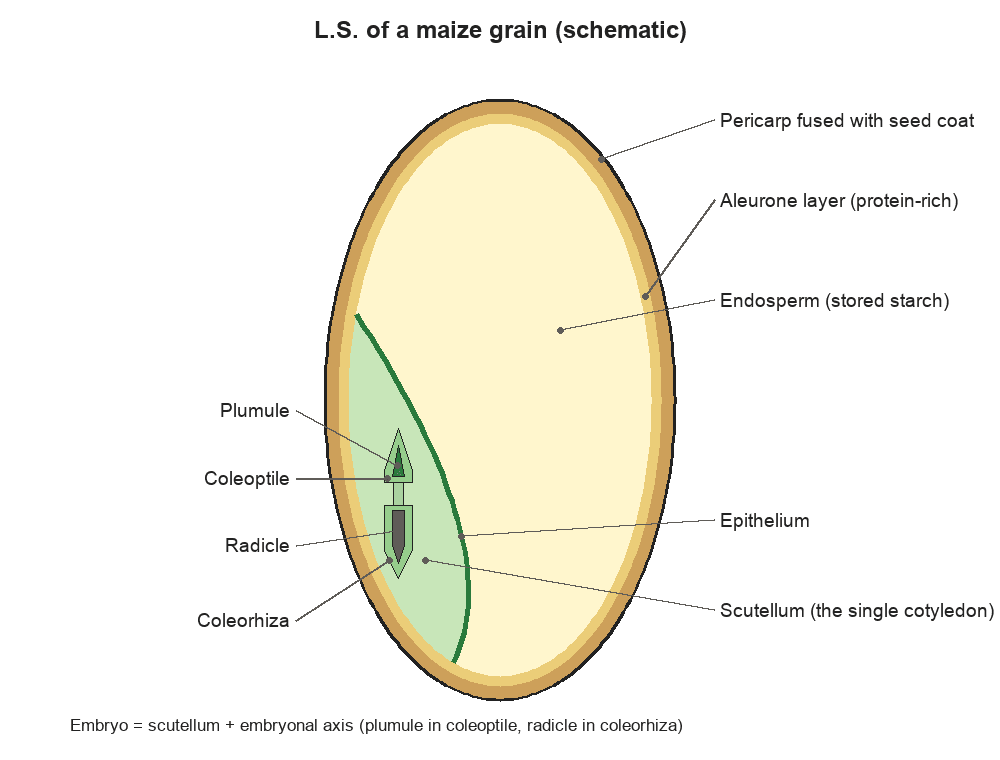
Therefore, albuminous seeds keep the endosperm and have thin cotyledons, unlike non-albuminous seeds; the maize grain has a fused pericarp–seed coat, an endosperm with aleurone layer, and an embryo of scutellum, plumule in coleoptile and radicle in coleorhiza.
- 795 marks
Question 79
How is a floral formula devised? What does a floral formula represent? Draw a floral diagram to explain.
Solve with AIWritten solution
Solution:
Concept: a flower is described by a floral formula (symbols) and a floral diagram (ground plan), so that its features can be read at a glance.
Step 1 — What it represents: a floral formula sums up the sex, symmetry, number of parts in each whorl, their union (cohesion and adhesion) and the position of the ovary in one line.
Step 2 — How it is devised — symbols: Br (bracteate) or Ebr; ⊕ actinomorphic or % zygomorphic; ⚥ bisexual (♂ male, ♀ female); then K calyx, C corolla, P perianth, A androecium, G gynoecium, each followed by its number of members (∞ for many).
Step 3 — How it is devised — union and position: a number in brackets means the members are united, e.g. K(5) gamosepalous; an arc over C and A means epipetalous stamens; a line below G means a superior ovary and a line above G an inferior ovary. For Petunia:
In symbols: Br ⊕ ⚥
This reads: bracteate, actinomorphic, bisexual; 5 united sepals; 5 united petals with 5 epipetalous stamens; 2 united carpels in a superior ovary.
Step 4 — How a floral diagram is drawn: concentric circles are drawn: calyx outermost, then corolla, androecium and gynoecium (a T.S. of the ovary showing locules, placentation and ovules) innermost. The mother axis is a dot at the top (posterior side) and the bract is drawn at the bottom (anterior side). Members are drawn joined where united, overlapping as per aestivation, and stamens are joined to petals if epipetalous.
Step 5 — Floral diagram of Petunia:
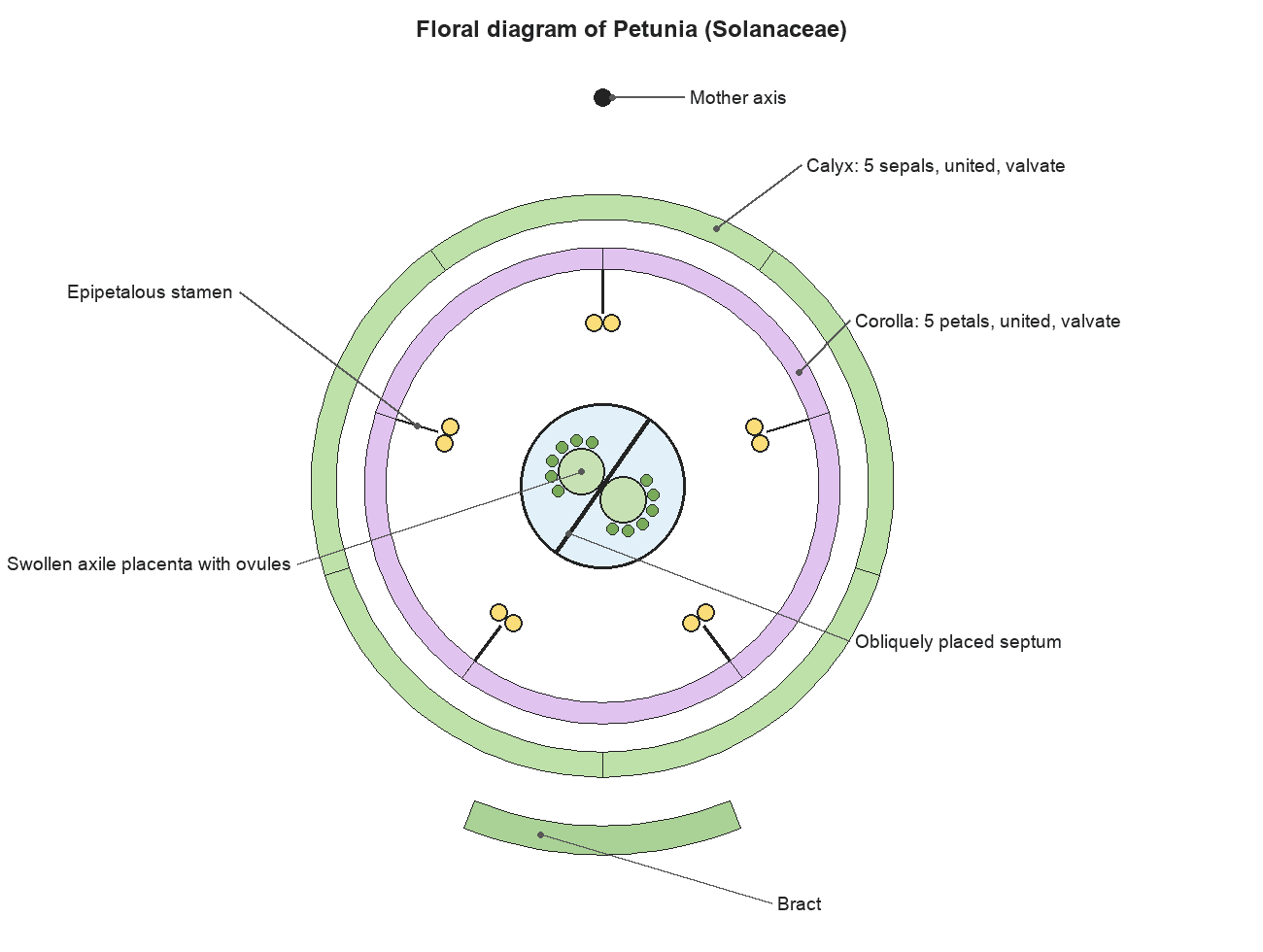
Therefore, a floral formula is built from symbols for bract, symmetry, sex, each whorl, union and ovary position; it represents the flower's structure in one line, and the floral diagram shows the same as a ground plan.
- 805 marks
Question 80
Explain family fabaceae with respect to its flower and its various parts. Give floral formula and a floral diagram of a pea flower.
Solve with AIWritten solution
Solution:
Concept: Fabaceae (as taught here, the subfamily Papilionoideae of the legume family; earlier called Papilionaceae) is the pea family; the pea plant Pisum sativum is the type example.
Step 1 — Flower: bisexual, zygomorphic, pedicellate, with a papilionaceous (butterfly-like) corolla; the ovary is superior.
Step 2 — Calyx: five sepals, united (gamosepalous) into a tube with five lobes, slightly unequal, imbricate.
Step 3 — Corolla: five free petals in vexillary aestivation: a large posterior standard (vexillum) outermost, two lateral wings (alae), and two innermost anterior keel (carina) petals united like a boat that encloses the stamens and pistil.
Step 4 — Androecium: ten stamens, diadelphous (9) + 1 — nine filaments united into a staminal tube and the posterior stamen free; anthers dithecous.
Step 5 — Gynoecium: monocarpellary, superior, one-chambered ovary with many ovules on marginal placentation; style bent, stigma simple. The fruit is a legume (pod) with non-endospermic seeds.
Step 6 — Floral formula: zygomorphic, bisexual; K(5); C 1 + 2 + (2) (standard, wings, united keel); A (9) + 1; G 1, superior:
In symbols: % ⚥
Step 7 — Floral diagram:
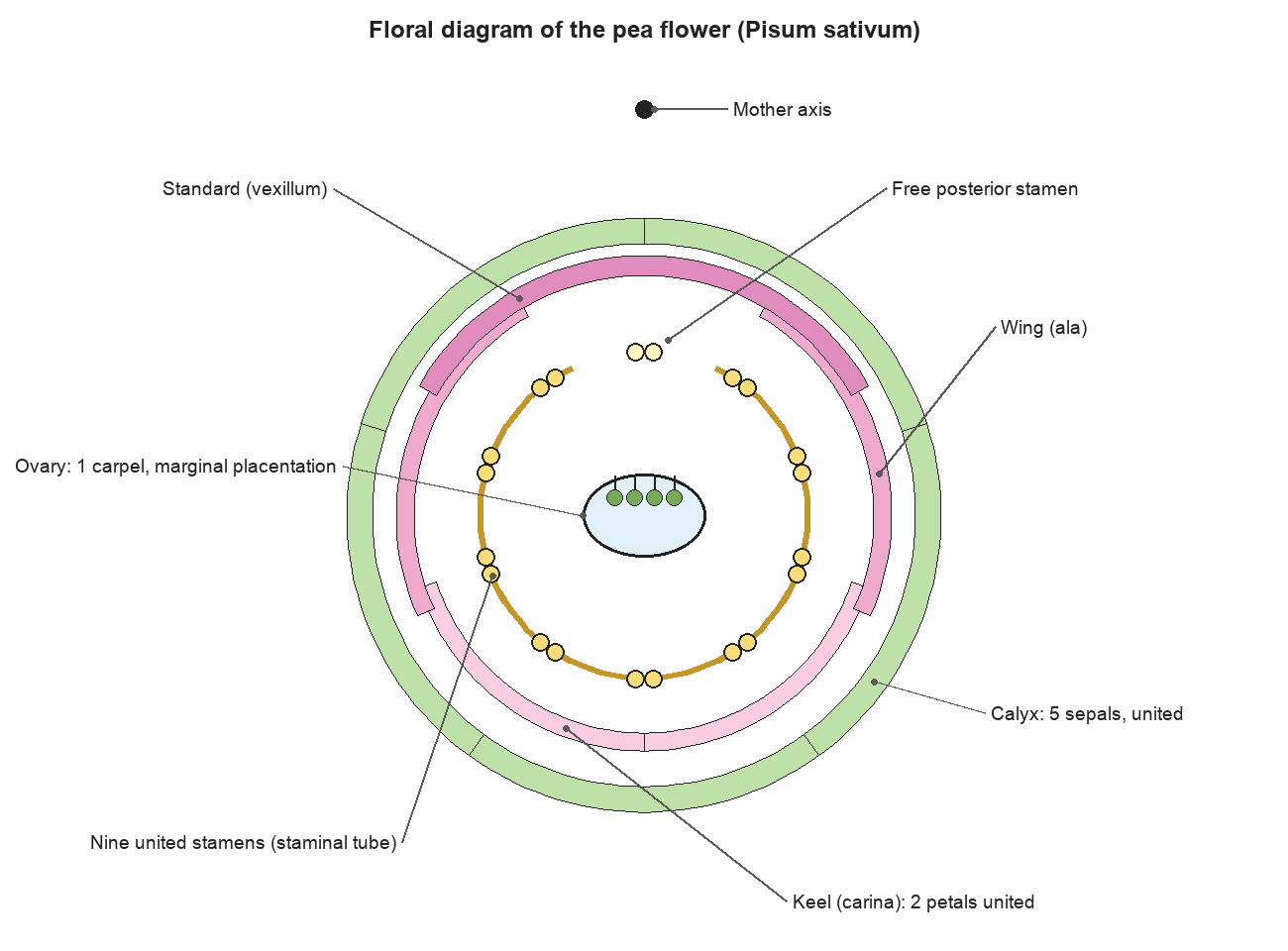
Therefore, Fabaceae has zygomorphic papilionaceous flowers with united calyx, vexillary corolla, diadelphous (9) + 1 stamens and a monocarpellary superior ovary with marginal placentation.
What Class 11 Biology Ch 8 covers
The sections of the chapter, in the order the book takes them. Every question above comes from one of these.
- 01Plant Morphology and the Root System
- 02The Stem
- 03The Leaf
- 04The Inflorescence
- 05The Flower
- 06The Fruit
More ways to study this chapter
The same chapter asked three other ways. Practise it, revise it, and see what the board has set on Ch 8 before.
Class 11 Biology Ch 8 questions students ask
How many questions are there in Class 11 Biology Ch 8?
80 questions. Every one is solved step by step on this page.
Are these Class 11 Biology solutions free?
Yes. Every question and its full working is free to read, with no account needed.
Can I download the Class 11 Biology Ch 8 solutions as a PDF?
There is no PDF to download. Every solution is on this page instead, which means it is searchable, always the current syllabus, and readable on a phone. Use your browser's print option if you want it on paper.