
Question 795 marksMedium
How is a floral formula devised? What does a floral formula represent? Draw a floral diagram to explain.
Confirming your payment
Sign up now and get 250 free tokens.
Morphology of Flowering Plants · Question 79 of 80
How is a floral formula devised? What does a floral formula represent? Draw a floral diagram to explain.
Solution:
Concept: a flower is described by a floral formula (symbols) and a floral diagram (ground plan), so that its features can be read at a glance.
Step 1 — What it represents: a floral formula sums up the sex, symmetry, number of parts in each whorl, their union (cohesion and adhesion) and the position of the ovary in one line.
Step 2 — How it is devised — symbols: Br (bracteate) or Ebr; ⊕ actinomorphic or % zygomorphic; ⚥ bisexual (♂ male, ♀ female); then K calyx, C corolla, P perianth, A androecium, G gynoecium, each followed by its number of members (∞ for many).
Step 3 — How it is devised — union and position: a number in brackets means the members are united, e.g. K(5) gamosepalous; an arc over C and A means epipetalous stamens; a line below G means a superior ovary and a line above G an inferior ovary. For Petunia:
In symbols: Br ⊕ ⚥
This reads: bracteate, actinomorphic, bisexual; 5 united sepals; 5 united petals with 5 epipetalous stamens; 2 united carpels in a superior ovary.
Step 4 — How a floral diagram is drawn: concentric circles are drawn: calyx outermost, then corolla, androecium and gynoecium (a T.S. of the ovary showing locules, placentation and ovules) innermost. The mother axis is a dot at the top (posterior side) and the bract is drawn at the bottom (anterior side). Members are drawn joined where united, overlapping as per aestivation, and stamens are joined to petals if epipetalous.
Step 5 — Floral diagram of Petunia: 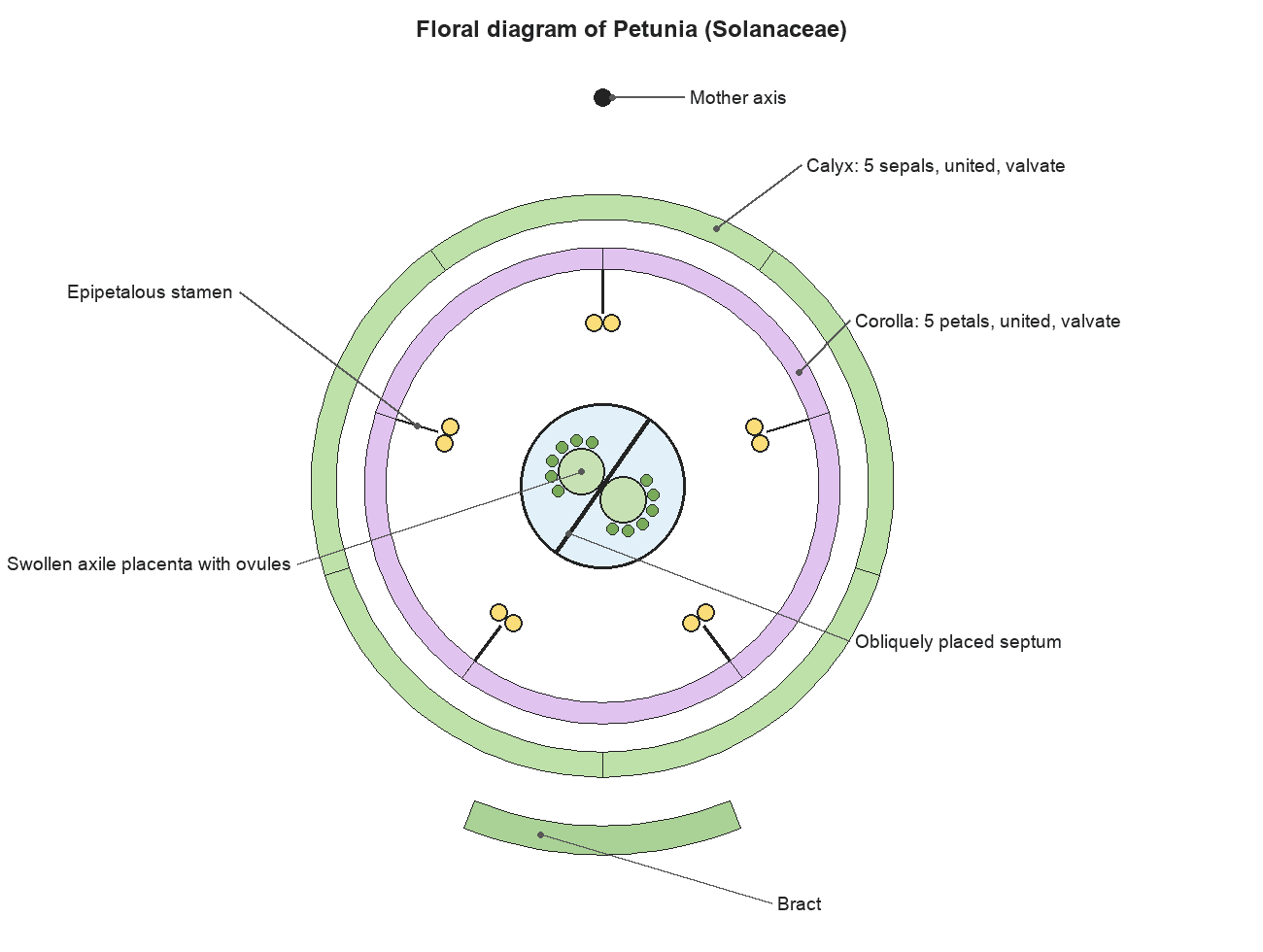
Therefore, a floral formula is built from symbols for bract, symmetry, sex, each whorl, union and ovary position; it represents the flower's structure in one line, and the floral diagram shows the same as a ground plan.