
Question 785 marksMedium
Give three important differences between albuminous and non-albuminous seeds. Explain various parts of a maize seed and draw a schematic diagram.
Confirming your payment
Sign up now and get 250 free tokens.
Morphology of Flowering Plants · Question 78 of 80
Give three important differences between albuminous and non-albuminous seeds. Explain various parts of a maize seed and draw a schematic diagram.
Solution:
Concept: seeds are albuminous (endospermic) or non-albuminous (non-endospermic) depending on whether the endosperm remains in the mature seed. The maize 'seed' is really a one-seeded fruit (caryopsis).
Step 1 — Three differences:
| Feature | Albuminous seed | Non-albuminous seed |
|---|---|---|
| Endosperm | present in the mature seed | absent (used up during development) |
| Food stored in | the endosperm | the cotyledons |
| Cotyledons | small, thin and papery | thick and fleshy |
Examples: castor, maize, rice (albuminous); gram, pea, bean (non-albuminous).
Step 2 — Maize — outer covering: the seed coat is fused with the fruit wall (pericarp) into a thin covering, so the grain is a fruit called a caryopsis.
Step 3 — Maize — endosperm: the bulky endosperm stores starch (with some protein and oil); its outermost layer, the aleurone layer, is rich in protein.
Step 4 — Maize — embryo: the embryo lies obliquely on one side. It has a single shield-shaped cotyledon, the scutellum, pressed against the endosperm through an epithelium layer that digests and absorbs the food for the embryo. The embryonal axis has the plumule covered by a sheath, the coleoptile, and the radicle with root cap covered by the coleorhiza.
Step 5 — Schematic diagram: a longitudinal section of the grain shows these parts:
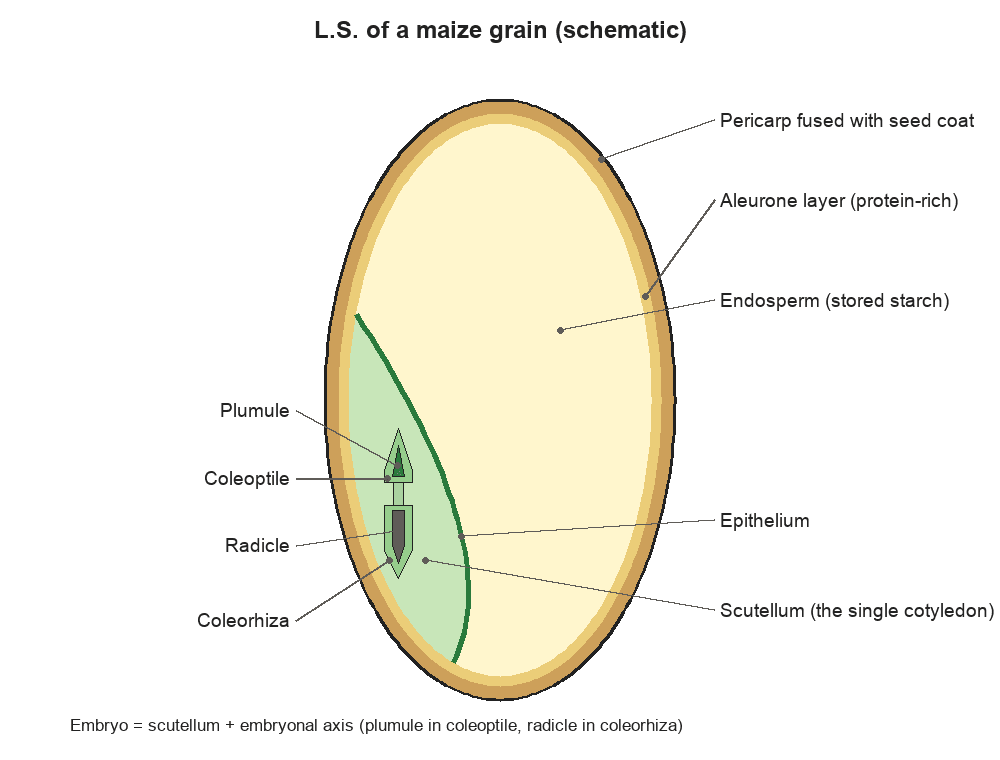
Therefore, albuminous seeds keep the endosperm and have thin cotyledons, unlike non-albuminous seeds; the maize grain has a fused pericarp–seed coat, an endosperm with aleurone layer, and an embryo of scutellum, plumule in coleoptile and radicle in coleorhiza.