
Question 805 marksMedium
Explain family fabaceae with respect to its flower and its various parts. Give floral formula and a floral diagram of a pea flower.
Confirming your payment
Sign up now and get 250 free tokens.
Morphology of Flowering Plants · Question 80 of 80
Explain family fabaceae with respect to its flower and its various parts. Give floral formula and a floral diagram of a pea flower.
Solution:
Concept: Fabaceae (as taught here, the subfamily Papilionoideae of the legume family; earlier called Papilionaceae) is the pea family; the pea plant Pisum sativum is the type example.
Step 1 — Flower: bisexual, zygomorphic, pedicellate, with a papilionaceous (butterfly-like) corolla; the ovary is superior.
Step 2 — Calyx: five sepals, united (gamosepalous) into a tube with five lobes, slightly unequal, imbricate.
Step 3 — Corolla: five free petals in vexillary aestivation: a large posterior standard (vexillum) outermost, two lateral wings (alae), and two innermost anterior keel (carina) petals united like a boat that encloses the stamens and pistil.
Step 4 — Androecium: ten stamens, diadelphous (9) + 1 — nine filaments united into a staminal tube and the posterior stamen free; anthers dithecous.
Step 5 — Gynoecium: monocarpellary, superior, one-chambered ovary with many ovules on marginal placentation; style bent, stigma simple. The fruit is a legume (pod) with non-endospermic seeds.
Step 6 — Floral formula: zygomorphic, bisexual; K(5); C 1 + 2 + (2) (standard, wings, united keel); A (9) + 1; G 1, superior:
In symbols: % ⚥
Step 7 — Floral diagram: 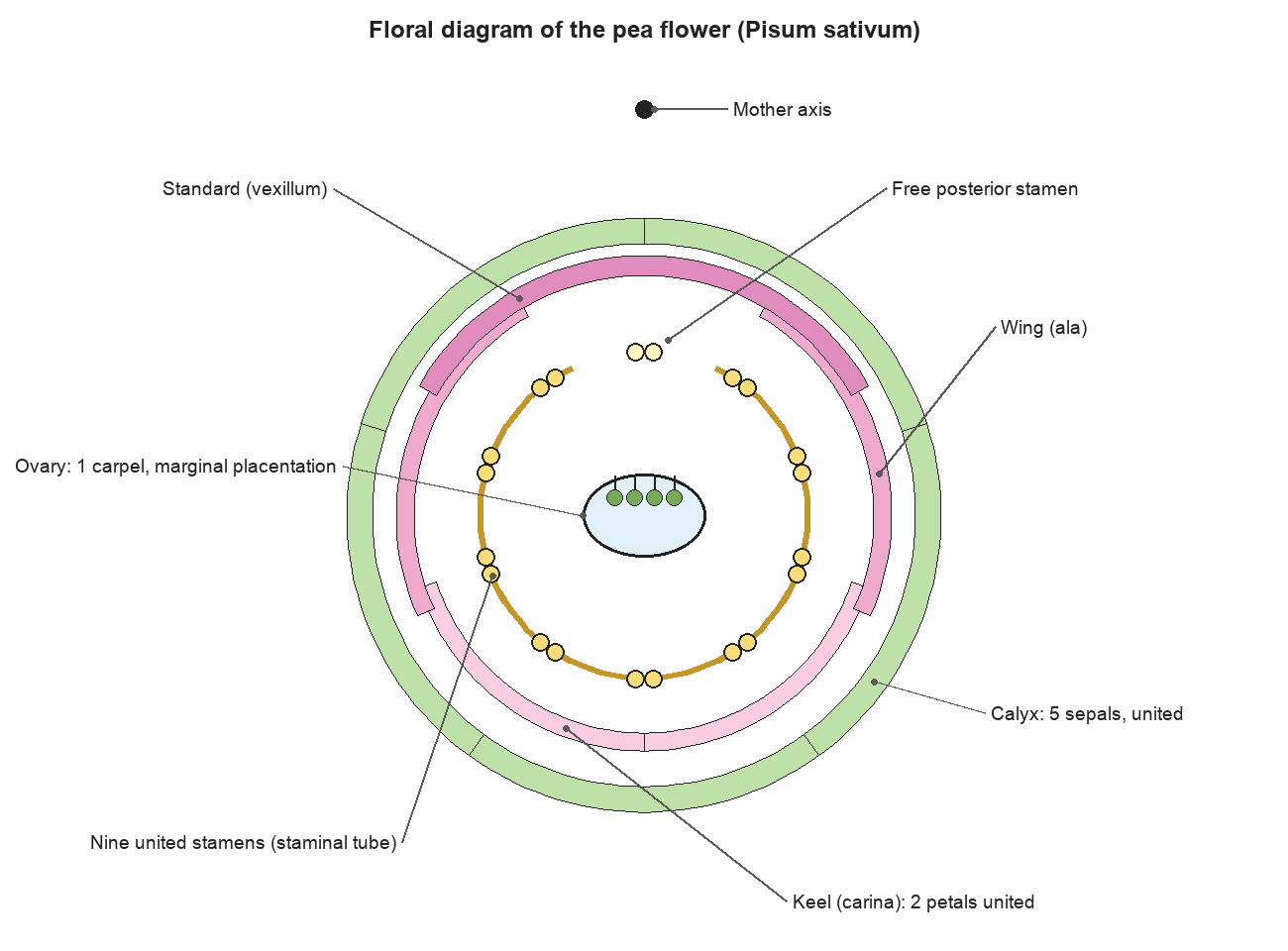
Therefore, Fabaceae has zygomorphic papilionaceous flowers with united calyx, vexillary corolla, diadelphous (9) + 1 stamens and a monocarpellary superior ovary with marginal placentation.