
Opening your dashboard
Class 11 Biology Chapter 8 Morphology of Flowering Plants: Competency-Based Questions (CBQ)
40 questions on Chapter 8, each worked through on its own page with the AI tutor. Class 11 Biology, ICSE 2026-27.
40 questions
1–10 marks · Mixed difficulty
- 14 marks
Question 1
In a school biology laboratory in Lucknow, a student germinates gram seeds on moist blotting paper. When the young root (radicle) of one seedling is about 15 mm long, she uses a fine thread dipped in waterproof ink to make 10 marks, exactly 1 mm apart, starting at the very tip of the root. This gives 9 gaps, numbered 1 to 9 from the tip. After 24 hours she measures each gap again. (Hypothetical data.)
Gap (from tip) 1 2 3 4 5 6 7 8 9 Length at start (mm) 1.0 1.0 1.0 1.0 1.0 1.0 1.0 1.0 1.0 Length after 24 h (mm) 1.4 3.6 4.2 2.1 1.1 1.0 1.0 1.0 1.0 (a) By how many millimetres did the marked part of the root grow in 24 hours? Which gaps lie mainly in the region of elongation? (1 mark)
(b) Gap 1 includes the region where cells divide fastest, yet it lengthened only a little. Explain why. (1 mark)
(c) Gaps 6 to 9 did not lengthen at all. Name the region they belong to, and explain why it is an advantage to the plant that this region does not elongate, while the tip is pushed forward through the soil. (2 marks)
- 21 mark
Question 2
Assertion (A): When a young mango sapling is moved from a nursery bag into the field, the gardener keeps the ball of soil around its roots unbroken.
Reason (R): Most water and minerals are absorbed through delicate root hairs in the region of maturation, and these are easily torn off when the roots are pulled out of the soil.
- 31 mark
Question 3
After a night of strong wind and rain in Bihar, a farmer finds that most of his maize plants are still standing upright. On digging round one plant, he sees thick roots that start from the lowest few nodes of the stem above the soil and grow obliquely down into the ground. What are these roots?
- 44 marks
Question 4
At an agricultural science centre in Shimla, trainees cut potato tubers and sweet potatoes into pieces of about the same size and plant them in moist sand. (Hypothetical data.)
Set Pieces planted What each piece had Pieces that sprouted after 3 weeks P 20 potato pieces one "eye" each 18 Q 20 potato pieces no "eye" 0 R 20 sweet potato pieces no eyes in any regular pattern 14 (shoots appeared at scattered points) (a) What is an "eye" of a potato? Use the results of sets P and Q to explain why only pieces with an eye sprouted. (1 mark)
(b) What do the results of sets P and Q show about the nature of the potato tuber? (1 mark)
(c) A trainee argues: "Sweet potato pieces also sprouted, so sweet potato must be a stem too." Is he right? Give two reasons. (2 marks)
- 51 mark
Question 5
Assertion (A): The new chrysanthemum plants that come up in a ring around an old clump in a garden bed are seedlings that grew from the parent's fallen seeds.
Reason (R): In chrysanthemum, lateral branches arise from the underground base of the main stem, grow for some distance under the soil and then turn obliquely upward to form new leafy shoots called suckers.
- 61 mark
Question 6
At a vegetable stall, a student examines the underground part of an arbi (Colocasia) plant. It is rounded, grows vertically in the soil, has ring-like scars of scale leaves at its nodes, and buds in the axils of these scars. One bud at the top is growing into a shoot. What is this structure?
- 73 marks
Question 7
During a nature walk in a botanical garden in Pune, three groups each count the nodes and leaves on one twig of a different plant. They also note how the leaves at neighbouring nodes are placed. (Hypothetical data.)
Plant Nodes counted Leaves counted Note made by the group X 10 10 leaves at successive nodes point in different directions Y 12 24 the leaf pair at each node is at right angles to the pair at the next node Z 8 32 leaves form a circle round each node (a) Work out the number of leaves per node for each plant, and name the type of phyllotaxy each shows. (1 mark)
(b) On plant Y, the group finds that the pair of leaves at node 1 lies exactly above the pair at node 3. How many of the 12 nodes of the twig carry leaf pairs lying in the same plane as node 1 (count node 1 too)? Show your reasoning. (1 mark)
(c) Using your answer to (b), explain how the leaf arrangement of plant Y helps its leaves. (1 mark)
- 84 marks
Question 8
In a kitchen garden in Uttarakhand, a teacher grows 40 garden pea plants (Pisum sativum) in one bed, each next to a nylon net. When the plants are about two weeks old, she carefully snips off every tendril from 20 of them and leaves the other 20 untouched. After three more weeks she records how many plants are holding on to the net. (Hypothetical data.)
Group Plants Plants holding on to the net Tendrils left intact 20 19 Tendrils snipped off 20 4 (a) In the pea plant, which part of the leaf is modified into tendrils? Which part of the same leaf is large and leafy? (1 mark)
(b) Work out the percentage of plants holding on to the net in each group, and explain the difference. (1 mark)
(c) A student concludes from this experiment that "tendrils are always modified leaves". Explain why this conclusion is wrong, giving an example of a tendril that is not a leaf, and the part it is modified from. (2 marks)
- 91 mark
Question 9
Assertion (A): In a maize plant, the base of each leaf is broad and forms a sheath that wraps partly around the stem.
Reason (R): In monocots, the leaf base usually bears a pair of lateral leaf-like stipules that wrap around the stem.
- 103 marks
Question 10
A florist in Bengaluru photographs three flowering stems every morning for a week to decide which plants to grow for cut flowers. Her notes are given below. (Hypothetical observations.)
Plant What she saw P The lowest flowers opened on day 1; each day, flowers higher up opened; on day 7 the tip of the axis was still producing new buds. Q The tip of the main axis ended in a flower that opened on day 1; two side branches below it each ended in a flower that opened on day 3. S All the flower stalks arose from one point at the top of the axis; the outer flowers opened first and the central ones last. (a) Classify P, Q and S as racemose or cymose, giving the evidence for each. (1 mark)
(b) Name the kind of racemose inflorescence shown by S, and say whether its flowers open in acropetal or centripetal order. (1 mark)
(c) The florist wants a stem that keeps giving fresh flowers for the longest time. Which plant should she choose? Explain using the growth of the main axis. (1 mark)
- 111 mark
Question 11
Assertion (A): In a cymose inflorescence, the main axis stops growing once it has formed its first flower.
Reason (R): In a cymose inflorescence, the flowers open in basipetal order, the oldest flower being at the top.
- 123 marks
Question 12
In a practical class in Bhopal, students try to cut fresh flowers into two similar (mirror-image) halves. For each flower they try four different vertical planes passing through the centre of the flower. (Hypothetical observations.)
Flower Planes tried Planes giving two similar halves Datura 4 4 Gulmohur 4 1 Canna 4 0 (a) Name the type of symmetry of each flower, and write the symbol used in a floral formula for the first two. (1 mark)
(b) Why did only one plane work for gulmohur? (1 mark)
(c) A student who tried only one plane, chosen at random, on a gulmohur flower got two unequal halves and wrote "asymmetric". Explain the mistake in her method. (1 mark)
- 131 mark
Question 13
Assertion (A): A flower of the garden pea is actinomorphic.
Reason (R): The corolla of the pea flower has one large posterior petal (standard), two lateral petals (wings) and two anterior petals forming a keel.
- 141 mark
Question 14
A student cuts a guava flower lengthwise. She finds that the ovary is completely sunk in and fused with the cup-like thalamus, and that the sepals, petals and stamens arise from the rim of the thalamus above the ovary. How should the flower and its ovary be described?
- 153 marks
Question 15
In a home-science class in Kolkata, students sort a basket of kitchen produce into "botanical fruits" and "not fruits". The basket holds: brinjal, green pea pods, shelled green peas, potato and carrot.
(a) State the botanical meaning of a fruit, and use it to pick out the botanical fruit(s) in the basket. (1 mark)
(b) Name the kind of fruit that brinjal is, and say which parts of the fruit form what we eat. (1 mark)
(c) A pea pod is a fruit, but a shelled pea is not. Explain why. (1 mark)
- 161 mark
Question 16
Assertion (A): A mango fruit develops from a monocarpellary, superior ovary.
Reason (R): The part of a ripe mango that we eat is its endocarp.
- 171 mark
Question 17
A farmer leaves a few lady's finger (okra) fruits on the plant to collect seed. When they dry, each fruit splits lengthwise from the tip into several valves, showing many seeds in a few rows. The fruit developed from a multicarpellary, syncarpous ovary. What type of fruit is this?
- 184 marks
Question 18
In a school laboratory in Jaipur, a student cuts a soaked maize grain lengthwise and splits a soaked gram seed into its two halves. She puts a drop of dilute iodine solution on each cut surface. Iodine turns blue-black where there is starch. (Hypothetical observations.)
Seed Region Colour with iodine Maize grain large region filling most of the grain blue-black Maize grain small region at one side (embryo, with the shield-shaped scutellum) pale yellow-brown Gram seed both cotyledons blue-black Gram seed small embryonal axis between the cotyledons pale yellow-brown (a) Name the tissue that stores starch in each seed, and use it to classify each seed as albuminous or non-albuminous. (1 mark)
(b) The maize embryo stays pale, yet it needs the starch when the grain germinates. How does the embryo obtain this food? (1 mark)
(c) After a gram seedling has grown for ten days, its two cotyledons are shrivelled and much smaller. Explain this observation. (2 marks)
- 191 mark
Question 19
Assertion (A): Botanically, a maize grain is a fruit and not just a seed.
Reason (R): In maize, the thin seed coat is fused with the fruit wall (pericarp), so the grain is a one-seeded fruit.
- 201 mark
Question 20
A student germinates maize grains on wet cotton in a dark box. On day 3, she sees a pointed, colourless, hollow sheath pushing upward from the grain, with the first green leaf only appearing later from inside it. What is this sheath?
- 214 marks
Question 21
At a district science fair in Nashik, a student displays a herbarium sheet of a flowering plant. Its semi-technical description of the flower reads:
"Flower bracteate, bisexual, actinomorphic, hypogynous. Calyx: 5 sepals, united. Corolla: 5 petals, united. Androecium: 5 stamens, attached to the petals (epipetalous). Gynoecium: bicarpellary, syncarpous; ovary superior."
Below it, the student has written the floral formula as:
Br % ⚥
(a) Identify three errors in the student's floral formula when it is compared with the description. (1 mark)
(b) Write the correct floral formula, explaining what each symbol shows. (2 marks)
(c) A judge points out that the flower also has many ovules on a swollen placenta attached to the central axis. In which part of the semi-technical description should this be added? (1 mark)
- 221 mark
Question 22
A Class 11 student is preparing a semi-technical description of a mustard plant for a herbarium sheet. In which order should she describe its features?
- 234 marks
Question 23
During a field visit to an agricultural university garden in Hisar, students record flower features of three plants, P, Q and R, whose labels are hidden.
Feature Plant P Plant Q Plant R Symmetry zygomorphic actinomorphic actinomorphic Perianth / petals 5 petals: 1 standard, 2 wings, 2 forming a keel 5 petals, united 6 tepals in two whorls of 3 Stamens 10: 9 united + 1 free 5, attached to the petals 6, in two whorls of 3 Gynoecium 1 carpel, ovary superior 2 carpels, united, placed obliquely; swollen placenta 3 carpels, united, ovary superior Leaf venation reticulate reticulate parallel (a) Assign P and Q to their families, giving one deciding feature for each. (1 mark)
(b) Plant R is a lily (Lilium). Give two features from the table which show that R is not a dicot. (1 mark)
(c) Write the floral formula of P, and state the type of fruit you would expect it to form. (2 marks)
- 241 mark
Question 24
Assertion (A): In brinjal and potato flowers, the five stamens are attached to the corolla tube (epipetalous).
Reason (R): In family Solanaceae, the ovary is bicarpellary and syncarpous, with the carpels placed obliquely.
- 251 mark
Question 25
A pharmacy student visits a medicinal plant garden and is told that ashwagandha (Withania somnifera) belongs to the same family as potato and brinjal. Which set of floral features should she expect in its flowers?
- 267 marks
Question 26
Match the following (Part A):
Column A Column B 1. Raceme with sessile flowers (a) Catkin 2. Spike with fleshy axis (b) Umbel 3. Equal flower stalks from the same point (c) Spike 4. Flattened convex receptacle bearing stalkless flowers (d) Cyathium 5. Spike with pendulous axis (e) Spadix 6. Cup-shaped involucre with single female flower (f) Corymb 7. Flower stalks of varying length on a shortened raceme axis (g) Capitulum - 2710 marks
Question 27
Match the following (Part B):
Column A Column B 1. Conical tap root (a) Opuntia 2. Epiphytic roots (b) Utricularia 3. Rhizome (c) Castor 4. Runner (d) Mustard 5. Phylloclade (e) Ginger 6. Reticulate pinnate leaf (f) Carrot 7. Bladderwort (g) Potato 8. Dicot endospermic seed (h) Orchids 9. Racemose inflorescence (i) Peepul 10. Tuber (j) Mint - 285 marks
Question 28
On germination of seed, when the plant embryo emerges from the seed, the first root arises from the radicle of the embryo plant. The tip of the root is protected by the root cap. The root cap is continuously replaced because it gets damaged easily as the root pushes through soil. The root tip can be divided into three zones—a zone of cell division, a zone of elongation and a zone of maturation and differentiation. The zone of cell division is closest to the root tip; it is made up of the actively dividing cells. The cells are very small, thin-walled with dense cytoplasm. The zone of elongation is where the newly formed cells increase in length, thereby lengthening the root. Zone of cell maturation is where the root cells begin to differentiate and the root hairs emerge.
(1) The following structure/zone is continuously replaced as it gets damaged easily.
(a) zone of elongation
(b) zone of maturation
(c) zone of cell division
(d) root cap
(2) Which part of root is made of actively dividing cells?
(a) root tip
(b) root cap
(c) zone of cell division
(d) zone of elongation
(3) The importance of zone of cell maturation is
(a) protects the root cap
(b) region from which root hair emerge
(c) root undergoes rapid elongation
(d) lengthens the root
(4) From where does the first root of a plant arise?
(a) radicle
(b) seed
(c) root cap
(d) root hair
(5) The cells in the zone of cell division are
(a) large cells with vacuoles
(b) elongated with less cytoplasm
(c) small with dense cytoplasm
(d) small, vacuolated cells
- 295 marks
Question 29
The flat part of the leaves is called leaf blade. A leaf is usually attached to the stem by a small stalk called petiole. Veins carry water and food to and from the leaves. Dicot plants usually have broad leaves with veins forming a net-like pattern throughout the leaf. Monocots usually have narrow leaves with veins present parallel to each other. The deciduous trees shed all their leaves during cold or dry season and grow new leaves during summer season again. During autumn or dry season, the leaves lose their chlorophyll. As their green colour fades, red, yellow or orange pigments become visible. Meanwhile, a weak layer called abscission layer develops at the base of the petiole of each leaf. This weak layer causes the leaf to loosen and then fall off.
(1) Which statement is true for deciduous trees?
(a) have narrow leaves
(b) shed their leaves during cold season
(c) have broad leaves
(d) shed their leaves during summer season
(2) The veins of a leaf have a net-like pattern
(a) during summer season
(b) during winter season
(c) in dicots
(d) in monocots
(3) The abscission layer in a leaf is present
(a) at the tip
(b) at the base of the petiole
(c) in the veins
(d) on the leaf blade
(4) Function of veins is to
(a) carry water
(b) carry food
(c) photosynthesise
(d) carry both water and food
(5) Monocots usually have leaves with a
(a) parallel vein pattern
(b) flat petiole
(c) abscission layer
(d) flat leaf blade
- 305 marks
Question 30
Carnivorous plants are well-adapted for capturing and digesting insects by means of traps. The trapping mechanism is always a modified leaf. Pitfall traps, such as those found in pitcher plants, are among the most common and employ a hollow, lidded leaf filled with liquid to passively collect and digest prey. Bladderworts rely on sticky mucilage, while sundew has gland-tipped hair on leaves to capture prey. Venus flytrap (Dionaea) uses rapid leaf movements to actively capture insects. Carnivorous plants digest their prey by releasing enzymes. The digested nitrogenous compounds and salts are absorbed by the plants to enable their survival under nitrogen-deficient soil conditions. Most carnivorous species are green plants that manufacture food by photosynthesis.
(1) Which part of the plant is used as a trapping mechanism by carnivorous plants?
(a) stem
(b) leaf
(c) branch
(d) flower
(2) Which of the following plants uses rapid leaf movements to actively capture the prey?
(a) Venus fly trap
(b) sundew
(c) bladderwort
(d) pitcher plant
(3) Which of the following statements is true for most carnivorous plants?
(a) Non-green plants
(b) Present in highly acidic soil
(c) Can carry photosynthesis
(d) All of these
(4) The following component of the digested food is absorbed by carnivorous plants
(a) glucose
(b) starch
(c) sugars
(d) nitrogen
(5) Which mechanism does sundew plant use to capture prey?
(a) lidded leaf
(b) gland-tipped hair
(c) sticky mucilage
(d) enzymes in trap
- 315 marks
Question 31
Define the following terms
(i) aestivation,
(ii) placentation,
(iii) actinomorphic,
(iv) zygomorphic,
(v) superior ovary,
(vi) perigynous flower,
(vii) epipetalous stamen
- 321 mark
Question 32
During a practical class in Dehradun, a student cuts a mature flower bud of an actinomorphic flower across, just above the calyx, and looks at the corolla under a hand lens. The five petals are of the same size and shape. She draws what she sees and numbers the petals 1 to 5, as in the figure. At every place where two neighbouring petals meet, one petal's margin lies outside the other's.
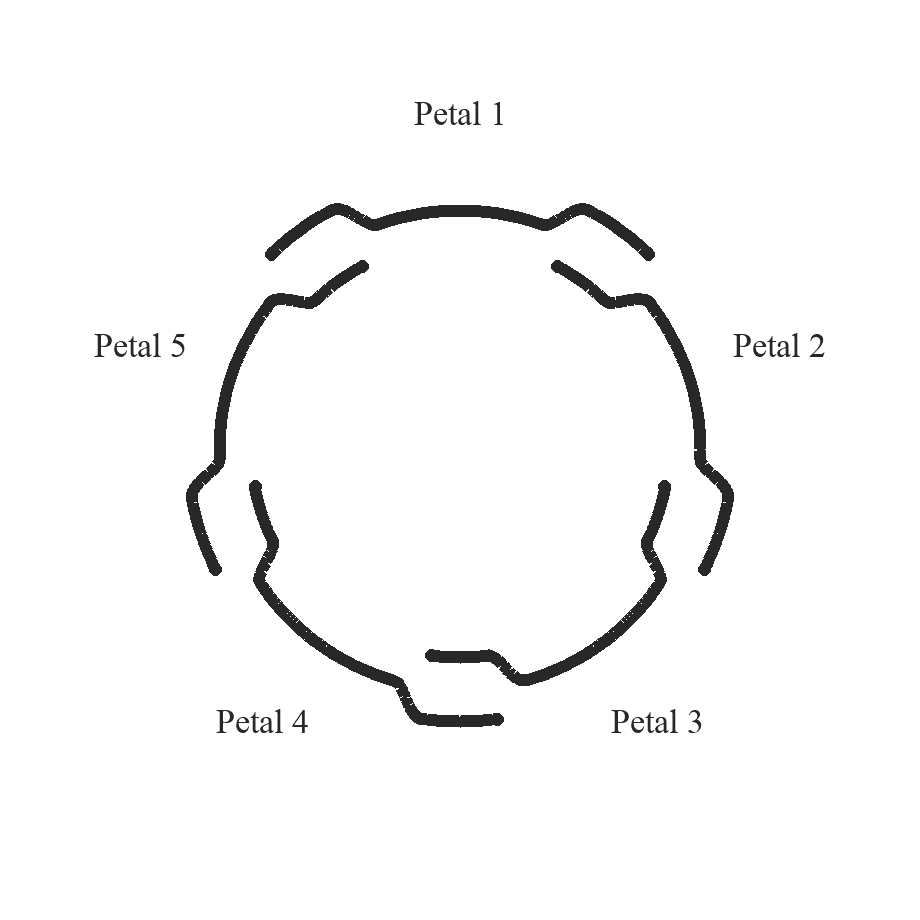
From the figure, which type of aestivation does the corolla show?
- 331 mark
Question 33
On a breezy morning in a wheat field in Punjab, a student looks at flowering ears with a hand lens. From each tiny flower, three anthers hang out on long, thin filaments, and every anther keeps swinging in the wind, shedding some light, dry pollen into the air. When she pulls one stamen out and looks closely, she sees that the tip of the filament is joined to the back of the anther at a single point near its middle. Which type of anther attachment does this show?
- 341 mark
Question 34
Assertion (A): While writing a semi-technical description of a mango flower, a student notes that the style does not rise from the top of the ovary but arises from one side of it, and records it as "style lateral".
Reason (R): In the mango flower, the tip of the ovary is bent over to one side, so the style arises from the side of the ovary.
- 351 mark
Question 35
Assertion (A): Each roasted sunflower "seed" sold as a snack contains only one true seed inside its hard, striped wall.
Reason (R): The ovary of a sunflower disc floret is bicarpellary and syncarpous, with axile placentation and many ovules.
- 362 marks
Question 36
A village pond in Odisha gets one rosette of water hyacinth (Eichhornia) from a flood. Villagers see that new rosettes keep appearing round it, each joined to its parent by a short, thick, horizontal green branch that grows from the axil of a leaf, has a node at its tip, and bears a tuft of roots below the new rosette. In this pond, the number of rosettes doubles every 10 days. (Hypothetical data.)
(a) Name the kind of sub-aerial stem that joins the rosettes, and give one feature from the observation which shows that it is a stem and not a root. (1 mark)
(b) Starting with one rosette, how many rosettes will there be after 50 days? A villager suggests breaking the plants apart with a stick to stop the spread. Explain why this will not work. (1 mark)
- 372 marks
Question 37
During a nature walk in the Western Ghats, Aditi says: "I can tell whether any flowering plant is a monocot or a dicot just by its leaf: net venation always means a dicot." Her teacher shows her the broad leaf of a Smilax climber, which has a clear network of veins, and tells her that Smilax is a monocot.
(a) Evaluate Aditi's rule using this example. (1 mark)
(b) Suggest two other features she could check, other than the leaf, that are more reliable for deciding whether a plant is a monocot or a dicot. (1 mark)
- 383 marks
Question 38
A botany club in Mysuru studies three plants, X, Y and Z, whose inflorescences are cymose. On one idealised shoot of each plant, they count the flowers formed at each order of branching. The first order is the single flower that ends the main axis; each later order is formed by the branches that arise below the flowers of the order before it. (Hypothetical data.)
Order of branching 1st 2nd 3rd 4th Plant X: flowers formed 1 1 1 1 Plant Y: flowers formed 1 2 4 8 Plant Z: flowers formed 1 3 9 27 (a) Work out how many branches arise below each flower in each plant, and name the type of cyme (uniparous, biparous or multiparous) shown by X, Y and Z. (1 mark)
(b) If plant Y branches in the same way up to the 5th order, how many flowers will its shoot bear in all? (1 mark)
(c) In plant Y, where will the oldest flower be found, and in what order do the flowers open? (1 mark)
- 393 marks
Question 39
A mangrove nursery in the Sundarbans raises seedlings of Avicennia in trays of waterlogged mud. Each seedling has sent up several small pencil-like roots that stick up above the mud and carry tiny pores. A student wants to find out by experiment whether these upward-growing roots help the plant to get oxygen for its roots buried in the airless mud.
(a) Name these roots, and write the hypothesis she will test. (1 mark)
(b) Describe how she should set up the experiment, including a control and two factors she must keep the same. (1 mark)
(c) State the result she should expect if the hypothesis is correct, and how she should interpret it. (1 mark)
- 405 marks
Question 40
For a project on vegetables in a Nagpur market, students measure a carrot, a radish and a turnip, each of which is the swollen tap root of its plant. They measure the diameter of each root at five points along its length, from just below the leaves (10% of the length) to near the thin tip (90% of the length). (Hypothetical data.)
Diameter (cm) at 10% 30% 50% 70% 90% Carrot (length 18 cm) 4.0 3.3 2.5 1.6 0.6 Radish (length 24 cm) 1.4 3.2 3.8 3.0 1.2 Turnip (length 12 cm) 8.0 9.0 4.0 0.8 0.3 The students also dig up a Dahlia plant from the college garden. Its stem base carries several swollen, food-filled roots in a bunch, all arising together from the same point; there is no single main root.
A farmer tells them that carrot, radish and turnip are biennials: in the first season each plant forms leaves and a swollen root; if left in the ground, in the next season it sends up a tall flowering shoot and forms seeds. He always harvests these roots before the plants flower.
(a) Use the data to name the shape of each of the three roots, giving the evidence for each. (2 marks)
(b) Is the swollen root of Dahlia a modified tap root like the other three? Give a reason and name the type. (1 mark)
(c) Explain why the farmer harvests the roots before flowering, and predict what would happen to the root if the plant were allowed to flower. (2 marks)