
Opening your dashboard
Class 11 Biology Chapter 8 Morphology of Flowering Plants: Practice Questions
116 questions on Chapter 8, each worked through on its own page with the AI tutor. Class 11 Biology, ICSE 2026-27.
116 questions
1–4 marks · Mixed difficulty
- 11 mark
Question 1
A student looks at a thin slice of a root tip under a microscope. In one zone the cells are very small and thin-walled, have dense cytoplasm and are dividing repeatedly. Which zone is this, and what lies immediately below it, towards the tip?
- 22 marks
Question 2
A student writes in a test: "Roots are never green, because they always live below the soil."
Give two examples of roots from this chapter that show the statement is wrong, and explain how the green colour is useful to such roots.
- 33 marks
Question 3
Both carrot and sweet potato (Ipomoea batatas) store food in swollen roots, yet they belong to different root systems.
(i) Name the root system to which the storage root of each belongs.
(ii) Explain, from the origin of each root, why they are placed in different systems.
(iii) Name the shape-based type of each storage root.
- 41 mark
Question 4
In a pond, Ceratophyllum and Utricularia grow completely under the water. Their root system is very poorly developed or absent. What is the best explanation?
- 52 marks
Question 5
The roots of Pinus trees growing in a forest are found to be covered by a web of fungal hyphae. This is called a mycorrhizal association.
(i) What does the fungus give to the Pinus root?
(ii) What does the Pinus root give to the fungus? Hence name the kind of relationship.
- 61 mark
Question 6
A swollen structure is dug out of the soil. A student notes:
1. It stores a lot of starch.
2. It has no chlorophyll.
3. It bears small dry scale leaves, each with a bud in its axil.
4. It lies under the soil.
Which observation alone proves that the structure is a stem and not a root?
- 73 marks
Question 7
The sharp, straight, woody thorns of Duranta look nothing like a stem. Give three points of evidence which show that they are modified stems (modified buds), and state their main function.
- 81 mark
Question 8
Stem tendrils help weak plants climb. In grapevine (Vitis) the tendril takes the place of the stem tip; in passion flower (Passiflora) it arises in the axil of a leaf; in Antigonon it develops from a bud that would have formed flowers. Which part is modified in each?
- 92 marks
Question 9
In a hill garden, the leaves and flowers of Crocus die down completely in winter, yet the same plants appear again in spring. Explain how its corm makes this possible, giving two roles of the corm.
- 103 marks
Question 10
A farmer wants to raise many new strawberry plants without sowing seeds, by using the plant's runners.
(i) Describe a runner.
(ii) Explain, in order, how a runner gives rise to an independent new plant.
(iii) Is a runner an organ of perennation as well? Give a reason.
- 111 mark
Question 11
In the glory lily (Gloriosa), each simple leaf ends in a thin, coiled thread that winds round a support. Which part of the leaf has been modified into this tendril?
- 123 marks
Question 12
On a neem twig, a student finds a long green axis carrying many small leaf-like blades in two rows. She is unsure whether this axis is a pinnately compound leaf or a small branch bearing simple leaves.
Give three observations she can make on the twig to decide, and say what each would show if it is a compound leaf.
- 131 mark
Question 13
On a tulsi (Ocimum) stem, two leaves arise at each node, facing each other. The pair at each node lies at right angles to the pair at the node just above or below it. What is this phyllotaxy called?
- 142 marks
Question 14
A prickly pear (Opuntia) growing in a dry, open area has no flat green leaves; instead it bears sharp spines.
(i) Give two ways in which these spines help the plant.
(ii) If the plant has no green leaves, which part carries out photosynthesis?
- 153 marks
Question 15
The petiole of a leaf is usually just a stalk, but it is modified in some plants. Explain how the modified petiole helps each of these plants:
(i) water hyacinth (Eichhornia) floating on a pond
(ii) Australian Acacia (Acacia auriculiformis), whose mature plants show flat, green, blade-like structures instead of compound leaves
(iii) Clematis, a climber
- 161 mark
Question 16
In a jasmine shoot, the main axis ends in a flower which opens first. Below it, one branch arises on each side; each branch also ends in a flower, and the same pattern repeats on these branches. What type of inflorescence is this?
- 174 marks
Question 17
A child says a sunflower is "one big flower".
(i) Explain why this is not correct, naming the type of inflorescence.
(ii) Name the two kinds of florets present and where each lies.
(iii) Where is the oldest floret found, and what is this order of opening called?
(iv) Describe a labelled diagram of the longitudinal section (L.S.) of this inflorescence.
- 181 mark
Question 18
In a candytuft corymb, the main axis is short, yet all the flowers come to lie at almost the same level. Which statement explains this and correctly gives the position of the oldest flower?
- 192 marks
Question 19
The structure at the centre of each red cluster of a Poinsettia (a Euphorbia) looks like a single flower, but it is a special inflorescence called a cyathium.
(i) Describe the structure of a cyathium.
(ii) Explain why it is easily mistaken for one bisexual flower.
- 201 mark
Question 20
A vertical section of a plum flower shows a cup-shaped thalamus. The ovary sits at the bottom of the cup but is not fused with its wall, and the sepals, petals and stamens arise from the rim of the cup. How is this flower described?
- 212 marks
Question 21
Two flowers are examined.
- Flower X has 4 stamens: 2 with long filaments and 2 with short filaments.
- Flower Y has 6 stamens: 4 long and the rest short.
(i) Name the condition of the stamens in X and in Y, and give one example of each.
(ii) How many short stamens does Y have?
- 222 marks
Question 22
In a papaya orchard of a dioecious variety, some trees flower every year but never bear fruit, while others fruit well.
(i) What is meant by a dioecious plant?
(ii) Explain why some of the trees never bear fruit.
- 233 marks
Question 23
In a garden, insects ate away all the sepals and petals of some flowers, but those flowers still formed seeds. In other flowers, a student carefully removed all the stamens and carpels, keeping the sepals and petals; these flowers formed no seeds.
(i) Explain these results using the terms essential and non-essential whorls.
(ii) Give one function of each non-essential whorl.
- 241 mark
Question 24
A flower has sepals, stamens and carpels, but no petals at all. How is it correctly described?
- 254 marks
Question 25
A China rose (Hibiscus) flower is examined and the following are noted:
- the sepals are fused together;
- the petals are free from one another;
- the filaments of all the stamens are fused into a single tube, but the anthers are free;
- the five carpels are fused;
- the ovary is on the highest part of the thalamus, with the other parts below it.
Give the correct technical term for each of the five observations.
- 261 mark
Question 26
The fruit of a creeper develops from an inferior ovary made of several fused carpels with parietal placentation. It has many seeds in a juicy pulp, and the pulp we eat comes from the ovary wall, not from the thalamus. Which kind of fleshy fruit is it?
- 271 mark
Question 27
Which fruit is correctly matched with the part of it that we eat?
- 282 marks
Question 28
A student opens a ripe pea pod and a ripe mustard fruit. Both are dry fruits that split open on their own. Give two differences between them: one based on the number of carpels, and one based on the placentation of the ovary each came from.
- 293 marks
Question 29
A student collects three dry fruits: a wheat grain, a sunflower ‘seed’ and the spiny fruit of Datura. For each, say whether it is dehiscent or indehiscent, name the kind of fruit, and give one feature that identifies it.
- 303 marks
Question 30
In a pumpkin field, the female flowers that are not pollinated wither and drop off, while the pollinated ones swell into fruits. Explain, step by step, the part played by pollination and by the developing seeds in turning an ovary into a fruit.
- 311 mark
Question 31
A raspberry develops from one flower whose many free carpels each ripen into a small one-seeded drupelet, all sitting together on one receptacle. What kind of fruit is a raspberry?
- 324 marks
Question 32
A coconut is a drupe. Name the layer or part of the coconut that gives:
(a) the coir fibre used for ropes and mats;
(b) the hard brown shell;
(c) the white kernel and the coconut water.
(d) We do not eat the pericarp of a coconut, yet it is still called a drupe. Explain why.
- 331 mark
Question 33
A student soaks four kinds of seeds overnight and cuts each one open. Which observation belongs to a castor seed?
- 342 marks
Question 34
When a gram seed that has been soaked in water overnight is gently squeezed, a tiny drop of water comes out at one point just below a scar on its seed coat.
(a) Name the pore through which the water comes out, and say why it comes out only there.
(b) Name the scar just above it and say what it represents.
- 351 mark
Question 35
In the embryonal axis of a seed, the portion that lies between the point of attachment of the cotyledons and the plumule is called the
- 363 marks
Question 36
The figure shows a longitudinal section of a maize grain with some parts lettered.
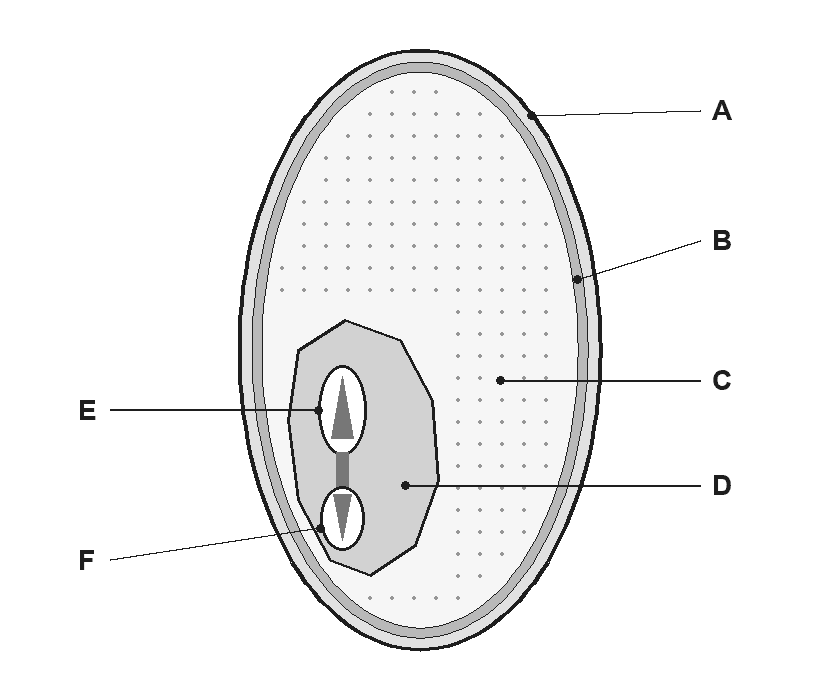
(a) Name layers A and B, and say which of the two is a part of the endosperm.
(b) Name part D and state how it helps the growing embryo.
(c) Name sheaths E and F, and say what each one protects.
- 372 marks
Question 37
In most seeds the nucellus is completely used up as the seed develops, but in a ginger seed a thin layer of it is still present round the endosperm. Name this layer, and state how its origin is different from that of the endosperm.
- 383 marks
Question 38
Give reasons:
(a) Every gram seed forms an endosperm while it develops, yet a mature gram seed has none.
(b) Seeds help a plant species to survive a long dry season.
(c) Plants raised from seeds are not exactly alike, unlike plants raised from cuttings.
- 391 mark
Question 39
In a floral formula, which sign shows that the stamens are epipetalous (attached to the petals)?
- 401 mark
Question 40
The floral formula of a (hypothetical) flower is
Br ⊕ ⚥
Which statement about this flower is correct?
- 413 marks
Question 41
Write the floral formula of a (hypothetical) flower with the following features, and explain each symbol you use:
The flower has a bract; it is zygomorphic and bisexual. It has 5 united sepals, 5 free petals and 10 free stamens. The gynoecium is a single carpel with a superior ovary.
- 422 marks
Question 42
While drawing a floral diagram, a student puts a black dot outside the outermost circle and draws the bract on the opposite side.
(a) What does the black dot represent, and why is it not drawn for a terminal flower?
(b) How does the dot decide which side of the flower is posterior and which is anterior?
- 433 marks
Question 43
The figure shows transverse sections of three ovaries, P, Q and R.
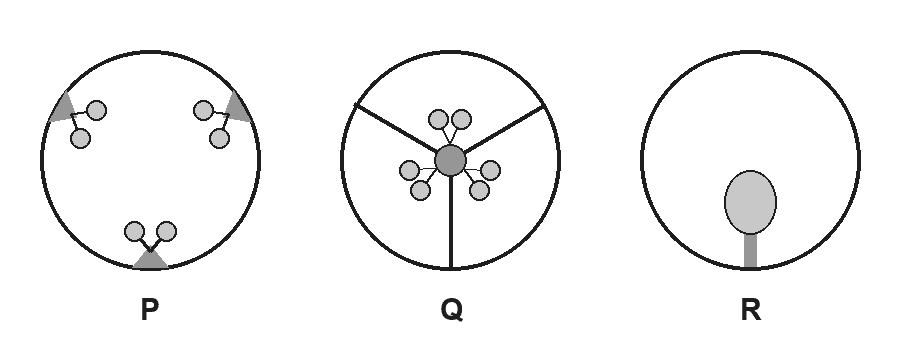
Name the type of placentation in each, give the number of chambers in each ovary, and name one plant from this chapter that shows each type.
- 444 marks
Question 44
Name the type of aestivation described in each case. For (a), (b) and (d), also name one plant from this chapter that shows it.
(a) The petals just touch one another along their margins and do not overlap.
(b) Each petal overlaps the next one by one margin, all in the same direction round the flower.
(c) One petal is wholly outside, one is wholly inside, and the remaining petals overlap like the previous type.
(d) There are five petals: the largest posterior petal covers the two lateral petals, which in turn cover the two smallest anterior petals.
- 451 mark
Question 45
A flower has 5 united petals forming a funnel, 5 stamens attached to the corolla tube and alternating with its lobes, and a bicarpellary, superior ovary placed obliquely with swollen placentae. Which plant could it belong to?
- 461 mark
Question 46
Which floral formula is that of an onion (Allium cepa) flower?
- 473 marks
Question 47
A farmer grows Bengal gram on a field after harvesting wheat, and finds that the next wheat crop needs less nitrogen fertiliser.
(a) Which feature of the roots of the gram family explains this?
(b) Name this family, and give the scientific names of two pulses that belong to it.
(c) Name one fodder crop and one oil-seed crop of this family.
- 484 marks
Question 48
Differentiate between the flowers of family Fabaceae and family Solanaceae on the basis of:
(a) symmetry and corolla;
(b) androecium;
(c) gynoecium and placentation;
(d) fruit.
- 492 marks
Question 49
We eat the underground stem of the potato plant and the fruit of the tomato plant, yet both belong to the same family.
(a) Name the family and the kind of fruit that a tomato is.
(b) Name the kind of underground stem a potato is, and give one feature that shows it is a stem and not a root.
- 501 mark
Question 50
Which statement about the onion plant, Allium cepa, is correct?
- 511 mark
Question 51
Roots that grow from any other part of the plant other than the radicle are called
- 521 mark
Question 52
A large globular root that tapers sharply at the lower end is called
- 531 mark
Question 53
The roots that have swellings at regular intervals are called
- 541 mark
Question 54
Massive aerial roots present in a Banyan tree are
- 551 mark
Question 55
Plants growing in swamps have roots that grow vertically upwards like conical spikes and have aerating pores. Such roots are called
- 561 mark
Question 56
The roots of the parasitic plant Cuscuta are of
- 571 mark
Question 57
A short, vertical underground stem that contains the food reserve is called
- 581 mark
Question 58
Ginger is an example of
- 591 mark
Question 59
A long green stem with long internodes growing horizontally on the soil surface is called
- 601 mark
Question 60
A short, green, flattened branch resembling a leaf arising from the axil of a reduced scale leaf is called
- 611 mark
Question 61
When many equally strong veins like midrib arise from the petiole towards the margin of the leaf forming a network, the leaf is said to
- 621 mark
Question 62
In a pitcher plant, the pitchers are modified
- 631 mark
Question 63
The sharp spines in cactus are modified
- 641 mark
Question 64
The tendrils of the pea plant—Pisum are modifications of
- 651 mark
Question 65
When the leaflets are joined together at a common point at the petiole, the leaf is
- 661 mark
Question 66
Phyllotaxy refers to an arrangement of
- 671 mark
Question 67
A flower that has only stamens is called
- 681 mark
Question 68
A flower with a superior ovary is called
- 691 mark
Question 69
An inflorescence with main axis elongated bearing flowers in a pendulous axis is called
- 701 mark
Question 70
On maturity an ovule forms a
- 711 mark
Question 71
Pineapple is an example of
- 721 mark
Question 72
Monocarpellary, superior ovary is found in
- 731 mark
Question 73
Tricarpellary, syncarpous condition is found in
- 741 mark
Question 74
Family Fabaceae has
- 751 mark
Question 75
Just above the root cap for a few millimetres is the region of _____.
- 761 mark
Question 76
Turmeric is an example of modified _____ root.
- 771 mark
Question 77
Epiphytic roots of orchids are surrounded by a spongy tissue called _____ that helps to absorb moisture.
- 781 mark
Question 78
Onion is an example of modified underground stem called _____.
- 791 mark
Question 79
In dicot plants, the leaf base bears two lateral outgrowths called _____.
- 801 mark
Question 80
The arrangement of leaves on a stem or a branch is called _____.
- 811 mark
Question 81
When the ovary occupies the highest position on thalamus, the flower is said to be _____.
- 821 mark
Question 82
_____ is a branch of science that deals with the study of fruits and their cultivation.
- 831 mark
Question 83
In albuminous seeds the food is stored in the _____.
- 841 mark
Question 84
When the stamens are united to petals by their filaments and the anthers are free, it is called _____ condition.
- 851 mark
Question 85
Haustoria are the epiphytic hanging roots present in climbing plants.
- 861 mark
Question 86
Sweet potato is a horizontally growing underground stem.
- 871 mark
Question 87
In a pea plant Pisum, the tendrils are modified upper leaflets.
- 881 mark
Question 88
Asparagus has thin fleshy green leaves that carryout photosynthesis.
- 891 mark
Question 89
Ficus is an example of hypanthodium inflorescence.
- 901 mark
Question 90
Ovary is superior in an epigynous flower.
- 911 mark
Question 91
Apocarpous is a polycarpellary condition when carpels are united.
- 921 mark
Question 92
An embryo consists of cotyledons and an embryonal axis.
- 931 mark
Question 93
Apple is a true fruit as it develops from a ripened ovary.
- 941 mark
Question 94
When anthers are free but filaments are united together it is called syngenesious condition.
- 951 mark
Question 95
Conical spike-like vertically growing respiratory roots in plants growing in marshy land.
- 961 mark
Question 96
Kind of sub-aerial stem generally found in rosette type of aquatic plants like water lettuce.
- 971 mark
Question 97
Part of the stem that is modified as stem tendril in passion flower.
- 981 mark
Question 98
Scientific term for the arrangement of leaves on a stem or a branch.
- 991 mark
Question 99
A modification when the petiole of a compound leaf becomes green flattened and leaf-like.
- 1001 mark
Question 100
Kind of inflorescence present in sunflower.
- 1011 mark
Question 101
A plant that bears both male and female flowers on the same plant.
- 1021 mark
Question 102
A scar left by the funiculus on the seed coat.
- 1031 mark
Question 103
A single, shield-shaped much reduced cotyledon in a maize seed.
- 1041 mark
Question 104
Type of aestivation in which sepals or petals are present close to each other along their margins but do not overlap.
- 1051 mark
Question 105
Assertion (A): Epiphytes grow on branches of trees for shelter and space but do not draw nutrition from them.
Reason (R): Epiphytes have hanging roots with spongy tissue called velamen.
- 1061 mark
Question 106
Assertion (A): Apical meristem of root is sub-terminal.
Reason (R): Root cap is present at the terminal end of the roots.
- 1071 mark
Question 107
Assertion (A): Thorns are modifications of axillary or terminal buds. These are used as organs of defense.
Reason (R): In some plants thorns are called as prickles as they are smaller and hooked.
- 1081 mark
Question 108
Assertion (A): The leaf base is swollen in some leguminous plants.
Reason (R): The swollen leaf base is called pulvinus.
- 1091 mark
Question 109
Assertion (A): Leaves of Bryophyllum help in vegetative propagation.
Reason (R): Leaves of Bryophyllum possess adventitious buds.
- 1101 mark
Question 110
Assertion (A): China rose has simple leaf while rose plant has compound leaf.
Reason (R): Leaflets of a rose plant are joined to a common point at the petiole.
- 1111 mark
Question 111
Assertion (A): In Lathyrus odoratus, the leaf apex is modified into leaf tendrils.
Reason (R): This leaf tendril helps the plant in reducing transpiration.
- 1121 mark
Question 112
Assertion (A): Mustard flower is said to be hypogynous with superior ovary.
Reason (R): In mustard flower, various floral parts like sepals, petals and stamens are present above the ovary.
- 1131 mark
Question 113
Assertion (A): Apple is a false and parthenocarpic fruit.
Reason (R): Apple fruit develops without fertilisation.
- 1141 mark
Question 114
Assertion (A): Rice and wheat are monocot albuminous seeds.
Reason (R): In albuminous seeds the food is stored in the endosperm.
- 1153 marks
Question 115
What is meant by modification of root? What type of modification of root is found in the:
(i) Banyan tree
(ii) Turnip
(iii) Mangrove trees
- 1163 marks
Question 116
Justify the following statement on the basis of external features.
Underground parts of a plant are not always roots.