
Opening your dashboard
Class 10 Maths Chapter 9: Matrices Solutions
73 textbook questions with step-by-step answers, free to read, for ICSE 2026-27.
Get talked through Ch 9, not just shown the answer
Reading a finished solution is not the same as being able to do it. The AI tutor takes one question at a time and works it with you, in your own words, until you can.
- Ask it out loud, in your own words
- It gives you the next step, not the answer
- Stuck on part (ii)? Start there
73 questions with solutions
1–3 marks · Mixed difficulty
The first 13 solutions are on this page. This chapter is a long one, so the rest open on their own page to keep this one quick to load.
- 11 mark
Question 1
If , the value of , , and are :
Solve with AIAnswer
- Correct
(A) , , and
(B) , , and
(C) , , and
(D) , , and
Answer: (A) , , and
Concept: Two matrices are equal only when they have the same order and every element of one equals the element in the same position (same row, same column) of the other. So one matrix equation gives one ordinary equation for each position.
Step 1 — Check that the matrices can be compared.
Both matrices have 2 rows and 2 columns, so they are of the same order, 2 × 2. We may therefore match them position by position; the figure shows matching positions in the same colour.
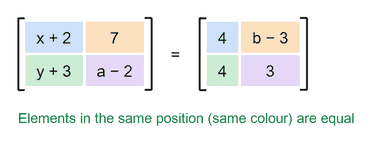
Step 2 — Compare the elements of row 1.
The elements in row 1, column 1 give an equation in ; we subtract 2 from both sides.
The elements in row 1, column 2 give an equation in ; we add 3 to both sides.
Step 3 — Compare the elements of row 2.
The elements in row 2, column 1 give an equation in ; we subtract 3 from both sides.
The elements in row 2, column 2 give an equation in ; we add 2 to both sides.
Check: With these values the left matrix becomes , which is exactly the right matrix.
Watch out: Match each element with the element in the same position. The 7 is in row 1, column 2, so it pairs with , not with .
Why the other options are wrong:
- (B) , , and : if were −2, the element would be 0, not 4.
- (C) , , and : if were −1, the element would be 2, not 4.
- (D) , , and : if were −5, the element would be −7, not 3.
Therefore, , , and , option (A).
- 21 mark
Question 2
If and ; the value of matrix is :
Solve with AIAnswer
(A)
- Correct
(B)
(C)
(D)
Answer: (B)
Concept: Matrices of the same order are added or subtracted element by element: each element of the answer comes from the elements in the same position of the given matrices. Matrices of different orders cannot be added or subtracted.
Step 1 — Check the orders.
and are both 2 × 2 matrices, so is possible and is also a 2 × 2 matrix.
Step 2 — Subtract element by element.
From each element of we subtract the element of in the same position. Subtracting a negative number is the same as adding the positive number, so we keep the brackets.
Check: Here every element of is the negative of the element of in the same position, so subtracting is the same as adding . Doubling every element of gives the same matrix.
Watch out: Subtracting a negative element changes it to an addition: is 10, not 0.
Why the other options are wrong:
- (A) : this is , not . Since , adding them gives the zero matrix.
- (C) : the element in row 2, column 1 is , which is 6, not −6; the element in row 2, column 2 is , which is −6, not 6.
- (D) : this is : the subtraction was done in the wrong order, so every sign is reversed.
Therefore, , option (B).
- 31 mark
Question 3
If , and then matrix is :
Solve with AIAnswer
(A)
(B)
- Correct
(C)
(D)
Answer: (C)
Concept: Matrices of the same order are added or subtracted element by element: each element of the answer comes from the elements in the same position of the given matrices. Matrices of different orders cannot be added or subtracted.
Step 1 — Check the orders.
, and are all 2 × 2 matrices, so is possible and is a 2 × 2 matrix.
Step 2 — Work position by position.
For each position we add the elements of and and then subtract the element of . The −2 of is in brackets, because subtracting −2 means adding 2.
Watch out: The element of in row 1, column 1 is −2, so is 10, not 6.
Why the other options are wrong:
- (A) : the element in row 2, column 1 is , which is 3, not −3.
- (B) : the element in row 1, column 1 is , which is 10, not −10; and the element in row 2, column 2 is , which is 3, not −3.
- (D) : the element in row 1, column 2 is , which is 4, not −4.
Therefore, , option (C).
- 41 mark
Question 4
If and , then the matrix P (such that ) is :
Solve with AIAnswer
(A)
(B)
(C)
- Correct
(D)
Answer: (D)
Concept: Matrices of the same order are added or subtracted element by element: each element of the answer comes from the elements in the same position of the given matrices. Matrices of different orders cannot be added or subtracted. A matrix equation such as is solved like an ordinary equation: subtract from both sides.
Step 1 — Make the subject.
We subtract from both sides of . On the left, is the zero matrix, which leaves .
Step 2 — Subtract element by element.
From each element of we subtract the element of in the same position.
Check: Adding to must give .
Watch out: The order matters: , not . Working out would give every element of with the wrong sign.
Why the other options are wrong:
- (A) : the element in row 1, column 1 is , which is −9, not 4; this matrix does not satisfy .
- (B) : the element in row 1, column 1 is , which is −9, not 9; and the element in row 2, column 2 is , which is −3, not −2.
- (C) : the element in row 2, column 2 is , which is −3, not 3.
Therefore, , option (D).
- 51 mark
Question 5
The additive inverse of matrix , where and is :
Solve with AIAnswer
- Correct
(A)
(B)
(C)
(D)
Answer: (A)
Concept: The additive inverse of a matrix is the matrix , found by changing the sign of every element, so that is the zero matrix. Matrices of the same order are added or subtracted element by element: each element of the answer comes from the elements in the same position of the given matrices. Matrices of different orders cannot be added or subtracted.
Step 1 — Add the matrices.
and are both 2 × 2, so we add the elements in the same positions.
Step 2 — Change the sign of every element.
The additive inverse of is , so each element of changes sign.
Check: , which is the zero matrix.
Watch out: Every element changes sign, including the negative one: is .
Why the other options are wrong:
- (B) : the elements in row 1 are and , which are the elements of itself, not their negatives.
- (C) : the element in row 2, column 2 is , which is 6, not −6.
- (D) : only some signs have been changed: the inverse of 3 is −3, not 3; of 10 is −10, not 10; and of −6 is 6, not −6.
Therefore, the additive inverse of is , option (A).
- 63 marks
Question 6
State, whether the following statements are true or false. If false, give a reason.
(i) If A and B are two matrices of orders 3 × 2 and 2 × 3 respectively; then their sum A + B is possible.
(ii) The matrices and are conformable for subtraction.
(iii) Transpose of a 2 × 1 matrix is a 2 × 1 matrix.
(iv) Transpose of a square matrix is a square matrix.
(v) A column matrix has many columns and only one row.
Solve with AIWritten solution
Solution:
Concept: Matrices can be added or subtracted only when they have the same order. The transpose of a matrix is formed by writing its rows as columns, so the transpose of an matrix is an matrix.
Step 1 — Part (i): with orders 3 × 2 and 2 × 3.
has 3 rows and 2 columns, while has 2 rows and 3 columns. Their orders are different, so the elements of cannot all be paired with elements of in the same positions. The sum is not possible, so statement (i) is false.
Step 2 — Part (ii): subtraction of and .
Both matrices have the same order, 2 × 3, so every element of has a partner in the same position of . Matrices of the same order are conformable for subtraction (and for addition), so statement (ii) is true.
Step 3 — Part (iii): transpose of a 2 × 1 matrix.
A 2 × 1 matrix has 2 rows and 1 column. In its transpose the rows become columns, so the transpose has 1 row and 2 columns: it is a 1 × 2 matrix. For example, take the 2 × 1 matrix ; its transpose is , as the figure shows.

So statement (iii) is false: the transpose of a 2 × 1 matrix is a 1 × 2 matrix, not a 2 × 1 matrix.
Step 4 — Part (iv): transpose of a square matrix.
A square matrix has as many rows as columns, say . Interchanging rows and columns gives an matrix again, so statement (iv) is true.
Step 5 — Part (v): a column matrix.
A column matrix has only one column and any number of rows; for example, is a column matrix of order 2 × 1. A matrix with only one row is a row matrix. So statement (v) is false: it describes a row matrix, not a column matrix.
Watch out: A column matrix is one column (tall and thin); a row matrix is one row (short and wide).
Therefore, (i) false, since the orders are different; (ii) true; (iii) false, since the transpose is 1 × 2; (iv) true; (v) false, since a column matrix has only one column.
- 73 marks
Question 7
Solve for , and ; if :
(i)
(ii)
Solve with AIWritten solution
Solution:
Concept: Two matrices are equal only when they have the same order and every element of one equals the element in the same position (same row, same column) of the other. So one matrix equation gives one ordinary equation for each position.
Step 1 — Part (i): match the positions.
Both matrices are 2 × 2, so we compare the elements in the same positions. Row 1, column 1 gives an equation in : we subtract 4 from both sides.
Row 1, column 2 gives an equation in : we subtract 5 from both sides.
Row 2, column 2 gives an equation in : we add 1 to both sides.
Row 2, column 1 gives 3 = 3, which is already true.
Step 2 — Part (ii): find first.
Both matrices are 2 × 2. The figure shows the matching positions in the same colour. Row 1, column 1 gives directly.
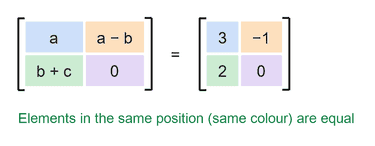
Step 3 — Part (ii): find and then .
Row 1, column 2 gives ; we put in it and solve for .
Row 2, column 1 gives ; we put in it and solve for .
Check: In (i) both matrices become ; in (ii) the left matrix becomes , the right matrix.
Watch out: In (ii), find carefully before using it to find : is 4, not −4, because is −1.
Therefore, (i) , and ; (ii) , and .
- 83 marks
Question 8
Wherever possible, write each of the following as a single matrix.
(i)
(ii)
(iii)
Solve with AIWritten solution
Solution:
Concept: Matrices of the same order are added or subtracted element by element: each element of the answer comes from the elements in the same position of the given matrices. Matrices of different orders cannot be added or subtracted.
Step 1 — Part (i): add two 2 × 2 matrices.
Both matrices are of order 2 × 2, so the sum is possible. We add the elements in the same positions.
Step 2 — Part (ii): subtract two 2 × 3 matrices.
Both matrices are of order 2 × 3, so the difference is possible. From each element of the first matrix we subtract the element of the second in the same position; becomes .
Step 3 — Part (iii): compare the orders.
The first matrix has 2 rows and 3 columns (order 2 × 3), but the second has 2 rows and 2 columns (order 2 × 2). The two elements in the third column of the first matrix have no partners to be added to, as the figure shows.
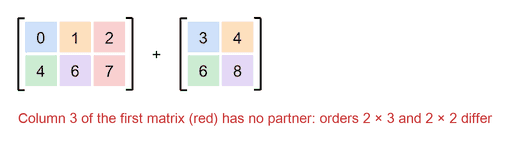
So this sum is not possible and cannot be written as a single matrix.
Watch out: Check the orders before adding. Never add the extra column on its own or fill a gap with zeros.
Therefore, (i) ; (ii) ; (iii) not possible, because the orders 2 × 3 and 2 × 2 are different.
- 93 marks
Question 9
Find, and from the following equations :
(i)
(ii)
Solve with AIWritten solution
Solution:
Concept: Matrices of the same order are added or subtracted element by element: each element of the answer comes from the elements in the same position of the given matrices. Matrices of different orders cannot be added or subtracted. Two matrices are equal only when they have the same order and every element of one equals the element in the same position (same row, same column) of the other. So one matrix equation gives one ordinary equation for each position.
Step 1 — Part (i): simplify the left side.
We subtract the two 2 × 2 matrices element by element, keeping in brackets because the whole element is subtracted.
Step 2 — Part (i): compare with the right side.
The left side must equal . Row 1, column 2 gives an equation in : we subtract 3 from both sides and divide by −1.
Row 2, column 2 gives an equation in : we subtract 2 from both sides.
The other two positions give 4 = 4 and −3 = −3, which are already true.
Step 3 — Part (ii): simplify the left side.
We add the two 1 × 2 row matrices element by element.
Step 4 — Part (ii): compare with the right side.
The left side must equal . The first elements give an equation in : we add 8 to both sides.
The second elements give an equation in : we add 2 to both sides.
Check: In (i), with is , which is 7, and with is 2; in (ii), is −3 and is 2.
Watch out: opens to , because the minus sign changes the sign of both terms in the bracket. Forgetting the brackets gives instead of , and the wrong value of .
Therefore, (i) and ; (ii) and .
- 103 marks
Question 10
Given : , find its transpose matrix . If possible, find :
(i) (ii)
Solve with AIWritten solution
Solution:
Concept: The transpose of a matrix is formed by writing each row of as a column: row 1 becomes column 1 and row 2 becomes column 2. Matrices of the same order are added or subtracted element by element: each element of the answer comes from the elements in the same position of the given matrices. Matrices of different orders cannot be added or subtracted.
Step 1 — Write the transpose.
Row 1 of is 5, −3, so column 1 of is 5, −3; row 2 of is −2, 4, so column 2 of is −2, 4. The figure shows each row moving to a column.

Step 2 — Check that the sum and difference are possible.
is 2 × 2, so is also 2 × 2. Matrices of the same order can be added and subtracted, so both parts are possible.
Step 3 — Part (i): find .
We add the elements in the same positions.
Step 4 — Part (ii): find .
From each element of we subtract the element of in the same position.
Watch out: In the transpose the diagonal elements 5 and 4 stay where they are; only the two off-diagonal elements swap places.
Therefore, ; (i) ; (ii) .
- 113 marks
Question 11
Given , and ; find the matrix X in each of the following :
(i) (ii)
Solve with AIWritten solution
Solution:
Concept: Matrices of the same order are added or subtracted element by element: each element of the answer comes from the elements in the same position of the given matrices. Matrices of different orders cannot be added or subtracted. A matrix equation is solved like an ordinary equation: move the known matrices to the other side, changing the sign of each one moved.
Step 1 — Part (i): make the subject.
We subtract from both sides of .
Step 2 — Part (i): work element by element.
We write the three row matrices in that order, then work out each position.
Step 3 — Part (ii): make the subject.
From we add to both sides and then subtract from both sides.
Step 4 — Part (ii): work element by element.
We write the three row matrices in that order, then work out each position.
Check: In (i), and ; in (ii), and .
Watch out: In (ii) is subtracted from , so , not .
Therefore, (i) ; (ii) .
- 123 marks
Question 12
Given and ; find the matrix X in each of the following :
(i) (ii) (iii)
Solve with AIWritten solution
Solution:
Concept: Matrices of the same order are added or subtracted element by element: each element of the answer comes from the elements in the same position of the given matrices. Matrices of different orders cannot be added or subtracted. A matrix equation is solved like an ordinary equation: move the known matrix to the other side, changing its sign.
Step 1 — Part (i): solve .
We subtract from both sides, so . Then we subtract element by element.
Step 2 — Part (ii): solve .
We add to both sides and subtract from both sides, so .
Step 3 — Part (iii): solve .
We add to both sides, so .
Check: We put each back into its equation.
Watch out: The answers to (i) and (ii) are negatives of each other, because ; mixing them up is the usual slip.
Therefore, (i) ; (ii) ; (iii) .
- 131 mark
Question 13
If , the values of and are :
Solve with AIAnswer
(A) and
- Correct
(B) and
(C) and
(D) and
Answer: (B) and
Concept: To multiply a matrix by a number , multiply every element of the matrix by . After that, matrices of the same order are added or subtracted element by element. Two matrices are equal only when they have the same order and every element of one equals the element in the same position (same row, same column) of the other. So one matrix equation gives one ordinary equation for each position.
Step 1 — Simplify the left side.
We multiply every element of by 4 and every element of by 5, then subtract element by element.
Step 2 — Compare the first elements.
The left side must equal , so the first elements give an equation in . We subtract 20 from both sides and divide by −5.
Step 3 — Compare the second elements.
The second elements give an equation in . We subtract 10 from both sides and divide by 4.
Watch out: is , so the second element is , not .
Why the other options are wrong:
- (A) and : the two values are interchanged: taking as 2, the second element would be 18, not 22.
- (C) and : taking as −3, the second element would be −2, not 22.
- (D) and : taking as −2, the first element would be 30, not 10.
Therefore, and , option (B).
- 141 mark
Question 14
If and , then matrix B is :
- 151 mark
Question 15
If I is a unit matrix of order 2 and , then matrix M is :
- 161 mark
Question 16
If , the values of , and are :
- 171 mark
Question 17
Given and , then is :
- 183 marks
Question 18
Find and if :
(i)
(ii)
- 193 marks
Question 19
Given , and ; find :
(i) (ii)
- 203 marks
Question 20
If ; find A.
- 213 marks
Question 21
Given and
(i) find the matrix .
(ii) find a matrix C such that :
- 223 marks
Question 22
If ; find the values of , and .
- 233 marks
Question 23
Given and is its transpose matrix. Find :
(i) (ii) (iii) (iv)
- 243 marks
Question 24
Given and . Solve for matrix X :
(i) (ii) (iii) .
- 253 marks
Question 25
If I is the unit matrix of order 2 × 2; find the matrix M, such that :
- 261 mark
Question 26
If A is a matrix of order , B is a matrix of order and R is a matrix of order such that , the values of and are :
- 271 mark
Question 27
If , and , the value of is :
- 281 mark
Question 28
A, B and C are three matrices each of order 5; the order of matrix is :
- 291 mark
Question 29
If and , then which of the following is not possible ?
- 301 mark
Question 30
If , and , the matrix is :
- 313 marks
Question 31
Evaluate : if possible :
(i) (ii)
(iii) (iv)
If not possible, give a reason.
- 323 marks
Question 32
If , and I is a unit matrix of order 2 × 2, find :
(i) (ii) (iii)
- 333 marks
Question 33
If and , find and when .
- 343 marks
Question 34
Find and , if :
- 353 marks
Question 35
If , and , find :
(i) (ii)
Is ?
- 363 marks
Question 36
Let , and . Find .
- 373 marks
Question 37
If and I is a unit matrix of the same order as that of M; show that : .
- 383 marks
Question 38
If , , and , find the values of and .
- 393 marks
Question 39
Find the matrix A, if and .
- 403 marks
Question 40
If and , find and .
- 413 marks
Question 41
Solve for and :
(i)
(ii)
(iii)
- 423 marks
Question 42
In each case given below, find : (a) the order of matrix M. (b) the matrix M.
(i)
(ii)
- 433 marks
Question 43
If and ; find the value of , given that : .
- 443 marks
Question 44
If A and B are any two 2 × 2 matrices such that and B is not a zero matrix, what can you say about the matrix A ?
- 453 marks
Question 45
Given , and that ; find the values of , and .
- 463 marks
Question 46
If and , find the matrix X such that .
- 473 marks
Question 47
If , show that : ; where I is a 2 × 2 unit matrix.
- 483 marks
Question 48
If and , find and such that = null matrix.
- 493 marks
Question 49
Evaluate :
- 503 marks
Question 50
State, with reason, whether the following are true or false. A, B and C are matrices of order 2 × 2.
(i)
(ii)
(iii)
(iv)
(v)
(vi)
(vii)
(viii)
- 511 mark
Question 51
If a matrix and matrix , then which of the following is possible :
- 521 mark
Question 52
If , the order of matrix M is :
- 531 mark
Question 53
If , the value of and are :
- 541 mark
Question 54
If matrix and matrix then is :
- 551 mark
Question 55
Event A : Order of matrix A is 3 × 5. Event B : Order of matrix B is 5 × 3. Event C : Order of matrix C is 3 × 3.
Product of which two matrices gives a square matrix.
- 561 mark
Question 56
Two matrices A and B each of order 2 × 2.
Assertion (A) : or .
Reason (R) : Let and but
- 571 mark
Question 57
Matrix and Matrix .
Assertion (A) : Product BA is possible and order of resulting matrix is 2 × 2.
Reason (R) : The product BA of two matrices A and B is possible only if number of rows in matrix B is same as number of columns in matrix A.
- 581 mark
Question 58
A, B and C are three matrices each of order 2 × 2.
Statement (1) : If .
Statement (2) : Cancellation law is applicable in matrix multiplication.
- 591 mark
Question 59
Matrix and matrix
Statement (1) : .
Statement (2) : , even if and
- 603 marks
Question 60
Find and , if :
- 613 marks
Question 61
Find and , if :
- 623 marks
Question 62
If and ; find and , if :
(i) (whole numbers) (ii) (integers)
- 633 marks
Question 63
Evaluate :
- 643 marks
Question 64
If , and ; find matrix M.
- 653 marks
Question 65
Find and , if : .
- 663 marks
Question 66
If matrix and , find the matrix 'X' and matrix 'Y'.
- 673 marks
Question 67
If , and I is the identity matrix of the same order and is the transpose of matrix A, find .
- 683 marks
Question 68
Let , . Find
- 693 marks
Question 69
If , , and , find the values of , and .
- 703 marks
Question 70
Given , , and . Find the values of and .
- 713 marks
Question 71
Evaluate : .
- 723 marks
Question 72
Given and and . Find .
- 733 marks
Question 73
Given matrix and . If ,
(i) write the order of matrix X. (ii) find the matrix 'X'.
What Class 10 Maths Ch 9 covers
The sections of the chapter, in the order the book takes them. Every question above comes from one of these.
- 01Matrix, Order and Elements of a Matrix
- 02Types of Matrices
- 03Transpose of a Matrix
- 04Equality of Matrices
- 05Addition and Subtraction of Matrices
- 06Additive Identity and Additive Inverse
More ways to study this chapter
The same chapter asked three other ways. Practise it, revise it, and see what the board has set on Ch 9 before.
- Competency-Based Questions (CBQ)Case study questions: a situation, and the part of the chapter that answers it.40questionsOpen
- Previous Year QuestionsQuestions that have actually appeared in board papers, each tagged with its year.24questionsOpen
- Practice QuestionsExtra questions per chapter, for when one attempt at a method is not enough.43questionsOpen
Ch 9 in past ICSE papers
The same chapter as the board has actually asked it. These are worded differently from the textbook exercise, which is the point of reading them.
- 14 marks
Board paper question 1
Given and and . Find m.
Solve with AIWritten solution
Solution:
Concept: means . The product exists only when the number of columns of equals the number of rows of . The element in row , column of is found by multiplying the elements of row of by the matching elements of column of and adding the results. If is and is , then is . Two matrices are equal only when they have the same order and every element of one equals the element in the same position (same row, same column) of the other. So one matrix equation gives one ordinary equation for each position. Here has on the main diagonal and 0 elsewhere.
Step 1 — Work out .
is 2 × 2, so is possible and is also 2 × 2. We multiply each row of the first matrix by each column of the second: multiply the matching elements and add. The working below first writes each element as a sum of products, then works out the products, then adds them.
Step 2 — Work out the right side .
We multiply every element of by 9, write with on the main diagonal, and add element by element.
Step 3 — Compare one position.
Since , the elements in row 1, column 1 must be equal. This gives an equation in ; we subtract 18 from both sides.
Check: Row 2, column 2 must give the same value of .
The other two positions already agree: both are 0 in row 1, column 2, and both are −9 in row 2, column 1.
Watch out: means worked out by rows and columns; it is not found by squaring each element. Put a negative element in brackets before multiplying, e.g. ; most slips here are sign slips.
Therefore, .
- 23 marks
Board paper question 2
Given matrix and
If AX = B
(i) Write the order of matrix X.
(ii) Find the matrix 'X'.
Solve with AIWritten solution
Solution:
Concept: A product is possible only when the number of columns of equals the number of rows of . If is of order and is of order , then is of order : its rows come from and its columns from . First replace each trigonometric ratio by its value.
Step 1 — Simplify .
We use and , so each becomes 2 and each becomes 1.
Step 2 — Part (i): order of .
is 2 × 2 and is 2 × 1. For to exist, must have 2 rows (the number of columns of ). The product takes its number of columns from , and has 1 column, so has 1 column. The figure shows this.

Step 3 — Part (ii): multiply.
We write and multiply each row of by this column.
Step 4 — Part (ii): form and solve two equations.
Since , each element gives one equation.
We multiply (2) by 2 and subtract (1), so that cancels.
Putting in (1) and solving for :
Check: Multiplying by this must give .
Watch out: is a column matrix (2 × 1), not 2 × 2, because has only one column.
Therefore, (i) is of order 2 × 1; (ii) .
- 34 marks
Board paper question 3
If and and . Find matrix C where C is a 2 by 2 matrix.
Solve with AIWritten solution
Solution:
Concept: means . The product exists only when the number of columns of equals the number of rows of . The element in row , column of is found by multiplying the elements of row of by the matching elements of column of and adding the results. If is and is , then is . To multiply a matrix by a number , multiply every element of the matrix by . After that, matrices of the same order are added or subtracted element by element. To get from , we divide every element by 5.
Step 1 — Work out .
We multiply each row of the first matrix by each column of the second: multiply the matching elements and add. The working below first writes each element as a sum of products, then works out the products, then adds them.
Step 2 — Work out .
We use the same row-by-column method for , keeping each negative element in brackets.
So is the unit matrix .
Step 3 — Work out .
We multiply every element of by 5 and subtract element by element.
Step 4 — Find .
We are told , so each element of is one-fifth of the matching element.
Watch out: Put a negative element in brackets before multiplying, e.g. ; most slips here are sign slips. Also, is , so remember the last step of dividing by 5.
Therefore, .
- 44 marks
Board paper question 4
Given matrix . Find the matrix X if, .
Hence solve for and given
Solve with AIWritten solution
Solution:
Concept: means . The product exists only when the number of columns of equals the number of rows of . The element in row , column of is found by multiplying the elements of row of by the matching elements of column of and adding the results. If is and is , then is . To multiply a matrix by a number , multiply every element of the matrix by . After that, matrices of the same order are added or subtracted element by element. Two matrices are equal only when they have the same order and every element of one equals the element in the same position (same row, same column) of the other. So one matrix equation gives one ordinary equation for each position.
Step 1 — Work out .
We multiply each row of the first matrix by each column of the second: multiply the matching elements and add. The working below first writes each element as a sum of products, then works out the products, then adds them.
Step 2 — Work out .
We multiply every element of by 4 and subtract it from element by element.
Step 3 — Multiply by the column of unknowns.
Now we use this in the second equation and multiply each row of by the column .
Step 4 — Compare and solve.
This product equals , so the first elements give an equation in and the second elements give an equation in . We divide each by 5.
Check: and , which is the given column.
Watch out: In the elements 4 − 4 and 32 − 32 are 0, so each equation has only one unknown. Do not skip the subtraction of .
Therefore, , and .
- 53 marks
Board paper question 5
Find the value of 'x' and 'y' if :
Solve with AIWritten solution
Solution:
Concept: To multiply a matrix by a number , multiply every element of the matrix by . After that, matrices of the same order are added or subtracted element by element. Two matrices are equal only when they have the same order and every element of one equals the element in the same position (same row, same column) of the other. So one matrix equation gives one ordinary equation for each position.
Step 1 — Write the left side as one matrix.
We multiply every element of the first matrix by 2, then add the second matrix element by element.
Step 2 — Set it equal to the right side.
The left side must equal . Row 1, column 2 (7 = 7) and row 2, column 1 (22 = 22) already agree, so the other two positions give the equations.
Step 3 — Row 1, column 1 gives .
We subtract 6 from both sides, then divide by 2.
Step 4 — Row 2, column 2 gives .
We add 5 to both sides, then divide by 2.
Check: We put and into the left side; it must give the right side.
Watch out: Multiply every element by 2, including the inside : , not .
Therefore, and .
- 63 marks
Board paper question 6
If , , and , find .
Solve with AIWritten solution
Solution:
Concept: The product exists only when the number of columns of equals the number of rows of . The element in row , column of is found by multiplying the elements of row of by the matching elements of column of and adding the results. If is and is , then is . To multiply a matrix by a number , multiply every element of the matrix by . After that, matrices of the same order are added or subtracted element by element.
Given: , and are all 2 × 2, so every product, sum and difference below is possible and is 2 × 2.
Step 1 — Work out .
We multiply each row of the first matrix by each column of the second: multiply the matching elements and add. The working below first writes each element as a sum of products, then works out the products, then adds them.
Step 2 — Work out .
means , found by the same row-by-column method.
Step 3 — Combine.
We multiply every element of by 10, then add and subtract element by element.
Watch out: Matrix multiplication depends on the order of the matrices: in general , so keep each product in the order written. Put a negative element in brackets before multiplying, e.g. ; most slips here are sign slips.
Therefore, .
All 24 board paper questions for this chapter, solved the same way.
Class 10 Maths Ch 9 questions students ask
How many questions are there in Class 10 Maths Ch 9?
73 questions. Every one is solved step by step on this page.
Are these Class 10 Maths solutions free?
Yes. Every question and its full working is free to read, with no account needed.
Can I download the Class 10 Maths Ch 9 solutions as a PDF?
There is no PDF to download. Every solution is on this page instead, which means it is searchable, always the current syllabus, and readable on a phone. Use your browser's print option if you want it on paper.