Solution:
Concept: A product AB is possible only when the number of columns of A equals the number of rows of B. If A is of order m×n and B is of order n×p, then AB is of order m×p: its rows come from A and its columns from B. Once the order of X is known, write X with unknown letters and compare elements.
Step 1 — Find the order of X.
A is 2 × 2 and B is 2 × 1. For AX to exist, the rows of X must equal the 2 columns of A; and AX takes its columns from X, so X has 1 column like B. The figure shows this.
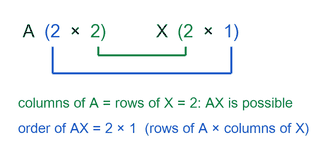
order of X=2×1
Step 2 — Multiply.
We write X=[xy] and multiply each row of A by this column.
AX=[2113][xy]=[2×x+1×y1×x+3×y]=[2x+yx+3y]
Step 3 — Form two equations.
Since AX=B, each element gives one equation.
2x+y=3...(1)
x+3y=−11...(2)
Step 4 — Solve by elimination.
We multiply (2) by 2 and subtract (1), so that x cancels.
2x+6y−(2x+y)5yy=−22−3=−25=−5
Putting y=−5 in (1):
2x−52xx=3=8=4
Check: Multiplying A by this X must give B.
AX=[2113][4−5]=[3−11]
Watch out: X is a column matrix here, not a 2 × 2 matrix, because B has only one column.
Therefore, X=[4−5].
