Solution:
Concept: The product AB exists only when the number of columns of A equals the number of rows of B. The element in row i, column j of AB is found by multiplying the elements of row i of A by the matching elements of column j of B and adding the results. If A is m×n and B is n×p, then AB is m×p. Two matrices are equal only when they have the same order and every element of one equals the element in the same position (same row, same column) of the other. So one matrix equation gives one ordinary equation for each position.
Step 1 — Part (i): multiply.
A (2 × 2) matrix times a (2 × 1) matrix gives a 2 × 1 matrix. The figure shows the two rows multiplied by the column.
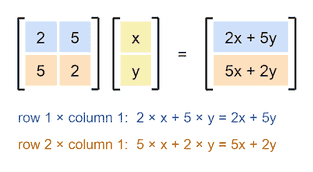
Left side=[2552][xy]=[2×x+5×y5×x+2×y]=[2x+5y5x+2y]
Step 2 — Part (i): form two equations.
The product must equal [−714], so each element gives one equation.
2x+5y=−7...(1)
5x+2y=14...(2)
Step 3 — Part (i): solve by elimination.
We multiply (1) by 5 and (2) by 2 so that both have 10x, and subtract the second from the first.
10x+25y=−35
10x+4y=28
21yy=−35−28=−63=−3
Putting y=−3 in (1):
2x−152xx=−7=8=4
Step 4 — Part (ii): multiply.
A (1 × 2) matrix times a (2 × 2) matrix gives a 1 × 2 matrix. The row is multiplied by each column, then like terms are collected.
Left side=[x+yx−4][−12−22]=[(x+y)×(−1)+(x−4)×2(x+y)×(−2)+(x−4)×2]=[−x−y+2x−8−2x−2y+2x−8]=[x−y−8−2y−8]
Step 5 — Part (ii): compare with [−7−11].
The second elements contain only y: we add 8 to both sides and divide by −2.
−2y−8−2yy=−11=−11+8=−3=−2−3=23
The first elements give x−y−8=−7; we put y=23 in it and solve for x.
x−23−8x−219x=−7=−7=−7+219=25
Step 6 — Part (iii): work out the product.
The (2 × 2)(2 × 1) product is a 2 × 1 matrix.
[−2301][−12x]=[(−2)×(−1)+0×2x3×(−1)+1×2x]=[2+0−3+2x]=[22x−3]
Step 7 — Part (iii): add 3[−21].
We multiply the column by 3 and add element by element.
Left side=[22x−3]+3[−21]=[22x−3]+[−63]=[2+(−6)2x−3+3]=[−42x]
Step 8 — Part (iii): compare with 2[y3].
The right side is [2y6]. The first elements give an equation in y and the second elements an equation in x; we divide each by 2.
2yy=−4=2−4=−2
2xx=6=26=3
Check: In (i), 2(4)+5(−3) is −7 and 5(4)+2(−3) is 14; in (ii), 25−23−8 is −7 and −3−8 is −11; in (iii), both sides become [−46].
Watch out: In (ii), the row is [x+yx−4], so keep each element in brackets when multiplying: −2(x+y)+2(x−4) is −2y−8.
Therefore, (i) x=4 and y=−3; (ii) x=25 and y=23; (iii) x=3 and y=−2.
