Solution:
Concept: The transpose At is formed by writing each row of A as a column. To multiply a matrix by a number k, multiply every element of the matrix by k. After that, matrices of the same order are added or subtracted element by element.
Step 1 — Write the transpose.
Row 1 of A is −3, 6, so column 1 of At is −3, 6; row 2 of A is 0, −9, so column 2 of At is 0, −9. The figure shows each row moving to a column.
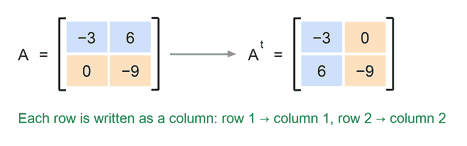
At=[−360−9]
Step 2 — Part (i): find 2A+3At.
We multiply every element of A by 2 and every element of At by 3, then add element by element.
2A+3At=2[−306−9]+3[−360−9]=[−6012−18]+[−9180−27]=[−6+(−9)0+1812+0−18+(−27)]=[−151812−45]
Step 3 — Part (ii): find 2At−3A.
We multiply At by 2 and A by 3, then subtract element by element.
2At−3A=2[−360−9]−3[−306−9]=[−6120−18]−[−9018−27]=[−6−(−9)12−00−18−18−(−27)]=[312−189]
Step 4 — Part (iii): find 21A−31At.
We halve every element of A and divide every element of At by 3, then subtract element by element.
21A−31At=21[−306−9]−31[−360−9]=[−2303−29]−[−120−3]=[−23−(−1)0−23−0−29−(−3)]=[−21−23−23]
Step 5 — Part (iv): find At−31A.
We divide every element of A by 3 and subtract the result from At element by element.
At−31A=[−360−9]−31[−306−9]=[−360−9]−[−102−3]=[−3−(−1)6−00−2−9−(−3)]=[−26−2−6]
Watch out: Use At (not A) wherever the question says At; the two differ in the off-diagonal positions (6 and 0).
Therefore, (i) [−151812−45]; (ii) [312−189]; (iii) [−21−23−23]; (iv) [−26−2−6].
