
Question 313 marksEasy
Evaluate : if possible :
(i) (ii)
(iii) (iv)
If not possible, give a reason.
Confirming your payment
Sign up now and get 250 free tokens.
Matrices · Question 31 of 73
Evaluate : if possible :
(i) (ii)
(iii) (iv)
If not possible, give a reason.
Solution:
Concept: The product exists only when the number of columns of equals the number of rows of . The element in row , column of is found by multiplying the elements of row of by the matching elements of column of and adding the results. If is and is , then is .
Step 1 — Part (i): (1 × 2)(2 × 1).
The first matrix has 2 columns and the second has 2 rows, so the product is possible and is of order 1 × 1. We multiply the row by the column and add.
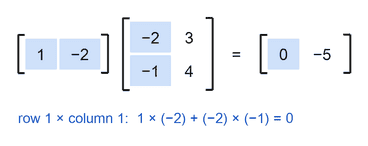
Step 2 — Part (ii): (1 × 2)(2 × 2).
The first matrix has 2 columns and the second has 2 rows, so the product is possible and is of order 1 × 2. The row is multiplied by each column in turn; the figure shows the first element.
Step 3 — Part (iii): (2 × 2)(2 × 1).
The first matrix has 2 columns and the second has 2 rows, so the product is possible and is of order 2 × 1. Each row is multiplied by the single column.
Step 4 — Part (iv): (2 × 2)(1 × 2).
The first matrix has 2 columns, but the second has only 1 row. These are not equal, so a row of the first matrix cannot be paired element by element with a column of the second.

This product is not possible.
Watch out: In (iv) the same two matrices as in (iii) appear, but the second is now a row, not a column; always check the orders first.
Therefore, (i) ; (ii) ; (iii) ; (iv) not possible, because the first matrix has 2 columns but the second has only 1 row.