
Question 591 markMCQMedium
Matrix and matrix
Statement (1) : .
Statement (2) : , even if and
Confirming your payment
Sign up now and get 250 free tokens.
Matrices · Question 59 of 73
Matrix and matrix
Statement (1) : .
Statement (2) : , even if and
(A) Both the statements are true.
(B) Both the statements are false.
(C) Statement 1 is true, and statement 2 is false.
(D) Statement 1 is false, and statement 2 is true.
Answer: (D) Statement 1 is false, and statement 2 is true.
Concept: only if every element of the product is 0. Separately, it is a general fact that two non-zero matrices can have the zero matrix as their product. The product exists only when the number of columns of equals the number of rows of . The element in row , column of is found by multiplying the elements of row of by the matching elements of column of and adding the results. If is and is , then is .
Step 1 — Check Statement 1 by finding .
We multiply each row of the first matrix by each column of the second: multiply the matching elements and add. The working below first writes each element as a sum of products, then works out the products, then adds them. The figure marks two of the elements.
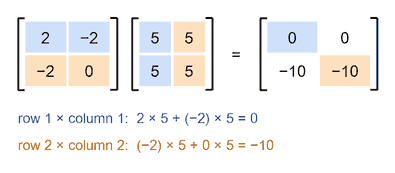
Row 2 is not zero, so . Statement 1 is false.
Step 2 — Check Statement 2.
Statement 2 says a product can be the zero matrix even when neither matrix is zero. That is true in general. For example, , and neither of these matrices is zero. Statement 2 is true.
Note: The example in Step 2 is the given with its last element changed from 0 to 2. Had that been the matrix of the question, would be 0 and both statements would be true; with the matrices as printed, only Statement 2 is true, which is the printed key.
Watch out: Check every element before writing ; here row 1 is zero but row 2 is not.
Why the other options are wrong:
Therefore, Statement 1 is false and Statement 2 is true, option (D).