
Opening your dashboard
Class 10 Maths Chapter 3: Shares and Dividends Solutions
62 textbook questions with step-by-step answers, free to read, for ICSE 2026-27.
Get talked through Ch 3, not just shown the answer
Reading a finished solution is not the same as being able to do it. The AI tutor takes one question at a time and works it with you, in your own words, until you can.
- Ask it out loud, in your own words
- It gives you the next step, not the answer
- Stuck on part (ii)? Start there
62 questions with solutions
1–3 marks · Mixed difficulty
The first 51 solutions are on this page. This chapter is a long one, so the rest open on their own page to keep this one quick to load.
- 11 mark
Question 1
The money required to buy 50, ₹ 20 shares at 10% premium is :
Solve with AIAnswer
(A) ₹ 800
- Correct
(B) ₹ 1,100
(C) ₹ 1,500
(D) ₹ 900
Answer: (B) ₹ 1,100
Concept: Shares are bought at their market value (M.V.). A premium given as a percent is a percentage of the nominal value (N.V.), and at a premium, M.V. = N.V. + premium.
Step 1 — Find the premium on one share.
The premium is 10% of the nominal value of ₹ 20.
So each share carries a premium of ₹ 2.
Step 2 — Find the M.V. of one share.
At a premium, the buyer pays the nominal value plus the premium.
So one share costs ₹ 22.
Step 3 — Find the money required.
Each of the 50 shares costs ₹ 22, so we multiply.
So ₹ 1,100 is required.
Watch out: The premium is 10% of ₹ 20, which is ₹ 2. It is not ₹ 10.
Why the other options are wrong:
- (A) ₹ 800: the face value of the 50 shares alone is 50 × ₹ 20 = ₹ 1,000. Shares at a premium cost more than their face value, so the cost cannot be less than ₹ 1,000.
- (C) ₹ 1,500: this takes the premium as ₹ 10 instead of 10%: 50 × (₹ 20 + ₹ 10) gives ₹ 1,500. The premium is 10% of ₹ 20, which is only ₹ 2.
- (D) ₹ 900: this subtracts the premium: 50 × (₹ 20 − ₹ 2) gives ₹ 900. A premium is always added to the nominal value.
Therefore, the money required is ₹ 1,100, option (B).
- 21 mark
Question 2
The money required to buy 50, ₹ 20 shares at ₹ 10 discount is :
Solve with AIAnswer
(A) ₹ 900
(B) ₹ 1,100
- Correct
(C) ₹ 500
(D) ₹ 800
Answer: (C) ₹ 500
Concept: At a discount a share costs less than its nominal value (N.V.): M.V. = N.V. − discount. Here the discount is given in rupees, ₹ 10 on each share, not as a percent.
Step 1 — Find the M.V. of one share.
We take the discount of ₹ 10 off the nominal value of ₹ 20.
So one share costs ₹ 10.
Step 2 — Find the money required.
Each of the 50 shares costs ₹ 10, so we multiply.
So ₹ 500 is required.
Watch out: “at ₹ 10 discount” means ₹ 10 off each share. It is not a 10% discount.
Why the other options are wrong:
- (A) ₹ 900: this reads the discount as 10% instead of ₹ 10: 10% of ₹ 20 is ₹ 2, and 50 × (₹ 20 − ₹ 2) gives ₹ 900.
- (B) ₹ 1,100: this is 50 × ₹ 22, the cost at a 10% premium. Shares at a discount cost less than their face value of ₹ 1,000.
- (D) ₹ 800: this would mean ₹ 16 for each share, a discount of only ₹ 4. The discount given is ₹ 10.
Therefore, the money required is ₹ 500, option (C).
- 31 mark
Question 3
The money required to buy 50, ₹ 20 shares quoted at ₹ 22 is :
Solve with AIAnswer
- Correct
(A) ₹ 1,100
(B) ₹ 2,100
(C) ₹ 1,540
(D) ₹ 1,440
Answer: (A) ₹ 1,100
Concept: The price at which a share is quoted is its market value (M.V.), the price a buyer actually pays. Money required = number of shares × M.V. of one share.
Step 1 — Read the M.V. of one share.
“Quoted at ₹ 22” tells us the market price of one share. So the buyer pays ₹ 22 for each share, not the nominal value of ₹ 20.
Step 2 — Find the money required.
Each of the 50 shares costs ₹ 22, so we multiply.
So ₹ 1,100 is required.
Watch out: The quoted price is already the full price of a share. Do not add the nominal value to it.
Why the other options are wrong:
- (B) ₹ 2,100: this adds the nominal value to the quoted price: 50 × (₹ 20 + ₹ 22) gives ₹ 2,100. The quoted price ₹ 22 is already the full price of one share.
- (C) ₹ 1,540: this would mean ₹ 30.80 for each share, but each share costs only ₹ 22.
- (D) ₹ 1,440: this would mean ₹ 28.80 for each share, but each share costs only ₹ 22.
Therefore, the money required is ₹ 1,100, option (A).
- 41 mark
Question 4
₹ 200 shares are available at a discount of 20%. The money required to buy 50 shares is:
Solve with AIAnswer
(A) ₹ 11,000
- Correct
(B) ₹ 8,000
(C) ₹ 19,000
(D) ₹ 14,000
Answer: (B) ₹ 8,000
Concept: A discount given as a percent is a percentage of the nominal value (N.V.). At a discount, M.V. = N.V. − discount, and money required = number of shares × M.V. of one share.
Step 1 — Find the discount on one share.
The discount is 20% of the nominal value of ₹ 200.
So each share is ₹ 40 cheaper.
Step 2 — Find the M.V. of one share.
We take the discount off the nominal value.
So one share costs ₹ 160.
Step 3 — Find the money required.
Each of the 50 shares costs ₹ 160, so we multiply.
So ₹ 8,000 is required.
Check: At face value the 50 shares would cost ₹ 10,000. Shares at a discount must cost less, and ₹ 8,000 is less.
Watch out: ₹ 160 is the price of one share only. Multiply by the number of shares, 50.
Why the other options are wrong:
- (A) ₹ 11,000: this would mean ₹ 220 for each share, which is more than the face value ₹ 200. Shares at a discount cost less than their face value.
- (C) ₹ 19,000: this would mean ₹ 380 for each share, far above the face value ₹ 200.
- (D) ₹ 14,000: this would mean ₹ 280 for each share, again more than the face value ₹ 200. Only an amount below ₹ 10,000 is possible.
Therefore, the money required is ₹ 8,000, option (B).
- 51 mark
Question 5
500, ₹ 50 shares at par earn a dividend of ₹ 1,250 in one year. The rate of dividend is :
Solve with AIAnswer
(A) 10%
(B) 7·5%
(C) 12·5%
- Correct
(D) 5%
Answer: (D) 5%
Concept: The rate of dividend is the dividend on one share written as a percentage of its nominal value (N.V.). Shares “at par” were bought at their nominal value.
Step 1 — Find the dividend on one share.
The ₹ 1,250 is shared equally by the 500 shares, so we divide.
So each share earns ₹ 2.50 in the year.
Step 2 — Find the rate of dividend.
We write ₹ 2.50 as a percentage of the nominal value ₹ 50.
So the rate of dividend is 5%.
Check: 5% of ₹ 50 is ₹ 2.50 on each share, and 500 shares then earn ₹ 1,250.
Watch out: ₹ 1,250 is the dividend on all 500 shares. Divide by the number of shares before finding the percentage.
Why the other options are wrong:
- (A) 10%: 10% of ₹ 50 is ₹ 5 on each share, so 500 shares would earn ₹ 2,500, twice the dividend given.
- (B) 7·5%: 7.5% of ₹ 50 is ₹ 3.75 on each share, so 500 shares would earn ₹ 1,875, not ₹ 1,250.
- (C) 12·5%: 12.5% of ₹ 50 is ₹ 6.25 on each share, so 500 shares would earn ₹ 3,125, not ₹ 1,250.
Therefore, the rate of dividend is 5%, option (D).
- 63 marks
Question 6
How much money will be required to buy 400, ₹ 12.50 shares at a premium of ₹ 1 ?
Solve with AIWritten solution
Solution:
Concept: Shares are bought at their market value (M.V.). At a premium a share costs more than its nominal value (N.V.): M.V. = N.V. + premium. The money required is the number of shares times the M.V. of one share.
Given: Number of shares = 400, nominal value of one share = ₹ 12.50, premium = ₹ 1 on each share.
Step 1 — Find the M.V. of one share.
At a premium, the buyer pays the nominal value plus the premium.
So one share costs ₹ 13.50.
Step 2 — Find the money required.
Each of the 400 shares costs ₹ 13.50, so we multiply.
So ₹ 5,400 is required.
Check: The face value of the shares is 400 × ₹ 12.50 and the total premium is 400 × ₹ 1. Together they give the same amount.
Watch out: The premium of ₹ 1 is paid on every share, so add it to the price of one share before multiplying.
Therefore, ₹ 5,400 is required to buy the 400 shares.
- 73 marks
Question 7
How much money will be required to buy 250, ₹ 15 shares at a discount of ₹ 1.50 ?
Solve with AIWritten solution
Solution:
Concept: Shares are bought at their market value (M.V.). At a discount a share costs less than its nominal value (N.V.): M.V. = N.V. − discount. The money required is the number of shares times the M.V. of one share.
Given: Number of shares = 250, nominal value of one share = ₹ 15, discount = ₹ 1.50 on each share.
Step 1 — Find the M.V. of one share.
At a discount, the buyer pays the nominal value minus the discount.
So one share costs ₹ 13.50.
Step 2 — Find the money required.
Each of the 250 shares costs ₹ 13.50, so we multiply.
So ₹ 3,375 is required.
Check: The face value of the shares is 250 × ₹ 15 and the total discount is 250 × ₹ 1.50. The difference gives the same amount.
Watch out: A discount is subtracted from the nominal value, never added.
Therefore, ₹ 3,375 is required to buy the 250 shares.
- 83 marks
Question 8
Find the annual income derived from 125, ₹ 120 shares paying 5% dividend.
Solve with AIWritten solution
Solution:
Concept: A dividend is always a percentage of the nominal value (N.V.) of a share. Annual income = number of shares × dividend on one share.
Given: Number of shares = 125, nominal value of one share = ₹ 120, rate of dividend = 5%.
Step 1 — Find the dividend on one share.
The dividend is 5% of the nominal value ₹ 120.
So each share earns ₹ 6 a year.
Step 2 — Find the annual income.
All 125 shares earn ₹ 6 each, so we multiply.
So the annual income is ₹ 750.
Check: The total nominal value is 125 × ₹ 120, that is ₹ 15,000, and 5% of it gives the same income.
Watch out: No market price is given here, and none is needed: the dividend depends only on the nominal value.
Therefore, the annual income from the shares is ₹ 750.
- 93 marks
Question 9
A man invests ₹ 3,072 in a company paying 5 % per annum, when its ₹ 10 share can be bought for ₹ 16 each. Find :
(i) his annual income;
(ii) his percentage income on his investment.
Solve with AIWritten solution
Solution:
Concept: Shares are bought at the market value (here ₹ 16), but the dividend is paid on the nominal value (here ₹ 10). The percentage income compares the yearly income with the money invested.
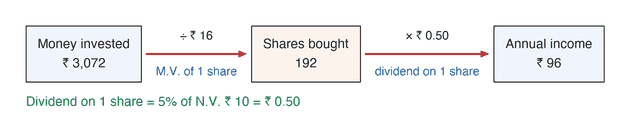
Given: Money invested = ₹ 3,072, rate of dividend = 5%, nominal value of one share = ₹ 10, market value of one share = ₹ 16.
Step 1 — Find the number of shares bought.
Each share costs ₹ 16, so we divide the money invested by ₹ 16.
So he buys 192 shares.
Step 2 — Part (i): find the dividend on one share.
The dividend is 5% of the nominal value ₹ 10.
So each share earns ₹ 0.50 a year.
Step 3 — Part (i): find his annual income.
All 192 shares earn ₹ 0.50 each, so we multiply.
So his annual income is ₹ 96.
Step 4 — Part (ii): find his percentage income.
We write the income as a percentage of the money invested.
So his percentage income is 3.125%.
Check: On one share he pays ₹ 16 and earns ₹ 0.50, which gives the same percentage.
Watch out: The 5% is on the nominal value ₹ 10, not on the ₹ 16 he pays. That is why his percentage income is less than 5%.
Therefore, (i) his annual income is ₹ 96; (ii) his percentage income is 3.125%.
- 103 marks
Question 10
A man invests ₹ 7,770 in a company paying 5 percent dividend when a share of nominal value of ₹ 100 sells at a premium of ₹ 5. Find :
(i) the number of shares bought;
(ii) annual income;
(iii) percentage income.
Solve with AIWritten solution
Solution:
Concept: Shares are bought at the market value (M.V. = N.V. + premium), but the dividend is paid on the nominal value (N.V.). The percentage income compares the yearly income with the money invested.
Given: Money invested = ₹ 7,770, rate of dividend = 5%, nominal value of one share = ₹ 100, premium = ₹ 5.
Step 1 — Find the M.V. of one share.
At a premium, the buyer pays the nominal value plus the premium.
So one share costs ₹ 105.
Step 2 — Part (i): find the number of shares bought.
Each share costs ₹ 105, so we divide the money invested by ₹ 105.
So he buys 74 shares.
Step 3 — Part (ii): find the annual income.
Each share earns 5% of its nominal value ₹ 100.
All 74 shares earn ₹ 5 each, so we multiply.
So his annual income is ₹ 370.

Step 4 — Part (iii): find the percentage income.
We write the income as a percentage of the money invested. Since 7,770 = 370 × 21, the fraction simplifies exactly.
So his percentage income is about 4.76%.
Check: On one share he pays ₹ 105 and earns ₹ 5, which gives the same fraction.
Watch out: The 5% dividend is on ₹ 100, but he pays ₹ 105 for each share, so his percentage income is a little under 5%.
Therefore, (i) he buys 74 shares; (ii) his annual income is ₹ 370; (iii) his percentage income is , about 4.76%.
- 113 marks
Question 11
A man buys ₹ 50 shares of a company, paying 12 percent dividend, at a premium of ₹ 10. Find :
(i) the market value of 320 shares;
(ii) his annual income;
(iii) his profit percent.
Solve with AIWritten solution
Solution:
Concept: He pays the market value (M.V. = N.V. + premium) for each share, but the dividend is worked out on the nominal value (N.V.). Here “profit percent” means his yearly income as a percentage of the money he paid.
Given: Nominal value of one share = ₹ 50, rate of dividend = 12%, premium = ₹ 10, number of shares = 320.
Step 1 — Find the M.V. of one share.
At a premium, the buyer pays the nominal value plus the premium.
So one share costs ₹ 60.
Step 2 — Part (i): find the market value of 320 shares.
Each share costs ₹ 60, so we multiply by 320.
So the market value of 320 shares is ₹ 19,200. This is the money he invests.
Step 3 — Part (ii): find his annual income.
Each share earns 12% of its nominal value ₹ 50.
All 320 shares earn ₹ 6 each, so we multiply.
So his annual income is ₹ 1,920.
Step 4 — Part (iii): find his profit percent.
We write the income as a percentage of the money he invested.
So his profit percent is 10%.
Check: On one share he pays ₹ 60 and earns ₹ 6, which is again 10%.
Watch out: The 12% is a rate on the nominal value ₹ 50. On the ₹ 60 he actually pays, his return is lower: 10%.
Therefore, (i) the market value of 320 shares is ₹ 19,200; (ii) his annual income is ₹ 1,920; (iii) his profit percent is 10%.
- 123 marks
Question 12
A man invests ₹ 8,800 in buying shares of a company of face value of rupees hundred each at a premium of 10%. If he earns ₹ 1,200 at the end of the year as dividend, find :
(i) the number of shares he has in the company.
(ii) the dividend percent per share.
Solve with AIWritten solution
Solution:
Concept: The number of shares comes from the price paid (M.V. = N.V. + premium), but the dividend percent is always worked out on the face value (N.V.) of a share.
Given: Money invested = ₹ 8,800, face value of one share = ₹ 100, premium = 10%, dividend earned in the year = ₹ 1,200.
Step 1 — Find the premium on one share.
The premium is 10% of the face value ₹ 100.
So each share carries a premium of ₹ 10.
Step 2 — Find the M.V. of one share.
At a premium, the buyer pays the face value plus the premium.
So one share costs ₹ 110.
Step 3 — Part (i): find the number of shares.
Each share costs ₹ 110, so we divide the money invested by ₹ 110.
So he has 80 shares.
Step 4 — Part (ii): find the dividend on one share.
The ₹ 1,200 is shared equally by his 80 shares, so we divide.
So each share earns ₹ 15.
Step 5 — Part (ii): find the dividend percent.
We write ₹ 15 as a percentage of the face value ₹ 100.
So the dividend is 15%.
Check: 15% of ₹ 100 is ₹ 15 on each share, and 80 shares then earn the ₹ 1,200 he received.
Watch out: The dividend percent is found on the face value ₹ 100, not on the ₹ 110 he paid (that would give about 13.64%).
Therefore, (i) he has 80 shares in the company; (ii) the dividend is 15% per share.
- 133 marks
Question 13
A man invests ₹ 1,680 in buying shares of nominal value ₹ 24 and selling at 12% premium. The dividend on the shares is 15% per annum. Calculate :
(i) the number of shares he buys;
(ii) the dividend he receives annually.
Solve with AIWritten solution
Solution:
Concept: Shares are bought at the market value (M.V. = N.V. + premium), and the dividend is paid on the nominal value (N.V.). A premium given as a percent is a percentage of the nominal value.
Given: Money invested = ₹ 1,680, nominal value of one share = ₹ 24, premium = 12%, rate of dividend = 15% per annum.
Step 1 — Find the premium on one share.
The premium is 12% of the nominal value ₹ 24.
So each share carries a premium of ₹ 2.88.
Step 2 — Find the M.V. of one share.
At a premium, the buyer pays the nominal value plus the premium.
So one share costs ₹ 26.88.
Step 3 — Part (i): find the number of shares.
Each share costs ₹ 26.88, so we divide the money invested by ₹ 26.88.
So the number of shares is 62.5.
Step 4 — Part (ii): find the dividend on one share.
The dividend is 15% of the nominal value ₹ 24.
So each share earns ₹ 3.60 a year.
Step 5 — Part (ii): find the annual dividend.
We multiply the number of shares by the dividend on one share.
So he receives ₹ 225 a year.
Check: The total nominal value of the shares is 62.5 × ₹ 24, that is ₹ 1,500, and 15% of it gives the same dividend.
Watch out: The 12% premium is a percentage of the nominal value ₹ 24, so it is ₹ 2.88, not ₹ 12.
Note: The printed numbers give 62.5 shares. In real life only whole shares can be bought, but we keep the value the question's data lead to.
Therefore, (i) he buys 62.5 shares (as the printed data give); (ii) the dividend he receives annually is ₹ 225.
- 143 marks
Question 14
By investing ₹ 7,500 in a company paying 10 percent dividend, an annual income of ₹ 500 is received. What price is paid for each of ₹ 100 share ?
Solve with AIWritten solution
Solution:
Concept: Work backwards. Each share earns a fixed dividend, so the annual income tells us how many shares he holds. Then price of one share = money invested ÷ number of shares.
Given: Money invested = ₹ 7,500, rate of dividend = 10%, annual income = ₹ 500, nominal value of one share = ₹ 100.
Step 1 — Find the dividend on one share.
The dividend is 10% of the nominal value ₹ 100.
So each share earns ₹ 10 a year.
Step 2 — Find the number of shares.
His income of ₹ 500 is made up of ₹ 10 from each share, so we divide.
So he holds 50 shares.
Step 3 — Find the price of each share.
The ₹ 7,500 bought these 50 shares, so we divide the money invested by 50.
So he paid ₹ 150 for each share.

Check: 50 shares at ₹ 150 cost ₹ 7,500, and they earn ₹ 10 each.
Watch out: Do not divide ₹ 7,500 by ₹ 100. That would count the shares only if they had been bought at par.
Therefore, ₹ 150 is paid for each ₹ 100 share.
- 151 mark
Question 15
The number of ₹ 25 shares, paying 24% dividend, with total dividend ₹ 1,350 is :
Solve with AIAnswer
(A) 125
(B) 27
- Correct
(C) 225
(D) 200
Answer: (C) 225
Concept: Every share earns the same dividend, a percentage of its nominal value (N.V.). So number of shares = total dividend ÷ dividend on one share.
Step 1 — Find the dividend on one share.
The dividend is 24% of the nominal value ₹ 25.
So each share earns ₹ 6.
Step 2 — Find the number of shares.
The total of ₹ 1,350 is made up of ₹ 6 from each share, so we divide.
So there are 225 shares.
Check: 225 shares at ₹ 6 each give the total dividend.
Watch out: The 24% is of ₹ 25 (one share), not of ₹ 1,350.
Why the other options are wrong:
- (A) 125: 125 shares would earn 125 × ₹ 6 = ₹ 750, not ₹ 1,350.
- (B) 27: 27 shares would earn 27 × ₹ 6 = ₹ 162, not ₹ 1,350.
- (D) 200: 200 shares would earn 200 × ₹ 6 = ₹ 1,200, which is ₹ 150 short of ₹ 1,350.
Therefore, the number of shares is 225, option (C).
- 161 mark
Question 16
₹ 600 shares of a company are available at a discount of 20%. If the company pays a dividend of 20%, the rate of return is :
Solve with AIAnswer
(A) 16%
- Correct
(B) 25%
(C) 10%
(D) 12·5%
Answer: (B) 25%
Concept: The dividend is a percentage of the nominal value (N.V.), but the rate of return is a percentage of the price actually paid (M.V.): rate of return = (dividend on one share ÷ M.V. of one share) × 100%.
Step 1 — Find the discount on one share.
The discount is 20% of the nominal value ₹ 600.
So each share is ₹ 120 cheaper.
Step 2 — Find the M.V. of one share.
We take the discount off the nominal value.
So one share costs ₹ 480.
Step 3 — Find the dividend on one share.
The dividend is 20% of the nominal value ₹ 600.
So each share earns ₹ 120 a year.
Step 4 — Find the rate of return.
We write the dividend as a percentage of the ₹ 480 paid.
So the rate of return is 25%.
Watch out: A share bought below its nominal value always returns more than its dividend rate. Here 25% is more than 20%.
Why the other options are wrong:
- (A) 16%: 16% is 20% of 80%: it multiplies the two percentages together. The right way is to find the rupee amounts first, ₹ 120 earned on ₹ 480 paid.
- (C) 10%: 10% of the price ₹ 480 is only ₹ 48, but each share earns ₹ 120.
- (D) 12·5%: 12.5% of the price ₹ 480 is only ₹ 60, but each share earns ₹ 120.
Therefore, the rate of return is 25%, option (B).
- 171 mark
Question 17
Rajesh invested ₹ 75,000 in a company paying 10% dividend. If ₹ 10 shares of this company are available for ₹ 15, the return on these shares is :
Solve with AIAnswer
(A) ₹ 2,500
- Correct
(B) ₹ 5,000
(C) ₹ 3,750
(D) ₹ 7,500
Answer: (B) ₹ 5,000
Concept: The number of shares depends on the price paid (M.V. = ₹ 15), but the dividend on each share is a percentage of its nominal value (N.V. = ₹ 10).
Step 1 — Find the number of shares bought.
Each share costs ₹ 15, so we divide the money invested by ₹ 15.
So Rajesh buys 5,000 shares.
Step 2 — Find the dividend on one share.
The dividend is 10% of the nominal value ₹ 10.
So each share earns ₹ 1 a year.
Step 3 — Find the return.
All 5,000 shares earn ₹ 1 each, so we multiply.
So the return is ₹ 5,000.
Watch out: Do not take 10% of the money invested. The dividend is 10% of the nominal value of the shares, not of the price paid.
Why the other options are wrong:
- (A) ₹ 2,500: this would mean only ₹ 0.50 on each of the 5,000 shares. Each share earns ₹ 1.
- (C) ₹ 3,750: this would mean ₹ 0.75 on each of the 5,000 shares. Each share earns ₹ 1.
- (D) ₹ 7,500: this is 10% of the money invested (10% of ₹ 75,000). The dividend is a percentage of the nominal value, not of the price paid.
Therefore, the return on these shares is ₹ 5,000, option (B).
- 181 mark
Question 18
100 shares, at par value of ₹ 120 each, give 10% half-yearly dividend. The annual dividend from these shares is :
Solve with AIAnswer
(A) ₹ 7,200
- Correct
(B) ₹ 2,400
(C) ₹ 1,200
(D) ₹ 10,800
Answer: (B) ₹ 2,400
Concept: A half-yearly dividend is paid twice a year, so annual dividend = 2 × the dividend for one half-year. The dividend is a percentage of the par (nominal) value, here ₹ 120.
Step 1 — Find the dividend on one share for one half-year.
The dividend is 10% of the par value ₹ 120.
So each share earns ₹ 12 every half-year.
Step 2 — Find the dividend on 100 shares for one half-year.
All 100 shares earn ₹ 12 each, so we multiply.
So the 100 shares earn ₹ 1,200 every half-year.
Step 3 — Find the annual dividend.
There are two half-years in a year, so we double it.
So the annual dividend is ₹ 2,400.
Watch out: 10% is the rate for each half-year, so the yearly dividend is twice as much.
Why the other options are wrong:
- (A) ₹ 7,200: this would need ₹ 72 on each share in a year. Each share earns ₹ 12 twice a year, which is ₹ 24.
- (C) ₹ 1,200: this is the dividend for only one half-year. It must be doubled for the whole year.
- (D) ₹ 10,800: this would need ₹ 108 on each share in a year, almost the whole value of the share (₹ 120). Each share earns only ₹ 24 in a year.
Therefore, the annual dividend is ₹ 2,400, option (B).
- 191 mark
Question 19
200 ₹ 20 shares, each available at a discount of 20%, give 10% dividend. The rate of return is :
Solve with AIAnswer
- Correct
(A) 12·5%
(B) 15%
(C) 16%
(D) 20%
Answer: (A) 12·5%
Concept: Rate of return = (dividend on one share ÷ M.V. of one share) × 100%. The dividend is found on the nominal value (N.V.); the return is found on the price paid (M.V.).
Step 1 — Find the discount on one share.
The discount is 20% of the nominal value ₹ 20.
So each share is ₹ 4 cheaper.
Step 2 — Find the M.V. of one share.
We take the discount off the nominal value.
So one share costs ₹ 16.
Step 3 — Find the dividend on one share.
The dividend is 10% of the nominal value ₹ 20.
So each share earns ₹ 2 a year.
Step 4 — Find the rate of return.
We write the dividend as a percentage of the ₹ 16 paid.
So the rate of return is 12.5%. The number of shares (200) does not change the rate: 200 shares cost ₹ 3,200 and earn ₹ 400, which is again 12.5%.
Watch out: The rate of return is on the ₹ 16 paid, not on the nominal value ₹ 20, so it is more than the 10% dividend rate.
Why the other options are wrong:
- (B) 15%: 15% of the price ₹ 16 is ₹ 2.40, but each share earns only ₹ 2.
- (C) 16%: 16 is the market value of one share in rupees (₹ 16), not a rate of return.
- (D) 20%: 20% is the rate of discount on the share, not the rate of return.
Therefore, the rate of return is 12.5%, option (A).
- 203 marks
Question 20
A man buys 75, ₹ 100 shares paying 9 percent dividend. He buys shares at such a price that he gets 12 percent of his money. At what price did he buy the shares ?
Solve with AIWritten solution
Solution:
Concept: The dividend on one share can be seen in two ways: as the dividend rate on the nominal value (N.V.), and as the return rate on the price paid (M.V.). So rate of dividend × N.V. = rate of return × M.V.
Given: Number of shares = 75, nominal value of one share = ₹ 100, rate of dividend = 9%, return on his money = 12%.
Step 1 — Find the dividend on one share.
The dividend is 9% of the nominal value ₹ 100.
So each share earns ₹ 9 a year.
Step 2 — Form an equation for the price.
Let him pay ₹ for one share. He gets 12% of his money, so 12% of must equal the ₹ 9 that one share earns.
Step 3 — Solve for .
We multiply both sides by 100 and divide by 12.
So he paid ₹ 75 for each share.
Check: 12% of ₹ 75 is ₹ 9, the dividend on one share.
Watch out: The number of shares (75) is not needed: the price works out the same for one share as for all of them.
Therefore, he bought the shares at ₹ 75 each.
- 213 marks
Question 21
By purchasing ₹ 25 gas shares for ₹ 40 each, a man gets 4 percent profit on his investment. What rate percent is the company paying ? What is his dividend if he buys 60 shares ?
Solve with AIWritten solution
Solution:
Concept: His profit is the dividend. On one share it is his profit rate on the price paid (M.V.), and it is also the company's dividend rate on the nominal value (N.V.).
Given: Nominal value of one share = ₹ 25, price paid = ₹ 40, profit on investment = 4%, number of shares = 60.
Step 1 — Find the dividend on one share.
His profit is 4% of the ₹ 40 he pays for each share.
So each share earns ₹ 1.60 a year.
Step 2 — Find the rate the company pays.
The company states its dividend as a percentage of the nominal value ₹ 25.
So the company is paying 6.4%.
Step 3 — Find his dividend on 60 shares.
Each of the 60 shares earns ₹ 1.60, so we multiply.
So his dividend is ₹ 96.
Check: 6.4% of the nominal value ₹ 25 gives the same ₹ 1.60 a share.
Watch out: The 4% is on the ₹ 40 he pays, not on the nominal value ₹ 25.
Therefore, the company is paying a dividend of 6.4%, and his dividend on 60 shares is ₹ 96.
- 223 marks
Question 22
Hundred rupee shares of a company are available in the market at a premium of ₹ 20. Find the rate of dividend given by the company when a man's return on his investment is 15 percent.
Solve with AIWritten solution
Solution:
Concept: The return is earned on the price paid (M.V.) and the dividend is declared on the nominal value (N.V.), but both describe the same money on one share. So rate of dividend × N.V. = rate of return × M.V.
Given: Nominal value of one share = ₹ 100, premium = ₹ 20, return on investment = 15%.
Step 1 — Find the M.V. of one share.
At a premium, the buyer pays the nominal value plus the premium.
So one share costs ₹ 120.
Step 2 — Find the dividend on one share.
His return is 15% of the ₹ 120 he pays.
So each share earns ₹ 18 a year.
Step 3 — Find the rate of dividend.
The company states the dividend as a percentage of the nominal value ₹ 100.
So the rate of dividend is 18%.
Watch out: The 15% return is on the ₹ 120 paid. The dividend rate on ₹ 100 comes out higher, 18%, because he paid more than the nominal value.
Therefore, the rate of dividend given by the company is 18%.
- 233 marks
Question 23
₹ 50 shares of a company are quoted at a discount of 10%. Find the rate of dividend given by the company, the return on the investment on these shares being 20 percent.
Solve with AIWritten solution
Solution:
Concept: The return is earned on the price paid (M.V.) and the dividend is declared on the nominal value (N.V.), but both describe the same money on one share. So rate of dividend × N.V. = rate of return × M.V.
Given: Nominal value of one share = ₹ 50, discount = 10%, return on investment = 20%.
Step 1 — Find the discount on one share.
The discount is 10% of the nominal value ₹ 50.
So each share is ₹ 5 cheaper.
Step 2 — Find the M.V. of one share.
We take the discount off the nominal value.
So one share costs ₹ 45.
Step 3 — Find the dividend on one share.
The return is 20% of the ₹ 45 paid.
So each share earns ₹ 9 a year.
Step 4 — Find the rate of dividend.
The company states the dividend as a percentage of the nominal value ₹ 50.
So the rate of dividend is 18%.
Check: 18% of the nominal value ₹ 50 is again ₹ 9 a share.
Watch out: The 20% return is on ₹ 45, the price paid, not on the nominal value ₹ 50.
Therefore, the rate of dividend given by the company is 18%.
- 243 marks
Question 24
A company declares 8 percent dividend to the shareholders. If a man receives ₹ 2,840 as his dividend, find the nominal value of his shares.
Solve with AIWritten solution
Solution:
Concept: A dividend is a percentage of the nominal value of the shares held. So total dividend = rate of dividend × total nominal value.
Given: Rate of dividend = 8%, dividend received = ₹ 2,840.
Step 1 — Form an equation.
Let the nominal value of all his shares be ₹ . The company pays 8% of this as dividend, and that is the ₹ 2,840 he receives.
Step 2 — Solve for .
We multiply both sides by 100 and divide by 8.
So the nominal value of his shares is ₹ 35,500.
Check: 8% of ₹ 35,500 is the dividend he received.
Watch out: The question asks for the nominal value of his shares, not for what he paid, so no market price is needed.
Therefore, the nominal value of his shares is ₹ 35,500.
- 253 marks
Question 25
How much should a man invest in ₹ 100 shares selling at ₹ 110 to obtain an annual income of ₹ 1,680, if the dividend declared is 12% ?
Solve with AIWritten solution
Solution:
Concept: First find how many shares are needed to earn the income, since each share earns a fixed dividend. Then money to invest = number of shares × market price of one share.
Given: Nominal value of one share = ₹ 100, market price of one share = ₹ 110, annual income wanted = ₹ 1,680, rate of dividend = 12%.
Step 1 — Find the dividend on one share.
The dividend is 12% of the nominal value ₹ 100.
So each share earns ₹ 12 a year.
Step 2 — Find the number of shares needed.
The income of ₹ 1,680 must come at ₹ 12 a share, so we divide.
So he needs 140 shares.
Step 3 — Find the money to invest.
Each share costs ₹ 110, so we multiply.
So he must invest ₹ 15,400.
Check: ₹ 15,400 buys 140 shares at ₹ 110, and they earn ₹ 12 each.
Watch out: Multiply the number of shares by the market price ₹ 110, not by the nominal value ₹ 100.
Therefore, he should invest ₹ 15,400.
- 263 marks
Question 26
A company declares a dividend of 11.2% to all its shareholders. If its ₹ 60 share is available in the market at a premium of 25%, how much should Rakesh invest, in buying the shares of this company, in order to have an annual income of ₹ 1,680 ?
Solve with AIWritten solution
Solution:
Concept: First find how many shares are needed to earn the income. Then money to invest = number of shares × M.V. of one share. The dividend is on the nominal value (N.V.); the price paid is the market value (M.V. = N.V. + premium).
Given: Rate of dividend = 11.2%, nominal value of one share = ₹ 60, premium = 25%, annual income wanted = ₹ 1,680.
Step 1 — Find the premium on one share.
The premium is 25% of the nominal value ₹ 60.
So each share carries a premium of ₹ 15.
Step 2 — Find the M.V. of one share.
At a premium, the buyer pays the nominal value plus the premium.
So one share costs ₹ 75.
Step 3 — Find the dividend on one share.
The dividend is 11.2% of the nominal value ₹ 60.
So each share earns ₹ 6.72 a year.
Step 4 — Find the number of shares needed.
The income of ₹ 1,680 must come at ₹ 6.72 a share, so we divide.
So Rakesh needs 250 shares.
Step 5 — Find the money to invest.
Each share costs ₹ 75, so we multiply.
So Rakesh must invest ₹ 18,750.

Check: 250 shares earn ₹ 6.72 each in a year.
Watch out: Both the 25% premium and the 11.2% dividend are percentages of the nominal value ₹ 60.
Therefore, Rakesh should invest ₹ 18,750.
- 273 marks
Question 27
A man buys 400, twenty-rupee shares at a premium of ₹ 4 each and receives a dividend of 12%. Find :
(i) the amount invested by him.
(ii) his total income from the shares.
(iii) percentage return on his money.
Solve with AIWritten solution
Solution:
Concept: He pays the market value (M.V. = N.V. + premium) for each share and earns the dividend on the nominal value (N.V.). His percentage return compares the income with the money he paid.
Given: Number of shares = 400, nominal value of one share = ₹ 20, premium = ₹ 4, rate of dividend = 12%.
Step 1 — Find the M.V. of one share.
At a premium, the buyer pays the nominal value plus the premium.
So one share costs ₹ 24.
Step 2 — Part (i): find the amount invested.
Each of the 400 shares costs ₹ 24, so we multiply.
So he invests ₹ 9,600.
Step 3 — Part (ii): find his total income.
Each share earns 12% of its nominal value ₹ 20.
All 400 shares earn ₹ 2.40 each, so we multiply.
So his total income is ₹ 960.
Step 4 — Part (iii): find the percentage return.
We write the income as a percentage of the amount invested.
So his percentage return is 10%.
Check: On one share he pays ₹ 24 and earns ₹ 2.40, which is again 10%.
Watch out: The 12% dividend is on the nominal value ₹ 20, not on the ₹ 24 he paid.
Therefore, (i) he invests ₹ 9,600; (ii) his total income is ₹ 960; (iii) his percentage return is 10%.
- 283 marks
Question 28
A man buys 400, twenty-rupee shares at a discount of 20% and receives a return of 12% on his money. Calculate :
(i) the amount invested by him.
(ii) the rate of dividend paid by the company.
Solve with AIWritten solution
Solution:
Concept: His return is a percentage of the money he invests (the market value). The same money is the dividend, which the company states as a percentage of the nominal value.
Given: Number of shares = 400, nominal value of one share = ₹ 20, discount = 20%, return on his money = 12%.
Step 1 — Find the discount on one share.
The discount is 20% of the nominal value ₹ 20.
So each share is ₹ 4 cheaper.
Step 2 — Find the M.V. of one share.
We take the discount off the nominal value.
So one share costs ₹ 16.
Step 3 — Part (i): find the amount invested.
Each of the 400 shares costs ₹ 16, so we multiply.
So he invests ₹ 6,400.
Step 4 — Find his income.
His return is 12% of the amount invested.
So his income is ₹ 768 a year.
Step 5 — Find the dividend on one share.
The ₹ 768 is shared equally by his 400 shares, so we divide.
So each share earns ₹ 1.92.
Step 6 — Part (ii): find the rate of dividend.
The company states the dividend as a percentage of the nominal value ₹ 20.
So the company pays a dividend of 9.6%.
Check: 9.6% of the nominal value ₹ 20 gives back the ₹ 1.92 a share earns.
Watch out: The 12% return is on the money invested (₹ 6,400), while the dividend rate is on the nominal value of the shares.
Therefore, (i) he invests ₹ 6,400; (ii) the company pays a dividend of 9.6%.
- 293 marks
Question 29
A company, with 10,000 shares of ₹ 100 each, declares an annual dividend of 5%.
(i) What is the total amount of dividend paid by the company ?
(ii) What should be the annual income of a man who has 72 shares in the company ?
(iii) If he received only 4% of his investment, find the price he paid for each share.
Solve with AIWritten solution
Solution:
Concept: The dividend is a percentage of the nominal value (N.V.), so every share earns the same amount. A man's return percent, however, is measured on the price he paid for the share.
Given: The company has 10,000 shares of nominal value ₹ 100 each, rate of dividend = 5%; the man holds 72 shares and gets 4% on his investment.
Step 1 — Find the dividend on one share.
The dividend is 5% of the nominal value ₹ 100.
So each share earns ₹ 5 a year.
Step 2 — Part (i): find the total dividend paid by the company.
All 10,000 shares earn ₹ 5 each, so we multiply.
So the company pays ₹ 50,000.
Step 3 — Part (ii): find the man's annual income.
His 72 shares earn ₹ 5 each.
So his annual income is ₹ 360.
Step 4 — Part (iii): form an equation for the price.
Let him pay ₹ for one share. His return is 4% of this price, and it equals the ₹ 5 a share earns.
Step 5 — Part (iii): solve for .
We multiply both sides by 100 and divide by 4.
So he paid ₹ 125 for each share.
Check: His investment is 72 × ₹ 125, that is ₹ 9,000, and 4% of it is his income.
Watch out: The 4% in part (iii) is on the price he paid, while the 5% is on the nominal value ₹ 100.
Therefore, (i) the company pays ₹ 50,000 in all; (ii) his annual income is ₹ 360; (iii) he paid ₹ 125 for each share.
- 303 marks
Question 30
A lady holds 1800, ₹ 100 shares of a company that pays 15% dividend annually. Calculate her annual dividend. If she had bought these shares at 40% premium, what is the return she gets as percent on her investment ? Give your answer to the nearest integer.
Solve with AIWritten solution
Solution:
Concept: The dividend is worked out on the nominal value (N.V.). The return percent compares that dividend with the money actually paid, which is the market value (M.V. = N.V. + premium).
Given: Number of shares = 1,800, nominal value of one share = ₹ 100, rate of dividend = 15%, premium = 40%.
Step 1 — Find the dividend on one share.
The dividend is 15% of the nominal value ₹ 100.
So each share earns ₹ 15 a year.
Step 2 — Find her annual dividend.
All 1,800 shares earn ₹ 15 each, so we multiply.
So her annual dividend is ₹ 27,000.
Step 3 — Find the premium on one share.
The premium is 40% of the nominal value ₹ 100.
So each share carries a premium of ₹ 40.
Step 4 — Find the price she paid for one share.
At a premium, the buyer pays the nominal value plus the premium.
So one share cost her ₹ 140.
Step 5 — Find her investment.
All 1,800 shares cost ₹ 140 each.
So her investment is ₹ 2,52,000.
Step 6 — Find the return percent.
We write the annual dividend as a percentage of her investment.
Rounded to the nearest integer, 10.71% is 11%.
Check: On one share she pays ₹ 140 and earns ₹ 15, which gives the same fraction.
Watch out: The return is on the ₹ 140 she paid for each share, so it is less than the 15% dividend rate.
Therefore, her annual dividend is ₹ 27,000, and her return is 11% (to the nearest integer) on her investment.
- 313 marks
Question 31
A man invests ₹ 11,200 in a company paying 6 percent per annum when its ₹ 100 shares can be bought for ₹ 140. Find :
(i) his annual dividend.
(ii) his percentage return on his investment.
Solve with AIWritten solution
Solution:
Concept: Shares are bought at the market value (here ₹ 140), but the dividend is paid on the nominal value (here ₹ 100). The percentage return compares the dividend with the money invested.
Given: Money invested = ₹ 11,200, rate of dividend = 6%, nominal value of one share = ₹ 100, market value of one share = ₹ 140.
Step 1 — Find the number of shares bought.
Each share costs ₹ 140, so we divide the money invested by ₹ 140.
So he buys 80 shares.
Step 2 — Part (i): find the dividend on one share.
The dividend is 6% of the nominal value ₹ 100.
So each share earns ₹ 6 a year.
Step 3 — Part (i): find his annual dividend.
All 80 shares earn ₹ 6 each, so we multiply.
So his annual dividend is ₹ 480.
Step 4 — Part (ii): find his percentage return.
We write the dividend as a percentage of the money invested.
So his percentage return is , about 4.29%.
Check: On one share he pays ₹ 140 and earns ₹ 6, which gives the same fraction.
Watch out: The 6% is on the nominal value ₹ 100. On the ₹ 140 he pays, his return is lower.
Therefore, (i) his annual dividend is ₹ 480; (ii) his percentage return is , about 4.29%.
- 323 marks
Question 32
Mr. Sharma has 60 shares of N.V. ₹ 100 and sells them when they are at a premium of 60%. He invests the proceeds in shares of nominal value ₹ 50, quoted at 4% discount, and paying 18% dividend annually. Calculate:
(i) the sale proceeds;
(ii) the number of shares he buys; and
(iii) his annual dividend from the shares.
Solve with AIWritten solution
Solution:
Concept: Shares are sold and bought at their market values. The money from the sale buys new shares at their M.V., and the new dividend is worked out on the new nominal value (N.V.).
Given: Old shares: 60 shares of nominal value ₹ 100, sold at a premium of 60%; new shares: nominal value ₹ 50, quoted at 4% discount, paying 18% dividend.
Step 1 — Find the selling price of one old share.
The premium is 60% of the nominal value ₹ 100.
At a premium, the share sells for its nominal value plus the premium.
So each old share sells for ₹ 160.
Step 2 — Part (i): find the sale proceeds.
All 60 shares sell at ₹ 160 each, so we multiply.
So the sale proceeds are ₹ 9,600.
Step 3 — Find the price of one new share.
The discount is 4% of the new nominal value ₹ 50.
At a discount, the share costs its nominal value minus the discount.
So each new share costs ₹ 48.
Step 4 — Part (ii): find the number of shares he buys.
The ₹ 9,600 buys shares at ₹ 48 each, so we divide.
So he buys 200 shares.
Step 5 — Part (iii): find his annual dividend.
Each new share earns 18% of its nominal value ₹ 50.
All 200 shares earn ₹ 9 each, so we multiply.
So his annual dividend is ₹ 1,800.

Check: 200 shares at ₹ 48 cost exactly the sale proceeds.
Watch out: The 4% discount and the 18% dividend are both on the new nominal value ₹ 50, not on ₹ 100.
Therefore, (i) the sale proceeds are ₹ 9,600; (ii) he buys 200 shares; (iii) his annual dividend from the shares is ₹ 1,800.
- 333 marks
Question 33
A company with 10,000 shares of nominal value ₹ 100 declares an annual dividend of 8% to the share-holders.
(i) Calculate the total amount of dividend paid by the company.
(ii) Ramesh had bought 90 shares of the company at ₹ 150 per share. Calculate the dividend he receives and the percentage of return on his investment.
Solve with AIWritten solution
Solution:
Concept: The dividend is a percentage of the nominal value (N.V.), so every share earns the same amount whatever price was paid for it. The percentage return compares that dividend with the price paid.
Given: The company has 10,000 shares of nominal value ₹ 100, rate of dividend = 8%; Ramesh holds 90 shares bought at ₹ 150 each.
Step 1 — Find the dividend on one share.
The dividend is 8% of the nominal value ₹ 100.
So each share earns ₹ 8 a year.
Step 2 — Part (i): find the total dividend paid by the company.
All 10,000 shares earn ₹ 8 each, so we multiply.
So the company pays ₹ 80,000.
Step 3 — Part (ii): find the dividend Ramesh receives.
His 90 shares earn ₹ 8 each.
So Ramesh receives ₹ 720.
Step 4 — Part (ii): find his investment.
He paid ₹ 150 for each of his 90 shares.
So he invested ₹ 13,500.
Step 5 — Part (ii): find his percentage return.
We write his dividend as a percentage of his investment.
So his return is , about 5.33%.
Check: On one share he pays ₹ 150 and earns ₹ 8, which gives the same fraction.
Watch out: The price Ramesh paid (₹ 150) does not change his dividend; it changes only his percentage return.
Therefore, (i) the company pays a total dividend of ₹ 80,000; (ii) Ramesh receives ₹ 720, a return of (about 5.33%) on his investment.
- 343 marks
Question 34
Which is the better investment : 16% ₹ 100 shares at 80 or 20% ₹ 100 shares at 120 ?
Solve with AIWritten solution
Solution:
Concept: The better investment is the one with the higher return percent (income on one share ÷ price paid × 100%), not the one with the higher dividend rate.
Given: First investment: 16% shares of nominal value ₹ 100 at ₹ 80; second investment: 20% shares of nominal value ₹ 100 at ₹ 120.
Step 1 — Find the return from the first investment.
Each share earns 16% of ₹ 100, and “at 80” means it costs ₹ 80.
We write ₹ 16 as a percentage of the ₹ 80 paid.
So the first investment returns 20%.
Step 2 — Find the return from the second investment.
Each share earns 20% of ₹ 100, and “at 120” means it costs ₹ 120.
We write ₹ 20 as a percentage of the ₹ 120 paid.
So the second investment returns .
Step 3 — Compare the two returns.
The table puts the two investments side by side.
Investment Price paid Income on one share Return 16% shares at ₹ 80 ₹ 80 ₹ 16 20% 20% shares at ₹ 120 ₹ 120 ₹ 20 Since 20% is more than , the first investment gives more income for every rupee invested.
Check: Put ₹ 240 into each. It buys 3 shares of the first kind or 2 shares of the second kind.
The first earns ₹ 48 and the second only ₹ 40.
Watch out: The higher dividend rate (20%) does not make an investment better; what matters is the income for each rupee invested.
Therefore, the first investment, 16% ₹ 100 shares at ₹ 80, is the better investment.
- 353 marks
Question 35
A man has a choice to invest in hundred-rupee shares of two firms at ₹ 120 or at ₹ 132. The first firm pays a dividend of 5% per annum and the second firm pays a dividend of 6% per annum. Find :
(i) which company is giving a better return.
(ii) if a man invests ₹ 26,400 with each firm, how much will be the difference between the annual returns from the two firms ?
Solve with AIWritten solution
Solution:
Concept: To compare two firms, compare their return percent: dividend on one share ÷ price of one share × 100%. The firm with the higher return percent gives the better return.
Given: Nominal value of each share = ₹ 100; first firm: price ₹ 120, dividend 5%; second firm: price ₹ 132, dividend 6%; in part (ii), ₹ 26,400 goes into each firm.
Step 1 — Find the dividend on one share of each firm.
Each dividend is a percentage of the nominal value ₹ 100. For the first firm:
For the second firm:
So a share of the first firm earns ₹ 5 and a share of the second firm earns ₹ 6.
Step 2 — Part (i): find the return from the first firm.
We write ₹ 5 as a percentage of the ₹ 120 paid.
Step 3 — Part (i): find the return from the second firm.
We write ₹ 6 as a percentage of the ₹ 132 paid.
Since 4.55% is more than 4.17%, the second firm gives the better return.
Step 4 — Part (ii): find the income from the first firm.
₹ 26,400 buys shares at ₹ 120 each.
Each of these shares earns ₹ 5.
Step 5 — Part (ii): find the income from the second firm.
₹ 26,400 buys shares at ₹ 132 each.
Each of these shares earns ₹ 6.
Step 6 — Part (ii): find the difference.
We subtract the smaller income from the larger.
So the annual returns differ by ₹ 100. The second firm earns more here too, which agrees with part (i).
Watch out: The firm with the lower price per share is not automatically better; compare the income for each rupee invested.
Therefore, (i) the second firm (₹ 132 shares paying 6%) gives the better return; (ii) the difference between the annual returns is ₹ 100.
- 363 marks
Question 36
A man bought 360, ten-rupee shares of a company, paying 12 percent per annum. He sold the shares when their price rose to ₹ 21 per share and invested the proceeds in five-rupee shares paying 4.5 percent per annum at ₹ 3.50 per share. Find the annual change in his income.
Solve with AIWritten solution
Solution:
Concept: Find his income before and after the change. Selling the old shares gives money (number of shares × selling price), which buys new shares at their market price. The dividend on each kind of share is always on its own nominal value.
Given: Old shares: 360 shares of nominal value ₹ 10 paying 12%, sold at ₹ 21 each; new shares: nominal value ₹ 5, paying 4.5%, bought at ₹ 3.50 each.
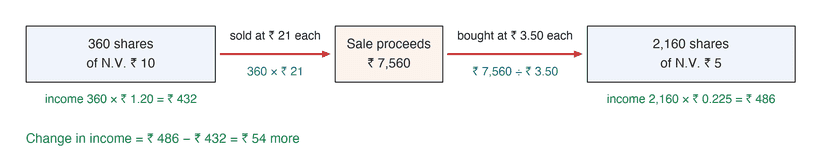
Step 1 — Find the old income.
Each old share earns 12% of its nominal value ₹ 10.
All 360 shares earn ₹ 1.20 each.
So his old income is ₹ 432 a year.
Step 2 — Find the sale proceeds.
He sells all 360 shares at ₹ 21 each.
So he gets ₹ 7,560.
Step 3 — Find the number of new shares.
The ₹ 7,560 buys new shares at ₹ 3.50 each, so we divide.
So he buys 2,160 new shares.
Step 4 — Find the new income.
Each new share earns 4.5% of its nominal value ₹ 5.
All 2,160 shares earn ₹ 0.225 each.
So his new income is ₹ 486 a year.
Step 5 — Find the change in income.
We subtract the old income from the new income.
The new income is larger, so his income increases by ₹ 54 a year.
Check: 2,160 shares at ₹ 3.50 cost exactly the sale proceeds.
Watch out: The 4.5% is on the new nominal value ₹ 5, not on the ₹ 3.50 he pays for each new share.
Therefore, his annual income increases by ₹ 54.
- 373 marks
Question 37
A man sold 400 (₹ 20) shares of a company, paying 5% at ₹ 18 and invested the proceeds in (₹ 10) shares of another company paying 7% at ₹ 12. How many (₹ 10) shares did he buy and what was the change in his income?
Solve with AIWritten solution
Solution:
Concept: Shares are sold and bought at their market prices, but the dividend is always worked out on the nominal value. Compare the income from the old shares with the income from the new shares.
Given: Old shares: 400 shares of nominal value ₹ 20 paying 5%, sold at ₹ 18 each; new shares: nominal value ₹ 10, paying 7%, bought at ₹ 12 each.
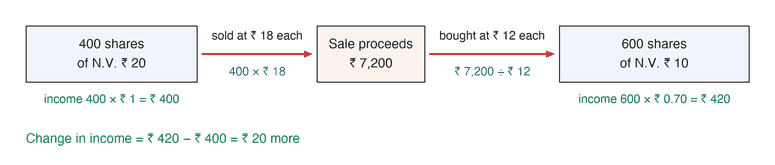
Step 1 — Find the old income.
Each old share earns 5% of its nominal value ₹ 20.
All 400 shares earn ₹ 1 each.
So his old income is ₹ 400 a year.
Step 2 — Find the sale proceeds.
He sells all 400 shares at ₹ 18 each.
So he gets ₹ 7,200.
Step 3 — Find the number of ₹ 10 shares bought.
The ₹ 7,200 buys new shares at ₹ 12 each, so we divide.
So he buys 600 shares.
Step 4 — Find the new income.
Each new share earns 7% of its nominal value ₹ 10.
All 600 shares earn ₹ 0.70 each.
So his new income is ₹ 420 a year.
Step 5 — Find the change in income.
We subtract the old income from the new income.
The new income is larger, so his income increased by ₹ 20 a year.
Check: 600 shares at ₹ 12 cost exactly the sale proceeds.
Watch out: The shares are sold at ₹ 18, not at their nominal value ₹ 20, so the proceeds are ₹ 7,200, not ₹ 8,000.
Therefore, he bought 600 shares of ₹ 10, and his income increased by ₹ 20 a year.
- 383 marks
Question 38
Two brothers A and B invest ₹ 16,000 each in buying shares of two companies. A buys 3% hundred-rupee shares at 80 and B buys ten-rupee shares at par. If they both receive equal dividend at the end of the year, find the rate percent of the dividend received by B.
Solve with AIWritten solution
Solution:
Concept: Find A's dividend first. B receives the same dividend, so share it among B's shares and write the dividend on one share as a percentage of its nominal value.
Given: Each brother invests ₹ 16,000; A buys 3% shares of nominal value ₹ 100 at ₹ 80; B buys shares of nominal value ₹ 10 at par; both receive the same dividend.
Step 1 — Find the number of shares A buys.
“At 80” means each of A's shares costs ₹ 80, so we divide.
So A buys 200 shares.
Step 2 — Find A's dividend.
Each of A's shares earns 3% of its nominal value ₹ 100.
All 200 shares earn ₹ 3 each.
So A's dividend is ₹ 600.
Step 3 — Find the number of shares B buys.
“At par” means B pays the nominal value, ₹ 10, for each share.
So B buys 1,600 shares.
Step 4 — Find the dividend on one share of B.
B also receives ₹ 600, shared equally by his 1,600 shares.
So each of B's shares earns ₹ 0.375.
Step 5 — Find B's rate of dividend.
We write ₹ 0.375 as a percentage of the nominal value ₹ 10.
So B's rate of dividend is 3.75%.
Check: B's shares are at par, so their total nominal value is the ₹ 16,000 he invested, and 3.75% of it equals A's dividend.
Watch out: “at 80” for A's shares means ₹ 80 a share, while “at par” for B's shares means ₹ 10 a share.
Therefore, B receives a dividend of 3.75%.
- 391 mark
Question 39
A company pays 18% dividend and its ₹ 100 share is available at a premium of 20%. The number of shares bought for ₹ 7,200 is :
Solve with AIAnswer
(A) 1080
(B) 90
- Correct
(C) 60
(D) 540
Answer: (C) 60
Concept: Shares are bought at their market value (M.V.), so number of shares = money invested ÷ M.V. of one share. The rate of dividend is not needed to count the shares.
Step 1 — Find the premium on one share.
The premium is 20% of the nominal value ₹ 100.
So each share carries a premium of ₹ 20.
Step 2 — Find the M.V. of one share.
At a premium, the buyer pays the nominal value plus the premium.
So one share costs ₹ 120.
Step 3 — Find the number of shares.
The ₹ 7,200 buys shares at ₹ 120 each, so we divide.
So 60 shares are bought.
Check: 60 shares at ₹ 120 cost exactly the money invested.
Watch out: Dividing by the face value gives 72 shares, which is wrong. Shares are always bought at the market value.
Why the other options are wrong:
- (A) 1080: this brings in the dividend rate: 7,200 × 18 ÷ 120 gives 1,080. The dividend rate decides the income, not the number of shares.
- (B) 90: this subtracts the premium: 7,200 ÷ (100 − 20) gives 90. A premium is added to the nominal value.
- (D) 540: 540 shares at ₹ 120 each would cost ₹ 64,800, far more than ₹ 7,200.
Therefore, the number of shares bought is 60, option (C).
- 401 mark
Question 40
100, ₹ 100 shares (paying 10% dividend) are bought at a discount of ₹ 20 and another 100, ₹ 100 shares (paying 10% dividend) are bought at ₹ 120. The total dividend earned is :
Solve with AIAnswer
(A) ₹ 00
- Correct
(B) ₹ 2,000
(C) ₹ 400
(D) ₹ 2,400
Answer: (B) ₹ 2,000
Concept: The dividend depends only on the nominal value (N.V.) of a share and the rate of dividend. The price paid for the share does not change it.
Step 1 — Find the dividend on one share.
Every share has a nominal value of ₹ 100 and pays 10%.
So every share earns ₹ 10, whether it was bought at ₹ 80 or at ₹ 120.
Step 2 — Find the total number of shares.
There are two lots of 100 shares.
So there are 200 shares in all.
Step 3 — Find the total dividend.
All 200 shares earn ₹ 10 each, so we multiply.
So the total dividend is ₹ 2,000.
Watch out: The ₹ 20 discount and the ₹ 120 price only change how much money was invested. They do not change the dividend.
Why the other options are wrong:
- (A) ₹ 00: the book prints “₹ 00” here, which is not a real amount (most likely a misprint). In any case the dividend cannot be nil, because every share earns ₹ 10.
- (C) ₹ 400: this would mean only ₹ 2 on each of the 200 shares. Each share earns ₹ 10.
- (D) ₹ 2,400: this takes 10% of the price ₹ 120 for all the shares (200 × ₹ 12). The dividend is 10% of the nominal value ₹ 100, not of the price paid.
Therefore, the total dividend earned is ₹ 2,000, option (B).
- 411 mark
Question 41
The money required, to buy 80 shares, each of ₹ 60 and quoted at ₹ 70, is :
Solve with AIAnswer
- Correct
(A) ₹ 5,600
(B) ₹ 4,800
(C) ₹ 80 × 60 × 70
(D) ₹ 4,200
Answer: (A) ₹ 5,600
Concept: The price at which a share is quoted is its market value (M.V.), the price a buyer pays. Money required = number of shares × M.V. of one share.
Step 1 — Read the M.V. of one share.
“Quoted at ₹ 70” tells us the market price of one share. So the buyer pays ₹ 70 for each share, not the nominal value of ₹ 60.
Step 2 — Find the money required.
Each of the 80 shares costs ₹ 70, so we multiply.
So ₹ 5,600 is required.
Watch out: Shares are bought at the quoted price, not at the nominal value.
Why the other options are wrong:
- (B) ₹ 4,800: this uses the nominal value instead of the quoted price: 80 × ₹ 60 gives ₹ 4,800.
- (C) ₹ 80 × 60 × 70: this multiplies by both the nominal value and the market value, which gives ₹ 3,36,000. Each share is paid for once, at ₹ 70.
- (D) ₹ 4,200: this is 60 × 70, the product of the two prices, and it leaves out the number of shares (80).
Therefore, the money required is ₹ 5,600, option (A).
- 421 mark
Question 42
₹ 20,000 is spent in buying ₹ 50 shares with dividend 5%. The dividend earned is:
Solve with AIAnswer
- Correct
(A) ₹ 1,000
(B) ₹ 200
(C) ₹ 500
(D) ₹ 2,000
Answer: (A) ₹ 1,000
Concept: No premium or discount is mentioned, so the shares are bought at par, at their nominal value of ₹ 50. Dividend = number of shares × dividend on one share.
Step 1 — Find the number of shares.
Each share costs ₹ 50, so we divide the money spent by ₹ 50.
So 400 shares are bought.
Step 2 — Find the dividend on one share.
The dividend is 5% of the nominal value ₹ 50.
So each share earns ₹ 2.50.
Step 3 — Find the total dividend.
All 400 shares earn ₹ 2.50 each, so we multiply.
So the dividend earned is ₹ 1,000.
Check: At par the money spent equals the total nominal value, and 5% of it gives the same dividend.
Watch out: Taking the dividend as 5% of ₹ 100 (₹ 5 a share) gives ₹ 2,000, but these are ₹ 50 shares.
Why the other options are wrong:
- (B) ₹ 200: this would mean only ₹ 0.50 on each of the 400 shares. Each share earns ₹ 2.50.
- (C) ₹ 500: this would mean ₹ 1.25 on each share, which is half of the correct ₹ 2.50.
- (D) ₹ 2,000: this would mean ₹ 5 on each share. That is 5% of ₹ 100, but these are ₹ 50 shares.
Therefore, the dividend earned is ₹ 1,000, option (A).
- 431 mark
Question 43
Each of ₹ 500 shares is available at a discount of ₹ 100. If the dividend on these shares is 8%, the income percent is :
Solve with AIAnswer
(A) 8%
(B) 15%
(C) 5%
- Correct
(D) 10%
Answer: (D) 10%
Concept: Income percent (rate of return) is the dividend on one share written as a percentage of the money paid for it (its M.V.), not of its nominal value.
Step 1 — Find the M.V. of one share.
At a discount of ₹ 100, the buyer pays the nominal value minus ₹ 100.
So one share costs ₹ 400.
Step 2 — Find the dividend on one share.
The dividend is 8% of the nominal value ₹ 500.
So each share earns ₹ 40 a year.
Step 3 — Find the income percent.
We write the dividend as a percentage of the ₹ 400 paid.
So the income percent is 10%.
Watch out: A share bought below its nominal value always gives an income percent higher than its dividend rate; here 10% is more than 8%.
Why the other options are wrong:
- (A) 8%: 8% is the rate of dividend on the nominal value. It would be the income percent only if the share were bought at par (₹ 500).
- (B) 15%: 15% of ₹ 400 is ₹ 60, but one share earns only ₹ 40.
- (C) 5%: 5% of ₹ 400 is ₹ 20, but one share earns ₹ 40. A share bought at a discount cannot give less than its 8% dividend rate.
Therefore, the income percent is 10%, option (D).
- 441 mark
Question 44
Investing in 16% ₹ 100 shares at ₹ 80 or in 20% ₹ 100 shares at ₹ 120.
Assertion (A) : It is better to invest in 16% ₹ 100 shares at ₹ 80.
Reason (R) : Return % from the shares .
Solve with AIAnswer
(A) A is true, R is false.
(B) A is false, R is true.
- Correct
(C) Both A and R are true and R is the correct reason for A.
(D) Both A and R are true and R is the incorrect reason for A.
Answer: (C) Both A and R are true and R is the correct reason for A.
Concept: To compare two investments, compare their return percent: the income from one share as a percentage of the price paid for it.
Step 1 — Judge the Reason.
The Reason gives the formula for the return percent: income as a percentage of the money invested. This is the correct formula, so the Reason is true.
Step 2 — Find the return from the first shares.
Each 16% ₹ 100 share earns 16% of ₹ 100 and costs ₹ 80.
We write ₹ 16 as a percentage of the ₹ 80 paid.
So the first investment returns 20%.
Step 3 — Find the return from the second shares.
Each 20% ₹ 100 share earns 20% of ₹ 100 and costs ₹ 120.
We write ₹ 20 as a percentage of the ₹ 120 paid.
So the second investment returns .
Step 4 — Judge the Assertion.
20% is more than , so the 16% shares at ₹ 80 give more income for every rupee invested. The Assertion is true.
Step 5 — Decide whether the Reason explains the Assertion.
The Assertion was decided by working out each return with the formula in the Reason, so the Reason is the correct reason for the Assertion.
Watch out: Do not compare the dividend rates (16% and 20%) directly; compare the returns on the money paid.
Why the other options are wrong:
- (A) A is true, R is false: the Reason is the standard formula for the return percent, so it is not false.
- (B) A is false, R is true: the Assertion is not false: the first investment returns 20%, more than the of the second.
- (D) Both A and R are true and R is the incorrect reason for A: the Reason is exactly the rule used to compare the two investments, so it is the correct reason for the Assertion.
Therefore, both the Assertion and the Reason are true and the Reason is the correct reason for the Assertion, option (C).
- 451 mark
Question 45
₹ 50 shares of a company are bought by John at 20% discount and sold at a gain of 25%.
Assertion (A) : The net gain on each share is 5%.
Reason (R) : For John, the selling price of each share is
Solve with AIAnswer
(A) A is true, R is false.
- Correct
(B) A is false, R is true.
(C) Both A and R are true and R is the correct reason for A.
(D) Both A and R are true and R is the incorrect reason for A.
Answer: (B) A is false, R is true.
Concept: A discount on a share is a percentage of its nominal value, but a gain percent is always counted on the cost price (the price John paid). The two percentages are of different amounts, so they cannot simply be subtracted.
Step 1 — Find the buying price of one share.
A 20% discount means John pays 80% of the nominal value ₹ 50.
So John pays ₹ 40 for each share.
Step 2 — Find the selling price of one share.
A gain of 25% means he sells for 125% of his cost.
So he sells each share for ₹ 50.
Step 3 — Judge the Reason.
Putting the buying price from Step 1 into Step 2 gives exactly the expression in the Reason.
So the Reason is true.
Step 4 — Judge the Assertion.
The gain on one share is the selling price minus the buying price.
We write the gain as a percentage of his cost.
So the gain is 25% of his cost, not 5%. A gain of 5% would be only ₹ 2 on a cost of ₹ 40. The Assertion is false.
Watch out: 25% − 20% is not the net gain, because the 20% is of ₹ 50 and the 25% is of ₹ 40.
Why the other options are wrong:
- (A) A is true, R is false: it is the other way round: the Assertion is false (the gain is 25%) and the Reason is true (it gives the selling price ₹ 50).
- (C) Both A and R are true and R is the correct reason for A: the Assertion is false, because the gain on each share is ₹ 10 on a cost of ₹ 40, which is 25%.
- (D) Both A and R are true and R is the incorrect reason for A: the Assertion is false, so this option, which needs both statements to be true, cannot be right.
Therefore, the Assertion is false and the Reason is true, option (B).
- 461 mark
Question 46
₹ 2,250 is invested in buying ₹ 50 shares available at 10% discount and the dividend paid by the company is 12%.
Statement (1) : Number of shares bought .
Statement (2) : Total dividend paid by the company = (12% of ₹ 50) × 50
Solve with AIAnswer
- Correct
(A) Both the statements are true.
(B) Both the statements are false.
(C) Statement 1 is true, and statement 2 is false.
(D) Statement 1 is false, and statement 2 is true.
Answer: (A) Both the statements are true.
Concept: Shares are bought at the market value (M.V.), so the number of shares uses the M.V. The dividend is paid on the nominal value (N.V.), so the dividend uses the N.V.
Step 1 — Find the M.V. of one share.
The discount is 10% of the nominal value ₹ 50.
We take it off the nominal value.
So one share costs ₹ 45.
Step 2 — Check Statement 1.
Number of shares = money invested ÷ M.V. of one share.
This is exactly what Statement 1 says, so Statement 1 is true.
Step 3 — Check Statement 2.
The dividend on one share is 12% of the nominal value ₹ 50, and there are 50 shares.
Statement 2 works out (12% of ₹ 50) × 50 in the same way: on the nominal value ₹ 50 and for the right number of shares. So Statement 2 is true.
Watch out: “total dividend paid by the company” here means the dividend paid to this investor on his 50 shares. It is worked on the nominal value ₹ 50, not on the price ₹ 45.
Why the other options are wrong:
- (B) Both the statements are false: neither statement is false: the working gives 50 shares and a dividend of (12% of ₹ 50) × 50, which is ₹ 300.
- (C) Statement 1 is true, and statement 2 is false: Statement 2 is not false; it correctly takes the dividend on the nominal value ₹ 50.
- (D) Statement 1 is false, and statement 2 is true: Statement 1 is not false; the M.V. is ₹ 45, and 2,250 ÷ 45 gives 50.
Therefore, both the statements are true, option (A).
- 471 mark
Question 47
100 shares are bought at ₹ 60 per share and the dividend received is ₹ 600.
Statement (1) : Rate of return × ₹ 60 × 100 = ₹ 600
Statement (2) : Rate of return × Market value = Dividend received on each share
Solve with AIAnswer
- Correct
(A) Both the statements are true.
(B) Both the statements are false.
(C) Statement 1 is true, and statement 2 is false.
(D) Statement 1 is false, and statement 2 is true.
Answer: (A) Both the statements are true.
Concept: The rate of return is the dividend written as a percentage of the money invested. So rate of return × money invested = dividend, for all the shares together and also for one share.
Step 1 — Find the money invested.
He bought 100 shares at ₹ 60 each.
So he invested ₹ 6,000.
Step 2 — Find the rate of return.
We write the dividend ₹ 600 as a percentage of the money invested.
So the rate of return is 10%.
Step 3 — Check Statement 1.
₹ 60 × 100 is the money invested, so Statement 1 says rate of return × money invested gives the dividend.
This is the ₹ 600 received, so Statement 1 is true.
Step 4 — Check Statement 2.
The dividend on each share is the total dividend shared by the 100 shares.
The rate of return times the market value of one share gives the same amount.
So Statement 2 is true.
Watch out: Statement 2 is just Statement 1 divided by the number of shares (100) on both sides, so the two stand or fall together.
Why the other options are wrong:
- (B) Both the statements are false: both statements hold with the rate of return 10%, as Steps 3 and 4 show.
- (C) Statement 1 is true, and statement 2 is false: Statement 2 is not false: 10% of ₹ 60 is ₹ 6, the dividend on each share.
- (D) Statement 1 is false, and statement 2 is true: Statement 1 is not false: 10% of ₹ 6,000 is ₹ 600, the total dividend.
Therefore, both the statements are true, option (A).
- 483 marks
Question 48
By investing ₹ 45,000 in 10% ₹ 100 shares, Sharad gets ₹ 3,000 as dividend. Find the market value of each share.
Solve with AIWritten solution
Solution:
Concept: Work backwards. Each share earns a fixed dividend, so the total dividend tells us the number of shares. Then M.V. of one share = money invested ÷ number of shares.
Given: Money invested = ₹ 45,000, rate of dividend = 10%, nominal value of one share = ₹ 100, total dividend = ₹ 3,000.
Step 1 — Find the dividend on one share.
The dividend is 10% of the nominal value ₹ 100.
So each share earns ₹ 10 a year.
Step 2 — Find the number of shares.
The ₹ 3,000 is made up of ₹ 10 from each share, so we divide.
So Sharad holds 300 shares.
Step 3 — Find the market value of each share.
The ₹ 45,000 bought these 300 shares, so we divide.
So each share cost ₹ 150.

Check: 300 shares at ₹ 150 cost ₹ 45,000, and they earn ₹ 10 each.
Watch out: Do not divide ₹ 45,000 by ₹ 100; that assumes the shares were bought at par.
Therefore, the market value of each share is ₹ 150.
- 493 marks
Question 49
Mrs. Kulkarni invests ₹ 1,31,040 in buying ₹ 100 shares at a discount of 9%. She sells shares worth ₹ 72,000 at a premium of 10% and the rest at a discount of 5%. Find her total gain or loss on the whole.
Solve with AIWritten solution
Solution:
Concept: “Shares worth ₹ 72,000” means shares whose nominal value adds up to ₹ 72,000. Gain or loss = total money received on selling − money invested.
Given: Money invested = ₹ 1,31,040, nominal value of one share = ₹ 100, bought at a discount of 9%; shares worth ₹ 72,000 sold at a premium of 10%, the rest at a discount of 5%.
Step 1 — Find the buying price of one share.
The discount is 9% of the nominal value ₹ 100.
We take it off the nominal value.
So each share cost ₹ 91.
Step 2 — Find the number of shares bought.
The ₹ 1,31,040 bought shares at ₹ 91 each, so we divide.
So she bought 1,440 shares.
Step 3 — Find the money from the first lot.
Shares worth ₹ 72,000 in nominal value are ₹ 72,000 ÷ ₹ 100 shares.
At a premium of 10% (₹ 10 on ₹ 100), each sells for:
So this lot brings in:
Step 4 — Find the money from the second lot.
The rest of the shares are sold at a discount of 5% (₹ 5 on ₹ 100).
Each of these sells for:
So this lot brings in:
Step 5 — Find the gain or loss.
We add the money from the two lots and compare it with the money invested.
She receives more than she invested, so she makes a gain.
So her gain is ₹ 16,560.

Check: She gains ₹ 19 (₹ 110 − ₹ 91) on each share of the first lot and ₹ 4 (₹ 95 − ₹ 91) on each share of the second lot.
Watch out: ₹ 72,000 is a nominal value, not money received; at a 10% premium those shares sell for ₹ 79,200.
Therefore, she makes a gain of ₹ 16,560 on the whole.
- 503 marks
Question 50
A man invests a certain sum in buying 15% ₹ 100 shares at 20% premium. Find :
(i) his income from one share.
(ii) the number of shares bought to have an income, from the dividend, ₹ 6,480.
(iii) sum invested.
Solve with AIWritten solution
Solution:
Concept: Shares are bought at the market value (M.V. = N.V. + premium), but the dividend is paid on the nominal value (N.V.).
Given: Rate of dividend = 15%, nominal value of one share = ₹ 100, premium = 20%, income wanted = ₹ 6,480.
Step 1 — Part (i): find the income from one share.
The dividend is 15% of the nominal value ₹ 100.
So his income from one share is ₹ 15.
Step 2 — Part (ii): find the number of shares.
The income of ₹ 6,480 must come at ₹ 15 a share, so we divide.
So he must buy 432 shares.
Step 3 — Find the M.V. of one share.
The premium is 20% of the nominal value ₹ 100.
At a premium, the buyer pays the nominal value plus the premium.
So one share costs ₹ 120.
Step 4 — Part (iii): find the sum invested.
All 432 shares cost ₹ 120 each, so we multiply.
So the sum invested is ₹ 51,840.
Check: His return on the sum invested is the same as ₹ 15 earned on each ₹ 120 paid.
Watch out: The shares are counted from the income (₹ 15 each), but they are paid for at ₹ 120 each, not ₹ 100.
Therefore, (i) his income from one share is ₹ 15; (ii) he must buy 432 shares; (iii) the sum invested is ₹ 51,840.
- 513 marks
Question 51
Ashwarya bought 496, ₹ 100 shares at ₹ 132 each. Find :
(i) investment made by her.
(ii) income of Ashwarya from these shares, if the rate of dividend is 7·5%.
(iii) how much extra must Ashwarya invest in order to increase her income by ₹ 7,200 ?
Solve with AIWritten solution
Solution:
Concept: Shares are bought at the market value (here ₹ 132), but the dividend is paid on the nominal value (here ₹ 100). Every extra share costs ₹ 132 and adds the same dividend to her income.
Given: Number of shares = 496, nominal value of one share = ₹ 100, market value of one share = ₹ 132, rate of dividend = 7.5%, increase wanted in income = ₹ 7,200.
Step 1 — Part (i): find her investment.
All 496 shares cost ₹ 132 each, so we multiply.
So her investment is ₹ 65,472.
Step 2 — Part (ii): find the dividend on one share.
The dividend is 7.5% of the nominal value ₹ 100.
So each share earns ₹ 7.50 a year.
Step 3 — Part (ii): find her income.
All 496 shares earn ₹ 7.50 each.
So her income is ₹ 3,720.
Step 4 — Part (iii): find the number of extra shares.
Each extra share adds ₹ 7.50 to her income, so we divide the increase wanted by ₹ 7.50.
So she needs 960 more shares.
Step 5 — Part (iii): find the extra investment.
Each extra share is bought at the market value ₹ 132.
So she must invest ₹ 1,26,720 more.
Check: With 496 + 960, that is 1,456, shares her income becomes ₹ 7,200 more than ₹ 3,720.
Watch out: The extra shares are bought at ₹ 132 each, not at their nominal value ₹ 100.
Therefore, (i) her investment is ₹ 65,472; (ii) her income is ₹ 3,720; (iii) she must invest ₹ 1,26,720 more.
- 523 marks
Question 52
Gopal has some ₹ 100 shares of company A, paying 10% dividend. He sells a certain number of these shares at a discount of 20% and invests the proceeds in ₹ 100 shares at ₹ 60 of company B paying 20% dividend. If his income, from the shares sold, increases by ₹ 18,000, find the number of shares sold by Gopal.
- 533 marks
Question 53
A man invests a certain sum of money in 6% hundred-rupee shares at ₹ 12 premium. When the shares fell to ₹ 96, he sold out all the shares bought and invested the proceed in 10%, ten-rupee shares at ₹ 8. If the change in his income is ₹ 540, find the sum invested originally.
- 543 marks
Question 54
Mr. Gupta has a choice to invest in ten-rupee shares of two firms at ₹ 13 or at ₹ 16. If the first firm pays 5% dividend and the second firm pays 6% dividend per annum, find :
(i) which firm is paying better.
(ii) if Mr. Gupta invests equally in both the firms and the difference between the returns from them is ₹ 30, find how much, in all, does he invest ?
- 553 marks
Question 55
A man invested ₹ 45,000 in 15% ₹ 100 shares quoted at ₹ 125. When the M.V. of these shares rose to ₹ 140, he sold some shares, just enough to raise ₹ 8,400. Calculate :
(i) the number of shares he still holds;
(ii) the dividend due to him on these remaining shares.
- 563 marks
Question 56
A dividend of 12% was declared on ₹ 150 shares selling at a certain price. If the rate of return is 10%, calculate :
(i) the market value of the shares.
(ii) the amount to be invested to obtain an annual dividend of ₹ 1,350.
- 573 marks
Question 57
Divide ₹ 50,760 into two parts such that if one part is invested in 8% ₹ 100 shares at 8% discount and the other in 9% ₹ 100 shares at 8% premium, the annual incomes from both the investments are equal.
- 583 marks
Question 58
Vivek invests ₹ 4,500 in 8%, ₹ 10 shares at ₹ 15. He sells the shares when the price rises to ₹ 30, and invests the proceeds in 12% ₹ 100 shares at ₹ 125. Calculate :
(i) the sale proceeds
(ii) the number of ₹ 125 shares he buys.
(iii) the change in his annual income from dividend.
- 593 marks
Question 59
Mr. Parekh invested ₹ 52,000 on ₹ 100 shares at a discount of ₹ 20 paying 8% dividend. At the end of one year he sells the shares at a premium of ₹ 20. Find:
(i) the annual dividend.
(ii) the profit earned including his dividend.
- 603 marks
Question 60
Salman buys 50 shares of face value ₹ 100 available at ₹ 132.
(i) What is his investment ?
(ii) If the dividend is 7·5%, what will be his annual income ?
(iii) If he wants to increase his annual income by ₹ 150, how many extra shares should he buy ?
- 613 marks
Question 61
Salman invests a sum of money in ₹ 50 shares, paying 15% dividend quoted at 20% premium. If his annual dividend is ₹ 600, calculate :
(i) the number of shares he bought.
(ii) his total investment.
(iii) the rate of return on his investment.
- 623 marks
Question 62
How much should a man invest in ₹ 50 shares selling at ₹ 60 to obtain an income of ₹ 450, if the rate of dividend declared is 10%. Also find his yield percent, to the nearest whole number.
What Class 10 Maths Ch 3 covers
The sections of the chapter, in the order the book takes them. Every question above comes from one of these.
- 01Formulae
- 02Miscellaneous Problems
More ways to study this chapter
The same chapter asked three other ways. Practise it, revise it, and see what the board has set on Ch 3 before.
- Competency-Based Questions (CBQ)Case study questions: a situation, and the part of the chapter that answers it.40questionsOpen
- Previous Year QuestionsQuestions that have actually appeared in board papers, each tagged with its year.16questionsOpen
- Practice QuestionsExtra questions per chapter, for when one attempt at a method is not enough.44questionsOpen
Ch 3 in past ICSE papers
The same chapter as the board has actually asked it. These are worded differently from the textbook exercise, which is the point of reading them.
- 13 marks
Board paper question 1
Ashok invested ₹ 26,400 on 12%, ₹25 shares of a company. If he receives a dividend of ₹2,475, find the:
(i) number of shares he bought
(ii) Market value of each share
Solve with AIWritten solution
Solution:
Concept: A share has a face value (also called nominal value, F.V.), printed on it, and a market value (M.V.), the price at which it is bought. The dividend is always a percentage of the face value, so the dividend on one share is the rate of dividend × F.V. The money invested is the number of shares × M.V., so the number of shares is the money invested ÷ M.V.
Given: Money invested ₹ 26,400; rate of dividend 12%; face value ₹ 25; dividend received ₹ 2,475.
Step 1 — Find the dividend on one share.
The dividend is 12% of the face value of ₹ 25.
So each share earns ₹ 3.
Step 2 — Find the number of shares (part i).
Each share earns ₹ 3, so the number of shares is the total dividend divided by ₹ 3.
Step 3 — Find the market value (part ii).
Ashok paid ₹ 26,400 for 825 shares, so we divide the money invested by the number of shares.

Check: 825 shares at ₹ 32 cost ₹ 26,400, and they earn ₹ 2,475.
Watch out: The dividend is a percentage of the face value, never of the market value.
Therefore, (i) Ashok bought 825 shares and (ii) the market value of each share is ₹ 32.
- 23 marks
Board paper question 2
How much should a man invest in ₹ 50 shares selling at ₹60 to obtain an income of ₹ 450, if the rate of dividend declared is 10%. Also find his yield percent, to the nearest whole number.
Solve with AIWritten solution
Solution:
Concept: A share has a face value (also called nominal value, F.V.), printed on it, and a market value (M.V.), the price at which it is bought. The dividend is always a percentage of the face value, so the dividend on one share is the rate of dividend × F.V. The money invested is the number of shares × M.V., so the number of shares is the money invested ÷ M.V.
The rate of return (yield) compares the income with the money actually invested: rate of return = (annual income ÷ money invested) × 100%.
Given: Face value ₹ 50; market value ₹ 60; income wanted ₹ 450; rate of dividend 10%.
Step 1 — Find the dividend on one share.
The dividend is 10% of the face value of ₹ 50.
So each share earns ₹ 5.
Step 2 — Find the number of shares needed.
To get ₹ 450 at ₹ 5 a share, we divide the income by the dividend on one share.
Step 3 — Find the investment.
Each share costs its market value, ₹ 60.
So he must invest ₹ 5,400.
Step 4 — Find the yield.
The yield is the income as a percentage of the money invested.
Check: 10% of the face value of 90 shares (₹ 4,500) is ₹ 450, the income wanted.
Watch out: The dividend is a percentage of the face value, never of the market value. The yield, however, uses the money invested (market value).
Therefore, he should invest ₹ 5,400, and his yield is 8% (to the nearest whole number).
- 33 marks
Board paper question 3
A man invests ₹ 22,500 in ₹ 50 shares available at 10% discount. If the dividend paid by the company is 12%, calculate :
(i) The number of shares purchased.
(ii) The annual dividend received.
(iii) The rate of return he gets on his investment. Give your answer correct to the nearest whole number.
Solve with AIWritten solution
Solution:
Concept: A share has a face value (also called nominal value, F.V.), printed on it, and a market value (M.V.), the price at which it is bought. The dividend is always a percentage of the face value, so the dividend on one share is the rate of dividend × F.V. The money invested is the number of shares × M.V., so the number of shares is the money invested ÷ M.V.
A share at a premium costs more than its face value (M.V. = F.V. + premium); at a discount it costs less (M.V. = F.V. − discount); at par M.V. = F.V.
The rate of return (yield) compares the income with the money actually invested: rate of return = (annual income ÷ money invested) × 100%.
Given: Money invested ₹ 22,500; face value ₹ 50; discount 10%; rate of dividend 12%.
Step 1 — Find the market value.
The share is at a 10% discount, so we take 10% of the face value off the face value.
Step 2 — Find the number of shares (part i).
Each share costs ₹ 45, so we divide the money invested by ₹ 45.
Step 3 — Find the annual dividend (part ii).
The dividend on one share is 12% of the face value:
We multiply it by the number of shares:
Step 4 — Find the rate of return (part iii).
The rate of return is the dividend as a percentage of the money invested.
Watch out: The 10% discount is on the face value ₹ 50, giving ₹ 45; and the 12% dividend is on ₹ 50, not on ₹ 45.
Therefore, (i) he buys 500 shares, (ii) his annual dividend is ₹ 3,000 and (iii) his rate of return is 13% (to the nearest whole number).
- 43 marks
Board paper question 4
A man invests ₹ 4500 in shares of a company which is paying 7.5% dividend. If ₹ 100 shares are available at a discount of 10%.
Find:
(i) Number of shares he purchases.
(ii) His annual income.
Solve with AIWritten solution
Solution:
Concept: A share has a face value (also called nominal value, F.V.), printed on it, and a market value (M.V.), the price at which it is bought. The dividend is always a percentage of the face value, so the dividend on one share is the rate of dividend × F.V. The money invested is the number of shares × M.V., so the number of shares is the money invested ÷ M.V.
A share at a premium costs more than its face value (M.V. = F.V. + premium); at a discount it costs less (M.V. = F.V. − discount); at par M.V. = F.V.
Given: Money invested ₹ 4,500; rate of dividend 7.5%; face value ₹ 100; discount 10%.
Step 1 — Find the market value.
The share is at a 10% discount on its face value of ₹ 100.
Step 2 — Find the number of shares (part i).
Each share costs ₹ 90, so we divide the money invested by ₹ 90.
Step 3 — Find the annual income (part ii).
The dividend on one share is 7.5% of the face value:
We multiply it by the number of shares:
Check: The face value of his 50 shares is ₹ 5,000, and 7.5% of ₹ 5,000 is ₹ 375.
Watch out: The dividend is a percentage of the face value, never of the market value.
Therefore, (i) he buys 50 shares and (ii) his annual income is ₹ 375.
- 54 marks
Board paper question 5
Sachin invests ₹ 8500 in 10%, ₹ 100 shares at ₹ 170. He sells the shares when the price of each share rises by ₹ 30. He invests the proceeds in 12% ₹ 100 shares at ₹ 125. Find:
(i) the sale proceeds.
(ii) the number of ₹ 125 shares he buys.
(iii) the change in his annual income.
Solve with AIWritten solution
Solution:
Concept: A share has a face value (also called nominal value, F.V.), printed on it, and a market value (M.V.), the price at which it is bought. The dividend is always a percentage of the face value, so the dividend on one share is the rate of dividend × F.V. The money invested is the number of shares × M.V., so the number of shares is the money invested ÷ M.V.
Given: ₹ 8,500 in 10%, ₹ 100 shares at ₹ 170, sold when the price rises by ₹ 30; proceeds put in 12%, ₹ 100 shares at ₹ 125.
Step 1 — Find the number of first shares.
Sachin pays ₹ 170 for each share, so we divide the money invested by ₹ 170.
Step 2 — Find the sale proceeds (part i).
The price rises by ₹ 30, so he sells each share at:
He sells all 50 shares:
Step 3 — Find the number of new shares (part ii).
He puts all ₹ 10,000 into shares costing ₹ 125 each.
Step 4 — Find the old annual income.
The 10% dividend on a ₹ 100 share is ₹ 10, and he held 50 shares.
Step 5 — Find the new annual income.
The 12% dividend on a ₹ 100 share is ₹ 12, and he now holds 80 shares.
Step 6 — Find the change in income (part iii).
We subtract the old income from the new one.

Watch out: Both dividends are on the face value ₹ 100: ₹ 10 and ₹ 12 a share, not 10% of ₹ 170 or 12% of ₹ 125.
Therefore, (i) the sale proceeds are ₹ 10,000, (ii) he buys 80 shares of ₹ 125 and (iii) his annual income increases by ₹ 460.
- 63 marks
Board paper question 6
A company with 500 shares of nominal value ₹ 120 declares an annual dividend of 15%. Calculate :
(i) the total amount of dividend paid by the company.
(ii) annual income of Mr. Sharma who holds 80 shares of the company.
If the return percent of Mr. Sharma from his shares is 10%. Find the market value of each share.
Solve with AIWritten solution
Solution:
Concept: A share has a face value (also called nominal value, F.V.), printed on it, and a market value (M.V.), the price at which it is bought. The dividend is always a percentage of the face value, so the dividend on one share is the rate of dividend × F.V. The money invested is the number of shares × M.V., so the number of shares is the money invested ÷ M.V.
The rate of return (yield) compares the income with the money actually invested: rate of return = (annual income ÷ money invested) × 100%.
For one share, rate of return = (dividend on one share ÷ M.V.) × 100%.
Given: 500 shares of nominal value ₹ 120; dividend 15%; Mr. Sharma holds 80 shares; his return is 10%.
Step 1 — Find the dividend on one share.
The dividend is 15% of the nominal value of ₹ 120.
Step 2 — Find the total dividend (part i).
The company pays ₹ 18 on each of its 500 shares.
Step 3 — Find Mr. Sharma's income (part ii).
He holds 80 shares, each earning ₹ 18.
Step 4 — Find the market value.
His return is 10%, so the ₹ 18 he earns on a share is 10% of the price he paid for it. We solve for the market value.
Check: 80 shares at ₹ 180 cost ₹ 14,400, and 10% of ₹ 14,400 is ₹ 1,440, his annual income.
Watch out: The return of 10% is on the market value, while the dividend of 15% is on the nominal value; keep the two apart.
Therefore, (i) the total dividend is ₹ 9,000, (ii) Mr. Sharma's annual income is ₹ 1,440, and the market value of each share is ₹ 180.
All 16 board paper questions for this chapter, solved the same way.
Class 10 Maths Ch 3 questions students ask
How many questions are there in Class 10 Maths Ch 3?
62 questions. Every one is solved step by step on this page.
Are these Class 10 Maths solutions free?
Yes. Every question and its full working is free to read, with no account needed.
Can I download the Class 10 Maths Ch 3 solutions as a PDF?
There is no PDF to download. Every solution is on this page instead, which means it is searchable, always the current syllabus, and readable on a phone. Use your browser's print option if you want it on paper.